TLP:CLEAR · Disclosure is not limited.
Bolivia Political Crisis: Pressure, Fuel Shortages and Unverified Protest Scale
Time window: Last 1 day · Audience: General analyst · Type: Situation report · DTG: 2026-08-31 14:35Z · Overall confidence: LOW
BLUF
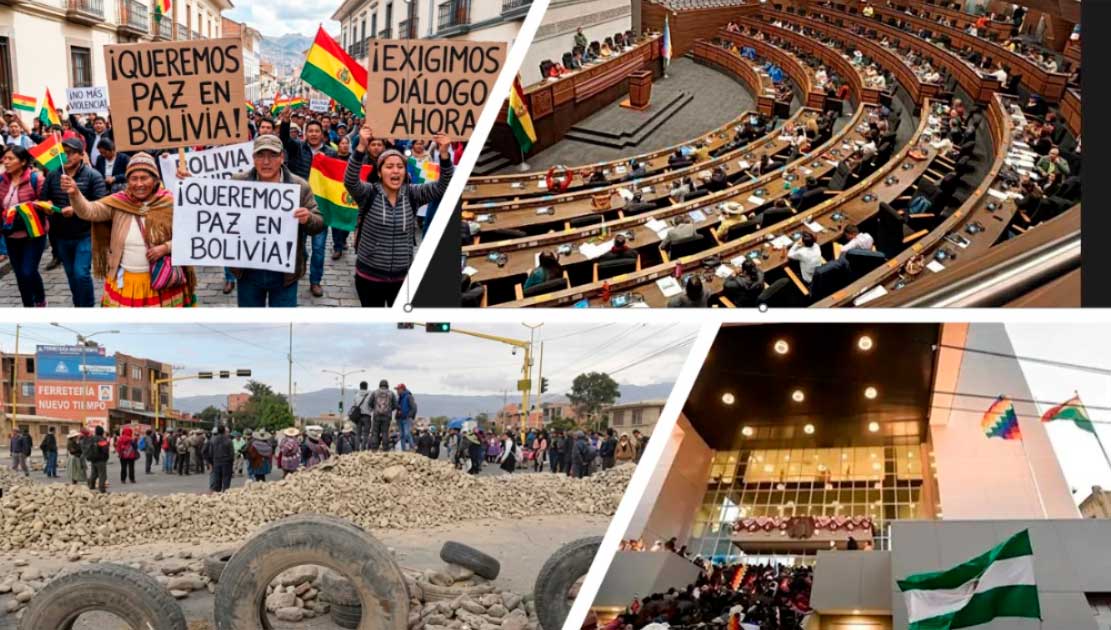
The reporting package now provides Bolivia-specific evidence of prior road blockades, fuel shortages and political turmoil in Rodrigo Paz's government, but overall confidence remains low. It does not substantiate that nationwide protests are currently active or that demonstrators are demanding Paz's resignation.
Executive summary
The package documents 51 days of blockades in May and June, fuel shortages under Rodrigo Paz's administration, and a reported state of exception ending on 18 September. It also links the detention of presidential adviser Fernando Cerimedo and corruption allegations to a political crisis in Paz's government, while José Peralta warns that fuel shortages could renew mobilisations in October. The package does not independently establish the current scale of protests, active nationwide blockades or demands for Paz's resignation.
Change from previous assessment
Since the prior brief, the evidence base has changed from unrelated Baja California and Southern California sensor and vessel data to Bolivia-specific local-media reporting. The assessment now recognises prior blockades, fuel shortages and a reported political crisis involving Fernando Cerimedo and corruption allegations, while retaining low confidence on the stronger claim of current nationwide protests demanding Rodrigo Paz's resignation.
Key judgments
- It is unlikely that the provided reporting package substantiates nationwide protests and road blockades currently demanding Rodrigo Paz's resignation. The reporting establishes 51 days of blockades in May and June and fuel shortages under Paz's administration, while the low-reliability social-media material records accusations that Paz lied rather than a documented nationwide resignation campaign. This is a low-confidence assessment because the package lacks independent corroboration of current protest scale, timing or demands. (Confidence: low · ASSESSED)
- I&W: Confirm: Within 0-14 days, two independent Bolivia-specific reports document active road blockades in multiple parts of Bolivia and explicit demands for Rodrigo Paz to resign. (0-14 days)
- I&W: Break: Within 0-14 days, independent reporting shows roads open and records no organised calls for Paz's resignation. (0-14 days)
- It is likely that fuel shortages will remain the most credible near-term trigger for renewed mobilisation in Bolivia through October. Bolivia experienced 51 days of blockades in May and June, and analyst José Peralta specifically warned that October mobilisations would resume if the government did not act quickly on fuel supply. Confidence is medium because the shortage and warning are local-media claims without independent corroboration in the package. (Confidence: medium · ASSESSED)
- I&W: Confirm: Within 0-14 days, Bolivia-specific reporting records continued fuel shortages alongside new road blockades. (0-14 days)
- I&W: Break: Within 1-3 months, October reporting records restored fuel supply and no mobilisation linked to fuel availability. (1-3 months)
- It is likely that political pressure on Rodrigo Paz's government will remain elevated through the reported 18 September end of the state of exception. The detention of presidential adviser Fernando Cerimedo for attempted femicide and corruption allegations are directly linked in the reporting to a political crisis in Paz's government. Confidence is medium because the legal-action reporting and the reported end date are not independently corroborated here. (Confidence: medium · ASSESSED)
- I&W: Confirm: Before 18 September, Bolivian authorities or local media report additional legal action tied to Fernando Cerimedo or new corruption allegations involving Paz's government. (0-14 days)
- I&W: Break: By 18 September, official reporting confirms the state of exception ends without new legal or corruption developments linked to Paz's government. (0-14 days)
- It is unlikely that US government support can be treated as the Bolivian executive's objectively established main strength. The package reports only analyst Marcelo Silva's view that US support is the executive's main strength, making this a low-confidence, single-source assessment rather than a corroborated fact. (Confidence: low · ASSESSED)
- I&W: Confirm: Within 0-14 days, an independent source explicitly identifies US government support as the Bolivian executive's main strength. (0-14 days)
- I&W: Break: Within 0-14 days, an independent source identifies another source of support as the executive's main strength or contradicts Marcelo Silva's assessment. (0-14 days)
Outlook & scenarios
Likely contained pressure through 18 September (45%)
The state of exception ends on 18 September while Rodrigo Paz's government remains under pressure from fuel shortages, the Fernando Cerimedo case and corruption allegations. Political criticism continues, but the available reporting does not establish a verified nationwide protest wave or an organised campaign for Paz's resignation.
Roughly even chance of renewed mobilisation in October (40%)
Fuel shortages persist and José Peralta's warning proves prescient. Road blockades and mobilisations reappear in October, with fuel supply as the main reported trigger. The available evidence still does not establish that the mobilisation becomes nationwide or forces a change in government.
Very unlikely, high-impact convergence (15%)
Fuel shortages, the Fernando Cerimedo case and corruption allegations combine into a nationwide mobilisation that directly challenges Rodrigo Paz's tenure after 18 September. This would turn an incompletely corroborated political crisis into a broader contest over executive authority.
Recommendations
- Maintain the overall assessment at low confidence. Label current nationwide protests, active nationwide blockades and demands for Rodrigo Paz's resignation as unverified until two independent Bolivia-specific sources confirm each element.
- Prioritise collection around 18 September. Verify whether the Bolivian government's state of exception ends on that date, and record any simultaneous reports of road blockades, fuel shortages or new political action.
- Establish a watch through October for fuel availability, new blockades and explicit mobilisation calls. Attribute José Peralta's warning to him rather than treating it as a forecast with established probability.
- Separate the Fernando Cerimedo detention, corruption allegations and criticism of Rodrigo Paz into distinct reporting lines. Do not use the Notisalud Tarija Facebook page or Joaquín Martela's statement as sole corroboration.
- Seek independent confirmation before elevating Marcelo Silva's assessment of US government support from an attributed opinion to a broader judgement about the Bolivian executive's political position.
Confidence & uncertainty
Overall confidence is low because the substantive reporting is largely local-media material with medium reliability priors, while the social-media claims have low reliability and the package contains no independent corroboration of the current protest scale or resignation demands. The high-confidence background claim on 51 days of blockades concerns May and June and does not establish current nationwide mobilisation. The main uncertainties are whether blockades remain active, whether fuel shortages are worsening, how the state of exception ends on 18 September and whether the October mobilisation warning materialises.
Intelligence gaps
- [EEI 1.1 · UNCOVERED] Official resignation letter or public statement from President Rodrigo Paz announcing intent to step down, with date/time and channels of release. Recommended collection: official statements/OSINT
- [EEI 1.2 · UNCOVERED] Number and identities of cabinet ministers or senior executive officials who have tendered resignations or publicly withdrawn support (names, offices, dates). Recommended collection: government sources/HUMINT
- [EEI 1.3 · UNCOVERED] Formal legislative actions filed and their sponsorship count (impeachment/ removal motions, dates filed, vote schedule, list of legislators publicly backing each action). Recommended collection: legislative records/OSINT
- [EEI 1.4 · UNCOVERED] Existence and content of signed negotiation outcomes or exit agreements between the presidency and opposition/protest leaders (meeting minutes, memoranda, signatories, deadlines). Recommended collection: HUMINT/diplomatic
- [EEI 2.1 · PARTIAL] Orders or directives from the Ministry of Defense or Interior authorizing deployment, use of lethal force, curfews, or emergency powers (document text, date/time, units named). Recommended collection: official statements/OSINT
- [EEI 2.2 · UNCOVERED] Observed troop and police unit movements and concentrations at key urban areas, government buildings, or protest hotspots (unit identifiers, equipment observed, locations, timestamps). Recommended collection: satellite/imagery
- [EEI 2.3 · UNCOVERED] Public resignations, defections, or denouncements by senior military/police officers (names, ranks, dates, content of statements). Recommended collection: social media/HUMINT
- [EEI 2.4 · UNCOVERED] Verified incidents of security forces using live ammunition, heavy weapons, or armored vehicles against protesters (casualty numbers, weapon types, time/place, supporting media or hospital records). Recommended collection: medical/hospital reports & open source
- [EEI 3.1 · PARTIAL] Location, number, and estimated duration of active roadblocks on major highways and access routes (GPS coordinates, reported start times, groups controlling each blockade). Recommended collection: transport/logistics & social media
- [EEI 3.2 · UNCOVERED] Operational status of key transport nodes (international airports, major bus terminals, rail hubs, and border crossings), open, limited, closed, with timestamps. Recommended collection: transport authority updates/OSINT
- [EEI 3.3 · PARTIAL] Size and frequency of street protests in major cities (estimated attendance counts, dates/times, trend compared to previous days). Recommended collection: social media/OSINT
- [EEI 3.4 · UNCOVERED] Communications from named protest leaders or coalitions calling for escalation, general strike, or de-escalation (public messages, strikes announced, coordination instructions). Recommended collection: social media/HUMINT
- [EEI 4.1 · PARTIAL] Fuel supply status at major depots and petrol stations (days of supply remaining, deliveries canceled/delayed, outages reported by region). Recommended collection: logistics/industry reports
- [EEI 4.2 · UNCOVERED] Availability and price movements of staple foods in principal wholesale markets and supermarkets (stock levels, price changes percent, locations affected). Recommended collection: market/retail & OSINT
- [EEI 4.3 · UNCOVERED] Scope and duration of disruptions to public services (electricity outages, water supply interruptions, hospital service reductions) with affected areas and timestamps. Recommended collection: utility operators/OSINT
- [EEI 4.4 · PARTIAL] Actions by foreign governments or international organizations: travel advisories, embassy evacuations, recognition/condemnation statements, sanctions or aid pledges (dates and content). Recommended collection: diplomatic channels/OSINT
Cited sources
[1] Erbol · Bolivia, ante una nueva prueba: acuerdos políticos y respuestas sociales para evitar otro conflicto (D) · Sun Aug 30 2026 19:57:45 GMT+0000 (Coordinated Universal Time) · sha256:7bc81583a4a8 [2] Notisalud Tarija (Facebook page) · 🚨🚨 #ÚLTIMO: RODRIGO PAZ LE MINTIÓ A TODA #BOLIVIA, SEGÚN EL PERIODISTA JOAQUÍN MARTELA. | Notisalud Tarija (E) · sha256:d4f298bf4e8e
Source content hashes were computed at collection time; the cited text is preserved unmodified for the life of this product.
TLP:CLEAR