TLP:CLEAR · Disclosure is not limited.
Bolivia: Protests, Blockades and Extended Emergency Powers
Time window: Last 1 day · Audience: General analyst · Type: Situation report · DTG: 2026-09-18 20:34Z · Overall confidence: LOW
BLUF
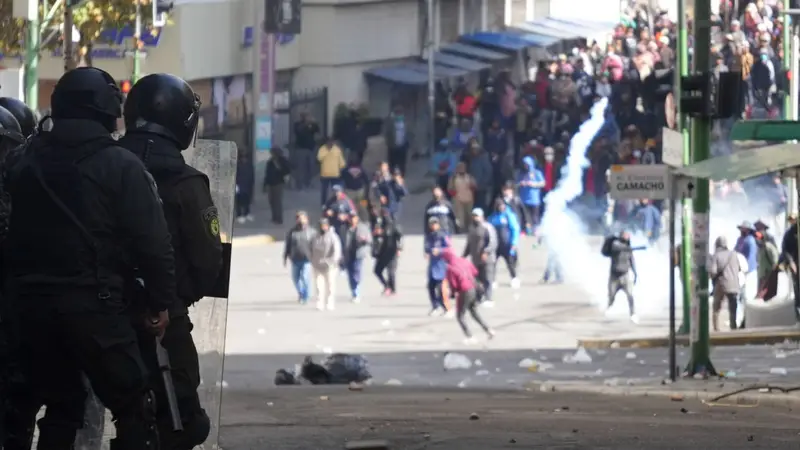
A single local-media source reports that protests demanding President Rodrigo Paz's resignation lasted 53 days, caused 22 deaths, and began over adulterated gasoline that damaged more than 66,000 vehicles. Police-military contingents reportedly cleared more than 100 roadblock points without resistance, while the Legislative Assembly approved a further 90-day state of exception by 100 votes to 58. Current mobilisation and the durability of the clearance remain low-confidence assessments because no independent source corroborates the account.
Executive summary
This limited brief revises the previous inability to verify active protests and road blockades. The available report describes a prolonged protest campaign in Bolivia, the clearing of more than 100 roadblock points, and a 90-day extension of exceptional powers for Rodrigo Paz's government. Ministers Marco Antonio Oviedo and Ernesto Justiniano argued that social organisations threatened to resume mobilisations. Evo Morales opposed the extension and alleged that the government planned to kill him after an announcement that his apprehension would be carried out. Separately, four people were reportedly shot dead in fewer than 48 hours in San Ignacio de Velasco, with authorities attributing the violence to PCC and Comando Vermelho. The government also awaits legislative approval of an agreement with the International Monetary Fund as part of plans to reorganise the financial system. All developments rely on one local-media source.
Change from previous assessment
Since the 17 September brief, the assessment has changed from insufficient to verify active protests, road blockades, or resignation demands to a low-confidence finding that one local-media account reports a 53-day protest campaign, 22 deaths, and the clearing of more than 100 roadblock points. The current brief adds a reported 90-day extension of the state of exception, the 100-58 Assembly vote, and direct statements from Evo Morales and ministers Marco Antonio Oviedo and Ernesto Justiniano. The previous judgment that fuel prices and shortages were likely to remain the main trigger remains untested; the new account instead identifies adulterated gasoline and damage to more than 66,000 vehicles. The previous roughly even chance estimate for renewed blockades is now informed by reported clearance operations and a ministerial warning of renewed mobilisation, but it remains low confidence. No prior judgment is retired because the new reporting remains single-source.
Key judgments
- The supplied account reports a 53-day protest campaign in Bolivia that caused 22 deaths and began over adulterated gasoline that damaged more than 66,000 vehicles before demands escalated to President Rodrigo Paz's resignation. This remains a single-source account rather than an independently established national picture. (Confidence: low · REPORTED)
- I&W: Confirm: independent Bolivian media or official records match the reported 53-day duration, 22 deaths, and damage to more than 66,000 vehicles from adulterated gasoline. (0-14 days)
- I&W: Break: records show that the duration, deaths, or vehicle-damage figures refer to a different episode or cannot be substantiated. (0-30 days)
- The immediate roadblock pressure is likely to have eased after Bolivian police-military contingents cleared more than 100 points that had besieged cities and reportedly encountered no resistance. The report does not establish that protest mobilisation has ended, and the finding remains single-source. (Confidence: low · ASSESSED)
- I&W: Confirm: follow-up reporting finds no reoccupation of the more than 100 cleared points and no repeat police-military clearance operations. (0-14 days)
- I&W: Break: roadblock points are reoccupied, or police-military contingents return to clear them after reported resistance. (0-14 days)
- President Rodrigo Paz's government is likely to retain exceptional powers for a further 90 days. The regime originated in a 20 June decree that authorised military deployment to dismantle protests, and the Legislative Assembly reportedly approved the extension by 100 votes in favour to 58 against or abstaining. The legal status and practical scope of the extension remain uncorroborated beyond one local-media source. (Confidence: low · ASSESSED)
- I&W: Confirm: Bolivian executive or Assembly records publish the 100-58 vote and a decree specifying a further 90-day period with authority to deploy military personnel against protests. (0-14 days)
- I&W: Break: official records show that the extension was not enacted, was shorter than 90 days, or did not retain the reported military deployment authority. (0-30 days)
- There is a roughly even chance that social organisations resume mobilisations within the next 1-3 months. The estimate rests mainly on ministers Marco Antonio Oviedo and Ernesto Justiniano citing a threat of renewed action, while the reported absence of resistance during the roadblock clearances provides no evidence of current organisational capacity. The warning is not independently corroborated. (Confidence: low · ASSESSED)
- I&W: Confirm: named social organisations issue mobilisation calls followed by new roadblock points or public demonstrations in Bolivia. (0-14 days)
- I&W: Break: no social organisation announces mobilisation and cleared roads remain open without new police-military operations. (1-3 months)
- The supplied reporting establishes an overt confrontation between Evo Morales and the Paz government. Morales criticised the 90-day extension, questioned the effectiveness of the first 90 days, and alleged that the government planned to kill him after Minister Marco Antonio Oviedo announced that his apprehension would be carried out. The allegation and the government's intent are single-source and unverified. (Confidence: low · REPORTED)
- I&W: Confirm: Evo Morales repeats the allegation or the government issues a further public statement or operational action concerning his apprehension. (0-14 days)
- I&W: Break: official government records disavow an apprehension order and Morales withdraws or materially revises the allegation. (0-30 days)
- A separate security incident in San Ignacio de Velasco involved four shooting deaths in fewer than 48 hours, which authorities attributed to the Brazilian criminal cartels PCC and Comando Vermelho. The supplied reporting does not establish a link between this violence and the political protests. (Confidence: low · ASSESSED)
- I&W: Confirm: additional reporting or official records verify four shooting deaths in San Ignacio de Velasco and retain the attribution to PCC and Comando Vermelho. (0-14 days)
- I&W: Break: authorities revise the death count or attribution, or establish that the incident was directly connected to the protests. (0-30 days)
- The Bolivian government's plan to reorganise the financial system remains contingent on Legislative Assembly approval of an agreement with the International Monetary Fund. This economic track is reported with lower source confidence and has no established connection to the protest campaign. (Confidence: low · REPORTED)
- I&W: Confirm: the Legislative Assembly records a vote on the International Monetary Fund agreement and the government links approval to financial-system reorganisation. (0-30 days)
- I&W: Break: official records show that no agreement is pending or that the proposed financial-system changes are unrelated to legislative approval. (0-30 days)
Outlook & scenarios
Contained clearance with entrenched emergency powers (45%)
Police-military clearance holds, road access remains open, and the Paz government uses the 90-day extension without a new mass mobilisation. The crisis remains politically contentious, with Evo Morales continuing opposition but no reported attempt to apprehend him.
Renewed blockades and resignation demands (40%)
Social organisations resume mobilisations, roadblock points return, and demands for Rodrigo Paz's resignation revive around the adulterated gasoline grievance. The government orders further police-military clearances, increasing the prospect of additional deaths beyond the reported 22.
Evo Morales apprehension wildcard (15%)
Low-probability/high-impact wildcard: the government executes the announced apprehension of Evo Morales, who frames the action as part of a plan to kill him. The confrontation triggers a new protest cycle and lethal violence. The current record does not establish operational intent or capability.
Recommendations
- Treat the reported 53-day protest duration, 22 deaths, damage to more than 66,000 vehicles, clearance of more than 100 roadblock points, and 90-day extension as unverified until at least two independent sources corroborate each item.
- Prioritise collection on the more than 100 cleared roadblock points. Record their locations, any reoccupation, police-military deployments, resistance, and effects on access to cities at least daily for the next 14 days.
- Track public statements and actions by Rodrigo Paz, Marco Antonio Oviedo, Ernesto Justiniano, and Evo Morales. Separate announcements concerning mobilisation from evidence of implementation, particularly any action concerning Morales's apprehension.
- Obtain Bolivian executive and Legislative Assembly records for the state-of-exception decree, the 100-58 vote, and the pending International Monetary Fund agreement before using the claims to assess institutional or economic stability.
- Keep the San Ignacio de Velasco killings analytically separate from the protest crisis until the four deaths and the attribution to PCC and Comando Vermelho are independently verified or directly linked to political mobilisation.
Confidence & uncertainty
Only one usable source was available, Estrategia through CLAE, a local-media outlet assessed in the source record as having medium prior reliability and medium proximity. The source provides several detailed claims, including some marked high confidence, but no independent outlet, official record, or contradictory account corroborates them in this run. Key uncertainties include the timing of the protest events, the current status of the cleared roadblocks, the legal effect of the 90-day extension, the government's intent towards Evo Morales, and the connection between separate security incidents and the political crisis.
Intelligence gaps
- [EEI 1.1 · UNCOVERED] Official resignation letter or public statement from President Rodrigo Paz announcing intent to step down, with date/time and channels of release. Recommended collection: official statements/OSINT
- [EEI 1.2 · UNCOVERED] Number and identities of cabinet ministers or senior executive officials who have tendered resignations or publicly withdrawn support (names, offices, dates). Recommended collection: government sources/HUMINT
- [EEI 1.3 · UNCOVERED] Formal legislative actions filed and their sponsorship count (impeachment/ removal motions, dates filed, vote schedule, list of legislators publicly backing each action). Recommended collection: legislative records/OSINT
- [EEI 1.4 · UNCOVERED] Existence and content of signed negotiation outcomes or exit agreements between the presidency and opposition/protest leaders (meeting minutes, memoranda, signatories, deadlines). Recommended collection: HUMINT/diplomatic
- [EEI 2.1 · PARTIAL] Orders or directives from the Ministry of Defense or Interior authorizing deployment, use of lethal force, curfews, or emergency powers (document text, date/time, units named). Recommended collection: official statements/OSINT
- [EEI 2.2 · PARTIAL] Observed troop and police unit movements and concentrations at key urban areas, government buildings, or protest hotspots (unit identifiers, equipment observed, locations, timestamps). Recommended collection: satellite/imagery
- [EEI 2.3 · UNCOVERED] Public resignations, defections, or denouncements by senior military/police officers (names, ranks, dates, content of statements). Recommended collection: social media/HUMINT
- [EEI 2.4 · UNCOVERED] Verified incidents of security forces using live ammunition, heavy weapons, or armored vehicles against protesters (casualty numbers, weapon types, time/place, supporting media or hospital records). Recommended collection: medical/hospital reports & open source
- [EEI 3.1 · PARTIAL] Location, number, and estimated duration of active roadblocks on major highways and access routes (GPS coordinates, reported start times, groups controlling each blockade). Recommended collection: transport/logistics & social media
- [EEI 3.2 · UNCOVERED] Operational status of key transport nodes (international airports, major bus terminals, rail hubs, and border crossings), open, limited, closed, with timestamps. Recommended collection: transport authority updates/OSINT
- [EEI 3.3 · PARTIAL] Size and frequency of street protests in major cities (estimated attendance counts, dates/times, trend compared to previous days). Recommended collection: social media/OSINT
- [EEI 3.4 · PARTIAL] Communications from named protest leaders or coalitions calling for escalation, general strike, or de-escalation (public messages, strikes announced, coordination instructions). Recommended collection: social media/HUMINT
- [EEI 4.1 · UNCOVERED] Fuel supply status at major depots and petrol stations (days of supply remaining, deliveries canceled/delayed, outages reported by region). Recommended collection: logistics/industry reports
- [EEI 4.2 · UNCOVERED] Availability and price movements of staple foods in principal wholesale markets and supermarkets (stock levels, price changes percent, locations affected). Recommended collection: market/retail & OSINT
- [EEI 4.3 · UNCOVERED] Scope and duration of disruptions to public services (electricity outages, water supply interruptions, hospital service reductions) with affected areas and timestamps. Recommended collection: utility operators/OSINT
- [EEI 4.4 · PARTIAL] Actions by foreign governments or international organizations: travel advisories, embassy evacuations, recognition/condemnation statements, sanctions or aid pledges (dates and content). Recommended collection: diplomatic channels/OSINT
Cited sources
[1] Estrategia (CLAE / estrategia.la) · Paz extiende el estado de excepción por otros 90 días en Bolivia - CLAE (D) · Fri Sep 18 2026 11:54:49 GMT+0000 (Coordinated Universal Time) · sha256:7ee15258bcab
Source content hashes were computed at collection time; the cited text is preserved unmodified for the life of this product.
Red cell review: CONCUR WITH COMMENT
TLP:CLEAR