TLP:CLEAR · Disclosure is not limited.
Ethiopia-Eritrea border build-up raises clash risk
Time window: Last 1 day · Audience: General analyst · Type: Situation report · DTG: 2026-11-18 19:09Z · Overall confidence: MEDIUM
BLUF
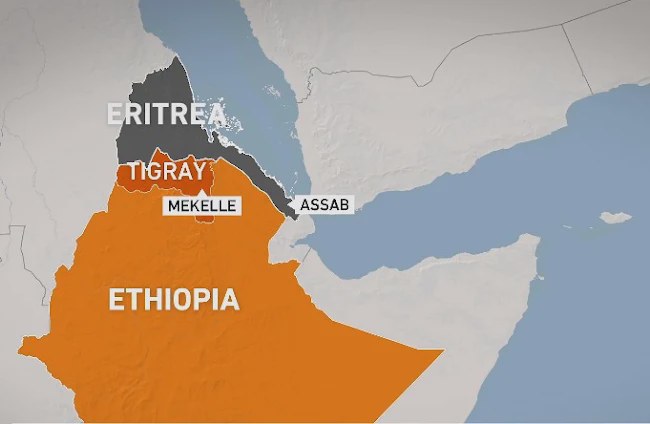
Ethiopia and Eritrea have likely concentrated large troop formations along their shared border. ACLED reports drone and artillery fire near Badme and a direct clash on 13 November, but Reuters could not independently confirm the clash and a militia-linked source disputes that it occurred. Open war in the next 1-3 months remains unlikely, although the risk has risen; the available reporting documents senators’ warnings to Marco Rubio, not a public warning by Rubio himself.
Executive summary
Reuters, citing conflict monitors and sources connected to Tigray armed groups, reports large Ethiopian and Eritrean force concentrations close to each other along the shared border. ACLED reports Ethiopian drone strikes on suspected Eritrean positions and Eritrean artillery fire near Badme on 12 November, a direct clash on 13 November, and Eritrean troops retaking Badme around 15 November. The reported clashes remain disputed: Reuters could not independently confirm skirmishes, and a person close to a pro-government militia rejected the accounts. The Ethiopian army has reportedly advanced north from Sheraro, pushing Tigrayan forces towards Eritrea, while border villagers have reportedly begun leaving their homes for fear of shelling. A reported 10 November letter from five Democratic senators urged diplomatic engagement; it does not establish that Rubio publicly warned of escalation.
Change from previous assessment
Since the 17 November brief, reporting now describes large troop formations close to one another and provides specific ACLED accounts of drone and artillery activity on 12 November, a direct clash on 13 November, and Eritrean troops returning to Badme around 15 November. This raises confidence that a substantial border build-up is under way and increases the assessed risk of localised incidents; open war over the next 1-3 months remains unlikely. The clash accounts remain contested. The earlier finding that a public Rubio warning was not established is unchanged; the new reporting documents senators’ letters to Rubio, not a public statement by him.
Key judgments
- It is likely that Ethiopia and Eritrea have concentrated large troop formations along their shared border, with forces reported close to one another near Badme. Reuters cites conflict monitors and sources tied to Tigray armed groups, while other reporting also describes a build-up; the available claims give no troop totals. (Confidence: medium · REPORTED)
- I&W: Confirm: ACLED or independent wire reporting identifies additional troop deployments or movements between Sheraro and Badme, or confirms that both armies remain at close positions near Badme. (0-14 days)
- I&W: Break: ACLED and independent reporting document withdrawals by both armies from the border positions near Badme and a sustained reduction in deployments. (0-14 days)
- There is a roughly even chance that Ethiopian and Eritrean forces directly clashed on 13 November as ACLED reported. ACLED also reports Ethiopian drone strikes on suspected Eritrean positions and Eritrean artillery fire near Badme on 12 November, and an Eritrean return to Badme around 15 November after a mid-October withdrawal. Reuters could not independently confirm the skirmishes, and a person close to a pro-government militia disputes that clashes occurred, so these specific incidents remain contested. (Confidence: low · ASSESSED)
- I&W: Confirm: ACLED and a separate independently sourced report corroborate a direct Ethiopian-Eritrean engagement on 13 November, including its location near Badme. (0-14 days)
- I&W: Break: ACLED revises or withdraws its 13 November clash account, and independent reporting finds no evidence of direct contact between the armies on that date. (0-14 days)
- Open war between Ethiopia and Eritrea over the next 1-3 months remains unlikely, while further localised border incidents are likely. The assessment reflects the reported force concentrations, renewed fighting in Tigray, Ethiopian advances north from Sheraro, and the reported October collapse in diplomatic relations. The clash accounts remain disputed, and the diplomatic breakdown is supported here by a single local-media claim. (Confidence: medium · ASSESSED)
- I&W: Break: ACLED and independent wire reporting confirm repeated direct engagements or sustained artillery or drone strikes between the regular armies near Badme. (0-14 days)
- I&W: Confirm: ACLED records no new direct Ethiopian-Eritrean engagements and reporting documents both armies pulling back from positions near Badme. (1-3 months)
- The available reporting does not substantiate a public escalation warning by US Secretary of State Marco Rubio. It reports that five Democratic senators wrote to Rubio on 10 November urging diplomatic engagement, and that six senators had sent an earlier letter on 28 September; neither item establishes a public statement by Rubio. (Confidence: low · REPORTED)
- I&W: Confirm: A State Department transcript or Rubio’s verified public remarks show him warning publicly about escalation between Ethiopia and Eritrea. (0-14 days)
- I&W: Break: The original coverage or an official clarification identifies the reported warning as the senators’ appeal rather than a public statement by Rubio. (0-14 days)
Outlook & scenarios
Armed standoff without interstate war (55%)
This is the most likely course over the next 1-3 months. Ethiopian and Eritrean forces remain concentrated near Badme, while Ethiopian pressure on Tigrayan forces from the Sheraro area continues. Both governments sustain accusations, but neither begins a sustained campaign against the other.
Localised clashes recur (25%)
Further short engagements, drone strikes or artillery exchanges near Badme are likely if forces remain in close proximity. The incidents remain geographically limited, but an exchange causing casualties or a territorial shift would increase pressure for retaliation.
Diplomatic pause and border pullback (15%)
A pullback from positions near Badme and a pause in public accusations would reduce the immediate risk. This outcome is less likely while the reported Tigray fighting and mutual allegations of support for armed groups continue.
Wildcard: a Badme incident triggers open war (5%)
A confirmed cross-border strike or seizure of territory near Badme prompts retaliation by the other army, turning local fighting into sustained interstate combat. This is a low-probability, high-impact scenario given the reported proximity of the forces and the contested accounts of recent engagements.
Recommendations
- Maintain a dated incident log separating reported events from independently corroborated events. Track the 12 November strikes, the alleged 13 November clash and the reported return of Eritrean troops to Badme as distinct entries.
- Prioritise daily checks of ACLED updates and independent wire reporting on force positions between Sheraro and Badme, control of Badme, and any new drone or artillery activity. Record whether each report relies on named sources, conflict monitors or summary-only material.
- Track reports of departures from border villages in Tigray alongside new fighting near Badme. Escalate the assessment if reporting confirms additional civilian flight or repeated strikes near populated areas.
- Do not attribute a public warning to Marco Rubio without a State Department transcript or verified public remarks. Distinguish his reported receipt of senators’ letters from statements made by the senators.
- Monitor official Ethiopian and Eritrean statements for changes in accusations, denials or references to military action, and compare those statements with independently sourced reporting before revising the assessment.
Confidence & uncertainty
Confidence is medium because reporting from Reuters and conflict monitors supports the troop build-up, and ACLED provides specific accounts of activity near Badme. The direct-clash reporting is not independently confirmed by Reuters and is disputed by a militia-linked source. The available material gives no troop totals, and some diplomatic context rests on a single local-media account.
Intelligence gaps
- [EEI 1.2 · PARTIAL] Military orders, mobilization notices, reserve call-ups, or official directives authorizing offensive or defensive operations. Recommended collection: official statements/local reporting
- [EEI 1.3 · UNCOVERED] Forward-positioning of fuel, ammunition, medical supplies, bridging equipment, or field headquarters near likely axes of advance. Recommended collection: satellite imagery/human reporting
- [EEI 3.1 · PARTIAL] US, African Union, Gulf, or neighboring-state mediation proposals, leader contacts, envoy travel, and requests for de-escalation. Recommended collection: diplomatic reporting
- [EEI 3.2 · UNCOVERED] Public and private Ethiopian or Eritrean responses to Secretary Rubio's warning and other external pressure. Recommended collection: official statements/diplomatic reporting
- [EEI 3.3 · PARTIAL] Evidence of foreign arms deliveries, military advisers, intelligence support, or expanded security cooperation with either government. Recommended collection: trade data/satellite imagery/diplomatic reporting
- [EEI 3.4 · PARTIAL] Border reopening or closure decisions, military hotlines, troop pullback commitments, and independently verified compliance with them. Recommended collection: official statements/field reporting
- [EEI 4.1 · UNCOVERED] Changes in shipping patterns, vessel advisories, port activity, or war-risk insurance premiums around Assab and nearby Red Sea routes. Recommended collection: maritime/AIS
- [EEI 4.2 · PARTIAL] Civilian evacuations, displacement flows, border-crossing surges, emergency mobilization, or disruptions to roads, airports, and communications. Recommended collection: humanitarian reporting/satellite imagery
- [EEI 4.3 · PARTIAL] Attacks or threats against ports, airfields, critical infrastructure, foreign personnel, or commercial shipping. Recommended collection: maritime/aviation/local reporting
- [EEI 4.4 · UNCOVERED] Deployment of foreign naval or military forces, establishment of new access agreements, or changes in regional basing activity. Recommended collection: maritime/AIS/satellite imagery
Red cell review: CONCUR WITH COMMENT
TLP:CLEAR