TLP:CLEAR · Disclosure is not limited.
Ethiopia-Eritrea Border: Force Buildup and Escalation Risk
Time window: Last 1 day · Audience: General analyst · Type: Situation report · DTG: 2026-11-19 19:37Z · Overall confidence: HIGH
BLUF
Ethiopia and Eritrea have likely concentrated forces near Badme, and ACLED has reported drone, artillery and direct-fire incidents there. Open war over the next 1-3 months remains unlikely, but further localised exchanges are likely; the reporting on troop locations, incident details and a claimed Rubio warning has material limits.
Executive summary
Reporting describes Ethiopian and Eritrean force concentrations near Badme, including Ethiopian troops around Gemhalo, Eritrean deployments towards Gual Gemhalo and Sembel, and increased activity at Eritrea’s Sawa facility. ACLED accounts describe drone and artillery fire on 12 November and direct engagements on 13 November. A reported drone strike near Biyara injured four civilians, although accounts differ on its date and do not identify the operator. The G7 has called for restraint and backed UN and African Union efforts to bring the parties to talks. A separate report describes fighting between Oromo and Ethiopian Somali communities around Moyale and substantial displacement in southern Ethiopia; it should not be conflated with Ethiopia-Eritrea border hostilities. The latest Rubio-related claim is a summary-only account of a 14 October call with Prime Minister Abiy Ahmed, not evidence of a public warning.
Change from previous assessment
Since the 18 November brief, reporting adds increased activity at Eritrea’s Sawa facility in imagery dated 14-16 November, a more specific account of Ethiopian and Eritrean deployments near Badme, and a reported civilian drone-strike incident near Biyara with conflicting dates. ACLED’s reported assessment of high full-scale confrontation risk adds weight to the escalation concern, but open war over the next 1-3 months remains unlikely. A lede-only account now reports a 14 October Rubio-Abiy call; it still does not establish a public warning by Rubio.
Key judgments
- Ethiopia and Eritrea have likely increased force concentrations near Badme. Reuters reporting describes Ethiopian troops concentrating around Gemhalo, about 32 km south of Badme, while ACLED reporting describes Eritrean reinforcements and heavy equipment near Gual Gemhalo and Sembel, as well as increased activity at Sawa on 14-16 November. The reporting does not establish troop totals, and it gives conflicting geographic descriptions of Gemhalo and Gual Gemhalo. Eritrea’s Information Minister Yemane Gebremeskel has dismissed buildup reports as propaganda. These gaps and the official denial reduce confidence in the precise locations and scale, but not in the broad buildup assessment. (Confidence: medium · ASSESSED)
- I&W: Confirm: new geolocated imagery or ACLED reporting shows additional troops or heavy equipment near Badme, Gemhalo, Gual Gemhalo or Sembel. (0-14 days)
- I&W: Break: geolocated reporting documents withdrawals from these positions and no continued activity at Sawa. (0-14 days)
- ACLED-reported exchanges near Badme on 12 and 13 November indicate that direct Ethiopia-Eritrea hostilities have been reported, but the available accounts do not provide independent, first-hand confirmation. ACLED said Ethiopian drones targeted suspected Eritrean positions near Badme on 12 November, followed by Eritrean artillery fire towards Ethiopian lines, and reported direct engagements at Adi Bokray and Adi Asmeru on 13 November. Confidence is medium because these reports are attributed to a conflict monitor and repeated by major media, but the underlying claims rely on ACLED’s reporting. (Confidence: medium · REPORTED)
- I&W: Confirm: ACLED or another named source records additional direct engagements between Ethiopian and Eritrean forces near Badme or at Adi Bokray and Adi Asmeru. (0-14 days)
- I&W: Break: ACLED revises or withdraws its 12-13 November incident accounts, or subsequent reporting identifies the incidents as involving different forces. (0-14 days)
- Open war between Ethiopia and Eritrea over the next 1-3 months remains unlikely, while further localised exchanges are likely. The troop reports, ACLED’s assessment that full-scale confrontation risk on the Badme front is high, renewed fighting in Tigray and the reported severing of diplomatic ties on 1 October raise the risk of miscalculation. The G7 call for maximum restraint and support for UN and African Union mediation points to an active diplomatic effort, but the available claims do not establish that talks have begun. The high-risk assessment is reported through local media, so confidence in the near-term outlook is medium. (Confidence: medium · ASSESSED)
- I&W: Confirm: ACLED or another named source reports sustained artillery exchanges, new cross-border incursions or additional force deployments near Badme. (0-14 days)
- I&W: Break: Ethiopia and Eritrea publicly confirm talks or verifiable withdrawals from forward positions. (0-14 days)
- A drone strike near Biyara, about 15 km from Badme, reportedly hit a truck carrying displaced people and injured four civilians. The operator has not been identified, and reports date the incident to either 16 or 18 November. The reported injuries are more credible than any attribution of responsibility; confidence is medium because the accounts differ on the date and do not establish who operated the drone. (Confidence: medium · REPORTED)
- I&W: Confirm: local authorities or subsequent reporting verify the four civilian injuries and identify the strike location near Biyara. (0-14 days)
- I&W: Break: the original reporting corrects the incident date, location or account of civilian injuries. (0-14 days)
- The available reporting does not establish a public escalation warning by US Secretary of State Marco Rubio. One lede-only summary says Rubio spoke with Prime Minister Abiy Ahmed on 14 October about tensions with Eritrea and called for de-escalation; because the full text was unavailable, this claim supports only a low-confidence account of a private call, not a public warning. (Confidence: low · REPORTED)
- I&W: Confirm: a US State Department transcript or Rubio’s public remarks record an explicit warning about Ethiopia-Eritrea escalation. (0-14 days)
- I&W: Break: an official readout confirms the 14 October contact was private and contains no public warning. (0-14 days)
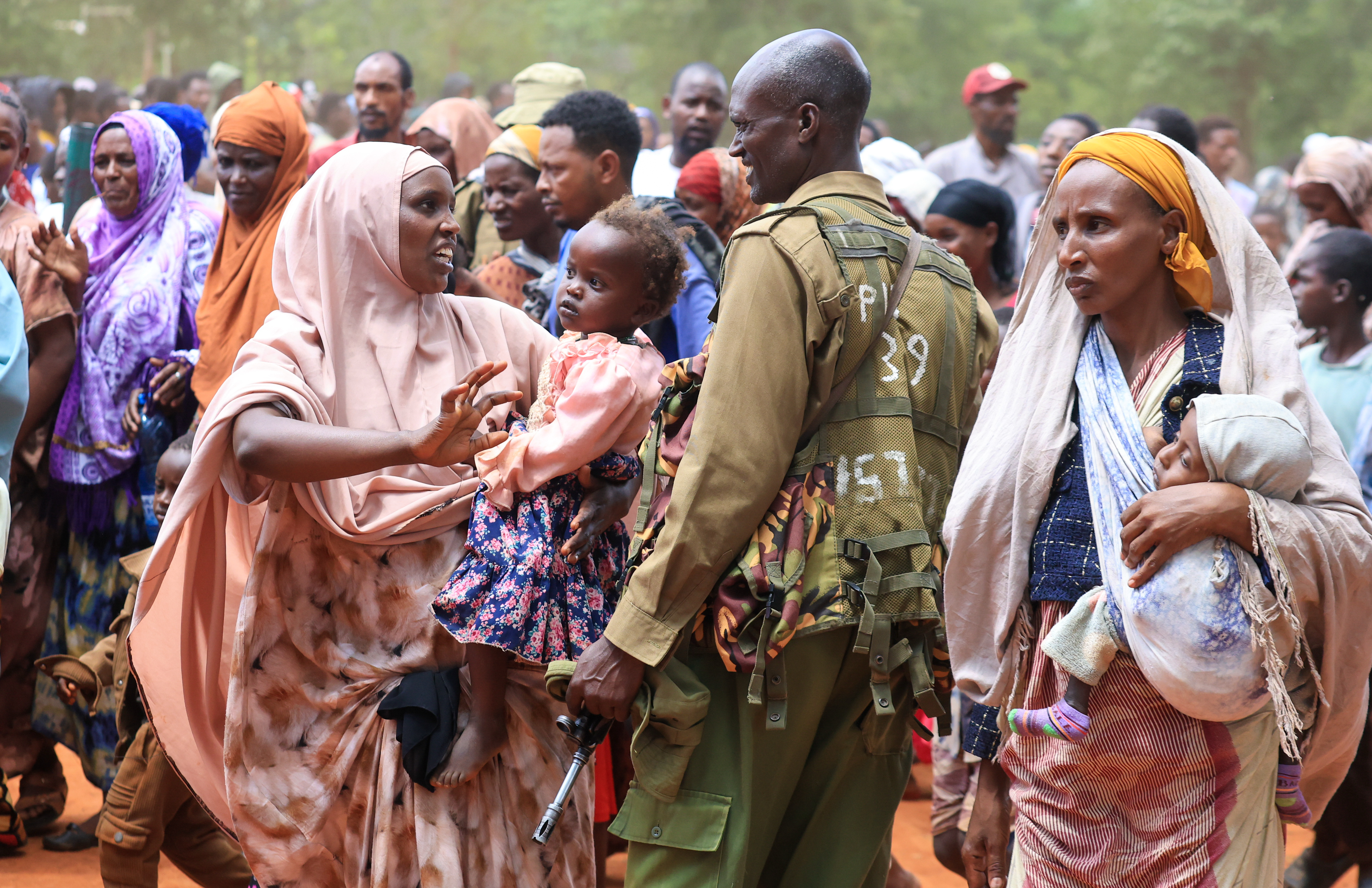
- Reporting describes a separate internal security crisis around Moyale, where fighting between Oromo and Ethiopian Somali communities began in late October. Islamic Relief reported nearly 700,000 displaced people across southern Ethiopia and more than 50,000 people fleeing to Kenya. These reports do not establish a connection to Ethiopia-Eritrea military activity, and the displacement figures derive from a limited set of reporting. (Confidence: medium · REPORTED)
- I&W: Confirm: Islamic Relief or another named humanitarian organisation publishes updated displacement figures for Dawa, southern Oromia or people crossing into Kenya. (0-30 days)
- I&W: Break: subsequent reporting identifies the displacement figures as outdated or unrelated to the late-October fighting around Moyale. (0-30 days)
Outlook & scenarios
Localised exchanges continue without open war (55%)
Further drone, artillery or direct-fire incidents occur near Badme as both governments maintain forces in the border area. The fighting remains localised, with no confirmed sustained Ethiopian-Eritrean campaign. The G7, UN and African Union continue to press for restraint and talks.
Diplomatic restraint reduces immediate pressure (30%)
Addis Ababa and Asmara accept mediated contact or take verifiable steps to reduce forward deployments. Border incidents decline, although unresolved tensions over Tigray, Badme and maritime access remain.
A border incident triggers a wider war (15%)
A sustained artillery exchange or a misidentified strike prompts a broader Ethiopian and Eritrean military response. The conflict expands beyond the Badme front and creates the wider regional and Red Sea trade disruption warned of by G7 foreign ministers.
Recommendations
- Track Ethiopian and Eritrean deployments around Badme, Gemhalo, Gual Gemhalo and Sembel separately. Require geolocation before treating similarly named places as the same site.
- Maintain an incident log that distinguishes ACLED-reported events from independently verified events. Record the reported date, location, actor attribution and source for each incident.
- Seek an official confirmation of the 14 October Rubio-Abiy contact and check whether any public Rubio statement exists. Do not describe the available summary-only account as a public warning.
- Keep the Moyale and southern Ethiopia displacement reporting on a separate internal-conflict and humanitarian track. Do not use it as evidence of Ethiopia-Eritrea military activity.
- Monitor statements and verified actions by the Ethiopian and Eritrean governments, the G7, the UN and the African Union for evidence of talks, withdrawals or further escalation.
Confidence & uncertainty
Confidence is high in the broad assessment that forces have concentrated near Badme and that reported exchanges have raised the risk of escalation. The assessment draws on Reuters and other major-media reporting, ACLED accounts and satellite-imagery reporting. Confidence is lower on exact force locations, incident-level verification and attribution: several outlets relay the same ACLED reporting, Gemhalo descriptions conflict, Eritrea disputes the buildup accounts, and the Rubio claim was read only in summary.
Alternative analysis (red cell)
The available evidence may indicate an escalation already moving beyond isolated local exchanges rather than a situation in which open war is clearly unlikely. ACLED’s high-risk assessment in efff2622-8b6e-4374-a104-b1eee9e8eca5, combined with reported drone and artillery exchanges in 8ead3dc7-4bc7-4173-be73-323a911c647e and 732aa17d-85ee-412b-b7b4-7d03e9067fb6, leaves the near-term trajectory materially more uncertain. Diplomatic concern in 2aa33059-3c8e-4124-8265-556e451a8e29 does not by itself demonstrate effective restraint or active talks.
Intelligence gaps
- [EEI 1.2 · UNCOVERED] Military orders, mobilization notices, reserve call-ups, or official directives authorizing offensive or defensive operations. Recommended collection: official statements/local reporting
- [EEI 1.3 · PARTIAL] Forward-positioning of fuel, ammunition, medical supplies, bridging equipment, or field headquarters near likely axes of advance. Recommended collection: satellite imagery/human reporting
- [EEI 2.1 · PARTIAL] Public statements or diplomatic communications identifying territorial, security, port-access, Tigray-related, or regime-survival demands. Recommended collection: official statements/diplomatic reporting
- [EEI 2.3 · PARTIAL] Movement or arming of aligned forces in Tigray, Afar, Amhara, or border-adjacent areas. Recommended collection: local reporting/human sources
- [EEI 2.4 · PARTIAL] Specific incidents or policy decisions publicly identified by either side as a red line, casus belli, or justification for military action. Recommended collection: official statements/media monitoring
- [EEI 3.2 · UNCOVERED] Public and private Ethiopian or Eritrean responses to Secretary Rubio's warning and other external pressure. Recommended collection: official statements/diplomatic reporting
- [EEI 3.3 · UNCOVERED] Evidence of foreign arms deliveries, military advisers, intelligence support, or expanded security cooperation with either government. Recommended collection: trade data/satellite imagery/diplomatic reporting
- [EEI 3.4 · UNCOVERED] Border reopening or closure decisions, military hotlines, troop pullback commitments, and independently verified compliance with them. Recommended collection: official statements/field reporting
- [EEI 4.1 · UNCOVERED] Changes in shipping patterns, vessel advisories, port activity, or war-risk insurance premiums around Assab and nearby Red Sea routes. Recommended collection: maritime/AIS
- [EEI 4.2 · PARTIAL] Civilian evacuations, displacement flows, border-crossing surges, emergency mobilization, or disruptions to roads, airports, and communications. Recommended collection: humanitarian reporting/satellite imagery
- [EEI 4.3 · UNCOVERED] Attacks or threats against ports, airfields, critical infrastructure, foreign personnel, or commercial shipping. Recommended collection: maritime/aviation/local reporting
- [EEI 4.4 · UNCOVERED] Deployment of foreign naval or military forces, establishment of new access agreements, or changes in regional basing activity. Recommended collection: maritime/AIS/satellite imagery
Red cell review: PARTIAL DISSENT
TLP:CLEAR