TLP:CLEAR · Disclosure is not limited.
Ethiopia-Eritrea Border Risk: Mobilisation Claims Remain Unverified
Time window: Last 1 day · Audience: General analyst · Type: Situation report · DTG: 2026-11-07 14:38Z · Overall confidence: LOW
BLUF
The supplied reporting does not verify a two-sided Ethiopia-Eritrea troop surge or a warning by Marco Rubio, and open war is unlikely in the next 1-3 months. One think-tank account says both governments appear to be preparing for war, but the supporting material lacks independently corroborated deployments; Tigray-related violence and rival claims over sea access remain relevant pressure points.
Executive summary
Reporting in the supplied material includes a think-tank assessment that Ethiopia and Eritrea appear to be preparing for war, but provides no independently corroborated deployment locations or force counts. The only direct troop-clash claim is a social-media post. The sole escalation-warning excerpt is summary-only and attributes the words to an unnamed woman, not Marco Rubio. A CRS-hosted account reports direct ENDF-TDF clashes in early 2026, Abiy Ahmed's troop surge to Tigray's borders and more than two dozen Ethiopian military airstrikes attributed to the period from early August to 23 September 2026. Claims about Eritrean support to Tigrayan forces or weapons supplied through Eritrea remain unverified and conflict with other claims about Eritrea-Tigray relations.
Change from previous assessment
Since the 6 November brief, the supplied material adds a think-tank assessment that both Ethiopia and Eritrea appear to be preparing for war, claims about Eritrea taking the dispute to the UN Security Council, and further reporting on sea-access and proxy-support accusations. The central assessment is unchanged: a two-sided troop build-up and a Marco Rubio warning remain unverified, and open war is not established. Confidence remains low. Eritrean involvement in Tigray is treated as unresolved, not confirmed.
Key judgments
- Open Ethiopia-Eritrea war in the next 1-3 months is unlikely on the supplied evidence. A single think-tank account says both governments appear to be preparing for war, but it does not give verifiable deployment details; the direct clash claim comes from social media, and the summary-only warning excerpt does not identify Marco Rubio. This judgement rests on thin and uncorroborated reporting. (Confidence: low · ASSESSED)
- I&W: Break: independently verified reporting or official releases document new combat-unit deployments by both the ENDF and Eritrean forces along the shared border. (0-14 days)
- I&W: Confirm: a 14-day review finds no independently corroborated bilateral deployments or cross-border engagement. (0-14 days)
- Ethiopia and Eritrea are exchanging claims over maritime access and alleged proxy support, but the supplied material does not establish a decision for war. Eritrea's claim that Ethiopia seeks forceful access to the sea and Ethiopia's stated preference for negotiated access come from different, non-government sources; the reported Eritrean approach to the UN Security Council is supported only by a social-media post. Ethiopia's accusation that Eritrea and Egypt back rebel groups is also uncorroborated here. (Confidence: low · REPORTED)
- I&W: Confirm: a formal Eritrean communication to the UN Security Council or a public Ethiopian statement repeats the sea-access or proxy-support allegations. (0-30 days)
- I&W: Break: Ethiopia and Eritrea issue a joint public statement committing to negotiated maritime access and rejecting the war and proxy-support allegations. (0-30 days)
- Tigray violence remains a pressure point for Ethiopia-Eritrea border risk, but Eritrean involvement is not established. A CRS-hosted account reports direct ENDF-TDF clashes in early 2026, Abiy Ahmed's troop surge to Tigray's borders and more than two dozen Ethiopian military airstrikes attributed to Tigray between early August and 23 September 2026. Ethiopian officials' claim that some weapons came through Eritrea is explicitly unverified, while social-media claims about Eritrea's relationship with Tigrayan forces conflict. (Confidence: medium · ASSESSED)
- I&W: Confirm: two independent reports document a dated and located ENDF-TDF clash or Ethiopian airstrike in Tigray. (0-30 days)
- I&W: Break: independently corroborated reporting documents an Eritrean weapons transfer to a named Tigrayan unit or Eritrean unit activity inside Tigray. (0-30 days)
Outlook & scenarios
Tensions persist without interstate fighting (68%)
Ethiopia and Eritrea continue diplomatic accusations, while no independently corroborated reporting establishes cross-border combat or a bilateral troop surge. Tigray-related security problems remain primarily an internal Ethiopian conflict. This is likely on the current evidence.
A border incident drives reciprocal deployments (24%)
A verified border clash or a Tigray-related incident prompts Ethiopia and Eritrea to announce reciprocal deployments and issue further warnings. This would raise the risk of interstate conflict, but would not by itself establish that either government has decided on open war.
Assab or the Bure Corridor becomes a war trigger (8%)
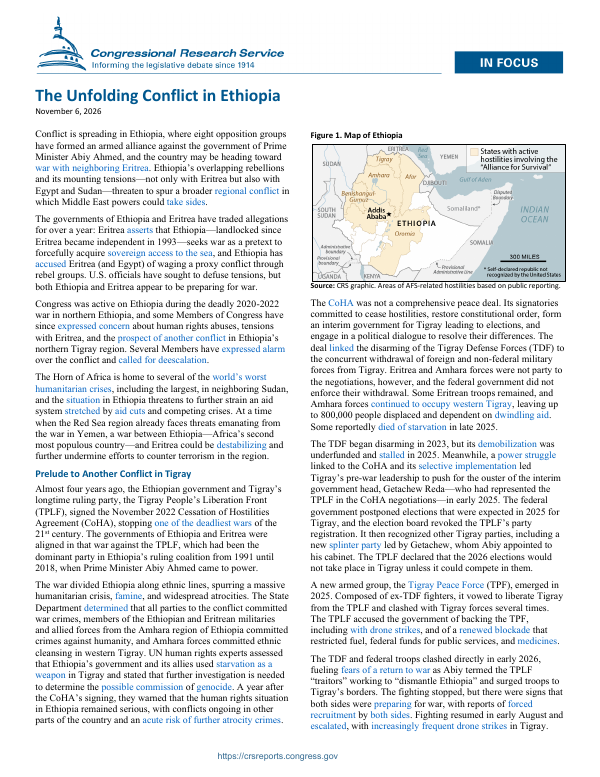
A confrontation linked to Assab or the Bure Corridor escalates into direct Ethiopia-Eritrea combat. This is an unlikely, high-impact wildcard; the location-specific warning in the supplied material rests on social-media claims rather than verified operational reporting.
Recommendations
- Treat the alleged bilateral troop surge and the attribution of an escalation warning to Marco Rubio as unconfirmed. Require independent corroboration of deployments by both governments and a primary-source transcript before using either as an established fact.
- Check official UN Security Council records for an Eritrean filing or meeting request. Report the outcome separately from the social-media claim that Eritrea brought the dispute to the Council.
- Maintain separate reporting lines for ENDF-TDF activity in Tigray and Ethiopia-Eritrea border activity. Seek independent confirmation of each dated clash, airstrike or deployment before linking it to Eritrea.
- Use a 0-14 day warning checklist for verified deployments by both sides and cross-border engagements. Raise the assessment of open-war risk only if reporting confirms specific military activity, rather than relying on political accusations or unsourced troop claims.
Confidence & uncertainty
Overall confidence is low because the central escalation claim rests on one think-tank assessment and low-reliability social-media reporting. The only warning excerpt is summary-only and does not identify Marco Rubio. The supplied material contains no independently corroborated force counts, deployment locations or orders. Claims about Eritrean support to Tigrayan forces and weapons routes conflict or remain explicitly unverified.
Alternative analysis (red cell)
The supplied evidence may indicate more than a thin warning of future war: claims f5f19bc1-3079-4535-96ff-07a931f00dcb and c51a5ccc-389e-42c6-a943-07a5bcca7652 describe apparent preparation and reported clashes, while 91fb327d-6cff-4484-825c-14836a83d6d9 points to escalation risk. The maritime and proxy allegations in, and fb603e07-d7b8-488a-94de-020e1717f45f are not sufficient to establish a war decision, but collectively support viewing the confrontation as an active security crisis rather than only an exchange of claims. Confidence should remain low because the key indicators are weakly sourced, temporally unclear, or uncorroborated.
Intelligence gaps
- [EEI 1.1 · PARTIAL] Verified changes in troop, armored vehicle, artillery, air-defense, or logistics deployments within designated border areas and around Assab. Recommended collection: commercial satellite imagery
- [EEI 1.2 · UNCOVERED] Military orders, mobilization notices, reserve call-ups, or official directives authorizing offensive or defensive operations. Recommended collection: official statements/local reporting
- [EEI 1.3 · UNCOVERED] Forward-positioning of fuel, ammunition, medical supplies, bridging equipment, or field headquarters near likely axes of advance. Recommended collection: satellite imagery/human reporting
- [EEI 2.2 · PARTIAL] Changes in command appointments, rules of engagement, force posture, or operational rhetoric by Ethiopian or Eritrean leadership. Recommended collection: government releases/intelligence reporting
- [EEI 2.4 · PARTIAL] Specific incidents or policy decisions publicly identified by either side as a red line, casus belli, or justification for military action. Recommended collection: official statements/media monitoring
- [EEI 3.1 · UNCOVERED] US, African Union, Gulf, or neighboring-state mediation proposals, leader contacts, envoy travel, and requests for de-escalation. Recommended collection: diplomatic reporting
- [EEI 3.2 · UNCOVERED] Public and private Ethiopian or Eritrean responses to Secretary Rubio's warning and other external pressure. Recommended collection: official statements/diplomatic reporting
- [EEI 3.4 · UNCOVERED] Border reopening or closure decisions, military hotlines, troop pullback commitments, and independently verified compliance with them. Recommended collection: official statements/field reporting
- [EEI 4.1 · UNCOVERED] Changes in shipping patterns, vessel advisories, port activity, or war-risk insurance premiums around Assab and nearby Red Sea routes. Recommended collection: maritime/AIS
- [EEI 4.2 · UNCOVERED] Civilian evacuations, displacement flows, border-crossing surges, emergency mobilization, or disruptions to roads, airports, and communications. Recommended collection: humanitarian reporting/satellite imagery
- [EEI 4.3 · UNCOVERED] Attacks or threats against ports, airfields, critical infrastructure, foreign personnel, or commercial shipping. Recommended collection: maritime/aviation/local reporting
Red cell review: PARTIAL DISSENT
TLP:CLEAR