TLP:CLEAR · Disclosure is not limited.
Ethiopia-Eritrea: Reported Border Clashes and Assab Rhetoric Raise Escalation Risk
Time window: Last 1 day · Audience: General analyst · Type: Situation report · DTG: 2026-11-03 13:08Z · Overall confidence: HIGH
BLUF
Wire-service reporting now describes Ethiopian and Eritrean forces fighting near Qolo-Berdo and along the Egela-Tsorona front on 30 October and 1 November. Ethiopian officials have also publicly tied access to the sea to force and to Assab, but the supplied reporting does not establish a large two-sided troop build-up or a warning by Marco Rubio.
Executive summary
Reporting published on 3 November adds accounts of direct Ethiopian-Eritrean combat to the earlier picture of renewed fighting in Tigray and disputed allegations of Eritrean intervention. Eritrea denies sending troops into Ethiopia. Separately, Ethiopian Prime Minister Abiy Ahmed and senior defence officials have been reported making forceful statements about sea access and Assab; the statements come through Eritrea's Ministry of Information and do not establish an operational decision to seize the port. The only supplied account of a US warning is a think-tank report of a State Department warning on 3 October, not a statement attributed to Rubio. Sudan's accusations against Ethiopia over drone attacks are a separate source of regional diplomatic strain, and Ethiopia denies them.
Change from previous assessment
Since the 2 November brief, reporting has added accounts of Ethiopian and Eritrean forces engaging near Qolo-Berdo on 30 October and along the Egela-Tsorona front on 1 November, as well as an alleged Eritrean crossing at Zelambesa on 7 October. The assessment therefore changes from no supplied reporting of direct clashes to a medium-confidence assessment that limited combat likely occurred. New statements attributed to Abiy Ahmed and senior Ethiopian military officials make the Assab issue more prominent. A large two-sided troop build-up remains unestablished, and the supplied reporting still does not substantiate a Rubio warning.
Key judgments
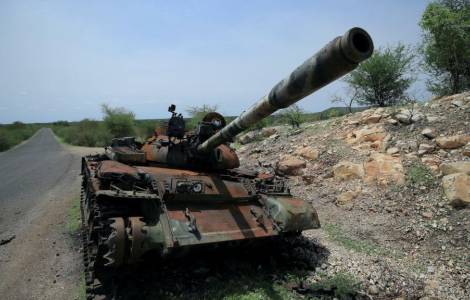
- Limited direct combat between Ethiopian and Eritrean forces likely occurred near Qolo-Berdo on 30 October and along the Egela-Tsorona front on 1 November. A wire-service account describes Ethiopian drone and artillery strikes followed by close-range infantry combat; a separate report alleges Eritrean troops crossed into Tigray, while Eritrea denies sending troops across the border. The scale and duration of the reported engagements remain unverified. (Confidence: medium · ASSESSED)
- I&W: Confirm: a second independent wire-service or official account reports another exchange of fire at Qolo-Berdo or the Egela-Tsorona front. (0-14 days)
- I&W: Break: a specific correction or retraction of the 30 October or 1 November clash reports is issued by the reporting outlet or a government source. (0-30 days)
- Assab is likely to remain a central escalation trigger because Ethiopian leaders have publicly linked sea access to force and named the Eritrean port as an objective. Abiy Ahmed, ENDF Chief of Staff Berhanu Jula, Deputy Chief of Staff Abebaw Tadesse, and Air Force Commander Yilma Merdasa are among those attributed with statements on force or Assab. The statements are carried through Eritrea's Ministry of Information, a single official channel, and do not establish an operational order or troop movement. (Confidence: low · ASSESSED)
- I&W: Confirm: Ethiopian military statements identify Assab as an operational objective, or independent reporting identifies additional Ethiopian units moving towards the Eritrean border. (0-30 days)
- I&W: Break: Abiy Ahmed or the named ENDF and Air Force officials publicly retract the force language and state that access to Assab will be pursued only through negotiations. (1-3 months)
- A large two-sided troop build-up and a warning by Marco Rubio remain unsubstantiated in the supplied reporting. The accounts of border activity describe alleged crossings and clashes but give no force totals or evidence of a broad mobilisation. A think-tank report says the State Department warned on 3 October that war would put US cooperation at risk, but it does not attribute that warning to Rubio. (Confidence: medium · ASSESSED)
- I&W: Break the build-up assessment: a credible report identifies Ethiopian and Eritrean units, personnel numbers, and staging locations in a sustained border deployment. (0-14 days)
- I&W: Break the Rubio assessment: a State Department transcript or Rubio's verified public statement directly records the warning and its wording. (0-14 days)
- A sustained Ethiopia-Eritrea war is unlikely in the next month, although renewed limited clashes are likely. The reported engagements and Ethiopian statements about force and Assab raise escalation risk, but the supplied evidence does not establish a broad mobilisation or continuing campaign. This forecast rests on incomplete and partly contested reporting. (Confidence: low · ASSESSED)
- I&W: Confirm: new reporting describes Ethiopian drone or artillery attacks, or Ethiopian-Eritrean infantry engagements, at Qolo-Berdo or the Egela-Tsorona front. (0-14 days)
- I&W: Break: both governments announce a withdrawal or separation of forces and no verified clash is reported at the front for 30 days. (0-30 days)
Outlook & scenarios
Limited clashes continue without a sustained war (40%)
Further exchanges occur around the reported Egela-Tsorona front, while the fighting remains limited and neither government confirms a campaign to seize territory. Ethiopian statements about Assab sustain tension, but no broad mobilisation is established.
Diplomatic restraint contains the crisis (30%)
Ethiopia and Eritrea avoid further engagements after the reported late-October and early-November clashes. Ethiopian officials temper their public language on force and Assab, and the troop-crossing allegations remain disputed rather than prompting sustained combat.
Border fighting expands into sustained interstate war (25%)
Further engagements follow the reported strikes and infantry combat. If Ethiopian forces pursue the stated objective of Assab, Eritrean forces respond with sustained operations, turning local clashes into a wider war.
Regional involvement widens the conflict (5%)
This low-probability, high-impact outcome follows if Ethiopia's accusations naming Egypt and Sudan, alongside Sudan's separate accusations over drone attacks from Ethiopian territory, lead to direct security involvement by additional states.
Recommendations
- Maintain separate tracking for reported Ethiopia-Eritrea combat, alleged Eritrean troop movements, and Ethiopian statements about Assab. Do not treat rhetoric as proof of mobilisation.
- For the next 14 days, seek independent corroboration of the reported 30 October and 1 November engagements, including the locations, weapons used, and whether forces remain in contact.
- Verify any claimed border build-up with reporting that identifies units, personnel numbers, and staging locations on both sides. Record unquantified reports as unconfirmed.
- Check State Department statements and Rubio's verified public remarks before attributing a warning to him. Retain the 3 October State Department account as a separate, think-tank-reported item unless independently confirmed.
- Track Sudan's allegations and Ethiopia's denials separately from the Ethiopia-Eritrea dispute. Do not infer that the Sudan drone allegations verify Eritrean involvement or a two-front military plan.
Confidence & uncertainty
Overall confidence is high for the broad picture because official, wire-service, major-media, and think-tank reporting covers the public rhetoric, reported fighting, and the dispute over Eritrean involvement. Confidence is lower on the scale and duration of combat, any broad troop build-up, and the operational significance of statements about Assab. Eritrea denies sending troops, and the only supplied account of a US warning does not name Rubio.
Alternative analysis (red cell)
The supplied evidence may indicate an early escalation sequence rather than a bounded pattern of limited clashes. Direct-combat reporting in claims 8c8e9dc8-7eed-4720-bd41-a94c19cc4d0c and 45d3f369-6979-4bef-a1fd-de37455f00f5, combined with Assab-related statements in claims 8a21caae-37a1-4524-8fb1-c61ee13ee9a6 and 6c324c1b-59d6-49a6-9335-763ca63f3bd5, leaves open the possibility of rapid expansion even without confirmed force totals. The evidence does not justify estimating a sustained war as likely, but neither does it justify treating renewed clashes as the more probable trajectory.
Intelligence gaps
- [EEI 1.2 · PARTIAL] Military orders, mobilization notices, reserve call-ups, or official directives authorizing offensive or defensive operations. Recommended collection: official statements/local reporting
- [EEI 1.3 · UNCOVERED] Forward-positioning of fuel, ammunition, medical supplies, bridging equipment, or field headquarters near likely axes of advance. Recommended collection: satellite imagery/human reporting
- [EEI 3.1 · UNCOVERED] US, African Union, Gulf, or neighboring-state mediation proposals, leader contacts, envoy travel, and requests for de-escalation. Recommended collection: diplomatic reporting
- [EEI 3.2 · UNCOVERED] Public and private Ethiopian or Eritrean responses to Secretary Rubio's warning and other external pressure. Recommended collection: official statements/diplomatic reporting
- [EEI 3.4 · UNCOVERED] Border reopening or closure decisions, military hotlines, troop pullback commitments, and independently verified compliance with them. Recommended collection: official statements/field reporting
- [EEI 4.1 · PARTIAL] Changes in shipping patterns, vessel advisories, port activity, or war-risk insurance premiums around Assab and nearby Red Sea routes. Recommended collection: maritime/AIS
- [EEI 4.3 · PARTIAL] Attacks or threats against ports, airfields, critical infrastructure, foreign personnel, or commercial shipping. Recommended collection: maritime/aviation/local reporting
- [EEI 4.4 · PARTIAL] Deployment of foreign naval or military forces, establishment of new access agreements, or changes in regional basing activity. Recommended collection: maritime/AIS/satellite imagery
Red cell review: PARTIAL DISSENT
TLP:CLEAR