TLP:CLEAR · Disclosure is not limited.
Europe: Baltic Maritime and Border-Zone Hybrid Pressures Linked to Russia
Time window: Last 1 day · Audience: General analyst · Type: Situation report · DTG: 2026-07-02 08:41Z · Overall confidence: MEDIUM
BLUF
Russia-linked hybrid pressure on Europe is intensifying in the Baltic maritime and border areas. A Russian corvette’s confrontation with Greenpeace near Germany and Latvia’s warning of provocations against the Baltics or Poland point to a very likely continuation of coercive activity over the next 1-3 months.
Executive summary
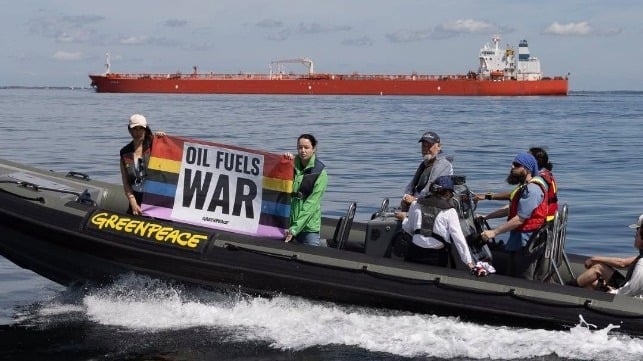
Western officials judge that Russia is already waging hybrid war against NATO, and Latvia’s intelligence service warns Moscow is gearing up for provocations against the Baltic states or Poland. At sea, a Steregushchiy-class corvette confronted Greenpeace activists while escorting the sanctioned tanker Kira K through Germany’s EEZ near Rügen, with a German Coast Guard vessel observing. Activists are pressing Baltic governments to tighten enforcement against the shadow fleet. Ireland has assumed the EU Council Presidency with a defence agenda that emphasises military mobility, procurement and sustained support to Ukraine, which will keep Russia-related security and sanctions enforcement high on Brussels’ docket. Russia’s fuel shortages and rationing add domestic stress that, in our view, could incentivise more asymmetric pressure on European energy and maritime nodes, though this rests on inference.
Change from previous assessment
New reporting shifts the near‑term risk focus toward the Baltic maritime and border zones. Since the prior brief, we have: documented a Russian Steregushchiy‑class corvette confronting Greenpeace while escorting the sanctioned tanker Kira K through Germany’s EEZ near Rügen; seen Latvian intelligence warn of potential Russian provocations against the Baltic states or Poland; and noted Ireland’s assumption of the EU Council Presidency with a defence agenda centred on military mobility, procurement and sustained support to Ukraine. We also register continued domestic fuel stress inside Russia. Confidence remains medium, with greater specificity on maritime tripwires in the German EEZ. This is an initial assessment of these particular maritime confrontation details within the broader topic.
Key judgments
- Russia is waging a hybrid campaign against NATO allies in Europe and is very likely to sustain or escalate pressure in the Baltic, North Sea theatre over the next 1-3 months. (Confidence: medium · ASSESSED)
- I&W: Another Steregushchiy-class corvette escorts a sanctioned tanker through Germany’s EEZ near Rügen and issues warnings to non-state vessels. (0-14 days)
- I&W: Noticeable absence of Russian naval escorts or confrontations in German and Danish EEZ transit corridors. (1-3 months)
- Hazardous encounters in Germany’s EEZ near Rügen are likely to recur in the next 0-30 days as Russian naval escorts accompany sanctioned tankers and confront NGOs or EU state assets. (Confidence: high · ASSESSED)
- I&W: Soobrazitelny or another Steregushchiy-class unit challenges Greenpeace or an EU coast guard while a shadow‑fleet tanker transits off Rügen. (0-14 days)
- I&W: German authorities report unescorted, incident‑free passages of sanctioned tankers past Rügen. (1-3 months)
- Cross-border provocations against Latvia, Lithuania, Estonia or Poland have a roughly even chance in the next 1-3 months. (Confidence: medium · REPORTED)
- I&W: Official reporting of drone incursions, sabotage attempts, or GPS jamming in Baltic or Polish border regions attributed to Russian actors. (0-14 days)
- I&W: No public reports of provocations in Baltic or Polish border areas and de‑escalatory signalling from Russian authorities. (1-3 months)
- Russia’s domestic fuel shortages and rationing make it likely that Moscow will increase asymmetric pressure on European energy and maritime nodes over the next 1-3 months, but this rests on inference from internal stress indicators. (Confidence: low · ASSESSED)
- I&W: Russian state outlets or officials explicitly tie domestic fuel woes to threats or pressure against EU LNG logistics or Denmark’s Fayard yard; harassment of Arc7 carriers near the Danish Straits. (1-3 months)
- I&W: Easing of rationing inside Russia and reduced emergency fuel imports without parallel hostile signalling or activity toward EU energy‑maritime nodes. (1-3 months)
- Ireland’s EU Council Presidency will likely intensify defence coordination on military mobility, procurement and support for Ukraine, keeping shadow‑fleet control and Russia‑related maritime enforcement high on the EU agenda over the next 1-3 months. (Confidence: medium · ASSESSED)
- I&W: EU Council working groups table proposals on shadow‑fleet sanction enforcement or port‑state control and convene sessions on defence procurement or military mobility. (1-3 months)
- I&W: Presidency briefings de‑prioritise defence and Russia‑related maritime enforcement items. (1-3 months)
Outlook & scenarios
Recurrent Baltic maritime confrontations around sanctioned tankers (45%)
Russian Steregushchiy‑class escorts continue to accompany sanctioned crude carriers through Germany’s EEZ off Rügen, issuing warnings to NGO craft and challenging EU state vessels. Greenpeace and other groups maintain at‑sea protests, increasing the risk of collision or escalation and forcing German and Danish authorities to raise patrol presence.
Border‑zone provocations in the Baltics and Poland (40%)
Moscow tests allied resolve with limited cross‑border drone incursions, GPS interference or deniable acts of sabotage targeting rail or power nodes in Latvia, Lithuania, Estonia or Poland. Incidents are calibrated to avoid direct military confrontation while sustaining political pressure and media noise.
EU policy tightening heightens friction on Russian energy logistics (50%)
The Irish Presidency’s defence agenda sustains momentum on military mobility, procurement and Ukraine support while member states press for tougher shadow‑fleet enforcement. Port‑state control and NGO scrutiny expand in the Baltic, increasing operational cost and political risk for Russia‑linked energy shipping and provoking sharper diplomatic and maritime signalling from Moscow.
Wildcard: An at‑sea incident with injuries triggers a NATO maritime posture shift (15%)
A confrontation near Rügen results in injuries aboard an NGO craft or damage to a German state vessel. Berlin requests allied maritime presence in the Baltic approaches, prompting Russia to shadow NATO patrols and raising miscalculation risk despite both sides’ desire to limit escalation.
Recommendations
- Prioritise OSINT tracking of Steregushchiy‑class corvettes, notably Soobrazitelny, and sanctioned tankers such as Kira K transiting the Baltic. Fuse AIS, coastal camera, VHF intercepts and NGO reporting to build a near‑real‑time incident picture for German and Danish waters.
- Establish a standing watch on Latvian, Lithuanian, Estonian and Polish official channels for reports of drone incursions, sabotage or GPS interference. Maintain a tripwire log with time, location, vector of approach and claimed attribution for rapid trend analysis.
- Support EU partners by preparing a short options memo on shadow‑fleet enforcement levers that align with existing sanctions and the 2027 LNG services prohibition timeline, highlighting port‑state control practices and NGO evidence standards.
- Map Arc7 LNG carrier maintenance calls at Odense and expected transits to and from the Danish Straits. Flag any Russian state media or diplomatic messaging that links these calls to coercive narratives, and prepare lines to brief counterparts in Copenhagen and Brussels.
- Engage with German maritime authorities and major NGOs to encourage standardised incident‑reporting formats and de‑confliction protocols for protests at sea to reduce the risk of miscalculation in the German EEZ.
Confidence & uncertainty
Overall confidence is medium. Multiple independent, credible sources corroborate core elements: Western officials’ characterisation of Russia’s hybrid campaign, Latvia’s warning of provocations, and a documented at‑sea confrontation involving a Russian corvette, a sanctioned tanker, and Greenpeace near Germany with a German Coast Guard vessel observing. These are reliable and mutually reinforcing. However, several forward‑looking judgments rest on analytic inference, and some supporting elements, such as Russia’s internal fuel stress translating into external asymmetric pressure, are single‑source or indirect. This mix supports a medium confidence headline.
Alternative analysis (red cell)
Open reporting credibly documents hazardous maritime encounters around sanctioned tankers and analyst attributions of Russian hybrid activity. However, the available evidence is concentrated on discrete maritime incidents and high-level assessments rather than consistent, multi-domain indicators of a sustained hybrid campaign across the Baltic/North Sea. It is therefore reasonable to interpret the record as indicating episodic sanction-evasion confrontations and continued risk of localized hazardous encounters, not definitive proof of a theatre-wide escalation against NATO allies in the next 1–3 months.
Intelligence gaps
- [EEI 1.2 · UNCOVERED] Observed reconnaissance activity around critical sites indicative of attack planning (unauthorised drone flights, repeated surveillance visits, loitering vehicles, mapping/photography of assets). Recommended collection: open-source/media
- [EEI 1.3 · UNCOVERED] Law-enforcement or customs seizures, arrests or interdictions of persons or shipments carrying explosives, sabotage tools, specialty cutting/electrical equipment, or covert comms gear destined for/near critical infrastructure. Recommended collection: law enforcement
- [EEI 2.1 · UNCOVERED] Emergence or amplification of coordinated social-media networks (sets of accounts, pages, channels) pushing identical narratives or hashtags across multiple platforms, including bot-like activity metrics and origin IP/common management indicators. Recommended collection: social-media/OSINT
- [EEI 2.2 · UNCOVERED] Publication or internal guidance from state-run media, proxy outlets, or identified influence platforms distributing talking points, pre-scripted messaging, or translated content targeted at specific EU countries/communities. Recommended collection: open-source/media
- [EEI 2.3 · UNCOVERED] Distribution of manipulated multimedia (deepfakes), targeted phishing/whaling campaigns, or localized false narratives timed to political events (elections, protests, court rulings) with tracked reach and engagement metrics. Recommended collection: cyber/forensic
- [EEI 3.1 · UNCOVERED] Unusual financial transactions: wire transfers, crypto conversions, or payments to shell companies, NGOs or individuals exceeding typical baselines that link to known proxies or front organisations. Recommended collection: financial
- [EEI 3.3 · UNCOVERED] Cargo, freight or maritime movements with discrepancies (concealed/dual-use equipment, false manifests, unusual routing) detected at ports, rail hubs or via AIS that correspond to deliveries of material used in sabotage or influence operations. Recommended collection: customs/ports
- [EEI 3.4 · UNCOVERED] Intercepted or otherwise-obtained communications showing tasking, coordination, or payment instructions between Russian agencies/handlers and proxy groups, including identified command-and-control servers or encrypted group identifiers. Recommended collection: signals-intel/SIGINT
Cited sources
[1] newsweek.com · Russian drone makers preparing for "great war with NATO" (B) · sha256:87e34f0186cc [2] maritime-executive.com · Russian Warship Orders Greenpeace to Stay Away from Sanctioned Tanker (C) · sha256:3d98e4bc7d9c [3] Al Jazeera · ‘The crisis is deep’: The view from Russia as fuel shortages worsen (A) · sha256:7278e4a02978 [4] gcaptain.com · Russia Buys Gasoline From India to Tackle Shortages, Sources Say (A) · sha256:5cd4d1f0efce [5] gcaptain.com · Last Western Shipyard Servicing Russia’s Arctic LNG Fleet Receives Another Icebreaking Gas Carrier (B) · sha256:43034133cada [6] irish-presidency.consilium.europa.eu · Programme of the Irish Presidency of the Council of the European Union (A) · sha256:ef9dbad0bf97
Source content hashes were computed at collection time; the cited text is preserved unmodified for the life of this product.
Red cell review: PARTIAL DISSENT
TLP:CLEAR