TLP:CLEAR · Disclosure is not limited.
Europe: Hybrid Threat Reporting and Black Sea Shipping Attacks, 7 October 2026
Time window: Last 1 day · Audience: General analyst · Type: Situation report · DTG: 2026-10-07 10:12Z · Overall confidence: HIGH
BLUF
Recent reporting reinforces the assessment that Russian-linked hybrid pressure is continuing across Europe, but does not establish a single command structure or resolve responsibility for the 5-6 October drone strikes on cargo ships in Bulgaria's exclusive economic zone. EU ambassadors are due to approve a package of around 1,650 Russia-related sanctions designations on 7 October, with final ministerial adoption scheduled for 12 October.
Executive summary
A 7 October report citing the Associated Press says more than 210 Russian sabotage attacks have been recorded in Europe since Russia's full-scale invasion of Ukraine; CSIS separately reports that Russian incursions quadrupled during the war's first year. Recent reports name a fire at Estonian defence company Milrem Robotics, arson at UK warehouses holding aid for Ukraine attributed to Wagner Group mercenaries, an attempted fire at a Lithuanian radio-wave scanner facility, and an attack on a Czech drone factory. The reporting does not independently establish Russian responsibility for each incident or a shared chain of command. On 5-6 October, drones struck the Togo-flagged Alfa Watan and Palau-flagged ABLE about 112 kilometres off Byala, Bulgaria. Alfa Watan sank, with 10 crew reported missing; all 18 ABLE crew were rescued, including two seriously wounded sailors. Bulgarian Prime Minister Rumen Radev said responsibility was unclear. Separate reporting on the Royad Mammadov off Romania gives conflicting accounts of attribution and casualties. EU ambassadors are due to consider a large Russia sanctions package, while the EU and UK have also sanctioned a broader ecosystem linked to Russian cyber-attacks.
Change from previous assessment
Since the 6 October brief, this assessment adds the reported European tally of more than 210 Russian sabotage attacks, CSIS's historical estimate of a fourfold rise in incursions, and details of the 5-6 October strikes on Alfa Watan and ABLE in Bulgaria's exclusive economic zone. It also adds the reported 1,650-entry EU sanctions package and a warning of a potential NATO hybrid attack within months. Confidence in Russian responsibility for the Bulgarian strikes remains low, and the new warning does not establish an operational attack plan.
Key judgments
- Russia is likely sustaining hybrid pressure across Europe, but current reporting does not establish a single campaign command structure. A 7 October report citing the Associated Press attributes more than 210 sabotage attacks in Europe to Russia since the invasion began, while CSIS reports a fourfold rise in Russian incursions during the war's first year. The same recent reporting names incidents at Milrem Robotics in Estonia, UK warehouses holding aid for Ukraine, a Lithuanian radio-wave scanner facility, and a Czech drone factory. The specific incident accounts and attributions largely come from one local-media report, which limits confidence in a common Russian link. (Confidence: medium · ASSESSED)
- I&W: Confirm: police or prosecutors in at least two of Estonia, the UK, Lithuania, and the Czech Republic publicly link the named incidents to the same Russian-directed network. Break: official findings attribute the incidents to unrelated actors. (0-30 days)
- I&W: Confirm: an updated AP or CSIS incident count documents continued Russian-linked activity using a consistent definition. Break: either organisation materially corrects or withdraws the reported trend. (1-3 months)
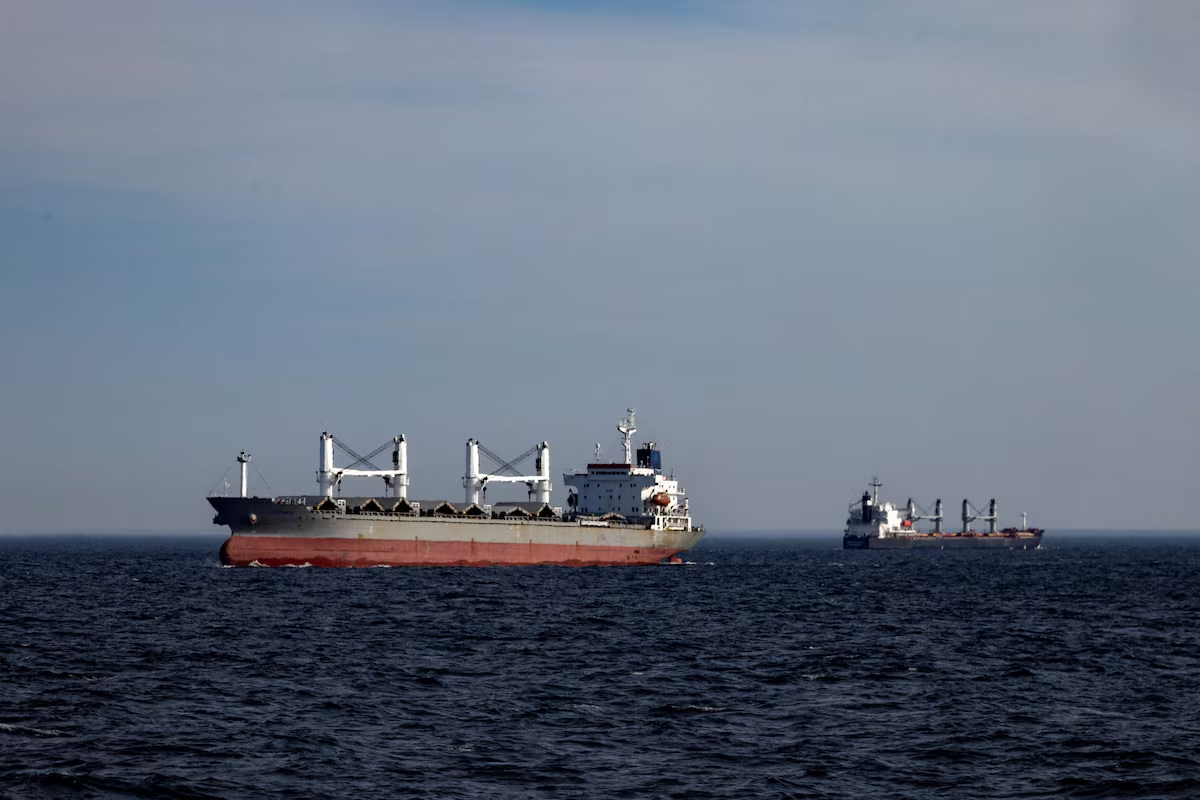
- The drone strikes on Alfa Watan and ABLE in Bulgaria's exclusive economic zone almost certainly occurred, while responsibility remains unconfirmed. Reports place the strikes about 112 kilometres off Byala overnight on 5-6 October. Alfa Watan sank, with 10 crew reported missing; all 18 people aboard ABLE were rescued, and two were seriously wounded. Rumen Radev said it was unclear whether Russia or Ukraine launched the drones. A separate reported sinking off Romania, identified as the Royad Mammadov in one account, also has conflicting attribution and casualty details. (Confidence: medium · REPORTED)
- I&W: Confirm: Bulgarian authorities publish an investigation update confirming the drone strikes and the identities of Alfa Watan and ABLE. Break: an official investigation rejects the reported strike account. (0-14 days)
- I&W: Break: a public Bulgarian investigation identifies the launch origin as Russian or Ukrainian. Continued official reporting that the operator is undetermined confirms the attribution remains unresolved. (0-30 days)
- The EU sanctions process is likely to proceed towards a large expansion of Russia-related listings, but the 7 October ambassador decision and 12 October ministerial adoption remain scheduled actions, not confirmed outcomes. Current reporting puts the planned package at around 1,650 designations, including about 1,570 entries linked to Russia's military-industrial complex, more than half associated with missile production. The earlier EEAS proposal covered 1,576 individuals and entities, so the final count remains unsettled. Separately, the EU and UK have sanctioned a broader ecosystem linked to Russian cyber-attacks. (Confidence: medium · ASSESSED)
- I&W: Confirm or break: an EU announcement records whether ambassadors approved the package on 7 October and states the designation count. (0-7 days)
- I&W: Confirm or break: EU foreign ministers adopt or defer the package on 12 October, with the final list size stated in the Council announcement. (0-14 days)
- Russian threat rhetoric is likely to heighten European concern, but the available claims do not establish a specific imminent attack plan. Reporting attributes to Putin a statement about using all available weapons, and describes Russian threats concerning Kaliningrad and European decision-making centres. The accounts differ on whether the threat to use the full arsenal was conditional on NATO isolating Kaliningrad or applied at the start of any conflict. A separate report warns of a potential hybrid attack on NATO within months, but provides no operational detail. These warnings are thinly sourced or contested, so confidence in their scope and implications is low. (Confidence: low · ASSESSED)
- I&W: Confirm: Putin or Nikolai Patrushev publicly repeats a threat naming Poland, Kaliningrad, or European decision-making centres. Break: the Kremlin publishes a retraction or a complete text that removes the reported threat. (0-30 days)
- I&W: Break: a named NATO or European intelligence authority publishes evidence of Russian operational preparations for a direct attack, rather than relying on threat rhetoric. (1-3 months)
Outlook & scenarios
Persistent below-threshold pressure (60%)
Russia is likely to continue sabotage, cyber activity, and disinformation aimed at European states and support for Ukraine. Public attribution is likely to remain uneven, particularly where reporting relies on single-source accounts or incidents have not been investigated publicly.
Russian responsibility established for Black Sea strikes (20%)
A Bulgarian or Romanian investigation identifies Russian operators behind one or more attacks on commercial vessels. This would strengthen the case for European action on maritime security and Russian-linked activity, while leaving the precise relationship between the ship strikes and other reported sabotage incidents to be established.
Black Sea attribution remains unresolved or points elsewhere (40%)
Investigations do not identify the operators, or evidence points to Ukrainian or other operators rather than Russia. The strikes on Alfa Watan and ABLE would remain confirmed incidents, but claims of a Russian link to those attacks would remain unverified.
High-impact spillover into NATO territory (8%)
A lethal or infrastructure-disabling incident occurs in a NATO member state and is attributed to Russian-directed operators. This is an unlikely, high-impact wildcard: disputed evidence or competing national responses would test allied coordination and could amplify the effects of the threat rhetoric.
Recommendations
- Keep the Bulgaria and Romania shipping incidents as separate case files. Do not attribute the strikes on Alfa Watan or ABLE to Russia or Ukraine until Bulgarian investigative findings establish launch origin; reconcile crew and casualty details with official updates.
- Maintain an incident ledger for Milrem Robotics in Estonia, the UK aid warehouses, the Lithuanian radio-wave scanner facility, and the Czech drone factory. Record the source, attribution basis, and whether each claim has independent official corroboration before assessing a common network.
- Track the EU ambassador decision expected on 7 October and ministerial consideration on 12 October. Distinguish the earlier proposal of 1,576 entries from the reported package of around 1,650, and record the final count only after an EU announcement.
- Treat the warning of a NATO hybrid attack within months as a monitoring lead, not proof of an attack plan. Reassess if a named official source provides operational evidence or if the full text of the Russian diplomatic note clarifies its scope.
Confidence & uncertainty
Overall confidence is high for the broad situation picture and the occurrence of well-reported incidents and policy actions. The assessment draws on reporting from major media, official statements by Bulgarian Prime Minister Rumen Radev and EU institutions, and separate analyses from AP, CSIS, and CEPA. Confidence is lower on Russian responsibility for individual sabotage incidents and the Bulgarian ship strikes, as well as on the scope of Russian threats; the package approval and final designation count were still pending at the end of the reporting window.
Intelligence gaps
- [EEI 1.2 · UNCOVERED] Observed reconnaissance activity around critical sites indicative of attack planning (unauthorised drone flights, repeated surveillance visits, loitering vehicles, mapping/photography of assets). Recommended collection: open-source/media
- [EEI 1.3 · UNCOVERED] Law-enforcement or customs seizures, arrests or interdictions of persons or shipments carrying explosives, sabotage tools, specialty cutting/electrical equipment, or covert comms gear destined for/near critical infrastructure. Recommended collection: law enforcement
- [EEI 2.1 · UNCOVERED] Emergence or amplification of coordinated social-media networks (sets of accounts, pages, channels) pushing identical narratives or hashtags across multiple platforms, including bot-like activity metrics and origin IP/common management indicators. Recommended collection: social-media/OSINT
- [EEI 2.2 · UNCOVERED] Publication or internal guidance from state-run media, proxy outlets, or identified influence platforms distributing talking points, pre-scripted messaging, or translated content targeted at specific EU countries/communities. Recommended collection: open-source/media
- [EEI 2.3 · UNCOVERED] Distribution of manipulated multimedia (deepfakes), targeted phishing/whaling campaigns, or localized false narratives timed to political events (elections, protests, court rulings) with tracked reach and engagement metrics. Recommended collection: cyber/forensic
- [EEI 3.1 · UNCOVERED] Unusual financial transactions: wire transfers, crypto conversions, or payments to shell companies, NGOs or individuals exceeding typical baselines that link to known proxies or front organisations. Recommended collection: financial
- [EEI 3.2 · UNCOVERED] Travel and movement indicators for suspected operatives: repeated border crossings, chartered/irregular flights, booking patterns or mobile/location data placing identified individuals in staging areas shortly before incidents. Recommended collection: border/immigration
- [EEI 3.3 · UNCOVERED] Cargo, freight or maritime movements with discrepancies (concealed/dual-use equipment, false manifests, unusual routing) detected at ports, rail hubs or via AIS that correspond to deliveries of material used in sabotage or influence operations. Recommended collection: customs/ports
- [EEI 3.4 · UNCOVERED] Intercepted or otherwise-obtained communications showing tasking, coordination, or payment instructions between Russian agencies/handlers and proxy groups, including identified command-and-control servers or encrypted group identifiers. Recommended collection: signals-intel/SIGINT
Cited sources
[1] Shelter (shelter.in.ua) · Arson, drones, and sabotage: How Russia is trying to make aid to Ukraine too costly for Europe (D) · 7 October 2026 · sha256:4b35e5d249b9 [2] Foreign Affairs · Russia’s Hybrid War Has Entered a Dangerous New Phase (A) · 7 October 2026 · sha256:9c38efe553d3 [3] Atlantic Council · We are staying: European diplomats reject Russian calls to leave Ukraine (C) · 6 October 2026 · sha256:acedb3ff6a92 [4] Independence Avenue Media · Christopher Walker: Russia's Shadow War Needs a 'Sufficiently Disproportionate' Response (B) · 6 October 2026 · sha256:0edf6a58a44a [5] Ynetnews · Black Sea drone attacks escalate: Ship hit off Bulgaria sinks, 10 missing (B) · 6 October 2026 · sha256:20bbcdef740d [6] gCaptain (republishing Bloomberg) · War in Ukraine Escalates With Drone Strikes on Cargo Ships (C) · 6 October 2026 · sha256:41f6dc0fa04b [7] European Pravda (pravda.com.ua), citing Reuters · Ambassadors from EU member states to approve largest batch of Russia sanctions since 2022 – Reuters (A) · 7 October 2026 · sha256:ed944898a14a [8] UNN (Ukrainian National News) · On Wednesday, EU ambassadors will approve the largest package of sanctions against Russia since 2022 - Reuters (B) · 6 October 2026 · sha256:607e342f55d8 [9] European External Action Service (EEAS) · Foreign Affairs Council: Remarks by High Representative Kaja Kallas at the press conference (A) · sha256:3e1032e37893 [10] Yahoo News · Are Europe and Russia Slow-Walking to World War III? (B) · 7 October 2026 · sha256:a67baebfc409 [11] The Maritime Executive · After Russian Threats, Macron Puts Nuclear Deterrent at the Forefront (C) · sha256:c13cda3b0b43 [12] thenews.com.pk · Poland pushes EU toward complete cutoff of Russian energy amid security threats (F) · 7 October 2026 · sha256:59a762312020
Source content hashes were computed at collection time; the cited text is preserved unmodified for the life of this product.
Red cell review: CONCUR WITH COMMENT
TLP:CLEAR