TLP:CLEAR · Disclosure is not limited.
Europe Hybrid Threats: New Incidents, Attribution Unresolved
Time window: Last 1 day · Audience: General analyst · Type: Situation report · DTG: 2026-11-01 15:11Z · Overall confidence: MEDIUM
BLUF
New reporting adds consecutive nights of drone disruption at Jersey Airport and investigative claims linking attacks on Starlink equipment in Lithuania, Bulgaria and Poland. These developments raise concern about further disruption, but they do not establish a single Russia-directed campaign; attribution remains unconfirmed.
Executive summary
Jersey Airport reported drone-related disruption on two consecutive nights, with flights cancelled or diverted and police estimating that two or three drones entered restricted airspace. Separately, Lithuanian investigators have reported links between suspects in attempted attacks on Starlink equipment in Vilnius, Plana near Sofia and Wola Krobowska south of Warsaw. The reported links are not evidence of Russian state direction, and Lithuanian reporting says no judicial finding has established that Russian intelligence ordered or financed the attacks. Russian officials have also amplified narratives about European energy prices and Poland’s constitutional dispute, while Polish Prime Minister Donald Tusk’s claim of Russian bot support for his opponents was reported without evidence. The evidence supports monitoring these distinct incidents and narratives, not treating them as a confirmed coordinated campaign.
Change from previous assessment
Since the 31 October brief, the assessment adds two consecutive nights of drone disruption at Jersey Airport, new reporting on Lithuanian investigative links among Starlink attacks in Vilnius, Plana and Wola Krobowska, and Russian officials’ messaging about Poland’s constitutional dispute and European energy costs. The likelihood of further disruption remains, but confidence in a common Russia-directed campaign has not increased: the new reporting adds incidents and investigative leads, not proof of shared command. The prior concern about autonomous AI activity is retained but narrowed to distinguish reported AI-assisted intrusions from uncorroborated claims of autonomous campaign management.
Key judgments
- Further disruptive drone or arson attempts against European transport and Ukraine-linked communications infrastructure are likely over the next 1-3 months, but the reported incidents do not establish a common campaign. Reported: Jersey Airport experienced drone-related disruption on two consecutive nights; police estimated that two or three drones entered restricted airspace, flights were cancelled or diverted, and no operator had been identified. Lithuanian investigators reported links between suspects and attempted attacks on Starlink equipment in Vilnius, Plana near Sofia and Wola Krobowska south of Warsaw. Assessment: repeated disruption and reported cross-border investigative links warrant continued monitoring, although the incidents differ in target and evidential status. (Confidence: medium · ASSESSED)
- I&W: Confirmation: Jersey Airport reports another drone-related flight cancellation or diversion. (0-14 days)
- I&W: Break: no further verified drone incursions or attempted damage at the named facilities are reported during the next three months. (1-3 months)
- It is unlikely that the supplied reporting establishes Russian state direction of the Jersey disruptions or the Starlink attacks. Reported: Lithuanian investigators have linked suspects to attacks at several sites, but the reporting says no judicial finding has established that Russian intelligence ordered or financed them. Poland’s ABW determined that a fire damaged Starlink ground-station power infrastructure in Wola Krobowska, while the available claim does not identify a perpetrator. Jersey Police said no drone operator had been identified and that the incident was not thought to be terrorism-related. Assessment: the Russian attribution remains unconfirmed, and the incidents should not be combined as a proven state-directed operation. (Confidence: low · ASSESSED)
- I&W: Confirmation: Lithuanian prosecutors’ public statements or filings disclose no Russian handler, tasking or financing evidence. (1-3 months)
- I&W: Break: prosecutors or a court publish corroborated evidence tying the suspects to Russian intelligence direction or financing. (1-3 months)
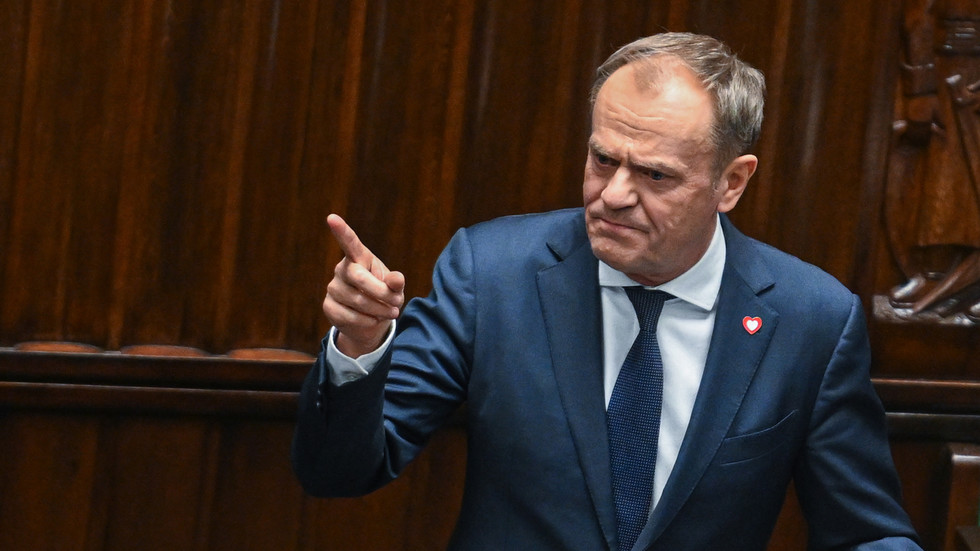
- Russian officials are likely to continue amplifying narratives that exploit European political divisions, but the supplied reporting does not establish a coordinated bot campaign in Poland. Reported: Kirill Dmitriev blamed Europe’s energy prices for unrest and highlighted reporting about protests in Germany; Dmitry Medvedev characterised Poland’s constitutional dispute as a coup. Donald Tusk accused his opponents of support from Russian bots without presenting proof. Assessment: these statements show public narrative exploitation, not proof of covert coordination or Russian responsibility for the Polish political dispute. (Confidence: low · ASSESSED)
- I&W: Confirmation: Dmitriev or other Russian officials repeat claims linking European energy costs or Poland’s constitutional dispute to unrest, with Russian media amplifying the same claims. (0-30 days)
- I&W: Break: Polish investigators or independent platform analysis find no coordinated inauthentic activity linked to the bot allegation, and Russian officials stop amplifying it during the next month. (0-30 days)
- It is unlikely that the supplied reporting demonstrates Russian state adoption of autonomous AI agents to direct a coordinated campaign against European targets. Reported: Anthropic described a Russian-linked espionage actor using Claude in workflows targeting Ukrainian and European government, diplomatic and defence organisations. Separate claims about autonomous malware adaptation and Russian-based development of drone-swarm software have insufficient evidential support, while the assessment concerning NATO response thresholds addresses a narrower activity. Assessment: the reports do not establish state-directed autonomous campaign management. (Confidence: low · ASSESSED)
- I&W: Confirmation: public reporting continues to lack independent technical evidence tying autonomous target selection or campaign direction to Russian state tasking. (1-3 months)
- I&W: Break: independent technical reporting or court filings corroborate Russian state tasking of autonomous systems against European targets. (1-3 months)
Outlook & scenarios
Repeated local disruption, without confirmed common direction (55%)
Jersey authorities investigate further drone activity while European investigators pursue the Starlink cases. Disruptions recur, but evidence does not establish shared Russian tasking. This is the most likely course on the current reporting.
Investigations establish a cross-border proxy network (25%)
Lithuanian prosecutors or a court publish corroborated evidence connecting suspects in the Vilnius, Plana and Wola Krobowska incidents to a shared organiser. Evidence of Russian state direction would represent a further finding, not an automatic consequence of establishing a cross-border network.
Incidents remain unconnected or are not substantiated further (15%)
Jersey drone activity remains unattributed, and public legal or technical findings do not substantiate a connection among the Starlink incidents. Analysts continue to assess each event separately.
Low-probability, high-impact infrastructure disruption (5%)
A renewed attack disables equipment at a Ukraine-linked satellite communications facility while drone activity disrupts an airport. The combination causes prolonged communications or transport disruption before investigators establish whether the events are connected.
Recommendations
- Maintain separate incident records for Jersey Airport and the Starlink cases. Record the event, target, date, source, legal status and attribution confidence before assessing links among them.
- Track statements and public filings from Lithuanian prosecutors, the Bulgarian prosecution and Poland’s ABW. Raise attribution confidence only if they provide corroborated evidence of a handler, tasking or financing.
- Follow Jersey Police and Jersey Airport updates for additional drone incursions, operator identification and flight disruption. Keep the police assessment that the incident was not thought to be terrorism-related distinct from any assessment of state involvement.
- Assess Donald Tusk’s Russian-bot allegation against observable coordination evidence before treating it as fact. Distinguish Russian officials’ public messaging from evidence of covert influence activity.
- Keep the autonomous-AI assessment low confidence until independent technical reporting or legal evidence establishes Russian state tasking and operational use.
Confidence & uncertainty
Reporting on the Jersey flight disruption and the existence of investigations into Starlink equipment attacks is supported by named authorities and established media. Confidence is lower on cross-border links, Russian state direction and coordinated information activity: those assessments rest on limited reporting, unresolved investigations or political claims without public corroboration. The AI-related claims also remain weakly corroborated and cover different activities.
Intelligence gaps
- [EEI 1.2 · UNCOVERED] Observed reconnaissance activity around critical sites indicative of attack planning (unauthorised drone flights, repeated surveillance visits, loitering vehicles, mapping/photography of assets). Recommended collection: open-source/media
- [EEI 1.3 · PARTIAL] Law-enforcement or customs seizures, arrests or interdictions of persons or shipments carrying explosives, sabotage tools, specialty cutting/electrical equipment, or covert comms gear destined for/near critical infrastructure. Recommended collection: law enforcement
- [EEI 2.1 · UNCOVERED] Emergence or amplification of coordinated social-media networks (sets of accounts, pages, channels) pushing identical narratives or hashtags across multiple platforms, including bot-like activity metrics and origin IP/common management indicators. Recommended collection: social-media/OSINT
- [EEI 2.2 · UNCOVERED] Publication or internal guidance from state-run media, proxy outlets, or identified influence platforms distributing talking points, pre-scripted messaging, or translated content targeted at specific EU countries/communities. Recommended collection: open-source/media
- [EEI 2.3 · PARTIAL] Distribution of manipulated multimedia (deepfakes), targeted phishing/whaling campaigns, or localized false narratives timed to political events (elections, protests, court rulings) with tracked reach and engagement metrics. Recommended collection: cyber/forensic
- [EEI 3.1 · UNCOVERED] Unusual financial transactions: wire transfers, crypto conversions, or payments to shell companies, NGOs or individuals exceeding typical baselines that link to known proxies or front organisations. Recommended collection: financial
- [EEI 3.2 · PARTIAL] Travel and movement indicators for suspected operatives: repeated border crossings, chartered/irregular flights, booking patterns or mobile/location data placing identified individuals in staging areas shortly before incidents. Recommended collection: border/immigration
- [EEI 3.3 · UNCOVERED] Cargo, freight or maritime movements with discrepancies (concealed/dual-use equipment, false manifests, unusual routing) detected at ports, rail hubs or via AIS that correspond to deliveries of material used in sabotage or influence operations. Recommended collection: customs/ports
- [EEI 3.4 · UNCOVERED] Intercepted or otherwise-obtained communications showing tasking, coordination, or payment instructions between Russian agencies/handlers and proxy groups, including identified command-and-control servers or encrypted group identifiers. Recommended collection: signals-intel/SIGINT
Red cell review: CONCUR WITH COMMENT
TLP:CLEAR