TLP:CLEAR · Disclosure is not limited.
Europe: Russian Hybrid Pressure Expands Around Ukraine Support
Time window: Last 1 day · Audience: General analyst · Type: Situation report · DTG: 2026-08-31 20:12Z · Overall confidence: HIGH
BLUF
Russian-linked hybrid pressure in Europe is very likely to continue, with the 31 August fire at WB Electronics in Skarżysko-Kamienna, Poland, adding a new incident at a plant supplying Polish and Ukrainian forces. Russian responsibility for that fire and the Leipzig airport explosives incident remains unconfirmed, while NATO and several European governments report no imminent conventional Russian attack.
Executive summary
Reported developments include a fire at Poland's WB Electronics drone facility after a balaclava-wearing person entered the site, a foiled arson attempt at Slovakia's Skyeton drone plant, repeated Russian drone incursions into Romanian airspace, and Finnish-Swedish plans for enhanced surveillance along Finland's 1,340-kilometre border with Russia. The Russian Defence Ministry has announced preparations for further attacks on Ukraine's energy infrastructure, while Western intelligence agencies assess that Moscow will favour hybrid attacks against European factories and supply routes over direct confrontation with NATO. Attribution of the Polish and Leipzig incidents remains unresolved. Russian officials are also increasing coercive rhetoric over NATO's Arctic Sentry mission.
Change from previous assessment
Since the 30 August brief, the assessment has shifted from a broad continuation of Russian-linked hybrid activity to a sharper focus on defence-industrial targeting. New reporting adds the 31 August fire at WB Electronics in Skarżysko-Kamienna, further detail on the suspected Skyeton arson plot in Slovakia, Finnish-Swedish border surveillance plans and clearer reporting on Russian preparations for strikes against Ukraine's energy sector. Confidence in the occurrence of the Polish fire and the associated investigation is high, while confidence in Russian attribution remains low. The judgement that a direct Russian conventional attack on NATO is unlikely remains in place, supported by additional NATO, Finnish, Romanian and Latvian statements, but Polish warnings and false-flag reporting keep confidence at medium. A separate Arctic signalling judgement has been added. The purpose of Ratcliffe's Moscow visit remains disputed rather than resolved.
Key judgments
- Hybrid activity against European defence facilities and logistics supporting Ukraine is very likely to continue over the next 1-3 months, but Russian direction of the 31 August fire at WB Electronics in Skarżysko-Kamienna and the early-August Leipzig airport incident remains unconfirmed. The Polish fire involved a balaclava-wearing person entering the plant, an abandoned backpack and shirt, and investigations by Poland's Internal Security Agency and Military Counterintelligence Service. Slovakia separately prevented an attempted arson attack at the Skyeton drone plant, involving two Latvian citizens and one Ukrainian citizen suspected of preparing the attack. Western intelligence agencies assess that Moscow will avoid direct confrontation with NATO and instead intensify hybrid attacks, sabotage at European weapons factories and strikes on supply routes. (Confidence: medium · ASSESSED)
- I&W: Confirm: Poland's Internal Security Agency or Military Counterintelligence Service identifies deliberate arson or Russian direction in the WB Electronics fire, or Slovak authorities announce further suspects linked to the Skyeton case. (0-14 days)
- I&W: Break: Polish and German investigators attribute the WB Electronics and Leipzig incidents to non-hostile causes, and no further attempted arson, fire or disruption is reported at named European defence facilities supporting Ukraine. (1-3 months)
- Pro-Russian cyber disruption targeting Finnish public institutions and critical infrastructure is likely to persist over the next 1-3 months. Aalto University research describes NoName057(16) as responsible for thousands of DDoS attacks against NATO and European targets, including 23 rounds affecting 129 Finnish public and private organisations since 7 January 2025. The group reportedly recruits through Telegram, collaborates with groups linked to the Russian cyber army and offers cryptocurrency rewards of up to US$1,200. This is a thin assessment based mainly on academic reporting, and the count of Finnish incidents is low-confidence. (Confidence: low · ASSESSED)
- I&W: Confirm: NoName057(16) claims or conducts new DDoS attacks against the Parliament of Finland, Finnish municipalities, banks or critical infrastructure providers, with Finnish authorities reporting service disruption. (0-14 days)
- I&W: Break: Finnish authorities and Aalto University researchers publicly disavow the attribution to NoName057(16), and no new attacks against the named Finnish sectors are reported for three months. (1-3 months)
- Russia is unlikely to launch a direct conventional attack on Estonia, Latvia, Lithuania, Poland or another NATO member over the next 0-3 months; a deniable provocation is likely to remain the more plausible escalation path. NATO, Finland, Romania and Latvia report no evidence of preparations for an imminent attack, while Polish Prime Minister Donald Tusk, Poland's foreign intelligence chief and reporting on possible false-flag use of Ukrainian drones describe a continuing risk of provocations. The reporting also identifies Narva, Daugavpils, the Suwałki corridor and Svalbard as potential pressure points. Confidence is medium because official assessments conflict with warnings from Polish officials and media reporting on possible Russian preparations. (Confidence: medium · ASSESSED)
- I&W: Confirm: NATO, Finland, Romania and Latvia continue to report no evidence of preparations for a direct attack, while Russian activity remains limited to drone incursions, cyber operations or deniable actions. (0-14 days)
- I&W: Break: NATO or national authorities report Russian conventional force preparations directed at Estonia, Latvia, Lithuania or Poland, or identify a Russian attack on NATO territory. (0-14 days)
- Russia is very likely to intensify attacks on Ukraine's energy sector and likely to increase pressure on European production and supply routes supporting Ukraine over the next 1-3 months. The Russian Defence Ministry announced preparations for further massive strikes on Ukrainian energy facilities, although the reporting differs on whether the announcement occurred on 30 or 31 August. Vladimir Putin announced strikes on sensitive sectors of Ukraine's economy on 22 August. Western intelligence agencies assess that Moscow plans sabotage at European weapons factories and attacks on supply routes. Confidence is medium because the claims report intent and preparations rather than a confirmed future strike. (Confidence: medium · ASSESSED)
- I&W: Confirm: The Russian Defence Ministry announces the execution of the planned strikes, followed by reported damage or outages at Ukrainian energy facilities. (0-14 days)
- I&W: Break: The Russian Defence Ministry withdraws or abandons the announced preparations, and no strike on Ukrainian energy infrastructure or disruption of European supply routes is reported. (0-14 days)
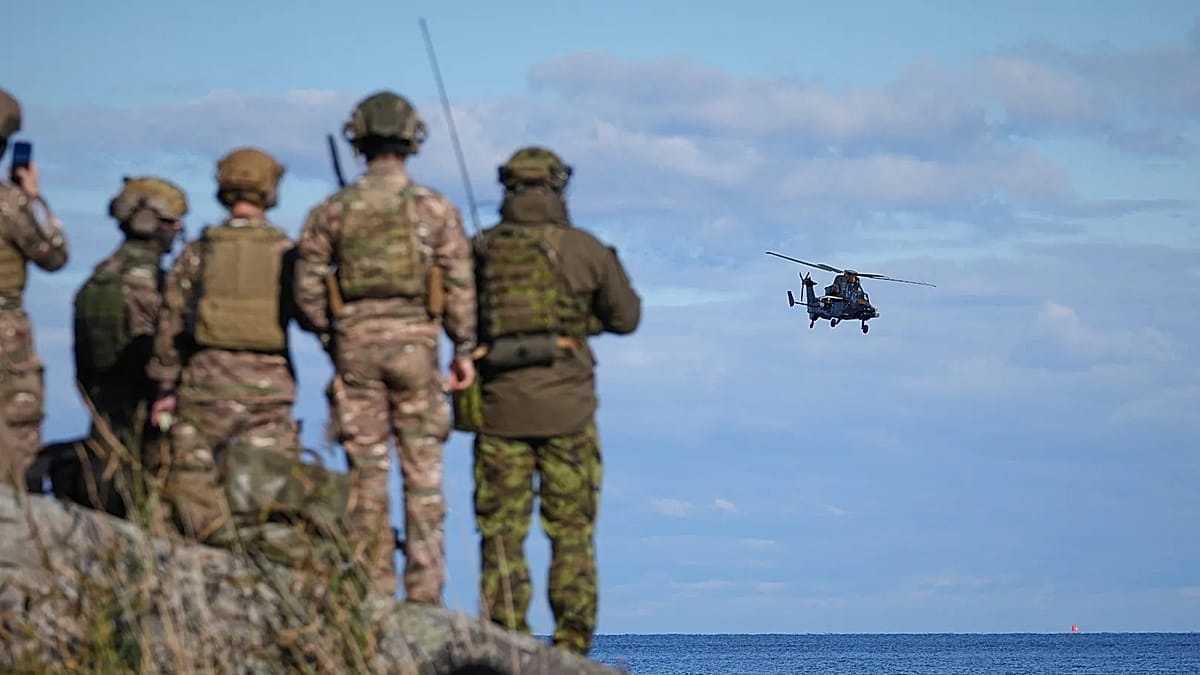
- Finland and Sweden are very likely to deepen bilateral surveillance along Finland's 1,340-kilometre border with Russia in the near term. Finland has requested Swedish aircraft and naval support, and Sweden has agreed to dispatch Gripen fighter jets and a naval vessel for Finnish territorial surveillance. This judgment rests on multiple reports of the same arrangement and is therefore high confidence as a reported development. (Confidence: high · REPORTED)
- I&W: Confirm: Sweden announces the assignment or arrival of Gripen aircraft and the naval vessel, while Finland reports expanded patrols along the Finnish-Russian border. (0-14 days)
- I&W: Break: Sweden rescinds the support arrangement or Finland states that the request for aircraft and naval surveillance has been cancelled. (0-14 days)
- It is roughly even chance that CIA Director John Ratcliffe's Moscow visit on or around 25 August included a warning about NATO, rather than being solely devoted to Ukraine-war talks. The visit itself is corroborated, but its purpose is disputed: the Wall Street Journal reported a possible warning to Vladimir Putin, European officials rejected that interpretation, and Donald Trump described the trip as semi-routine. The arrival date is also inconsistent across reports, with one account placing it on 23 August and another on 25 August. Confidence is low because the assessment rests on conflicting media interpretations and the purpose has not been fully reported. (Confidence: low · ASSESSED)
- I&W: Confirm: US, Russian or European officials publicly state that the Moscow meeting addressed NATO commitments or a warning over Russian action against NATO. (0-14 days)
- I&W: Break: US and European officials reaffirm that the meeting was semi-routine or solely concerned the Ukraine war, without reference to a NATO warning. (0-14 days)
- Russian coercive signalling against NATO's Arctic Sentry mission is likely to continue over the next 1-3 months, but the available reporting does not establish an imminent armed confrontation in the Arctic. On 31 August, Sergey Lavrov called NATO military operations in the Arctic a direct threat and warned of an asymmetric response. NATO states that Arctic Sentry addresses security gaps amid Moscow's growing military activity. The reporting supports a signalling trend, not an imminent attack. Confidence is medium because the evidence consists mainly of public statements and media reporting. (Confidence: medium · ASSESSED)
- I&W: Confirm: The Russian Foreign Ministry issues further warnings that Arctic Sentry or NATO activity near Svalbard threatens Russia, accompanied by renewed references to asymmetric measures. (0-14 days)
- I&W: Break: Russia and NATO publicly reduce Arctic-related threat rhetoric, and no Russian action against NATO Arctic patrols or Norwegian positions on Svalbard is reported. (1-3 months)
Outlook & scenarios
Sustained grey-zone pressure below the threshold of open conflict (65%)
Russia sustains cyber disruption, suspected arson and coercive signalling against European institutions and defence supply chains supporting Ukraine. Poland's WB Electronics fire, Slovakia's Skyeton case and the Leipzig incident remain under investigation. NATO and European governments continue to report no imminent conventional attack.
Ukrainian energy escalation with European supply-chain spillover (45%)
Russia conducts the announced strikes against Ukrainian energy facilities and increases pressure on European factories and logistics routes supporting Ukraine. Further fires, attempted sabotage or disruption at defence-related sites follow, but the activity remains deniable and below the threshold of direct NATO-Russia war.
Wildcard: deniable incident triggers a NATO crisis (10%)
A false-flag or covert operation affects Poland, Estonia, Latvia, Lithuania or Svalbard and is attributed to Russia or Ukraine. The incident produces rapid political pressure for a NATO response, despite the absence of confirmed preparations for a conventional Russian attack.
Limited diplomatic containment (25%)
The Ratcliffe visit contributes to continued US-Russia contact focused on the Ukraine war. NATO and European governments maintain deterrence measures, including Finnish-Swedish border surveillance and Arctic Sentry, while Russian hybrid activity remains below the level that prompts a direct military response.
Recommendations
- Prioritise immediate collection on the WB Electronics fire. Track findings from Poland's Internal Security Agency and Military Counterintelligence Service, CCTV evidence, forensic conclusions, arrests and any Russian linkage. Keep the fire's cause separate from attribution in reporting.
- Maintain a 0-14 day watch on Russian Defence Ministry statements and Russian strike activity against Ukrainian energy facilities. Record the exact announcement date, target set, damage and effects on European supply routes.
- Monitor NoName057(16) Telegram channels, payment claims and target lists for activity against the Parliament of Finland, Finnish municipalities, banks and critical infrastructure providers. Treat the reported 129-organisation count as unconfirmed until independently corroborated.
- Separate warning lines for a direct conventional attack from warning lines for deniable provocation. Prioritise Poland, the Suwałki corridor, Narva, Daugavpils, Svalbard and Romanian airspace in daily reporting.
- Track the Finnish request and Sweden's delivery of Gripen aircraft and a naval vessel. Report changes in patrol patterns along the 1,340-kilometre Finnish-Russian border as indicators of deterrence posture rather than evidence of imminent attack.
- Treat the purpose and date of John Ratcliffe's Moscow visit as unresolved. Do not use the visit alone as evidence of an imminent Russian attack or a confirmed US warning until an official account clarifies its purpose.
- Monitor Russian Foreign Ministry statements linking NATO's Arctic Sentry mission to an asymmetric response, alongside any reported activity involving Svalbard or NATO Arctic patrols.
Confidence & uncertainty
Overall confidence is high for the occurrence of the principal reported developments and for the positions publicly attributed to NATO, Finland, Romania, Latvia and Poland. The assessment benefits from corroboration across multiple major-media reports, official statements relayed through those reports, local reporting on the Polish and Slovak incidents, and academic research on NoName057(16). The main uncertainties concern Russian attribution of the WB Electronics and Leipzig incidents, the purpose and date of Ratcliffe's Moscow visit, the reliability of low-confidence cyber-incident counts, and whether announced Russian preparations will result in further strikes.
Intelligence gaps
- [EEI 1.1 · PARTIAL] Reports, operator notifications, CCTV or satellite imagery showing unexplained physical damage or operational outages at critical infrastructure sites (power substations, gas pipelines/compressor stations, water treatment plants, railway signaling centers, major telecom exchanges). Recommended collection: satellite/imagery
- [EEI 1.2 · UNCOVERED] Observed reconnaissance activity around critical sites indicative of attack planning (unauthorised drone flights, repeated surveillance visits, loitering vehicles, mapping/photography of assets). Recommended collection: open-source/media
- [EEI 1.3 · UNCOVERED] Law-enforcement or customs seizures, arrests or interdictions of persons or shipments carrying explosives, sabotage tools, specialty cutting/electrical equipment, or covert comms gear destined for/near critical infrastructure. Recommended collection: law enforcement
- [EEI 2.1 · UNCOVERED] Emergence or amplification of coordinated social-media networks (sets of accounts, pages, channels) pushing identical narratives or hashtags across multiple platforms, including bot-like activity metrics and origin IP/common management indicators. Recommended collection: social-media/OSINT
- [EEI 2.2 · UNCOVERED] Publication or internal guidance from state-run media, proxy outlets, or identified influence platforms distributing talking points, pre-scripted messaging, or translated content targeted at specific EU countries/communities. Recommended collection: open-source/media
- [EEI 2.3 · UNCOVERED] Distribution of manipulated multimedia (deepfakes), targeted phishing/whaling campaigns, or localized false narratives timed to political events (elections, protests, court rulings) with tracked reach and engagement metrics. Recommended collection: cyber/forensic
- [EEI 3.1 · PARTIAL] Unusual financial transactions: wire transfers, crypto conversions, or payments to shell companies, NGOs or individuals exceeding typical baselines that link to known proxies or front organisations. Recommended collection: financial
- [EEI 3.2 · UNCOVERED] Travel and movement indicators for suspected operatives: repeated border crossings, chartered/irregular flights, booking patterns or mobile/location data placing identified individuals in staging areas shortly before incidents. Recommended collection: border/immigration
- [EEI 3.3 · PARTIAL] Cargo, freight or maritime movements with discrepancies (concealed/dual-use equipment, false manifests, unusual routing) detected at ports, rail hubs or via AIS that correspond to deliveries of material used in sabotage or influence operations. Recommended collection: customs/ports
- [EEI 3.4 · PARTIAL] Intercepted or otherwise-obtained communications showing tasking, coordination, or payment instructions between Russian agencies/handlers and proxy groups, including identified command-and-control servers or encrypted group identifiers. Recommended collection: signals-intel/SIGINT
Cited sources
[1] RBC-Ukraine (newsukraine.rbc.ua) · Putin's biggest fear may explain why Russia is escalating war (B) · Mon Aug 31 2026 10:32:30 GMT+0000 (Coordinated Universal Time) · sha256:ab89db03245d [2] Meduza · «Меня повесят» (B) · Mon Aug 31 2026 07:20:03 GMT+0000 (Coordinated Universal Time) · sha256:e4e7bd616e2c [3] New Voice of Ukraine (NV) · Fire hits Polish drone plant supplying Ukraine after unidentified person seen (B) · Mon Aug 31 2026 13:07:00 GMT+0000 (Coordinated Universal Time) · sha256:7d5524328624 [4] Слово и дело (Slovo i Dilo) · В Польше вспыхнул пожар на заводе, где производят дроны для Украины (D) · Mon Aug 31 2026 22:57:14 GMT+0000 (Coordinated Universal Time) · sha256:602c8b3c0582 [5] UnHerd · The case for de-escalation with Russia (B) · Sun Aug 30 2026 23:04:25 GMT+0000 (Coordinated Universal Time) · sha256:574cf745bc48 [6] Aalto University (via Newswise) · ‘Gamified’ DDoS attacks wage psychological warfare against NATO states, finds study | Newswise (C) · sha256:24e87f3d9210 [7] NV (Novoye Vremya) English edition · NATO sees no imminent threat of Russian attack despite hybrid escalation (B) · Mon Aug 31 2026 08:39:00 GMT+0000 (Coordinated Universal Time) · sha256:b23c94b0c3a9 [8] Euronews · Why the Baltics are pushing back against new fears of a Russian attack (A) · Mon Aug 31 2026 15:33:50 GMT+0000 (Coordinated Universal Time) · sha256:d700b0838503 [9] IndexBox · NATO Allies Dismiss Imminent Russian Attack, But Warn of Growing Threat (D) · Mon Aug 31 2026 15:41:00 GMT+0000 (Coordinated Universal Time) · sha256:412bcb24052e [10] Meduza · Western officials fear Putin is preparing to escalate beyond Ukraine. Bild and The Telegraph outline possible Russian moves against NATO. (B) · Mon Aug 31 2026 06:50:13 GMT+0000 (Coordinated Universal Time) · sha256:8f522baabc06 [11] Geopolitical Futures · An Attempt to Understand a Strange Visit to Moscow - Geopolitical Futures (C) · Mon Aug 31 2026 10:00:50 GMT+0000 (Coordinated Universal Time) · sha256:86dd7222048e [12] The Kyiv Independent · Lavrov calls NATO's Arctic operations 'direct threat,' says Russia's opponents will face 'asymmetric' response (B) · Mon Aug 31 2026 11:13:44 GMT+0000 (Coordinated Universal Time) · sha256:23a735bfa8ad
Source content hashes were computed at collection time; the cited text is preserved unmodified for the life of this product.
TLP:CLEAR