TLP:CLEAR · Disclosure is not limited.
Europe: Russian-Linked Threat Allegations and Hybrid Security Response
Time window: Last 1 day · Audience: General analyst · Type: Situation report · DTG: 2026-11-11 14:17Z · Overall confidence: HIGH
BLUF
Reporting documents new Russia-related espionage and sabotage investigations in the UK and Poland, alongside hoax threats that disrupted flights and prompted the evacuation of 312 Italian schools. The incidents almost certainly demonstrate recurring security pressure, but the supplied reporting does not establish a centrally directed Russian campaign across Europe; attribution remains unresolved in several cases.
Executive summary
UK police arrested a 41-year-old US serviceman near Gloucester on suspicion of Russia-related espionage. Polish authorities reported two Ukrainian nationals suspected of spying and sabotage for Russian intelligence, as well as a separate 5 November case involving six people suspected of supplying military components to Russia. The arrest dates in the UK and two-suspect Polish cases conflict across reports, and the allegations are not proof of Russian tasking. Hoax threats disrupted at least 27 flights on 5 November and led to 312 school evacuations in Italy on 11 November; authorities reported no evidence linking the threats to a government. A Romanian allegation of a Russian-coordinated sabotage network remains thinly supported and contested. The UK has announced a 10-country Northern Navies Initiative and £90 million for maritime surveillance and undersea-threat capabilities, but the reporting describes plans rather than demonstrated operational capacity.
Change from previous assessment
Since the 10 November brief, reporting adds the Gloucester arrest of a US serviceman on suspicion of Russia-related espionage, Polish allegations involving two Ukrainian nationals and a separate six-person case, and the evacuation of 312 Italian schools after an emailed threat. It also adds Romania's contested sabotage-network allegation and the UK's 10-country Northern Navies Initiative. Confidence has increased on the scale of reported disruption and the breadth of active investigations, but not on Russian direction across cases. The new Matrjoschka claim is retained as low confidence because it lacks independent corroboration.
Key judgments
- It is unlikely that the reported UK and Polish investigations establish a single centrally directed Russian campaign across Europe. UK police arrested a 41-year-old US serviceman near Gloucester on suspicion of espionage related to Russia; he was reported to be assigned to NATO's Allied Rapid Reaction Corps at Imjin Barracks in Innsworth. Reports place his arrest on either 10 or 11 November, and Dmitry Peskov denied Russian involvement. Polish authorities accuse two Ukrainian men, aged 24 and 25, arrested in Mińsk Mazowiecki, of photographing military installations and setting vehicles on fire for Russian intelligence; reports place their arrest on either 3 or 10 November. Separately, Polish police arrested six people on 5 November over suspected espionage and supply of military components to Russia. Russia's FSB separately claimed it arrested two Polish intelligence agents in Kaliningrad. These are reported allegations and counter-allegations, not findings that establish a common command structure. (Confidence: medium · ASSESSED)
- I&W: UK police or prosecutors publish evidence tying the Gloucester suspect to Russian intelligence, or Polish court filings document Russian tasking or payments to the two Mińsk Mazowiecki suspects. Such evidence would strengthen the case for Russian direction in individual investigations. (0-3 months)
- I&W: UK or Polish investigators publicly withdraw the Russia-related allegations or court filings show the suspected acts lacked an intelligence-service link. This would weaken the assessment of Russian tasking in those cases. (0-3 months)
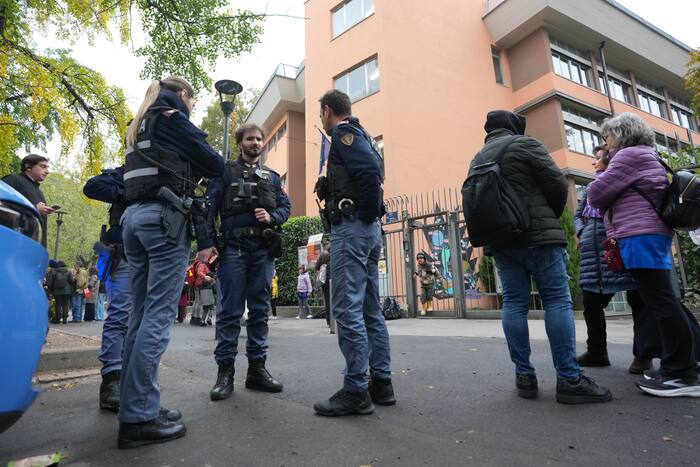
- Hoax email threats almost certainly caused cross-border disruption in early November, but the supplied reporting does not establish Russian state direction. At least 27 passenger flights across Europe were disrupted on 5 November, while Italian authorities evacuated 312 schools on 11 November; schools in Ireland, Scotland and Northern Ireland also received similar threats. Authorities said they had not attributed the threats to a group or state and had no evidence linking them to a government. The use of the same Russian name in separate threat emails does not establish who sent them. (Confidence: high · REPORTED)
- I&W: Police publish technical findings showing that the 5 and 11 November threats used shared sender infrastructure. This would confirm coordination across incidents, though not state sponsorship. (0-30 days)
- I&W: An official investigation publishes forensic evidence linking the sender infrastructure to a Russian state service. This would overturn the current assessment that state direction is unestablished. (0-30 days)
- It is unlikely that the supplied reporting establishes Russian coordination of the alleged sabotage network in Brașov County, Romania. Romanian authorities linked two Belarusians and a Ukrainian living in EU countries to an alleged Russian-coordinated network, and reported a fire near a Romarm facility and detentions in Germany, with a European arrest warrant for a third suspect in Poland. The reporting is thin, and the Russian Embassy in Bucharest rejected the allegation, saying no evidence of Moscow's involvement had been presented to the ambassador. (Confidence: low · ASSESSED)
- I&W: Romanian prosecutors or courts release forensic findings or charging documents that identify Russian handlers and connect them to the Brașov suspects. This would strengthen the allegation of coordination. (0-3 months)
- I&W: Investigators state that the Brașov fire was accidental or unrelated to the suspects, or withdraw the alleged Russian coordination link. This would weaken the allegation. (0-3 months)
- It is unlikely that the supplied reporting establishes an active Russian-directed Matrjoschka operation to influence Spain's 29 November election. The claim that the botnet is promoting narratives of European economic ruin and supporting far-right groups appears in social-media reporting without independent corroboration in the supplied material. (Confidence: low · ASSESSED)
- I&W: Spanish election authorities or independent researchers publish account-level analysis linking Matrjoschka to coordinated election-related activity. This would strengthen the claim of an active operation. (0-1 month)
- I&W: The source withdraws the allegation or independent technical reviews find no linked accounts or coordinated activity before the election. This would weaken the claim. (0-1 month)
- The UK has announced a 10-country Northern Navies Initiative and £90 million for Royal Navy drones, sensors and artificial intelligence systems, but the reporting does not demonstrate an operational shared surveillance capability. The initiative links the UK with Denmark, Estonia, Finland, Iceland, Latvia, Lithuania, the Netherlands, Norway and Sweden. Luke Pollard reported a 41 per cent increase in Russian naval activity around the UK during the first nine months of 2026; this supports the stated rationale for the initiative, not proof that the announced measures are already operational. (Confidence: low · ASSESSED)
- I&W: The UK or participating governments publish a joint exercise schedule or announce a deployed shared maritime surveillance capability. This would show implementation beyond the announcement. (1-3 months)
- I&W: UK procurement or programme updates show that the planned drones, sensors and artificial intelligence systems remain uncontracted or delayed, with no joint activity announced. (1-3 months)
Outlook & scenarios
Disruption and investigations continue, attribution remains unresolved (60%)
The most likely near-term outcome is continued investigation of the UK and Polish cases alongside further threat reporting against European institutions. Authorities do not publicly establish a common Russian command link, and the hoax threats remain unattributed.
Evidence links one or more cases to Russian intelligence (20%)
A less likely outcome is that UK or Polish court filings disclose communications, payments or other evidence tying an investigated suspect to Russian intelligence. This would substantiate Russian tasking in a specific case, but would not by itself prove that the flight and school threats or the Romanian allegations belong to the same operation.
Investigations point to separate or unproven actors (15%)
Investigators fail to substantiate Russian links in the hoax threats or the Romanian case, while the UK and Polish proceedings remain unresolved or produce case-specific explanations. The incidents remain a mixed set of threats and investigations rather than a demonstrated common campaign.
Low-probability, high-impact undersea infrastructure incident (5%)
A physical incident damages a cable or pipeline in UK waters during a period of heightened Russian naval activity. UK ministers have cited undersea threats and Russian submarine activity as reasons for maritime measures, but the supplied reporting does not describe a current cable or pipeline attack.
Recommendations
- Maintain a case-by-case attribution record for the Gloucester arrest, the Mińsk Mazowiecki investigation, the six Polish arrests of 5 November and the Brașov inquiry. Record separately the confirmed event, the suspected perpetrator and any evidence of Russian tasking.
- Resolve the conflicting arrest dates in the Gloucester and Mińsk Mazowiecki cases against UK police statements and Polish ABW or prosecutor records before using either timeline in further analysis.
- Compare available email and sender-account evidence from the 5 November flight threats and the 11 November school threats. Keep the shared Russian name separate from verified identity or state attribution.
- Seek independent technical corroboration of the Matrjoschka claim before assessing Russian election interference in Spain. Reassess the claim against published findings before 29 November.
- Track Northern Navies Initiative milestones, including contracts for the planned £90 million capability, joint exercises and evidence of shared surveillance in operation. Distinguish announced policy from deployed capacity.
Confidence & uncertainty
Overall confidence is high for the reported event picture: multiple major-media reports and official statements corroborate the arrests, flight disruption, school evacuations and UK maritime announcements. Confidence is lower for claims of Russian command or coordination. The UK and Polish allegations remain under investigation, the Romanian reporting is thin and contested, the hoax threats remain unattributed, and the Matrjoschka claim relies on social-media reporting.
Intelligence gaps
- [EEI 1.1 · PARTIAL] Reports, operator notifications, CCTV or satellite imagery showing unexplained physical damage or operational outages at critical infrastructure sites (power substations, gas pipelines/compressor stations, water treatment plants, railway signaling centers, major telecom exchanges). Recommended collection: satellite/imagery
- [EEI 1.2 · PARTIAL] Observed reconnaissance activity around critical sites indicative of attack planning (unauthorised drone flights, repeated surveillance visits, loitering vehicles, mapping/photography of assets). Recommended collection: open-source/media
- [EEI 1.3 · PARTIAL] Law-enforcement or customs seizures, arrests or interdictions of persons or shipments carrying explosives, sabotage tools, specialty cutting/electrical equipment, or covert comms gear destined for/near critical infrastructure. Recommended collection: law enforcement
- [EEI 2.1 · UNCOVERED] Emergence or amplification of coordinated social-media networks (sets of accounts, pages, channels) pushing identical narratives or hashtags across multiple platforms, including bot-like activity metrics and origin IP/common management indicators. Recommended collection: social-media/OSINT
- [EEI 2.2 · UNCOVERED] Publication or internal guidance from state-run media, proxy outlets, or identified influence platforms distributing talking points, pre-scripted messaging, or translated content targeted at specific EU countries/communities. Recommended collection: open-source/media
- [EEI 2.3 · UNCOVERED] Distribution of manipulated multimedia (deepfakes), targeted phishing/whaling campaigns, or localized false narratives timed to political events (elections, protests, court rulings) with tracked reach and engagement metrics. Recommended collection: cyber/forensic
- [EEI 3.1 · UNCOVERED] Unusual financial transactions: wire transfers, crypto conversions, or payments to shell companies, NGOs or individuals exceeding typical baselines that link to known proxies or front organisations. Recommended collection: financial
- [EEI 3.2 · UNCOVERED] Travel and movement indicators for suspected operatives: repeated border crossings, chartered/irregular flights, booking patterns or mobile/location data placing identified individuals in staging areas shortly before incidents. Recommended collection: border/immigration
- [EEI 3.3 · UNCOVERED] Cargo, freight or maritime movements with discrepancies (concealed/dual-use equipment, false manifests, unusual routing) detected at ports, rail hubs or via AIS that correspond to deliveries of material used in sabotage or influence operations. Recommended collection: customs/ports
- [EEI 3.4 · UNCOVERED] Intercepted or otherwise-obtained communications showing tasking, coordination, or payment instructions between Russian agencies/handlers and proxy groups, including identified command-and-control servers or encrypted group identifiers. Recommended collection: signals-intel/SIGINT
Red cell review: PARTIAL DISSENT, KJ-5 downgraded MEDIUM→LOW (kj_single_origin)
TLP:CLEAR