TLP:CLEAR · Disclosure is not limited.
Gaza civilian risks and Lebanon tensions
Time window: Last 7 days · Audience: General analyst · Type: Situation report · DTG: 2026-11-17 12:29Z · Overall confidence: HIGH
BLUF
Israeli fire and strikes in Gaza are likely to continue in localised form, while medical and aid constraints are very likely to remain acute. Israel’s reported strike near Janta and its stated intention to continue operations in Lebanon keep Israel-Hezbollah understandings under pressure, but current reporting does not establish renewed direct fire between the two sides.
Executive summary
Reporting from 10 to 17 November describes an Israeli airstrike near a UN fuel convoy in Rafah, continued shooting incidents in Gaza, and a child reportedly shot at a school in Mawasi, Khan Younis. UN and other reporting describes depleted medicine stocks, shortages of specialised food, and shelter supplies held outside Gaza. In Lebanon, Israel said it struck a weapons shipment allegedly intended for Hezbollah near Janta and would continue operations to remove threats. Separate reporting relayed Israeli intelligence assessments of Hezbollah’s rocket and drone capabilities, which are not independently corroborated. On 17 November, the UK announced or imposed sanctions on Tzav 9 and eight firms involved in West Bank settlement activity.
Change from previous assessment
Since the 16 November brief, the assessment adds reporting on the 15 November strike near a UN fuel convoy, the reported shooting of Rami Akhras in Mawasi, and more specific medicine, specialised-food, truck, and shelter-supply constraints. The Janta strike is not new, but this update adds Israeli intelligence reporting on Hezbollah’s rocket and drone capabilities; confidence in the forecast for Lebanon is low because those estimates come through a single report. The UK sanctions announced on 17 November are a new policy judgment. Gaza and humanitarian confidence remain medium.
Key judgments
- Likely, Israeli strikes and gunfire in Gaza will continue in localised form through 1 December. Reporting describes an Israeli airstrike near a UN fuel convoy in Rafah on 15 November and a 17 November report of Rami Akhras being shot during school assembly in Mawasi, Khan Younis; UN officials have also warned of recurring attacks near civilians and aid workers. The reporting documents specific incidents, not a verified near-daily rate. (Confidence: medium · ASSESSED)
- I&W: Confirm if UN or major-media reporting records another Israeli strike or shooting injury in Gaza, especially near a school, residential area, or aid convoy. (0-14 days)
- I&W: Weaken if UN or OCHA reporting records no Israeli strikes or shooting incidents affecting civilians or aid workers in Gaza for 14 consecutive days. (0-14 days)
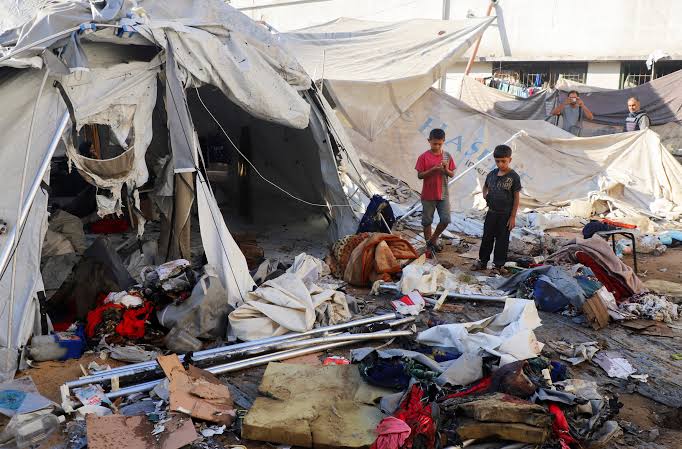
- Very likely, Gaza’s medical and specialised-food shortages will remain acute through 17 December. OCHA reporting says 42% of medicines have run out and about 55% of essential chemotherapy medicines are unavailable; Gaza transport union head Nadhir Shheiber said 250 trucks were operational against 600 to 700 needed for food distribution. The UN also reported more than 150,000 tents and 300,000 tarpaulins held outside Gaza. These are reported figures from separate accounts, not a single verified inventory. (Confidence: medium · ASSESSED)
- I&W: Confirm if OCHA continues to report medicine stock-outs, or if UN agencies report that the tents and tarpaulins remain outside Gaza. (0-1 month)
- I&W: Weaken if UN agencies confirm entry of the held shelter supplies and Gaza’s operational food-distribution truck count reaches at least 600. (0-1 month)
- Likely, Israeli operations against alleged Hezbollah supply routes in Lebanon will continue through 17 December, keeping Israel-Hezbollah understandings under pressure. Israel said it struck a weapons shipment allegedly intended for Hezbollah near Janta on 16 November and that the IDF would continue operations to remove threats. A separate report relayed Israeli intelligence assessments that Hezbollah has about 10,000 rockets and shells, thousands of fibre-optic kamikaze drones, and trained operators. The strike and capability claims are not independently corroborated in the available reporting, so confidence in this forward assessment is low; the reporting does not establish renewed direct fire between Israel and Hezbollah. (Confidence: low · ASSESSED)
- I&W: Confirm if Israel reports another strike or raid in Lebanon targeting an alleged Hezbollah weapons route, or if Hezbollah claims an attack on Israeli forces or northern Israeli towns. (0-1 month)
- I&W: Weaken if the IDF announces a halt to operations in Lebanon and no new Israeli strikes or Hezbollah attacks are reported for 30 days. (0-1 month)
- The UK has widened formal pressure on aid obstruction and West Bank settlement activity. On 17 November, the UK sanctioned Tzav 9, which London said had blocked aid convoys, and eight construction and property development firms involved in settlement expansion; the measures include asset freezes and director disqualification. The UK had also convened more than 50 countries on 12 November to call for greater aid access to Gaza. (Confidence: high · REPORTED)
- I&W: Confirm if the UK publishes or implements additional designations related to Gaza aid obstruction or West Bank settlement activity. (0-1 month)
- I&W: Break if the UK government rescinds the Tzav 9 or company designations, or formally states that the measures did not take effect. (0-1 month)
Outlook & scenarios
Localised Gaza violence and continued Lebanon strain (60%)
Through 17 December, Israeli fire and strikes in Gaza continue without a documented shift to a sustained, wider Israel-Hezbollah exchange. Medicine and shelter constraints remain acute, while the reported Janta strike and Israeli statements keep the Lebanon front tense.
Direct Israel-Hezbollah exchange (25%)
Unlikely, an Israeli strike in Lebanon or an attack by Hezbollah on Israeli forces is followed by reciprocal action and a wider exchange. The IDF has said it is preparing for possible infiltration, explosive-device attacks, armed clashes, and attempted soldier abduction in the security zone in Lebanon.
Diplomatic pressure improves aid access (10%)
Unlikely, UK sanctions and the call by more than 50 countries lead to the release of shelter supplies held outside Gaza and an increase in operational food-distribution trucks. The available reporting does not yet show that aid entry has improved.
Conditional Iran-war wildcard (5%)
Very unlikely within the outlook period, but high impact: if a new war with Iran begins, Israeli Military Intelligence assesses that Hezbollah is very likely to join immediately or shortly afterwards. This is a conditional assessment relayed in one report, not evidence that a new war is imminent.
Recommendations
- Track OCHA updates on Gaza medicine stocks, shelter-supply entry, and civilian or aid-worker incidents. Record the date, location, reported actor, and source for each incident rather than inferring a daily attack rate.
- Seek a current UN or Israeli-authority accounting of whether the 150,000 tents and 300,000 tarpaulins have entered Gaza. Compare Gaza’s operational truck count with the 600 to 700 trucks cited by the transport union.
- Keep the Janta strike separate from confirmed Hezbollah attacks in reporting. Treat the shipment’s alleged destination and the Israeli intelligence estimates of Hezbollah’s arsenal as unverified unless independently corroborated.
- Monitor official UK designation notices and subsequent reporting on aid access. Distinguish implementation of sanctions from any measured change in aid deliveries.
Confidence & uncertainty
Overall confidence is high for the occurrence of the main reported developments. The UK government’s sanctions announcement is supported by official reporting and separate major-media coverage, while Gaza reporting includes UN and OCHA statements alongside coverage by more than one outlet. Confidence is lower in forecasts and in the reported Israeli intelligence estimates of Hezbollah’s capabilities, which are not independently corroborated; attribution and purpose of the Janta shipment also remain unverified.
Intelligence gaps
- [EEI 1.1 · UNCOVERED] Number, type and geolocated coordinates of projectiles (rockets, mortars, anti-tank guided missiles) fired from Lebanon into Israel in the last 24/72 hours, including time-stamped launch and impact locations. Recommended collection: signals/intel
- [EEI 1.2 · UNCOVERED] Satellite or aerial imagery showing movement, concentration, or forward displacement of Hezbollah-associated military assets (armored vehicles, artillery pieces, mobile rocket launchers, logistics convoys) to positions within 0-10 km of the Israel-Lebanon border. Recommended collection: satellite/imagery
- [EEI 1.3 · UNCOVERED] Intercepted or captured Hezbollah command-and-control communications or orders explicitly directing cross-border operations or coordinated strikes with Palestinian groups (time-stamped messages, unit identifiers, orders to fire/move). Recommended collection: signals/intel
- [EEI 1.4 · UNCOVERED] Observable changes in Israeli northern-front posture within Israel (numbers and types of reinforcements deployed to northern brigades, activation of reserves, air defense redeployments, evacuation orders or shelter alerts in northern towns), including timestamps and unit IDs where available. Recommended collection: human/intel
- [EEI 2.1 · UNCOVERED] Official or corroborated reports of IDF reservist mobilization and unit-level deployment orders (number of reservists called, named brigades/units ordered to deploy, deployment timelines). Recommended collection: open-source/media
- [EEI 2.2 · UNCOVERED] Satellite or ground imagery showing concentrations of IDF heavy equipment (tanks, infantry fighting vehicles, engineering vehicles), staging areas, field hospitals or forward supply dumps within X km of the Gaza border and at known crossing points. Recommended collection: satellite/imagery
- [EEI 2.3 · PARTIAL] Change in strike patterns consistent with pre-ground-attack shaping: sustained high-frequency airstrikes on tunnel networks, command nodes, coastal launch sites, and known insurgent concentrations (strike counts, munition types, locations, times). Recommended collection: open-source/media
- [EEI 2.4 · UNCOVERED] Logistics indicators: verified convoys of fuel/ammunition entering staging areas, establishment of forward logistics or medical bases, or documented requisitioning orders for bulk combat supplies with timestamps and quantities. Recommended collection: human/intel
- [EEI 3.1 · UNCOVERED] Number, participants and content of diplomatic contacts or negotiation sessions in the last 48 hours involving mediators (Egypt, Qatar, US, UN), including any proposed ceasefire text, prisoner/exchange lists, timelines or verification mechanisms. Recommended collection: diplomatic
- [EEI 3.2 · UNCOVERED] Public statements, press releases or verified communiqués from Hamas and other Gaza armed groups specifying acceptance, rejection, or conditions for a ceasefire (explicit conditions such as prisoner release lists, withdrawal terms, lifting of blockades), with timestamps and speaker attribution. Recommended collection: open-source/media
- [EEI 3.3 · PARTIAL] Humanitarian indicators relevant to ceasefire: establishment and operation of agreed humanitarian corridors/checkpoints, number of aid deliveries admitted, civilian evacuations completed, and NGO/hospital reports of access denials or safe-passage violations. Recommended collection: humanitarian/NGO reports
- [EEI 3.4 · PARTIAL] Operational evidence of a de facto pause: verified sustained reduction (e.g., ≥12 hours) in strikes or launches from either side in specific sectors, supported by strike/impact logs, radar tracks and incident reports. Recommended collection: open-source/media
Red cell review: CONCUR
TLP:CLEAR