TLP:CLEAR · Disclosure is not limited.
Hormuz attacks widen regional risk
Time window: Last 1 day · Audience: General analyst · Type: Situation report · DTG: 2026-10-15 16:39Z · Overall confidence: MEDIUM
BLUF
Commercial shipping in the Strait of Hormuz faces repeated attacks, with GFS Pride and Cape Dao reported sunk and GFS Giselle damaged; the cause of the GFS Pride sinking and the timing of the Cape Dao incident remain disputed. The 14 and 15 October reporting documents Iranian maritime pressure and Houthi attacks on Saudi targets, but does not establish whether Iran and Israel have exchanged direct fire since June.
Executive summary
Maritime security is the clearest immediate escalation risk. Singapore’s Maritime and Port Authority confirmed that GFS Pride sank after damage and a fire, and UK Maritime Trade Operations issued four verified attack warnings covering 13 October. GFS Giselle was also struck, while accounts of the Cape Dao sinking differ on when it was hit. US forces report enforcing a blockade against Iran; reporting also describes Iranian use of small vessels to identify commercial ships, although the stated motives for that activity differ. Separately, the Houthis vowed to continue attacks on Saudi airports and oil facilities after strikes affecting Riyadh and Dhahran. The latest claims do not resolve whether direct Iran-Israel fire has occurred since June.
Change from previous assessment
Since 14 October, the assessment has shifted from a general warning about Hormuz disruption to a clearer picture of repeated vessel incidents: GFS Giselle was struck, UK Maritime Trade Operations reported four verified attack warnings covering 13 October, and new reporting described the Cape Dao sinking. The cause of the GFS Pride sinking and the timing of the Cape Dao strike remain unresolved, so confidence in attribution has not risen. The direct Iran-Israel fire judgment remains unresolved, while Houthi threats and attacks involving Saudi airports and Aramco facilities broaden the regional risk picture.
Key judgments
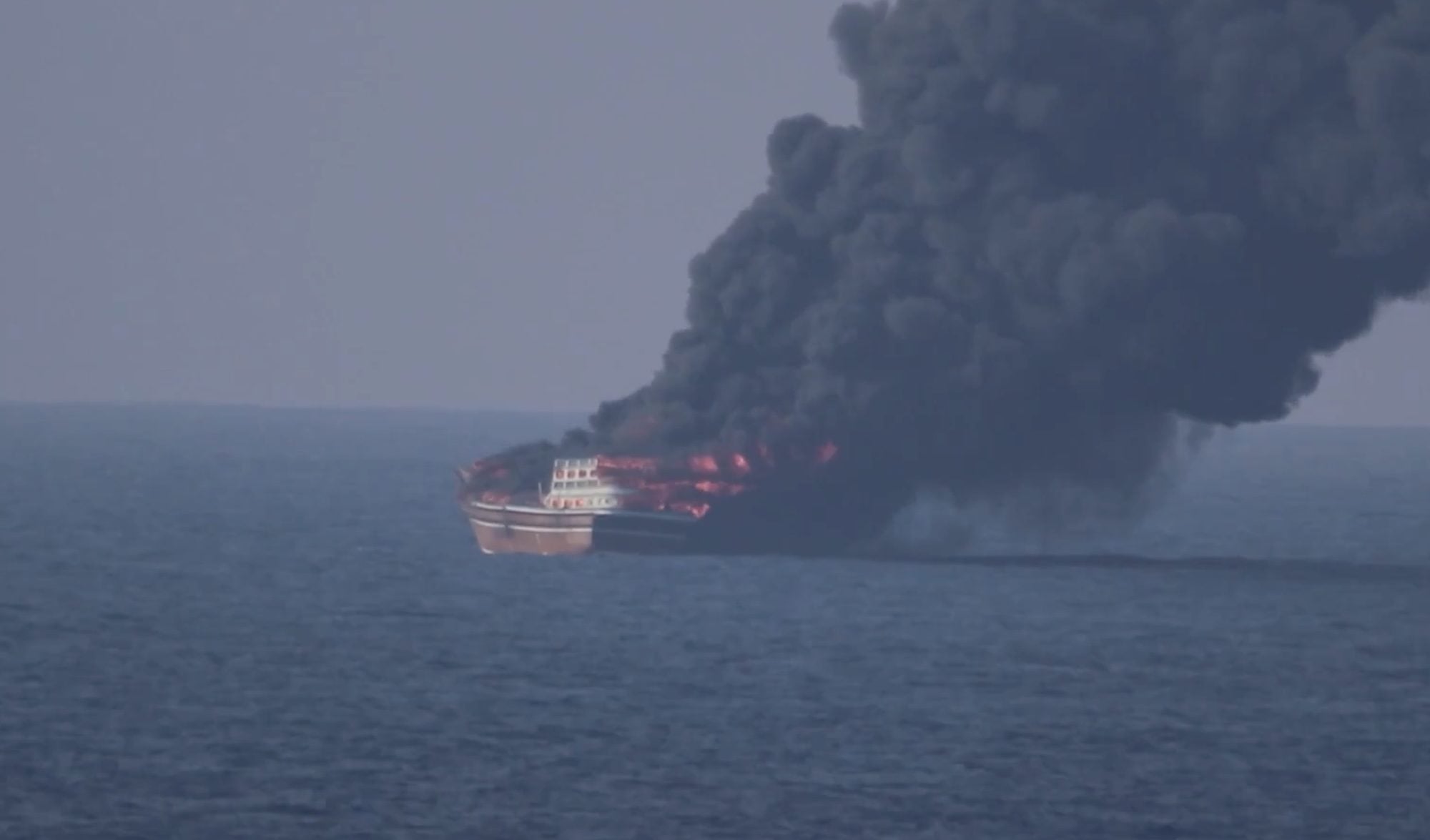
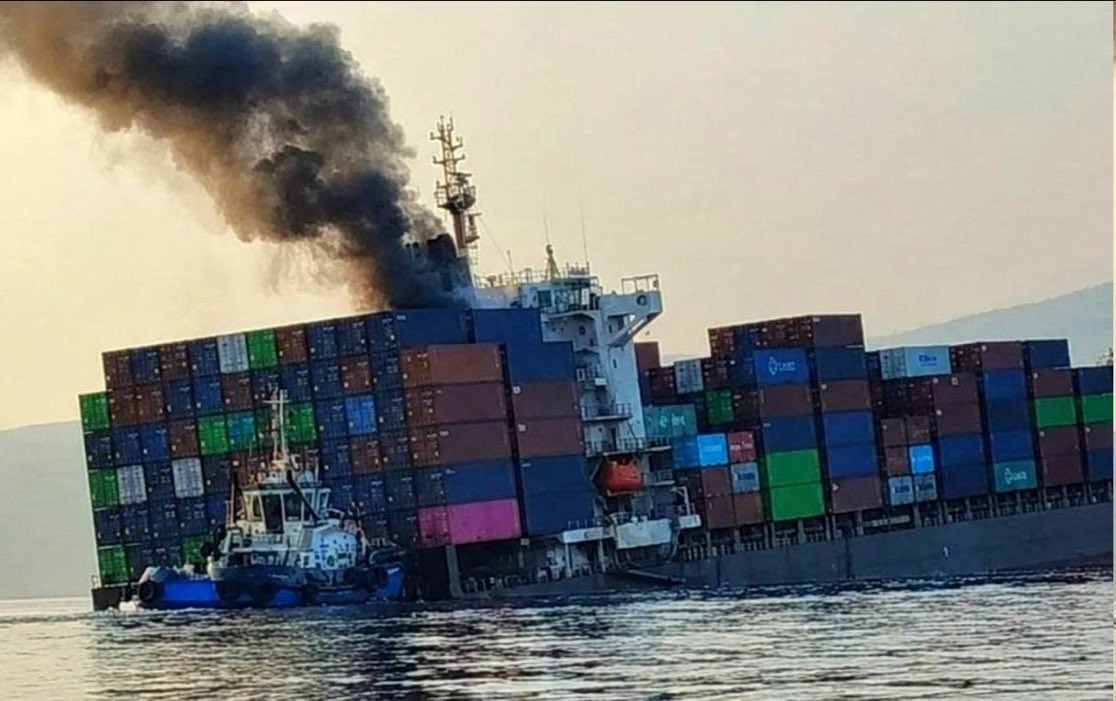
- Further attacks on commercial shipping in the Strait of Hormuz are likely over the next 14 days, but responsibility and some incident details remain unresolved. Singapore’s Maritime and Port Authority confirmed that GFS Pride sank and its 21 crew were evacuated; UK Maritime Trade Operations issued four verified warnings covering attacks on three containerships and one tanker on 13 October; GFS Giselle was struck on 14 October and reached safe anchorage with all 22 crew safe. Iran said GFS Pride struck a mine, while other reporting attributes its damage to a projectile. Reports also disagree on whether Cape Dao was struck on 23 September or shortly before its sinking. Confidence is medium: the sinking and damage reports have corroboration from maritime authorities and incident reporting, but attribution and the Cape Dao timeline are contested. (Confidence: medium · ASSESSED)
- I&W: Confirmation: UK Maritime Trade Operations issues a new verified warning for an attack on a commercial vessel in the Strait of Hormuz. (0-14 days)
- I&W: Break: no new verified UK Maritime Trade Operations attack warning or flag-state report of vessel damage in the Strait of Hormuz during the next 14 days. (0-14 days)
- Iran-US coercive activity around the Strait of Hormuz is likely to remain active over the next 14 days. US reporting describes renewed blockade enforcement from 14 July, 135 ships turned around and 10 IRGC-linked tankers destroyed; a US fighter jet disabled the Panama-flagged Ocean Molica in the Gulf of Oman on 10 October. Other reporting says Iranian forces have used small-vessel spotters to identify commercial ships. The stated drivers are unresolved: Iranian officials described efforts to keep oil prices elevated and influence US midterm elections, while another account linked small-boat use to damage to coastal surveillance infrastructure. Confidence is medium because the reporting includes wire-service accounts but relies in part on US military and Iranian official statements, with no independent confirmation of every enforcement statistic or motive. (Confidence: medium · ASSESSED)
- I&W: Confirmation: CENTCOM reports another vessel turned back or disabled in the Gulf of Oman, or UK Maritime Trade Operations verifies a new attack involving small Iranian vessels. (0-14 days)
- I&W: Break: CENTCOM announces that blockade enforcement has stopped and Iran announces unrestricted transit through the Strait of Hormuz. (0-14 days)
- Houthi attacks on Saudi transport and energy sites are likely to continue over the next 14 days. On 14 October, the Houthis vowed to continue attacks on Saudi airports and oil facilities and said they launched missiles and drones at Aramco facilities, Riyadh airport and an Aramco refinery. The Saudi-led coalition reported intercepting a ballistic missile directed towards Riyadh on 14 October and thwarting attacks on Medina and eastern Saudi Arabia on 15 October. Reporting on the 13 October fire at Saudi Aramco’s Dhahran base conflicts: three sources described a fire across several floors, while the Saudi energy ministry called it limited. Confidence is medium because the threat and interception reports come from different accounts, but some attack and damage details rely on claims by the parties involved. (Confidence: medium · ASSESSED)
- I&W: Confirmation: the Saudi-led coalition reports another interception directed at Riyadh, Medina or the Eastern Province, or the Houthis claim a new strike on a Saudi airport or oil facility. (0-14 days)
- I&W: Break: King Khalid International Airport resumes flights after its announced closure through 17 October, with no new coalition interception report or Houthi attack claim during the following week. (0-14 days)
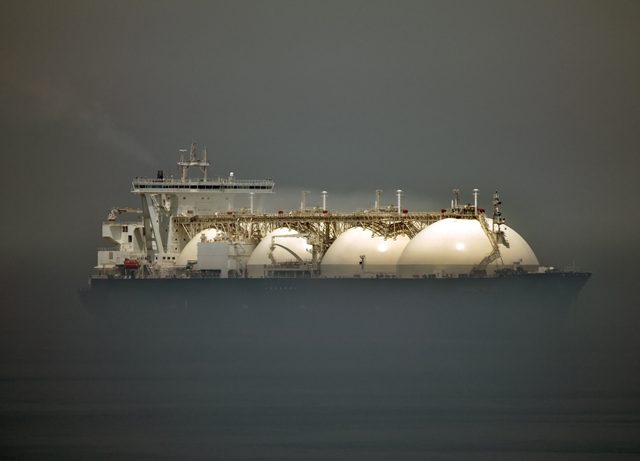
- Shipping and Qatari LNG trade are likely to remain disrupted over the next one to three months, although Qatar’s exports have partly recovered from their near-stop. Reporting says Qatari LNG shipments had almost stopped by late August, then roughly 20 tankers exited the Strait of Hormuz in the four weeks after Al Rayyan’s 10 September crossing; deliveries approached one-third of prewar levels by the end of September. A separate account puts the April-to-September export decline at almost 90 per cent year on year. Shipowners are also diverting around Africa, avoiding Fujairah for refuelling and using alternative bunkering locations. Confidence is medium: trade reporting describes vessel movements and industry responses, but the Qatar export figures cover different periods and do not provide a fully consistent recovery picture. (Confidence: medium · ASSESSED)
- I&W: Confirmation: ship-tracking data show Qatari LNG deliveries remaining below one-third of prewar levels, or shipping reports continue to record diversions around Africa and reduced refuelling at Fujairah. (1-3 months)
- I&W: Break: tracking data show Qatari LNG deliveries returning to prewar levels and shipping reports record a sustained return to routine refuelling at Fujairah. (1-3 months)
- The reporting provided for 14 and 15 October does not establish whether Iran and Israel have exchanged direct fire since June. The explicit account of strikes by Israel and the US on Iran dates those attacks to 28 February; the newer incident reporting concerns Hormuz shipping and Houthi attacks on Saudi targets. This is a reporting gap, not evidence that no later exchange occurred. Confidence is low because the claims provide no direct, current reporting on Iran-Israel strikes and their coverage is concentrated on other fronts. (Confidence: low · ASSESSED)
- I&W: Break: a dated report of an Israeli strike on Iran or an Iranian strike on Israel is supported by an official statement and independently verified evidence of an impact or interception. (0-14 days)
Outlook & scenarios
Managed maritime confrontation (55%)
Iranian pressure on Strait of Hormuz traffic and US blockade enforcement continue, with further commercial shipping disruption but no confirmed direct Iran-Israel exchange. Shipowners keep diverting routes and adjusting refuelling, while Houthi threats against Saudi airports and oil facilities persist.
Operational pause (20%)
Verified attacks on commercial vessels stop for a period, and shipowners resume some Strait of Hormuz transit and routine refuelling at Fujairah. Qatari LNG deliveries rise from the reported end-September level, but the pause does not itself indicate a political settlement.
Wider regional escalation (20%)
A new attack on commercial shipping prompts additional US interdictions, while Houthi attacks on Saudi transport or energy sites continue. More frequent vessel losses or damage increase pressure on Gulf partners and keep oil and bunker markets under strain.
Wildcard: US-Iran direct combat (5%)
A commercial vessel attack causes multiple casualties or directly endangers US Navy personnel. The US responds against Iranian assets, and Iran expands attacks on shipping or US forces in the Gulf. This is a low-probability, high-impact path that would sharply raise regional escalation risk.
Recommendations
- Maintain a vessel-by-vessel incident chronology for GFS Pride, Cape Dao and GFS Giselle. Reconcile the Cape Dao strike date against IMO data and UK Maritime Trade Operations warnings, and keep sinking dates separate from attack dates.
- Separate verified damage from attribution. Record the GFS Pride mine claim, projectile reporting, Iranian statements about small-vessel tactics and CENTCOM blockade claims as distinct accounts until independently corroborated.
- Track Houthi claims and Saudi-led coalition interception reports separately for Riyadh, Medina, the Eastern Province and Dhahran. Record whether each report concerns a claimed launch, an interception, damage or casualties, and monitor King Khalid International Airport’s reopening after 17 October.
- Use ship-tracking data to update Qatari LNG transit volumes and compare them with the reported end-September level. Track route diversions, Fujairah refuelling patterns and alternative bunkering demand as indicators of continuing commercial disruption.
- Keep the Iran-Israel direct-fire assessment explicitly unresolved until a dated incident is supported by official statements and independently verified evidence. Do not treat US-Iran maritime confrontation or Houthi attacks on Saudi Arabia as proof of a new Iran-Israel exchange.
Confidence & uncertainty
Confidence is medium because Singapore’s Maritime and Port Authority confirmed the GFS Pride sinking and crew evacuation, UK Maritime Trade Operations issued verified attack warnings, and separate reporting described damage to GFS Giselle. Reuters and trade reporting also provide detail on Iranian maritime activity, US blockade enforcement and Houthi threats. The cause of the GFS Pride sinking and the Cape Dao timeline remain disputed; some military claims rely on the parties involved, and the supplied reporting does not resolve direct Iran-Israel fire since June.
Intelligence gaps
- [EEI 1.1 · UNCOVERED] Detection and characterization of ballistic/cruise missile or rocket launches originating from Iranian territory or from Iran-controlled positions in Iraq/Syria (time, launch coordinates, missile type, flight trajectory/impact area). Recommended collection: satellite/imagery
- [EEI 1.2 · UNCOVERED] Movements and posture changes of Iran-backed proxy forces (Hezbollah units in Lebanon, militias in Syria/Iraq): concentrations of personnel, transport of rocket/artillery launchers, visible logistics build-up within operational range of Israel. Recommended collection: human/intel
- [EEI 1.3 · UNCOVERED] Israeli defensive and offensive posture changes: reservist call-ups, mobilization orders, sorties/airstrikes attributed to Israel, and domestic activation of missile-defense systems (locations and activation times). Recommended collection: open-source/media
- [EEI 1.4 · PARTIAL] Evidence of pre-positioning or arming of naval mines, fast attack craft, or anti-ship missile systems in the Gulf of Oman, northern Arabian Sea, or off the Lebanese/Syrian coasts that could be used to interdict Israeli or allied shipping. Recommended collection: maritime/AIS
- [EEI 2.1 · PARTIAL] Movements and tasking changes of external military assets: carrier strike groups, amphibious ready groups, expeditionary air wings, or ballistic-missile defense units into the Eastern Mediterranean, Persian Gulf, or Red Sea (vessel/aircraft IDs, routing, on-station times). Recommended collection: maritime/AIS
- [EEI 2.2 · UNCOVERED] Formal diplomatic/military actions: evacuation orders or embassy closures, public troop posture statements, bilateral/multilateral defense commitments announced, requests for overflight or basing rights in regional states. Recommended collection: diplomatic
- [EEI 2.3 · UNCOVERED] Changes to force protection or alert levels at foreign bases in the region (e.g., US bases in Kuwait, Qatar, UAE; Russian bases in Syria): activation of additional air defenses, curfews, or reinforcement shipments (personnel/equipment manifests). Recommended collection: signals/intel
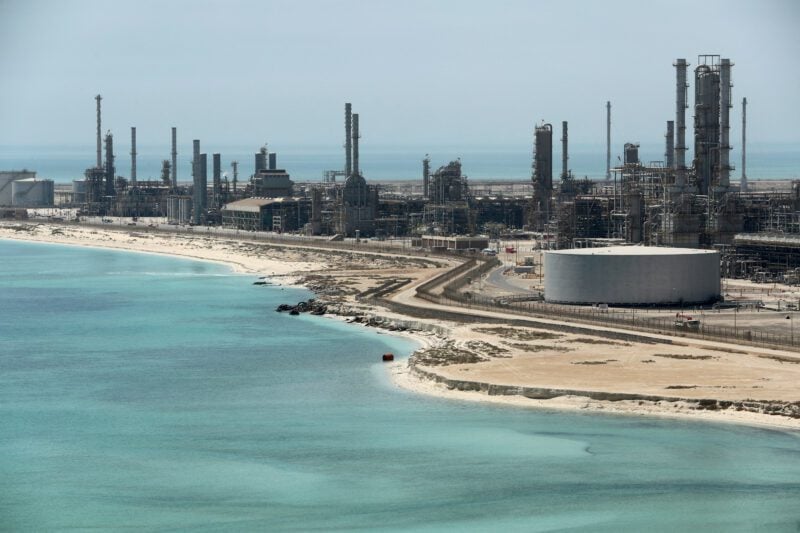
- [EEI 3.2 · PARTIAL] Changes in crude oil and refined product flows from key terminals (reported tanker loading delays, terminal closures, throughput volumes at Kharg, Mina al-Ahmadi, Ras Tanura, and major Gulf ports compared to baseline). Recommended collection: commercial/ports
- [EEI 3.3 · PARTIAL] Market and insurance indicators: sudden spikes in war-risk or hull insurance premiums for Middle East routes, large moves in regional FX/stock indices, and notable changes in commodity futures (oil, freight rates) tied to regional risk perceptions. Recommended collection: financial/transactional
Cited sources
[1] Reuters (republished by gCaptain) · Bulk Carrier Sinks Weeks After Deadly Strait of Hormuz Strike (A) · 14 October 2026 · sha256:2b3df83932f6 [2] gCaptain · Containership Sinks as Hormuz Attacks Spiral Out of Control (C) · 14 October 2026 · sha256:3d26cc4befe7 [3] gCaptain · U.S. Forces Destroy Iranian-Linked Dhow Accused of Targeting Navy Ships (C) · 14 October 2026 · sha256:d5780f21061b [4] Reuters (republished by gCaptain) · Yemen's Houthis Vow More Attacks on Saudi Airports, Oil Facilities After Aramco HQ Hit (A) · 14 October 2026 · sha256:b5d9f7c75dfc [5] Killeen Daily Herald (kdhnews.com) · Saudi Arabia says it thwarted a missile strike on Medina, and other Middle East developments (D) · 15 October 2026 · sha256:a505804cb531 [6] gCaptain (republishing Bloomberg News reporting) · Qatar Rewrites Its Gas Playbook With Old Tankers and New Tactics (C) · 14 October 2026 · sha256:dd9f1920f160 [7] gCaptain (republishing Bloomberg) · Ship Fuel Market Fragments as Middle East Conflict Hits Trade (C) · 15 October 2026 · sha256:cbdb487ae510
Source content hashes were computed at collection time; the cited text is preserved unmodified for the life of this product.
Red cell review: CONCUR WITH COMMENT
TLP:CLEAR