TLP:CLEAR · Disclosure is not limited.
Hormuz Disruption Persists; $108 Brent and Four-Strait Claim Unsubstantiated
Time window: Last 1 day · Audience: General analyst · Type: Situation report · DTG: 2026-11-09 15:24Z · Overall confidence: HIGH
BLUF
Commercial passage through the Strait of Hormuz is severely depressed, but the evidence does not establish a complete closure or disruption at four of five key straits. Brent reports for 9 November are below $100, not $108; the reported Bab-el-Mandeb evidence is too weak to support a blockade claim.
Executive summary
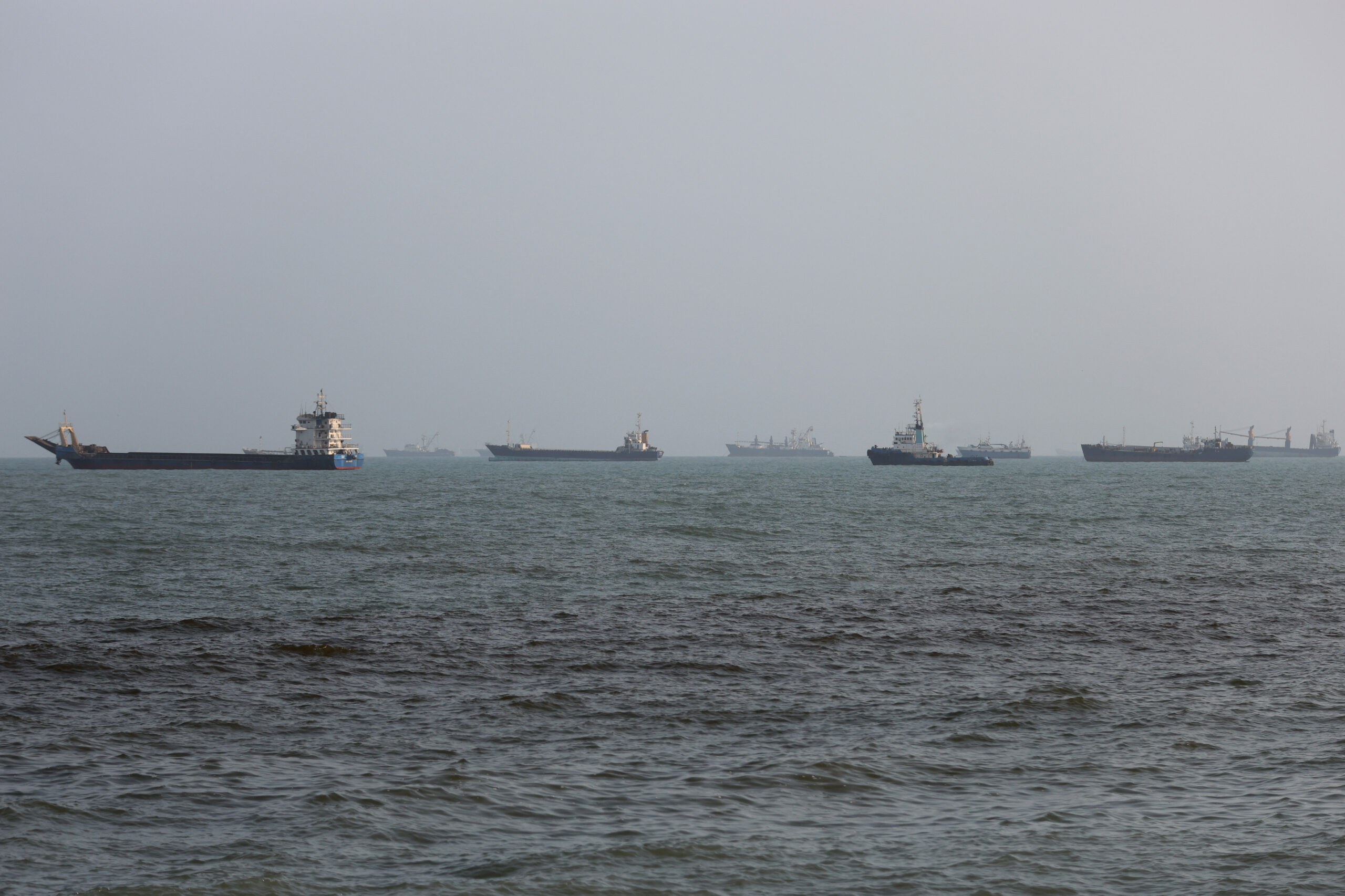
Hormuz remains the clearest maritime pressure point. IMF PortWatch recorded one transit on 1 November against a pre-crisis baseline of 85 per day; other reporting describes traffic in the single to low-double-digit range, and 46 AIS-visible vessels were holding position away from berth on 9 November. Iran's IRGC says the strait is closed and disputes US claims that routes are clear; the accounts of tanker incidents also differ on their cause and scale. The available Bab-el-Mandeb reporting does not verify a closure, and the record provides no comparable evidence for disruption at three other straits. Brent was reported at $94.78 and $97.57 on 9 November, while the latest official spot figure provided is $107.03 for 3 November. Freight costs and Egyptian fertilizer-sector gas constraints remain reported pressure points, but the evidence does not establish current war-risk premium levels or a quantified fertilizer trade impact.
Change from previous assessment
The prior brief already found that the evidence did not substantiate disruption at four of five straits or Brent at $108, and this assessment does not change those conclusions. New reporting adds a PortWatch count of one Hormuz transit on 1 November against a baseline of 85, a report of 46 vessels holding position on 9 November, and directly conflicting Iranian and US claims about closure and mine clearance. The 9 November Brent reports are below $100, replacing the prior brief's latest official observation of $107.03 on 3 November. New diplomatic reporting describes competing reopening proposals but does not establish an agreed plan. The Bab-el-Mandeb evidence remains too thin to verify a blockade.
Key judgments
- Commercial passage through the Strait of Hormuz is very likely to remain severely depressed over the next 14 days, but a complete closure is not established. Reported traffic ranges from one transit on 1 November against a baseline of 85, to single or low-double-digit daily counts in later reporting; 46 AIS-visible vessels were holding position away from berth on 9 November. Iran's claim that the strait is completely closed conflicts with US claims that primary routes are cleared and commercial vessels continue to transit. The mine and tanker-damage accounts are also contested. (Confidence: medium · ASSESSED)
- I&W: Confirms: IMF PortWatch records 10 or fewer commercial transits per day for at least three consecutive days. (0-14 days)
- I&W: Breaks: IMF PortWatch records at least 20 commercial transits per day for three consecutive days. (0-14 days)
- The available reporting does not substantiate a Bab-el-Mandeb blockade or disruption at four of five key straits. Bab-el-Mandeb-specific evidence consists of a low-confidence, lede-only social-media observation reporting southbound oil-product traffic and a separate lede-only post questioning whether the strait is closed. Neither verifies a closure, and the supplied record contains no comparable transit evidence for three additional straits. (Confidence: low · ASSESSED)
- I&W: Confirms the absence of a full Bab-el-Mandeb closure: independent AIS records show commercial vessels transiting the strait on at least three consecutive days. (0-14 days)
- I&W: Breaks the assessment that four-str ait disruption is unsubstantiated: two independent maritime monitors document sustained disruption at Bab-el-Mandeb and at least three other named straits. (0-14 days)
- Brent at $108 is not supported by the supplied 9 November price reporting. One report put Brent at $97.57 by 10:11 GMT and another at $94.78 by 11:46 UTC; the latest official spot observation in the record is $107.03 on 3 November. The current-day quotes differ, so the precise 9 November level is not settled here, but neither supports $108. (Confidence: medium · REPORTED)
- I&W: Breaks: a timestamped Brent market quote or official spot-price release records a price above $108 per barrel. (0-14 days)
- I&W: Confirms: the next official Brent spot-price observation remains below $100 per barrel. (0-14 days)
- Elevated shipping costs and pressure on Egyptian fertilizer producers are likely to persist over the next month if vessel shortages and gas allocation cuts continue. Reporting describes record freight rates amid tanker shortages and Hormuz risk, and a supertanker cost of nearly $40 per barrel to send US oil to Asia in early October, compared with $5 a year earlier. Egyptian fertilizer producers, including Misr Fertilizers Production Company, were notified of a further 33% reduction in natural gas supplies after an earlier 20% cut. The evidence does not quantify current war-risk premiums or establish the resulting scale of fertilizer trade disruption. (Confidence: medium · ASSESSED)
- I&W: Confirms: shipping-market reports continue to record tanker shortages and freight rates at or above the recent reported highs. (0-1 month)
- I&W: Breaks: Egyptian authorities restore fertilizer-sector gas allocations and Egyptian producers report normal production schedules. (0-1 month)
- An agreed Hormuz reopening within the next 14 days is unlikely. Iran's two-day reopening proposal and a reported US phased plan have not produced an agreed sequence; reporting also says Iran has not responded to the US offer and wants written commitments, while US Secretary of State Marco Rubio said negotiations had made no progress. The sources conflict over whether Iran is offering an opening or tying it to US concessions, so confidence in this forecast is limited. (Confidence: medium · ASSESSED)
- I&W: Breaks: Washington and Tehran publicly confirm a written reopening sequence, followed by at least two consecutive days of commercial transits through the strait. (0-14 days)
- I&W: Confirms: Iran reiterates that passage remains conditional on US concessions and no mutually acknowledged reopening plan is announced. (0-14 days)
Outlook & scenarios
Continued constrained passage (55%)
Hormuz traffic remains far below normal as the US blockade and Iranian transit controls continue. Shipping operators keep vessels waiting or avoid the route. Price and freight volatility persists, but the available evidence does not support a complete Bab-el-Mandeb closure or disruption at four of five straits.
Negotiated, phased reopening (30%)
The US and Iran reach agreement on the sequencing of blockade relief and Hormuz passage. Commercial transits resume through designated routes, initially under restrictions. Divergent public statements and Iran's reported demand for written commitments remain obstacles to this outcome.
Renewed military action and wider maritime disruption (10%)
A breakdown in negotiations or an incident involving US forces, the IRGC Navy, or commercial shipping triggers renewed strikes. The high-impact outcome is a further reduction in Hormuz transits, with additional attacks on shipping or Saudi targets. This is a low-probability wildcard given the competing statements on negotiations and military readiness.
Recommendations
- Correct any situation reporting that states Brent reached $108 on 9 November or that four of five key straits are disrupted. Use the dated price observations and describe the multi-strait claim as unsubstantiated by the supplied evidence.
- Track daily Hormuz transit counts against the 85-vessel pre-crisis baseline, separating vessels under way from vessels holding position. Reconcile PortWatch, AIS and UKMTO reporting before describing the strait as closed.
- Seek independent, dated AIS or port-monitoring data for Bab-el-Mandeb and the other named straits before assessing disruption. Do not treat the two lede-only social-media claims as confirmation of a blockade.
- Separate verified maritime incidents from official claims about mines, tanker destruction and route clearance. Record the reported source, incident location, vessel identity and cause as distinct fields.
- Monitor freight-rate reporting, tanker availability and Egyptian fertilizer-sector gas allocations as separate indicators. Do not infer a quantified war-risk premium or fertilizer trade shortfall without direct figures.
- Follow for a jointly acknowledged US-Iran reopening sequence and observable commercial transits. Treat unilateral proposals and statements as negotiating positions, not evidence that passage has been restored.
Confidence & uncertainty
Overall confidence is high for the broad picture of severe Hormuz disruption and for the conclusion that the supplied reporting does not substantiate Brent at $108 on 9 November or disruption at four of five straits. Multiple reporting streams provide transit, vessel-position and price observations, although they do not fully reconcile. Confidence is lower for a complete closure, Bab-el-Mandeb status, mine attribution, tanker counts and the diplomatic sequence; some relevant claims are single-source, low-confidence or available only in summary.
Alternative analysis (red cell)
The record supports a conclusion of unresolved negotiations, but not necessarily that an agreed reopening is unlikely. Iran has articulated a two-day reopening concept in d7e82b64-44ee-4c73-be70-59d5ec39356c and 6bd7ed38-c7e2-4350-bad2-0948054c03fc, while the United States has reportedly proposed a phased sequence in 764bc54b-5a7e-47e4-adca-202d207f4cfa. The absence of progress reported in c913f880-643c-4476-bb38-cca2d8035f82 and 3d2e69e7-b708-4f7b-b157-b42f488cda98 makes the outcome uncertain, but the competing proposals leave a meaningful possibility of agreement within the forecast window.
Intelligence gaps
- [EEI 1.3 · PARTIAL] Daily vessel-transit volume, AIS dark activity, anchorage buildup, and rerouting rates at Hormuz and Bab-el-Mandeb compared with pre-crisis levels. Recommended collection: maritime/AIS
- [EEI 1.4 · PARTIAL] Public or private warnings from the US Fifth Fleet, regional naval forces, port authorities, or shipping companies identifying specific routes or vessel categories as unsafe. Recommended collection: official-statements/shipping-notices
- [EEI 2.1 · PARTIAL] US, coalition, Iranian, Saudi, Omani, and other naval force posture changes, including escorts, convoy schedules, mine-countermeasure deployments, air patrols, and rules-of-engagement announcements. Recommended collection: maritime/defense-reporting
- [EEI 2.2 · UNCOVERED] Tanker and container-ship rerouting through the Cape of Good Hope or other alternatives, including added sailing days, fuel consumption, and available vessel capacity. Recommended collection: shipping-industry/AIS
- [EEI 2.3 · UNCOVERED] War-risk insurance premium, deductible, coverage-exclusion, and voyage-approval changes for Hormuz, Bab-el-Mandeb, Red Sea, Gulf of Aden, and adjacent waters. Recommended collection: insurance-market
- [EEI 2.4 · PARTIAL] Operational status and export-loading changes at Saudi, UAE, Omani, Iranian, Djiboutian, and Red Sea ports, terminals, pipelines, and storage facilities. Recommended collection: port-operator/energy-infrastructure
- [EEI 3.1 · PARTIAL] Brent and Dubai crude price movements, futures-curve shifts, volatility, and the spread between regional and global crude benchmarks. Recommended collection: commodity-markets
- [EEI 3.2 · PARTIAL] Changes in crude, refined-product, LNG, and LPG volumes transiting the straits and in announced production cuts, strategic-stock releases, or emergency cargo substitutions. Recommended collection: energy-trade/AIS
- [EEI 3.3 · UNCOVERED] Fertilizer shipment delays, canceled or redirected cargoes, regional price increases for urea and ammonia, and reported inventory levels in import-dependent markets. Recommended collection: commodity-trade/port-data
- [EEI 3.4 · UNCOVERED] Container freight rates, vessel charter rates, bunker costs, port congestion, and manufacturing or retail supply disruptions attributable to the chokepoint crisis. Recommended collection: shipping-and-logistics-markets
- [EEI 4.3 · UNCOVERED] Shipping-company decisions to resume, suspend, or expand transits and corresponding changes in insurer voyage approvals and war-risk premiums. Recommended collection: shipping-and-insurance-industry
- [EEI 4.4 · PARTIAL] New incidents, military alerts, vessel diversions, or port restrictions at other critical chokepoints indicating geographic spread beyond Hormuz and Bab-el-Mandeb. Recommended collection: maritime/AIS-official-notices
Red cell review: PARTIAL DISSENT
TLP:CLEAR