TLP:CLEAR · Disclosure is not limited.
Hormuz Disruption Sustains Global Oil Shock
Time window: Last 7 days · Audience: General analyst · Type: Situation report · DTG: 2026-09-15 18:11Z · Overall confidence: HIGH
BLUF
Brent crude has breached $100, with official EIA data putting Europe Brent spot at $109.51 per barrel on 9 September. Hormuz traffic remains severely constrained and the IEA's emergency stock response is historically large, but the evidence does not establish a simultaneous Bab el-Mandeb closure or a multi-year price path.
Executive summary
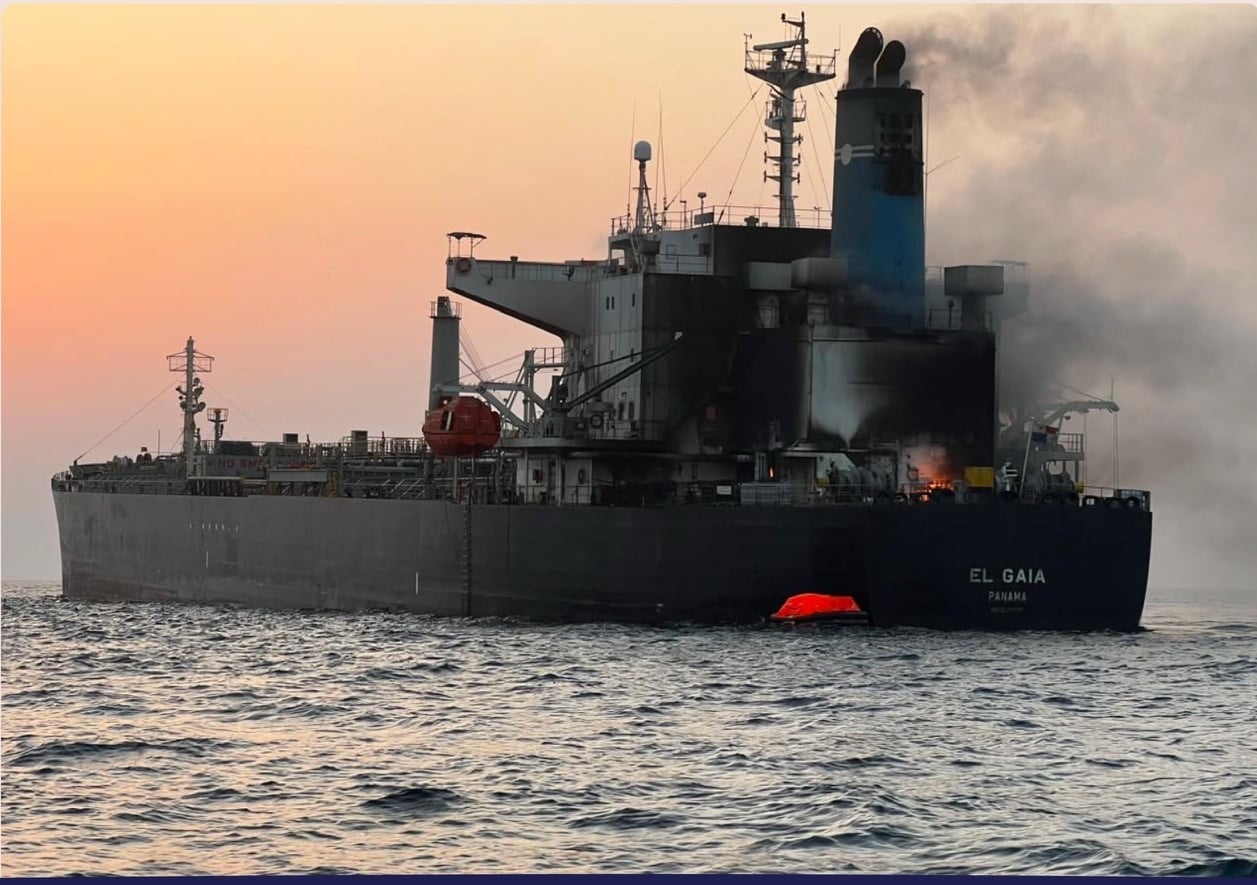
As of 15 September, the Strait of Hormuz remains the main source of global energy risk. UKMTO assessed traffic at about 90% below pre-conflict levels on 11 September, Kpler reported no very large crude carrier exits since 2 September, and the IEA reported August flows of 7.6 million barrels per day against pre-war levels about 13.1 million barrels per day higher. The IEA reported 8.3 million barrels per day of Middle East production shut in as of July, while global inventories fell by 69 million barrels in July. The US-Iran confrontation continues to affect commercial shipping, but the causes of the El Gaia incident, the number and location of tankers struck by US forces, and the duration of the price shock remain contested.
Key judgments
- Brent crude has breached $100 per barrel and is very likely to remain the main market indicator of the crisis in the near term. The EIA reported Europe Brent spot at $109.51 per barrel on 9 September, while the evidence does not confirm a $100 WTI spot breach: the EIA reported Cushing WTI spot at $97.26 on the same date, despite a trade report saying WTI exceeded $100 on 10 September. (Confidence: high · REPORTED)
- I&W: Confirm if the EIA reports Europe Brent spot above $100 per barrel in the next daily release. (0-14 days)
- I&W: Break if official EIA Cushing WTI spot data show a sustained move above $100, resolving the current spot-versus-futures discrepancy. (0-14 days)
- Commercial shipping through the Strait of Hormuz is very likely to remain severely constrained over the next 0-14 days. UKMTO reported traffic about 90% below pre-conflict levels, Kpler reported no very large crude carrier exits since 2 September, and JMIC continued to rate the threat to commercial shipping as severe while maritime authorities warned about drifting or uncharted mines. (Confidence: high · ASSESSED)
- I&W: Confirm if UKMTO and JMIC continue to report traffic at roughly 90% below pre-conflict levels or retain a severe shipping-threat rating. (0-14 days)
- I&W: Break if Kpler confirms renewed very large crude carrier exits and maritime authorities withdraw mine warnings for the wider Strait. (0-14 days)
- US-Iran military confrontation is likely to sustain disruption to commercial shipping, although the sequence and attribution of individual incidents remain disputed. The United States reported strikes on Iranian tankers, Iran was reported to have attacked commercial vessels and fired ballistic missiles towards US forces at al-Azraq Air Base in Jordan, and JMIC recorded three vessel attacks during its latest 72-hour reporting period. The reported number and location of tankers struck by US forces are unresolved. (Confidence: medium · ASSESSED)
- I&W: Confirm if Iran or the United States reports another attack on a commercial vessel, tanker, naval vessel, or military base. (0-14 days)
- I&W: Break if both governments announce and observe a verified ceasefire, with no new attacks and a sustained recovery in Hormuz traffic. (0-14 days)
- Global oil buffers are very likely to remain under pressure over the next 1-3 months. The IEA reported 8.3 million barrels per day of Middle East production shut in as of July, global production at 100.1 million barrels per day in August with about 10 million barrels per day of Gulf output shut in, and a 69 million-barrel inventory draw in July. The US Strategic Petroleum Reserve stood at 286.6 million barrels on 28 August, its lowest level since November 1982, after the IEA's 32 members agreed in March to make 400 million barrels available in the largest coordinated release in the organisation's history. (Confidence: high · ASSESSED)
- I&W: Confirm if weekly inventory data show further global draws and if the IEA continues to report shut-in Gulf output near current levels. (1-3 months)
- I&W: Break if Hormuz flows recover materially, Middle East production returns, and global inventories stop falling without additional emergency stock releases. (1-3 months)
- A concurrent Bab el-Mandeb shipping shutdown is unlikely to assess as established on present evidence, but it remains a credible high-impact wildcard. The available reporting places the Houthis on the Yemeni Red Sea coast, at Mokha port and on Perim Island, which divides the Bab el-Mandeb into two channels, but it does not report a confirmed traffic collapse or closure comparable to Hormuz. This judgment rests mainly on a single trade-publication account and a historical flow estimate, so confidence is low. (Confidence: low · ASSESSED)
- I&W: Confirm if maritime authorities report attacks, mining, or a sustained commercial traffic reduction in the Bab el-Mandeb. (0-14 days)
- I&W: Break if independent maritime reporting shows normal commercial transits and no new hostile incident in the strait. (0-14 days)
- A multi-year oil-price shock is roughly even chance rather than an established baseline. The IEA assumes Hormuz shipping remains restricted through the end of 2026, while Goldman Sachs warned of prices above $120 if attacks intensify and J.P. Morgan projected Brent averages of $86 in the third quarter, $80 in the fourth quarter and $78 at year-end. The forecasts are contested and rely partly on lower-confidence reporting, so confidence is low. (Confidence: low · ASSESSED)
- I&W: Confirm the persistent-shock case if Brent remains above $100 and the IEA extends its restricted-Hormuz assumption beyond 2026. (1-3 months)
- I&W: Break the persistent-shock case if Hormuz traffic recovers and Brent moves towards the J.P. Morgan year-end projection near $78. (1-3 months)
Outlook & scenarios
Prolonged Hormuz restriction (55%)
This is the most likely near-term outcome. Hormuz remains severely constrained through the next several weeks, Brent stays above $100, and inventory draws continue despite the IEA emergency stock response and the US SPR exchange programme. No concurrent Bab el-Mandeb closure is verified.
De-escalation and market retracement (25%)
A verified US-Iran ceasefire, followed by a sustained increase in Hormuz transits and removal of maritime warnings, reduces the immediate supply premium. Brent then moves towards J.P. Morgan's lower year-end projection. The timing and durability of any such recovery remain uncertain.
Low-probability, high-impact dual-chokepoint escalation (15%)
Iranian attacks on shipping continue while the Houthi position on the Yemeni Red Sea coast, Mokha port and Perim Island translates into a confirmed Bab el-Mandeb disruption. Brent moves above the $120 level identified by Goldman Sachs as an escalation threshold, and global inventories draw faster.
Recommendations
- Maintain a 0-14 day watch focused on UKMTO and JMIC reporting, Kpler very large crude carrier movements, mine warnings, projectile incidents, and official US and Iranian statements.
- Use EIA Europe Brent spot data as the primary price reference. Report the WTI $100 threshold as unconfirmed until official Cushing spot data resolve the discrepancy with the trade report.
- Separate confirmed shipping incidents from attribution claims. For El Gaia, report the Omani account, the IRGC mine claim and the CENTCOM account as competing narratives until physical or independent maritime evidence resolves the cause.
- Track the IEA emergency stock programme, the US SPR exchange programme, inventory draws and shut-in Gulf output together. Do not treat emergency stocks as evidence that physical Hormuz flows have normalised.
- Add Bab el-Mandeb to the daily maritime watch, but do not describe the strait as closed without confirmed reporting on attacks, mining or a sustained decline in commercial transits.
- Prepare two market briefs for the general analyst community: one based on continued Hormuz restriction through 2026, and another based on verified de-escalation and a recovery towards the lower J.P. Morgan price path.
- Use Nigeria's rise in petrol prices and South Korea's record July gasoline consumption as early indicators of regional and consumer pass-through, while distinguishing those effects from the unresolved global price forecast.
Confidence & uncertainty
Overall confidence is high because the core situation is corroborated by official and multilateral reporting from the EIA and IEA, maritime reporting from UKMTO and JMIC, and operational accounts from CENTCOM and Omani authorities. The strongest findings are the Brent price increase, the severe reduction in Hormuz traffic, the scale of shut-in production and the depletion of inventories and US SPR stocks. The main uncertainties concern the exact number and location of tanker strikes, the cause of the El Gaia incident, whether Bab el-Mandeb traffic is materially disrupted, and the conflicting forecasts for prices through the end of 2026.
Cited sources
[1] U.S. Energy Information Administration (EIA) · EIA crude oil spot prices — 2026-09-09 (A) · sha256:ac28286ac672 [2] Oilprice.com · WTI Breaks $100and This Rally Has Legs (C) · Thu Sep 10 2026 00:00:00 GMT+0000 (Coordinated Universal Time) · sha256:ac4ad9bc1ffb [3] BusinessAM Live · Hormuz crisis turns $100 oil into Nigeria’s fiscal gain, economic pain (D) · Mon Sep 14 2026 06:03:40 GMT+0000 (Coordinated Universal Time) · sha256:708d23351245 [4] gCaptain · U.S. Rejects Iran’s Mine Claim as Hormuz Shipping Threat Remains Severe (C) · Mon Sep 14 2026 20:28:38 GMT+0000 (Coordinated Universal Time) · sha256:e7b203f25a2c [5] gCaptain · Oman Says 'El Gaia' Being Towed to Port; Two Crew Missing (C) · Tue Sep 15 2026 14:51:52 GMT+0000 (Coordinated Universal Time) · sha256:0a1fa8a433cc [6] eciks.org · Oil prices break $100 as U.S.-Iran tensions escalate in Middle East (E) · Wed Sep 09 2026 13:55:01 GMT+0000 (Coordinated Universal Time) · sha256:c9f76e3d031e [7] Oilprice.com · Debunking the Viral Claim That America Has Only 14 Days of Oil Left (C) · Fri Sep 11 2026 14:00:00 GMT+0000 (Coordinated Universal Time) · sha256:4a929f35dfd8 [8] The Chosun Daily (chosun.com) · Price Ceiling Fuels South Korea's Record Gasoline Consumption (A) · Mon Sep 14 2026 15:53:27 GMT+0000 (Coordinated Universal Time) · sha256:2b18880a1c0d [9] Oilprice.com · The Next Oil Shock Is Never the Last (C) · Mon Sep 14 2026 19:00:00 GMT+0000 (Coordinated Universal Time) · sha256:eb1fdc95a2e3
Source content hashes were computed at collection time; the cited text is preserved unmodified for the life of this product.
TLP:CLEAR