TLP:CLEAR · Disclosure is not limited.
Iran-Israel Conflict: Hormuz Attacks and Regional Escalation
Time window: Last 1 day · Audience: General analyst · Type: Situation report · DTG: 2026-10-15 13:11Z · Overall confidence: HIGH
BLUF
Attacks on commercial shipping in the Strait of Hormuz are likely to continue, with two named cargo vessels now reported sunk and transit volumes sharply reduced. A renewed US strike on Iran remains unlikely over the next 0-14 days on the available reporting, but Iranian warnings identify US facilities and Gulf energy infrastructure as retaliation targets.
Executive summary
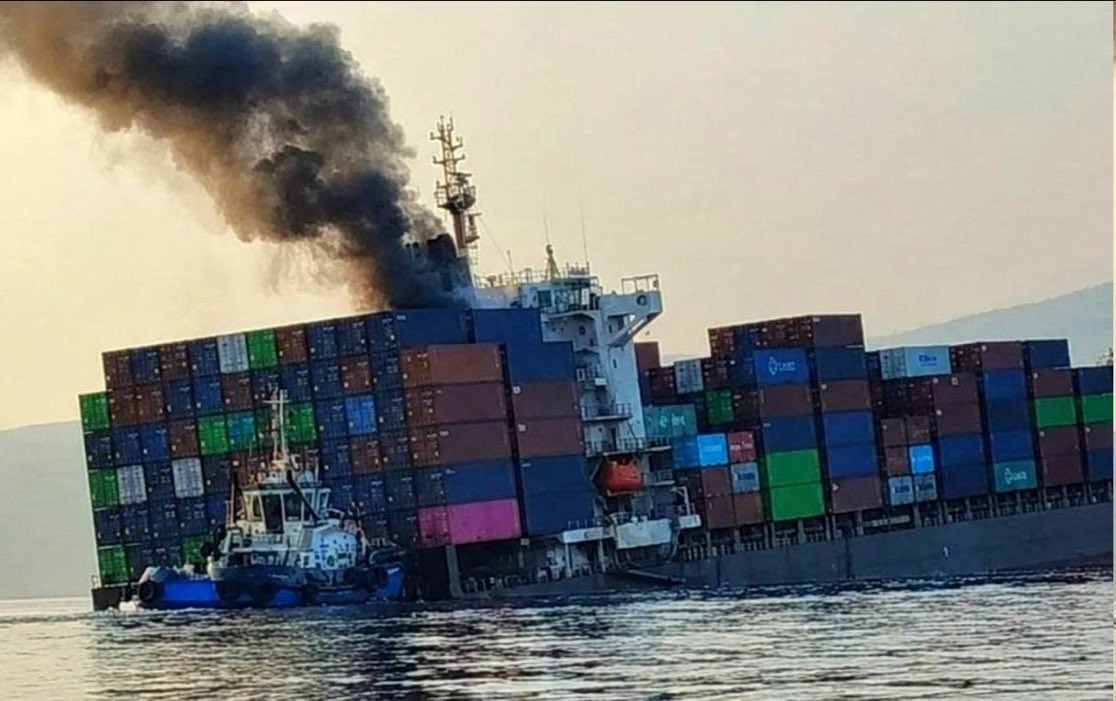
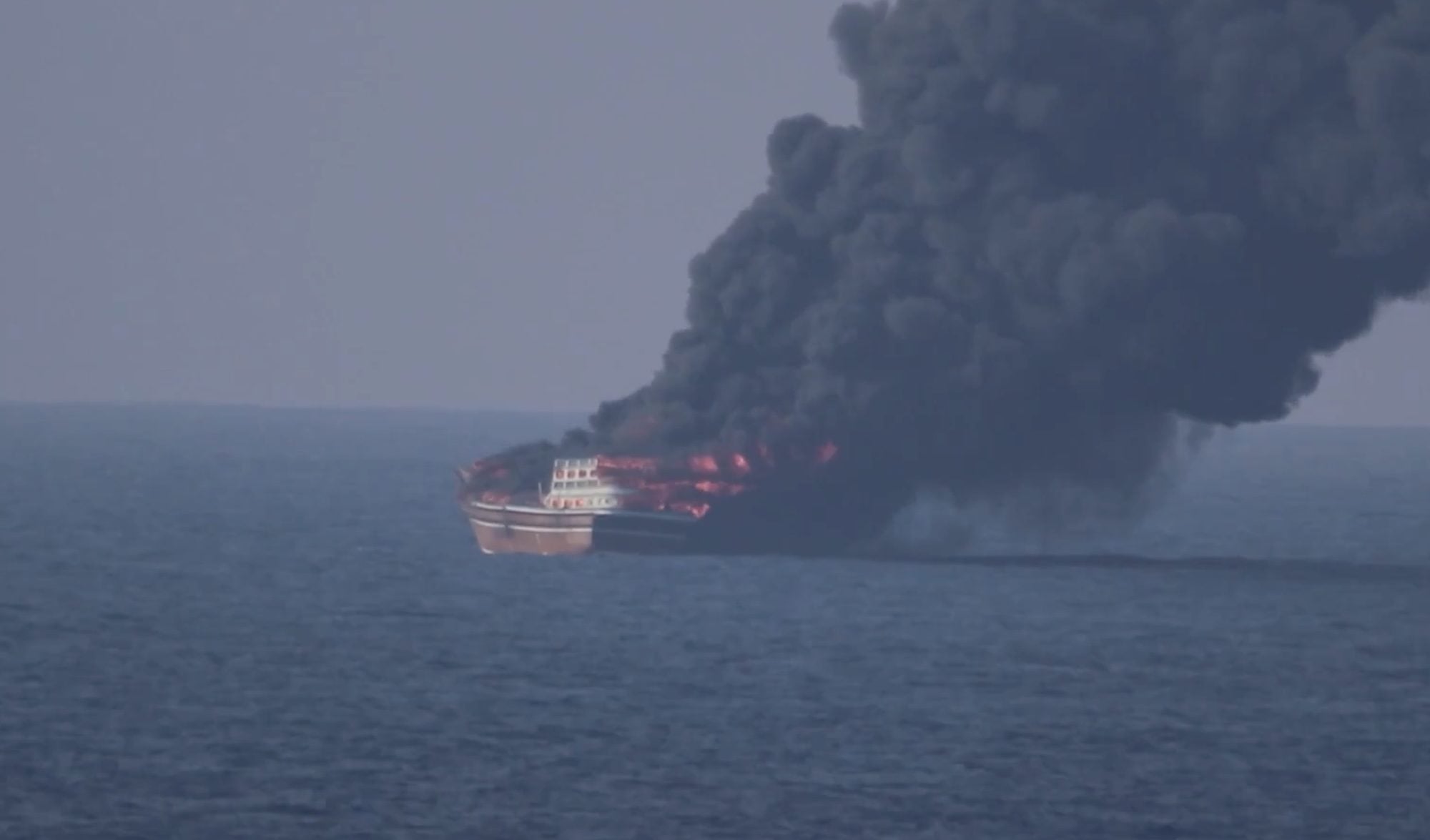
Reporting for 14-15 October points to rising maritime risk and renewed attention to US strike planning. The Singapore Maritime and Port Authority reported that GFS Pride sank after damage and a fire, while IMO data showed Cape Dao also sank; accounts of the cause of GFS Pride's sinking conflict. Iran says the Strait of Hormuz is closed and under its control, while CENTCOM says US forces and regional partners control it. Kpler data shows oil flows through the Strait fell from nearly 20.8 million barrels on 8 October to 2.9 million on 11 October. Press reports describe US contingency plans for renewed strikes, including possible use of the GBU-43/B MOAB, but say President Donald Trump has not approved them. The Houthis have vowed to continue attacks on Saudi airports and oil facilities. Hezbollah's reported rocket fire into northern Israel and Israel's threat to seize additional territory in southern Lebanon add to the risk of regional widening.
Change from previous assessment
Compared with the 14 October brief, the assessment of Hormuz shipping risk is firmer: the current reporting identifies the sinkings of GFS Pride and Cape Dao and reports at least 10 vessels hit since Sunday, alongside updated UKMTO counts. The earlier uncertainty about whether named vessels sank has therefore narrowed, but the cause of GFS Pride's sinking remains disputed. US strike reporting now describes more developed contingency plans, including possible MOAB use, while still placing approval with Trump; the assessment that a renewed strike is unlikely is unchanged, with low confidence.
Key judgments
- Commercial-vessel attacks in and around the Strait of Hormuz are likely to continue over the next 0-14 days. UKMTO reported 20 attacks since 1 October; a separate account reported 15 attacks from 6 to 14 October, including 11 in the final four days. Other reporting placed at least 10 vessels hit since Sunday. Singapore's Maritime and Port Authority reported that GFS Pride sank after sustaining damage and a fire, with all 21 crew evacuated; IMO data confirmed the sinking of Cape Dao after it was struck by a projectile on 23 September. Iran's claim that GFS Pride struck a mine conflicts with projectile-strike accounts and remains unverified. Multiple maritime and official reports corroborate the sinkings and attack tempo, but not the attribution or cause of every incident. (Confidence: medium · ASSESSED)
- I&W: Confirm: UKMTO issues another verified warning for an attack on a commercial vessel in the Strait of Hormuz or nearby waters. (0-14 days)
- I&W: Break: Kpler records daily oil flows of at least 15 million barrels for seven consecutive days and UKMTO issues no new verified attack warnings. (0-14 days)
- The Strait of Hormuz's operational status remains contested in reporting, and neither Iran's claim of closure and control nor CENTCOM's claim of US and partner control is independently settled by the supplied accounts. CENTCOM reported that US forces helped move more than 19 million barrels of crude through the Strait in one day, while Kpler recorded 2.9 million barrels on 11 October, down from nearly 20.8 million on 8 October. The conflicting claims and sharp variation in reported flows support a medium confidence assessment of severe disruption, not a definitive conclusion that the Strait is either fully closed or under one side's control. (Confidence: medium · REPORTED)
- I&W: Confirm disruption: Kpler continues to record daily oil flows far below the 20.8 million barrels reported on 8 October. (0-14 days)
- I&W: Break the assessment of unresolved status: independently verifiable transit data shows sustained normalised passage, or UKMTO reports a complete halt to commercial transits. (0-14 days)
- A renewed US strike on Iran is unlikely over the next 0-14 days, although US contingency planning reportedly has advanced. CNN reporting described plans for a renewed campaign and possible use of the GBU-43/B MOAB against Iranian energy and nuclear sites; another account said the plans await Trump's approval. US officials reportedly questioned whether the MOAB could destroy suspected underground nuclear sites, and a separate report said Washington had recently favoured economic pressure over military operations. The assessment rests mainly on press reporting, including accounts based on unnamed sources, with no supplied evidence of presidential authorisation. (Confidence: low · ASSESSED)
- I&W: Confirm: The White House or Department of Defense states that Trump has not authorised renewed strikes and CENTCOM announces no change in its operations against Iran. (0-14 days)
- I&W: Break: Trump publicly authorises renewed strikes or CENTCOM confirms an operation against Iranian targets. (0-14 days)
- Any renewed US strike on Iran would carry a likely risk of Iranian retaliation against US facilities or Persian Gulf energy infrastructure. Iranian Foreign Minister Abbas Araghchi warned officials in Saudi Arabia, Turkey, Qatar and Pakistan that US strikes could prompt such retaliation; Defence Ministry spokesman Reza Talaei-Nik said potential targets were prepared. Iranian media also circulated a map listing bridges in Israel, Saudi Arabia, the UAE, Qatar, Kuwait, Bahrain, Oman and Jordan. The statements are direct evidence of warnings, but the media-circulated map is not confirmation of an approved operational target list. (Confidence: medium · ASSESSED)
- I&W: Confirm: Iranian officials issue a further explicit warning naming US facilities or Gulf energy infrastructure as retaliation targets. (0-14 days)
- I&W: Break: Tehran publicly withdraws its threat to target US facilities or Gulf energy infrastructure. (0-14 days)
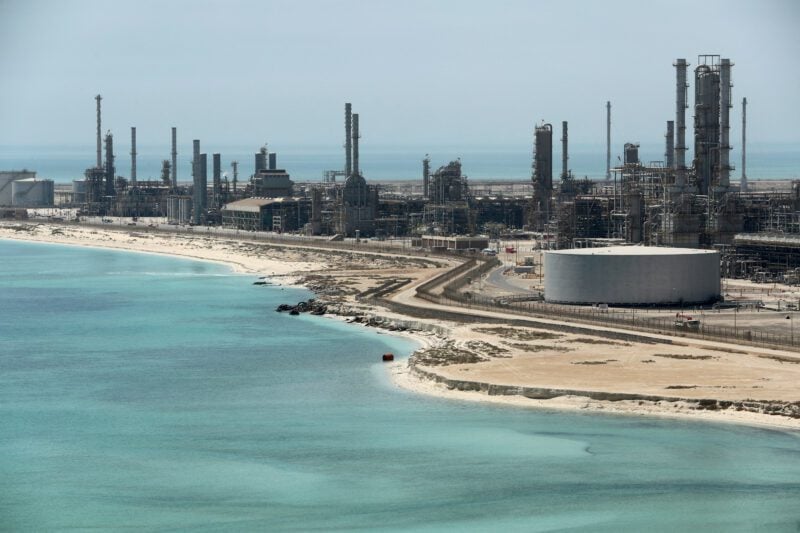
- The Houthis are likely to continue attempts to strike Saudi airports and oil facilities over the next 0-14 days. The Houthis vowed to continue such attacks and claimed launches against King Khalid International Airport and Aramco sites; the Saudi-led coalition separately reported intercepting a ballistic missile headed towards Riyadh. Reporting also described a fire at the Saudi Aramco base in Dhahran and the closure of King Khalid International Airport until 17 October. The Houthis' claimed targets and responsibility for the Dhahran damage are not independently established in all accounts. (Confidence: medium · ASSESSED)
- I&W: Confirm: The Saudi-led coalition reports another interception headed towards Riyadh, or Saudi authorities extend the King Khalid International Airport closure beyond 17 October. (0-14 days)
- I&W: Break: King Khalid International Airport reopens as scheduled and Saudi authorities report no further missile or drone interceptions at airports or oil facilities. (0-14 days)
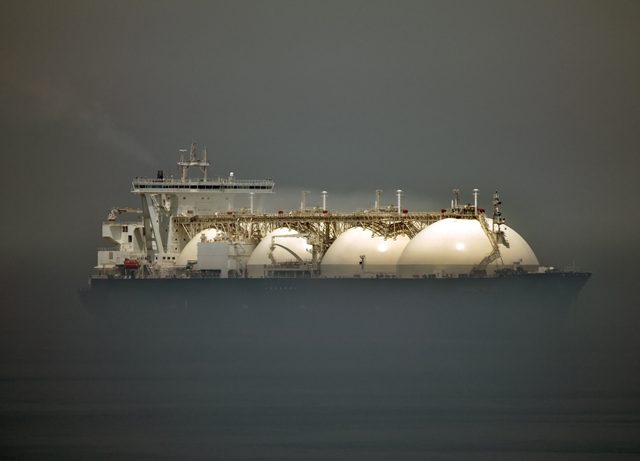
- Continued disruption to the Strait of Hormuz is likely to sustain pressure on global energy prices and Qatar's LNG earnings over the next 1-3 months if export flows remain constrained. Reporting says crude oil exceeded $100 a barrel for much of the past eight months, Qatari exports from April to September fell almost 90% year on year, and each week without Ras Laffan exports costs Qatar roughly $1 billion in lost sales. The IMF estimated a 15.6% contraction in Qatar's economy this year. These figures cover different periods, and the IMF figure is a forecast rather than a recorded outcome. (Confidence: medium · ASSESSED)
- I&W: Confirm: Kpler continues to record depressed oil flows through the Strait and QatarEnergy export reporting shows no sustained recovery in LNG shipments. (1-3 months)
- I&W: Break: QatarEnergy reports a sustained restart of Ras Laffan exports and Kpler records a sustained recovery in Strait of Hormuz flows. (1-3 months)
Outlook & scenarios
Sustained maritime attrition without a renewed US campaign (55%)
Iran continues to restrict transit and commercial-vessel attacks persist at an uneven rate. Trump does not authorise renewed US strikes in the near term. The Houthis continue threats against Saudi airports and oil facilities, while shipping and energy costs remain under pressure.
US strikes followed by Iranian retaliation (25%)
Trump authorises renewed US attacks on Iran. Iran responds against US facilities or Gulf energy infrastructure, increasing the risk to commercial shipping. The reported MOAB option remains uncertain, particularly for underground nuclear sites.
Restraint and partial recovery in shipping (15%)
Washington maintains economic pressure without renewing its air campaign, and Tehran limits further action against commercial shipping. Verified attacks decline and Strait of Hormuz flows recover, although the competing claims over control remain unresolved.
Low-probability, high-impact widening across the region (5%)
Hezbollah expands rocket attacks into northern Israel as Iran retaliates against a renewed US campaign. Israel then seizes additional territory in southern Lebanon, while attacks threaten the Gulf bridges named in Iranian media and regional energy infrastructure.
Recommendations
- Maintain a daily maritime picture that separates UKMTO verified warnings, IMO casualty records and Kpler transit data. Record each reporting window separately so overlapping attack counts are not treated as additive.
- Keep the reported US contingency plans distinct from presidential authorisation. Track public statements from Trump, the White House, the Department of Defense and CENTCOM for an explicit decision or operational confirmation.
- Treat Iran's mine account for GFS Pride and the bridge map circulated by Iranian media as unverified claims. Do not use either as settled attribution or evidence of an approved target package.
- Update the energy-risk assessment with Kpler flows, QatarEnergy export reporting and any confirmed Ras Laffan restart. Keep the IMF contraction estimate separate from measured export and revenue data.
- Track Saudi announcements on King Khalid International Airport after its reported 17 October closure date, alongside Saudi-led coalition statements on interceptions and Houthi claims of further attacks.
Confidence & uncertainty
Overall confidence is high for the occurrence and broad scale of the main maritime disruptions. UKMTO reporting, IMO casualty data, Singapore's Maritime and Port Authority, maritime-security sources and Kpler data provide corroboration from different reporting streams. Confidence is lower on responsibility for individual attacks, the Strait's control status, and whether reported US strike planning will lead to authorisation. The MOAB reporting is not independently confirmed, and some attack totals use different reporting windows.
Alternative analysis (red cell)
The supplied evidence supports a materially more uncertain reading of the strike outlook than the judgment conveys. Completed planning for a renewed campaign (55e6fecd-2778-4ee0-8d97-648a4b36a312), reported consideration of MOAB employment (c93e45b5-9970-4d1c-a0f9-706df7d77ed9), and pending presidential approval (e443b99c-7aa8-4fcf-b595-888832b8aef4) leave a renewed strike plausibly imminent as well as plausibly deferred. The evidence therefore does not establish that nonrenewal is the likelier outcome over the next 14 days; it supports low confidence in the direction of the forecast.
Intelligence gaps
- [EEI 1.1 · PARTIAL] Number, type, launch times, and trajectories of ballistic missiles, cruise missiles, armed UAV strikes, and combat-air sorties launched by Iranian or Israeli forces toward the other's territory or forward bases within a 72-hour window. Recommended collection: signals/intel
- [EEI 1.2 · PARTIAL] Observable changes in Israeli and Iranian force posture: mobilization or reserve call-up orders, unit road/rail movements, dispersal or sortie rates of air squadrons, redeployment of air-defense batteries, and activation of civil-defense alerts or sirens in major population centers. Recommended collection: open-source/media
- [EEI 2.1 · UNCOVERED] Counts, launch locations (coordinates), weapons types, and assessed damage from rocket/missile/drone strikes originating from Lebanon into northern Israel attributed to Hezbollah or allied groups. Recommended collection: open-source/media
- [EEI 2.2 · UNCOVERED] Reported attacks by Iranian-backed militias in Iraq and Syria: rocket/IED strikes on bases hosting US/coalition or Israeli personnel, documented militia unit movements toward borders, and captured movement or transfer of weapons systems to forward militia positions. Recommended collection: human
- [EEI 2.3 · UNCOVERED] Maritime harassment or attacks by proxies (e.g., Houthis): incidents of missile/rocket strikes against commercial vessels, small-boat swarm attacks, discovery or detonation of naval mines, and corresponding AIS anomalies in the Red Sea, Gulf of Aden, or southern Arabian Gulf. Recommended collection: maritime/AIS
- [EEI 3.1 · UNCOVERED] Movements and arrival dates of foreign military assets into the region: carrier strike groups, amphibious ships, surface combatants, strategic airlift/tanker deployments, and air/sea patrol patterns by US, European, Russian, or regional militaries. Recommended collection: imagery/satellite
- [EEI 3.2 · PARTIAL] Concrete diplomatic and political actions: emergency UN/Arab League meetings called, official embassy evacuation orders, public declarations of intent to interpose or protect shipping/airspace, and newly announced sanctions or arms-transfer approvals tied to the conflict. Recommended collection: diplomatic
- [EEI 3.3 · PARTIAL] Immediate commercial and market indicators: rerouting of commercial tankers and container vessels (e.g., avoidance of Bab el-Mandeb or Strait of Hormuz), sudden spikes in war-risk insurance premiums for regional sea lanes, temporary port closures, and near-term price moves in regional benchmark crude tied to incidents. Recommended collection: financial/market
Cited sources
[1] NIN · Novi planovi za udare na Iran: Tramp najavljuje brz kraj rata, UN upozoravaju na posledice (B) · 15 October 2026 · sha256:12b7063f8e52 [2] Banking News (bankingnews.gr) · «Οι στόχοι της Ώρας Μηδέν»: Αντίποινα σοκ του Ιράν σε στρατηγικής σημασίας γέφυρες σε Ισραήλ και 7 κράτη – Η λίστα του τρόμου (B) · 15 October 2026 · sha256:e29e821a3cac [3] Reuters (republished by gCaptain) · Bulk Carrier Sinks Weeks After Deadly Strait of Hormuz Strike (A) · 14 October 2026 · sha256:2b3df83932f6 [4] gCaptain · Containership Sinks as Hormuz Attacks Spiral Out of Control (C) · 14 October 2026 · sha256:3d26cc4befe7 [5] gCaptain · U.S. Forces Destroy Iranian-Linked Dhow Accused of Targeting Navy Ships (C) · 14 October 2026 · sha256:d5780f21061b [6] Hürriyet Daily News · US considers hitting Iran with ‘mother of all bombs’: Report - World News (B) · 15 October 2026 · sha256:c79ddc988688 [7] Srugim (srugim.co.il) · הפצצה הגדולה בעולם: התוכנית החדשה לתקיפה באיראן (D) · 15 October 2026 · sha256:8fd53c58f8d6 [8] Reuters (republished by gCaptain) · Yemen's Houthis Vow More Attacks on Saudi Airports, Oil Facilities After Aramco HQ Hit (A) · 14 October 2026 · sha256:b5d9f7c75dfc [9] Al Jazeera · G20 finance ministers, central bankers gather amid fallout from Iran war (A) · 15 October 2026 · sha256:70b6e7bb64b7 [10] gCaptain (reprinting a Bloomberg News report) · Qatar Rewrites Its Gas Playbook With Old Tankers and New Tactics (B) · 14 October 2026 · sha256:dd9f1920f160
Source content hashes were computed at collection time; the cited text is preserved unmodified for the life of this product.
Red cell review: PARTIAL DISSENT
TLP:CLEAR