TLP:CLEAR · Disclosure is not limited.
Iran-Israel Conflict: Hormuz Restriction and Regional Spillover
Time window: Last 1 day · Audience: General analyst · Type: Situation report · DTG: 2026-08-30 14:41Z · Overall confidence: MEDIUM
BLUF
The US-Iran-Israel confrontation is likely to remain militarily active over the next 14 days, while commercial traffic through the Strait of Hormuz is unlikely to normalise. Iran's closure claim, seven reported vessel transits, US mine-clearance claims and the International Maritime Organization's estimate of 400 ships and 6,000 seafarers unable to leave the Gulf indicate restricted and contested navigation. Oman and Qatar mediation has a roughly even chance of producing a temporary maritime arrangement, but an agreement resolving sanctions and blockade disputes is unlikely.
Executive summary
Current reporting describes Israeli strikes on Iranian government-linked sites in Tehran, continued US military activity around the Arabian Sea and Middle East, and expanding Israeli ground and air operations against Hezbollah in southern Lebanon. Navigation through the Strait of Hormuz remains disputed: Iran says the waterway is closed to vessels lacking coordination, while commercial vessels continue to cross and US officials report mine clearance. Diplomatic efforts involving Oman, Qatar, Türkiye and Iran's president have not produced a confirmed settlement. Reports of attacks in Kuwait, continuing violence in Gaza and pressure on Iranian trade indicate that the conflict is still imposing wider security, economic and humanitarian costs. Chronology, attribution and the status of several reported incidents remain uncertain.
Change from previous assessment
The core assessment is broadly unchanged: military activity is likely to persist, Hormuz is unlikely to normalise quickly and regional economic disruption is likely to continue. This brief raises attention to reported Israeli strikes on government-linked sites in Tehran, adds the reported Kuwait target and casualty discrepancy, and gives greater weight to the Iran-Oman maritime proposal and Qatar-Türkiye diplomatic contacts. Confidence remains medium overall, while confidence in the diplomatic channel remains low because the reporting still conflicts over whether an arrangement exists or is only under discussion.
Key judgments
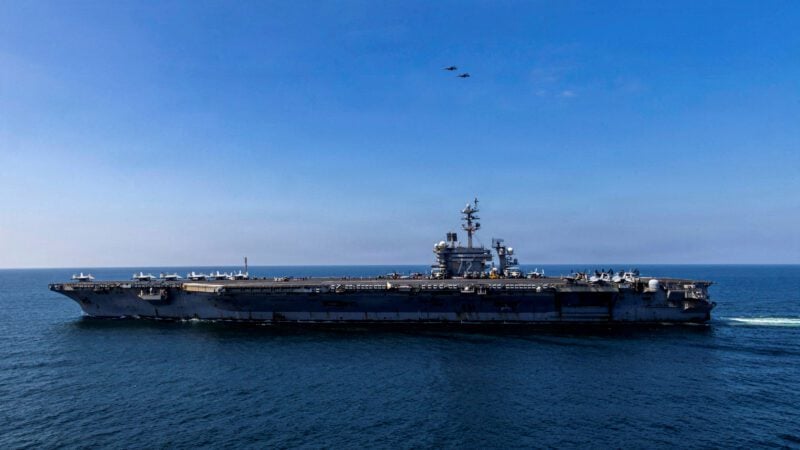
- The US-Iran-Israel confrontation is likely to remain militarily active over the next 14 days. Israeli forces have reported strikes on Iranian government-linked sites in Tehran, while the US maintains more than 50,000 troops across the Middle East and reports flight operations by USS George Washington and readiness training aboard USS Boxer. The IRGC has also said it targeted Al Udeid Air Base in Qatar, Ali Al Salem Air Base in Kuwait, Al Dhafra Air Base in the UAE and the US Navy Fifth Fleet headquarters in Bahrain. This is an assessed inference from current military activity, but conflicting accounts of the wider campaign's chronology and attribution lower confidence. (Confidence: medium · ASSESSED)
- I&W: A further confirmed Israeli strike on Iranian government-linked sites in Tehran, or a new IRGC-claimed attack on Al Udeid, Ali Al Salem, Al Dhafra or the Fifth Fleet headquarters, would confirm continued military activity. (0-14 days)
- I&W: A 14-day period with no further reported strikes and with US reporting that regional flight and readiness activity has ended would break this judgement. (0-14 days)
- The Strait of Hormuz is unlikely to return to normal commercial traffic over the next 14 days. Kazem Gharibabadi says the waterway is closed and that vessels must coordinate with Iran, yet Kpler data cited by Reuters recorded seven commodity vessels crossing on Thursday. US officials say both shipping lanes have been cleared of mines, while the International Maritime Organization reports up to 400 ships carrying about 6,000 seafarers unable to leave the Gulf safely. The evidence supports restricted and contested navigation rather than a confirmed total closure. This is an assessed judgement with medium confidence because the reporting describes both active transits and severe disruption. (Confidence: medium · ASSESSED)
- I&W: Kpler reports daily commodity transits at seven or below and the International Maritime Organization continues to report ships unable to depart safely. (0-14 days)
- I&W: The Iran-Oman corridor is implemented, daily transits rise to at least the reported 10-day average of 15 vessels, and the International Maritime Organization reports that the stranded ships and seafarers have begun departing safely. (0-14 days)
- Israeli military operations against Hezbollah in southern Lebanon are likely to continue over the next 14 days, while security exposure in Kuwait is likely to remain elevated. The Israeli military has confirmed expanding ground operations and airstrikes in southern Lebanon; Lebanon's National News Agency reported raids at al-Mansouri and near Zawtar al-Gharbiyeh, and smoke was seen over Beirut's southern suburbs after an Israeli strike on a reported Hezbollah stronghold. Separately, Kuwaiti authorities reported an attack on a power and water desalination plant that killed one Indian worker, while another report described a projectile striking a military camp and injuring ten Kuwaiti armed forces members. The Kuwait accounts conflict over the target and casualties, so confidence is low for that component. (Confidence: low · ASSESSED)
- I&W: Lebanon's National News Agency reports another Israeli raid at al-Mansouri or near Zawtar al-Gharbiyeh, or the Israeli military reports continued ground operations against Hezbollah. (0-14 days)
- I&W: Kuwaiti authorities report another projectile against a power, water or military site, or new casualties among workers or Kuwaiti armed forces members. (0-14 days)
- There is a roughly even chance that Oman and Qatar mediation produces a temporary US-Iran maritime arrangement over the next 14 days, but an agreement resolving the blockade, sanctions and compensation disputes is unlikely. Kazem Gharibabadi says Iran has reached a conditional understanding with Oman on a temporary route, while other reporting describes the route as still under discussion. Qatar's Sheikh Mohammed bin Abdulrahman Al Thani has visited Tehran and held de-escalation discussions with Türkiye, and Masoud Pezeshkian has called for revival of the June memorandum of understanding. No confirmed agreement currently resolves the core disputes. This is an assessed judgement resting on conflicting diplomatic reporting and limited evidence of implementation, so confidence is low. (Confidence: low · ASSESSED)
- I&W: Iran, Oman and the US publish matching terms for the maritime corridor and commercial vessels begin transiting under those terms. (0-14 days)
- I&W: Tehran or Washington rejects the reported arrangement, or no vessel uses the proposed corridor and no confirmed agreement emerges. (0-14 days)
- Economic and humanitarian disruption is likely to persist for the next 1-3 months. Iran's annual inflation is reported at 66 percent and Masoud Pezeshkian says imports and exports have fallen nearly 35 percent because of US sanctions and the naval blockade. US Central Command says the blockade has stopped Iran's seaborne oil exports, while up to 400 ships and 6,000 seafarers remain unable to leave the Gulf safely. Gaza also remains under severe humanitarian pressure, with 59 percent of the population facing crisis-level food insecurity or worse and 1.9 million Palestinians displaced. The duration of these effects is not established directly in the supplied reporting, which limits confidence. (Confidence: medium · ASSESSED)
- I&W: Updated reporting continues to show Iranian seaborne oil exports halted, inflation near 66 percent or trade down by about 35 percent, and ships unable to leave the Gulf. (1-3 months)
- I&W: Kpler reports sustained commercial transit at or above 15 commodity vessels per day and US Central Command reports resumed Iranian seaborne oil exports. (1-3 months)
Outlook & scenarios
Likely sustained confrontation and restricted shipping (55%)
Israeli strikes in Tehran and southern Lebanon continue, the US sustains military operations around the Strait of Hormuz, and Iran keeps maritime access restricted. Qatar and Oman mediation produces further statements but no implemented arrangement.
Temporary maritime accommodation (30%)
Iran and Oman implement a corridor after US-Iran contacts, allowing selected commercial vessels to transit. Sanctions, blockade and compensation disputes remain unresolved, so normal traffic does not return.
Expanded regional spillover (20%)
Further attacks affect power, water or military facilities in Kuwait, Qatar, Bahrain or the UAE while Israeli-Hezbollah exchanges continue in southern Lebanon. Shipping disruption and humanitarian pressure intensify.
Leadership shock and harder-line consolidation (10%)
Mojtaba Khamenei's public absence persists while senior military commanders receive further key appointments. Iranian leaders adopt a more confrontational message towards Gulf rulers and tighten control of shipping. This is a low-probability, high-impact wildcard.
Recommendations
- Maintain a single, dated operational timeline that separates the 12-Day War, the 28 February 2026 US-Israel strikes and the reported strikes on Tehran. Record actor attribution separately from confirmed activity.
- Track daily Strait of Hormuz transits against Iranian statements, Kpler reporting, US Central Command claims and International Maritime Organization updates. Treat the waterway as restricted until vessel movement and safe departures improve across multiple reporting cycles.
- Monitor the proposed Iran-Oman corridor for implementation rather than relying on diplomatic statements. Record whether vessels transit, whether Iranian coordination is required and whether Washington addresses the lapsed memorandum of understanding.
- Prioritise reporting on Al Udeid Air Base, Ali Al Salem Air Base, Al Dhafra Air Base, the US Navy Fifth Fleet headquarters, USS George Washington, USS Boxer and USS Abraham Lincoln for evidence of changing US force posture or additional attacks.
- Establish separate incident files for the reported Kuwait power and desalination plant attack and the reported strike on a Kuwaiti military camp. Do not merge their targets or casualty figures until independent reporting reconciles them.
- Use NASA FIRMS thermal detections only as corroborative evidence. The 12 detections recorded on 30 August do not establish that strikes occurred or identify their cause, and the low-reliability Gulf Strikes Tracker should not serve as a sole source for safety or escalation assessments.
Confidence & uncertainty
Overall confidence is medium. Multiple official government and major-media reports support the presence of sustained military activity, severe shipping disruption and active diplomatic engagement. Confidence is reduced by conflicting accounts of the conflict's chronology and attribution, disagreement over whether the Strait of Hormuz is closed or restricted, inconsistent reporting on the Kuwait incidents and reliance on some blog, social-media and reference-work material. The status of the proposed maritime corridor and the duration of economic disruption remain particularly uncertain.
Intelligence gaps
- [EEI 1.1 · PARTIAL] Number, type, launch times, and trajectories of ballistic missiles, cruise missiles, armed UAV strikes, and combat-air sorties launched by Iranian or Israeli forces toward the other's territory or forward bases within a 72-hour window. Recommended collection: signals/intel
- [EEI 1.2 · PARTIAL] Observable changes in Israeli and Iranian force posture: mobilization or reserve call-up orders, unit road/rail movements, dispersal or sortie rates of air squadrons, redeployment of air-defense batteries, and activation of civil-defense alerts or sirens in major population centers. Recommended collection: open-source/media
- [EEI 1.3 · PARTIAL] Indications of strike authorization or targeting preparations in Iranian or Israeli command chains: authenticated public orders by senior commanders, detected increases in encrypted communications consistent with targeting, or visible movement of strike munitions to launch/storage sites. Recommended collection: signals/intel
- [EEI 2.1 · UNCOVERED] Counts, launch locations (coordinates), weapons types, and assessed damage from rocket/missile/drone strikes originating from Lebanon into northern Israel attributed to Hezbollah or allied groups. Recommended collection: open-source/media
- [EEI 2.2 · UNCOVERED] Reported attacks by Iranian-backed militias in Iraq and Syria: rocket/IED strikes on bases hosting US/coalition or Israeli personnel, documented militia unit movements toward borders, and captured movement or transfer of weapons systems to forward militia positions. Recommended collection: human
- [EEI 2.3 · UNCOVERED] Maritime harassment or attacks by proxies (e.g., Houthis): incidents of missile/rocket strikes against commercial vessels, small-boat swarm attacks, discovery or detonation of naval mines, and corresponding AIS anomalies in the Red Sea, Gulf of Aden, or southern Arabian Gulf. Recommended collection: maritime/AIS
- [EEI 3.1 · PARTIAL] Movements and arrival dates of foreign military assets into the region: carrier strike groups, amphibious ships, surface combatants, strategic airlift/tanker deployments, and air/sea patrol patterns by US, European, Russian, or regional militaries. Recommended collection: imagery/satellite
- [EEI 3.3 · PARTIAL] Immediate commercial and market indicators: rerouting of commercial tankers and container vessels (e.g., avoidance of Bab el-Mandeb or Strait of Hormuz), sudden spikes in war-risk insurance premiums for regional sea lanes, temporary port closures, and near-term price moves in regional benchmark crude tied to incidents. Recommended collection: financial/market
Cited sources
[1] News On Air (Prasar Bharati / All India Radio) · West Asia conflict enters more intense phase with military activity spreading across several fronts (B) · sha256:2f3d78c2b314 [2] Reuters (republished by gCaptain) · US Military Families Ride 'Roller Coaster Of Emotions' Over Six Months Of Iran War (A) · sha256:7f13fd8b9553 [3] OSINT613 · United States Central Command – Military - OSINT613 (D) · sha256:4af78ed5e37c [4] Wikipedia · Timeline of the 2026 Iran war (C) · sha256:0965dfb32b89 [5] Al Jazeera · Iran’s Khamenei calls for Gulf unity as Hormuz tensions persist (A) · sha256:f3d9035e28f2 [6] Sunday Guardian Live · US-Israel-Iran War Latest Live News: Qatar, Turkiye Foreign Ministers Discuss Efforts To De-Escalate Middle East Tensions, Support Maritime Navigation & Lasting Peace (B) · sha256:41de23eb7569 [7] Sunday Guardian Live · US-Israel-Iran War Latest News: USS Abraham Lincoln Moves Toward Home After Middle East Mission, Passes Singapore (B) · sha256:0d5b3e821cbc [8] UK Government (gov.uk) · Both parties must fulfil their commitments under Resolution 2803 and refrain from actions that undermine peace: UK statement at the UN Security Council (A) · sha256:22593220c0b4 [9] The Maritime Executive · Tanker Caroline Bezengi Intact and Still Leaking Crude Oil (C) · sha256:6bc0cdb91af0
Source content hashes were computed at collection time; the cited text is preserved unmodified for the life of this product.
TLP:CLEAR