TLP:CLEAR · Disclosure is not limited.
Iran-Israel Conflict: Maritime Disruption, Regional Spillover and Diplomatic Off-Ramps
Time window: Last 1 day · Audience: General analyst · Type: Situation report · DTG: 2026-08-27 13:58Z · Overall confidence: MEDIUM
BLUF
Likely direct and associated military activity will persist over the next 0-14 days despite diplomatic efforts by Qatar and Pakistan. Very likely shipping through the Strait of Hormuz will remain disrupted and exposed, while Iranian oil exports remain constrained rather than fully halted.
Executive summary
The conflict remains active across Iran, Israel, Gaza, southern Lebanon and US-linked facilities. Qatar is pursuing a diplomatic off-ramp through a planned visit to Tehran, while Pakistan says its mediation continues, but President Donald Trump says there is no timetable to end the confrontation. Tankers were hit by unknown projectiles in the Strait of Hormuz on 25, 26 and 27 August, and Iran maintains restrictions on shipping. Israeli forces continue strikes in Gaza and southern Lebanon, with severe humanitarian conditions in Gaza and renewed Hezbollah-Israel exchanges. Reporting on Iranian oil exports, the geographical reach of Iranian attacks and the attribution of cyber incidents remains inconsistent.
Change from previous assessment
Since the 25 August brief, the assessment adds a diplomatic off-ramp involving Qatar and Pakistan, records tanker incidents in the Strait of Hormuz on 26 and 27 August, and raises the salience of renewed Hezbollah-Israel exchanges and reported Iranian cyber targeting of US water facilities. The prior judgments on continuing US economic pressure, low Hormuz traffic, shipping exposure and humanitarian strain are retained. Confidence remains medium because the new maritime and economic reporting includes unresolved attribution and conflicting Iranian accounts of oil exports. No prior judgment is retired.
Key judgments
- Likely direct and associated military activity will continue across Iran, Israel, southern Lebanon, Gaza and US-linked facilities over the next 0-14 days, while Qatar and Pakistan pursue diplomatic off-ramps. President Donald Trump says there is no timetable to end the conflict, Qatar's prime minister is due to visit Tehran on 27 August, and Pakistan says its diplomatic efforts continue. The assessment is medium confidence because current military reporting is supported by wire and major-media reporting, but diplomatic progress remains limited to statements and planned contacts, while several supplied timelines conflict. (Confidence: medium · ASSESSED)
- I&W: CONFIRM: A new Iranian missile or drone strike, Hezbollah drone launch, Israeli strike in southern Lebanon or Gaza, or Iranian-linked disruption at a named US water facility is reported. (0-14 days)
- I&W: BREAK: The parties announce a cessation and no new Iranian, Israeli, Hezbollah or Iranian-linked cyber incident is reported for 14 consecutive days. (0-14 days)
- Very likely US economic pressure on Iran will continue over the next 0-30 days, and likely it will intensify through the announced economic operation and action against sanctions-evasion networks. Iranian oil exports will likely remain reduced rather than fully halted. President Donald Trump announced Operation Economic Outcast, Washington is implementing economic measures, Iran's Central Bank Governor said oil exports had almost totally stopped, and Iran reportedly lacked shipping capacity to load oil at Kharg Island. Iran's oil minister nevertheless said sales and deliveries continued. The assessment is medium confidence because policy reporting and shipping analysis point in the same direction, but Iranian official statements conflict and some economic data carry inconsistent dates. (Confidence: medium · ASSESSED)
- I&W: CONFIRM: The US Treasury announces new Iran-related sanctions or identifies additional entities in the sanctions-evasion network. (0-30 days)
- I&W: BREAK: Iran reports restored oil loading at Kharg Island and sustained oil sales and deliveries without further reduction for 14 days. (0-30 days)
- Very likely commercial shipping through the Strait of Hormuz will remain disrupted and exposed over the next 0-14 days, but an immediate total closure is unlikely. Iran has blocked vessels, is negotiating with Oman over restrictions on military vessels, and the Iranian Revolutionary Guard claims control of the strait. Tankers were hit by unknown projectiles on 25, 26 and 27 August. Iran's oil minister says sales and deliveries continue, indicating that the waterway is not fully closed. The assessment is medium confidence because the tanker incidents and Iranian statements have multiple reports, but projectile attribution is unresolved and transit dates in the supplied dataset are inconsistent. (Confidence: medium · ASSESSED)
- I&W: CONFIRM: Another tanker is hit, set alight or detained in the Strait of Hormuz, or Iran issues a new notice blocking named vessels. (0-14 days)
- I&W: BREAK: Verified commercial transits continue for seven consecutive days without a reported attack, detention or new Iranian blockade notice. (0-14 days)
- Likely Israel-Hezbollah exchanges will continue in southern Lebanon over the next 0-30 days. Hezbollah launched two explosive drones at IDF soldiers, the IDF responded with strikes, and UNIFIL reported 86 Israeli airspace violations and nine airstrikes during the period reported on 20 August. A 27 August report says Israeli strikes in southern Lebanon killed one woman. The assessment is medium confidence because the drone-strike sequence and UNIFIL observations provide separate support, while the latest casualty report is wire-based and the supplied reporting does not establish the next attack. (Confidence: medium · ASSESSED)
- I&W: CONFIRM: Hezbollah launches another drone or rocket attack against IDF personnel or northern Israel, followed by an Israeli strike in southern Lebanon. (0-30 days)
- I&W: BREAK: Hezbollah announces a halt to attacks and UNIFIL records no Israeli airstrikes or airspace violations for 14 consecutive days. (0-30 days)
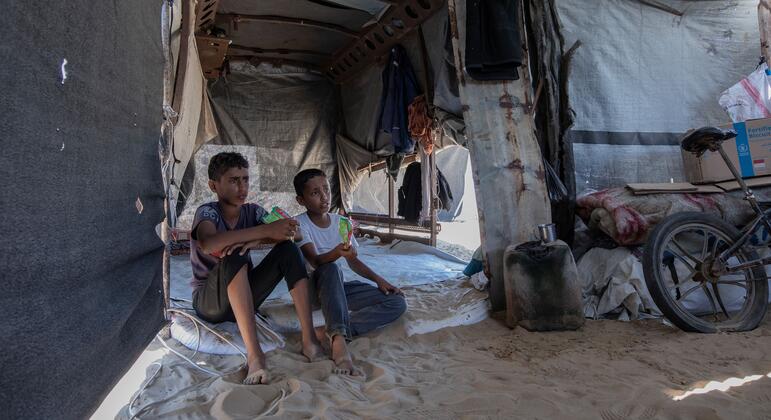
- Very likely severe humanitarian pressure will persist in Gaza and southern Lebanon over the next 1-3 months, and likely political friction will impede implementation of the Gaza plan. UN agencies report that 94 per cent of Gaza's 2.1 million residents need shelter and that more than four out of five families face critical or catastrophic living conditions. The UK Government reports that 59 per cent of Gaza's population faces crisis-level food insecurity or worse. Israel's military struck a tent sheltering displaced Palestinians in southern Gaza on 27 August, while Benjamin Netanyahu and Israel Katz said the Erez Crossing would not open for goods. The UK Government is demanding predictable aid access and a phased IDF withdrawal, while Israel's stated position links reconstruction and withdrawal to Hamas disarmament. The assessment is medium confidence because the humanitarian conditions are supported by UN and government reporting, but the forward assessment depends on changing access decisions and contested implementation of the Gaza plan. (Confidence: medium · ASSESSED)
- I&W: CONFIRM: The Erez Crossing remains closed for goods and UN agencies report further displacement, shelter need or food insecurity in Gaza. (0-30 days)
- I&W: BREAK: The Erez Crossing opens for goods and UN or UK reporting confirms predictable entry of aid and fuel at scale for 14 consecutive days. (0-30 days)
- Likely Iran will continue targeting US-linked military, intelligence or civilian infrastructure over the next 0-30 days, but the reported geographic scope remains unresolved. Reporting attributes attacks to at least 20 US government sites across eight countries and to at least 100 water facilities in 12 US states. Separate reporting says Iran has struck 11 countries, while Georgia experienced a sharp fall in water pressure. The assessment is low confidence because the geographic counts and cyber attribution are not independently corroborated in the supplied material, and the claims are inconsistent on the number and type of targets. (Confidence: low · ASSESSED)
- I&W: CONFIRM: A named US water utility reports pump or pressure disruption, or US and host-government officials attribute a new incident to Iranian hackers. (0-30 days)
- I&W: BREAK: US and host-government investigations attribute the reported incidents to non-Iranian actors and identify no additional Iranian-linked disruption for 30 days. (0-30 days)
Outlook & scenarios
Prolonged coercive stalemate (55%)
US economic measures remain in force, Iran sustains pressure on the Strait of Hormuz and US-linked targets, and Israel-Hezbollah and Gaza activity continues. Qatar, Pakistan and Oman maintain contacts, but no durable settlement follows.
Limited negotiated de-escalation (30%)
Qatar's prime ministerial visit to Tehran, Pakistan's mediation and Iran-Oman talks produce a monitored reduction in attacks. Commercial shipping improves gradually, but restrictions on military vessels and unresolved Gaza conditions prevent a comprehensive settlement.
Wider regional escalation (20%)
A further tanker strike, Iranian attack on a US-linked facility or Hezbollah drone launch prompts Israeli or US retaliation. The conflict spreads across additional Gulf, Lebanese or cyber targets while diplomatic contacts continue without effect.
Abrupt Hormuz closure and economic shock (8%)
Iran enforces a ban on military and commercial vessels, oil deliveries from Kharg Island stop, and the US expands blockade or vessel-seizure enforcement. This low-probability, high-impact outcome sharply reduces regional exports and raises pressure on US partners.
Recommendations
- Maintain a 24-hour Strait of Hormuz watch covering tanker strikes, vessel detentions, Iranian notices naming ships, Iranian Revolutionary Guard statements and the terms of any Iran-Oman agreement.
- Build a claim-resolution matrix for the reported Iranian reach. Separate the figure of at least 20 US government sites across eight countries from the separate claim that Iran struck 11 countries, and track which host governments confirm each incident.
- Treat NASA FIRMS thermal detections as corroboration of heat only, not proof of a strike or attribution. Pair them with official incident reports, imagery and local reporting before assessing responsibility.
- Track diplomatic deliverables rather than statements alone. Record whether Qatar's prime minister reaches Tehran, whether Pakistan announces a new contact round, and whether Iran and Oman publish operational terms for the Strait of Hormuz.
- Prioritise daily reporting on the Erez Crossing, entry of aid and fuel into Gaza, UN shelter and food-insecurity indicators, and UNIFIL observations in southern Lebanon.
- Seek direct validation from US and host-government authorities for reported damage to US sites and water facilities. Distinguish physical damage, cyber access and service disruption in collection and reporting.
Confidence & uncertainty
Overall confidence is medium because the current picture is supported by multiple high-reliability inputs from UN agencies, the UK Government, wire services and major outlets on Gaza's humanitarian conditions, diplomatic contacts, tanker incidents and Israel-Hezbollah exchanges. Confidence is lower on Iranian attack totals, cyber attribution, projectile responsibility in the Strait of Hormuz and the actual scale of Iranian oil-export disruption. Several supplied claims also contain inconsistent dates or conflicting official statements.
Intelligence gaps
- [EEI 1.1 · UNCOVERED] Movement, dispersal, or emplacement of Iranian conventional or IRGC heavy assets (ballistic missile launchers, Khoramshahr/Toofan-class missile transporters, ground-to-ground TELs, air defense batteries, amphibious units) from garrison areas toward forward bases or coastal launch sites. Recommended collection: satellite/IMINT
- [EEI 1.2 · UNCOVERED] Authenticated Iranian military orders, NSC/IRGC operations directives, or senior leadership statements explicitly directing strikes against Israel or US forces or authorizing cross-border operations. Recommended collection: human/diplomatic
- [EEI 1.3 · PARTIAL] Changes in Israeli and US force posture indicating anticipation of direct large-scale conflict, elevated readiness levels, mobilization notices, pre-positioning of munitions, or public/private orders to prepare offensive strikes. Recommended collection: open-source/diplomatic
- [EEI 2.1 · UNCOVERED] Observable pre-launch preparations for missile/rocket/cruise missile strikes (fueling, warhead mating, launcher orientation, support vehicle congregation) and abnormal munitions handling at known launch sites. Recommended collection: satellite/IMINT
- [EEI 2.2 · PARTIAL] Indications of proxy arms shipments and weapons transfers (truck convoys, small boat transfers, container movements from Iran to proxies, new stockpiles in Lebanon, Iraq, Yemen, Syria). Recommended collection: maritime/AIS
- [EEI 2.3 · UNCOVERED] Evidence of cyber attack planning or active exploitation campaigns targeting Israeli or US military/critical infrastructure (emergence of new command-and-control servers, spear-phishing campaigns against defense personnel, successful intrusions). Recommended collection: cyber
- [EEI 3.1 · UNCOVERED] Movements and posture changes of US regional platforms (carrier strike groups, amphibious ready groups, B-52/B-1/B-2 or fighter deployments, missile defense assets repositioning) and associated armament loadouts. Recommended collection: satellite/IMINT
- [EEI 3.2 · UNCOVERED] Official or leaked US government/diplomatic communications indicating thresholds for strikes, authorization for offensive operations, or limits on action (NSC/DoD statements, congressional notifications, diplomatic notes). Recommended collection: diplomatic/human
- [EEI 3.3 · PARTIAL] Changes in US base force-protection measures and rules of engagement at regional facilities (base lockdowns, evacuation notices, flight restrictions, activation of Local Defense Forces or missile intercept systems). Recommended collection: open-source/local reporting
- [EEI 4.2 · PARTIAL] Houthi-attributed maritime attack indicators: AIS anomalies/loss of contact for commercial vessels, reports of missile/drone strikes or near-miss incidents in Bab al-Mandeb/Red Sea, Houthi claims paired with imagery of weapons launches. Recommended collection: maritime/AIS
- [EEI 4.3 · UNCOVERED] Militia cross-border attack evidence from Iraq/Syria: recorded rocket/mortar launch events into Israel or strikes against US facilities, movement of armed convoys toward border areas, and intercepted communications coordinating cross-border operations. Recommended collection: signals/ELINT
Cited sources
[1] Associated Press · Regional powers seek off-ramp from Iran war, and other Middle East developments (A) · sha256:145ef90faa7e [2] haaretz.com · Netanyahu nixes IDF opening of Gaza border crossing despite U.S. pressure (A) · sha256:ea6dfc523c99 [3] Wikipedia · 2026 Iran war (B) · sha256:667946edcb95 [4] The Jerusalem Post · Live Updates: Latest from Israel, Iran, and the Middle East | The Jerusalem Post (A) · sha256:14c2d83838bf [5] addiyar.com · «حرب المياه الرقمية». هجمات إيرانية تطال 12 ولاية أميركية (B) · sha256:56675def8913 [6] haaretz.com · <b>Unprecedented U.K. sanctions</b> on Israel are coming. How will British Jews respond? (A) · sha256:4123c6e9d79d [7] Islam Times · Islam Times (B) · sha256:1054576f7196 [8] cnn.com · ‘We will retaliate like an earthquake:’ How Iran could respond to Trump’s economic ‘D-Day’ | CNN (A) · sha256:e2532a4d79dc [9] Al Jazeera · Iran emphasises self-sufficiency in battle against US economic war (A) · sha256:97be3b90a521 [10] maritime-executive.com · Iran's Floating Oil Storage Shrinks to Five-Month Supply (B) · sha256:234e2cdb565d [11] haaretz.com · Gaza Board of Peace envoy: Israel must honor commitments for cease-fire to advance (A) · sha256:d14ee3d5cd46 [12] gcaptain.com · Shipping Traffic Through Strait of Hormuz Rises Slightly, Data Shows (B) · sha256:4c7ebf23b140 [13] al-jareeda.com · مفاوضات مجمّدة وميدان ملتهب. وواشنطن تضغط على لبنان (B) · sha256:8896a5c363a5 [14] United Nations · Middle East: 94 per cent need shelter in Gaza, Israel ramps up demolitions in Lebanon (A) · sha256:aa5d2b0f402c [15] UK Government · Both parties must fulfil their commitments under Resolution 2803 and refrain from actions that undermine peace: UK statement at the UN Security Council (A) · sha256:22593220c0b4 [16] npr.org · Official leading Trump's Gaza ceasefire effort criticizes Israel for its attacks (A) · sha256:048246010b75 [17] The Daily Beast · Jaw-Dropping Cost of Damages in Trump’s War Exposed (B) · sha256:4906ed016b01
Source content hashes were computed at collection time; the cited text is preserved unmodified for the life of this product.
TLP:CLEAR
/file/attachments/2391/images-2026-08-26T233124531_960549.jpg)