TLP:CLEAR · Disclosure is not limited.
Iran-Israel Conflict: Maritime Risk and Regional Spillover, 7 October 2026
Time window: Last 1 day · Audience: General analyst · Type: Situation report · DTG: 2026-10-07 13:44Z · Overall confidence: HIGH
BLUF
Likely, Strait of Hormuz shipping and Yemen-linked security risks will remain the nearer-term regional concern. Israeli and Iranian warnings raise concern about a new direct exchange, but current reporting does not confirm an attack decision or a new Iran-Israel strike.
Executive summary
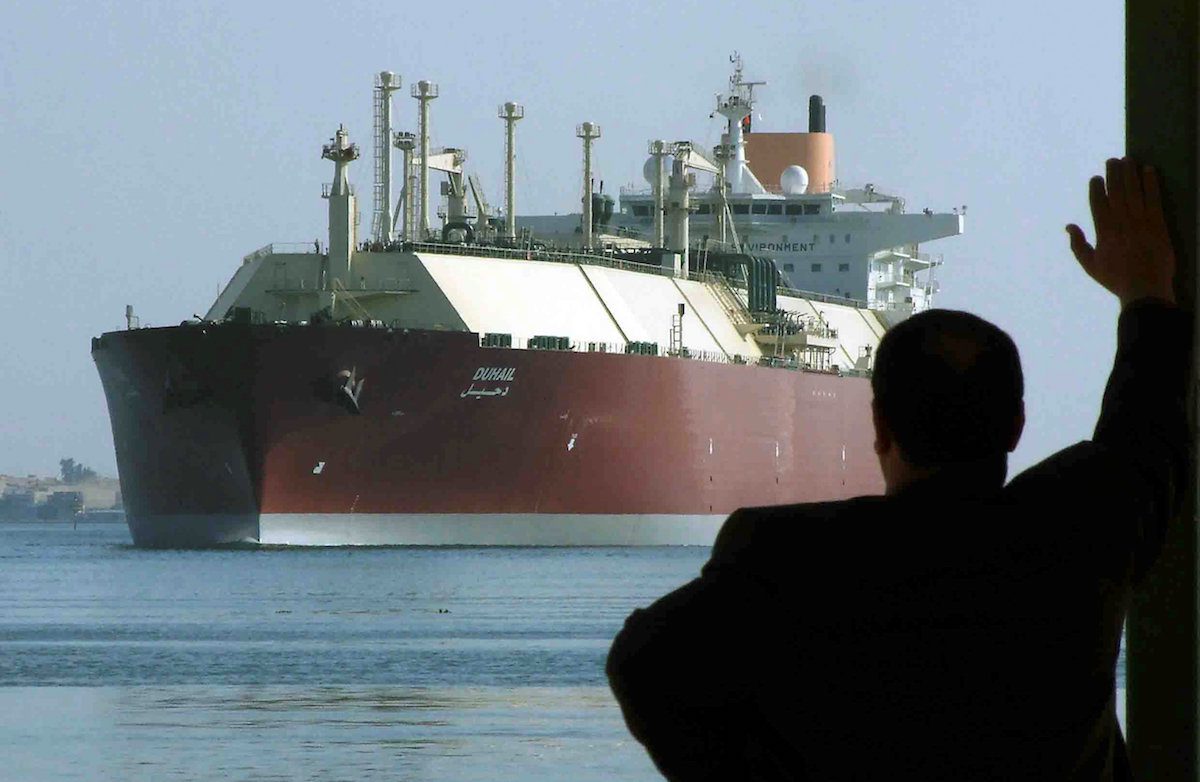
Reporting from 6-7 October describes continued danger to shipping: UKMTO reported tanker incidents on 5 October, India reported 12 crew injured aboard the Panama-flagged On Peace, and Greece's shipping ministry reported an unidentified object struck a Greek-owned LNG carrier near the Strait of Hormuz on 7 October. Attribution and some incident details remain unsettled. Israeli officials reportedly fear an Iranian attack, and a report citing Israeli army sources says Benjamin Netanyahu could order pre-emptive strikes; neither report confirms an operational decision. In Yemen, the Transport Ministry reported a Houthi attack near Aden International Airport, while Saudi authorities reported missile interceptions and the Houthis claimed attacks on Saudi airports. Gulf energy exports have recovered unevenly, and Qatar has positioned empty LNG carriers in the Persian Gulf, but this does not establish that normal shipments have resumed.
Change from previous assessment
Since the 6 October brief, reporting adds a 7 October strike report involving a Greek-owned LNG carrier, Qatar's positioning of at least 12 empty LNG carriers, and Houthi-reported attacks alongside a reported missile impact near Aden International Airport. The Strait of Hormuz hazard assessment is reinforced by these developments and the IMO's September cumulative figures. The prior brief's view that reporting did not establish a new direct Iran-Israel exchange remains unchanged for confirmed events, but reports of Israeli concern and possible pre-emption raise the assessed near-term risk; confidence in that warning-based judgment remains low. This brief adds a Yemen spillover judgment and continues to assess export recovery as incomplete and Iranian export estimates as disputed.
Key judgments
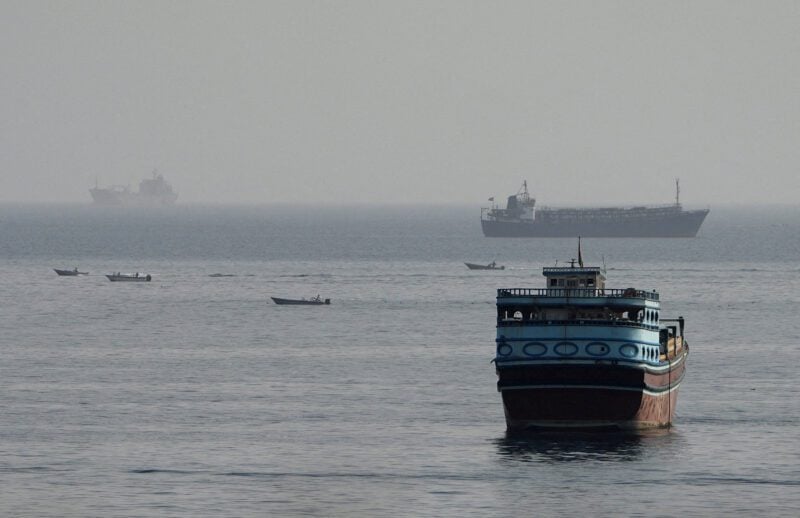
- Likely, commercial shipping in and around the Strait of Hormuz will remain hazardous and uneven through 21 October. UKMTO reported an unidentified tanker struck by an unknown projectile, causing an engine-room fire, on 5 October, and separately reported an IRGC order for an inbound tanker to turn back. India reported 12 crew injured aboard the Panama-flagged On Peace on 5 October; Greece's shipping ministry reported that an unidentified object struck a Greek-owned LNG carrier near the strait on 7 October. The IMO reported 80 verified attacks on merchant vessels and at least 22 seafarers killed since 28 February. A trade publication attributed 12 vessel hits in one week to Iran, but UKMTO left the projectile responsible for the 5 October strike unidentified, so attribution of individual attacks remains unresolved. (Confidence: medium · ASSESSED)
- I&W: Confirm: UKMTO issues another warning for a projectile strike on a named commercial vessel in or near the Strait, or reports another IRGC order for a vessel to turn back. (0-14 days)
- I&W: Break: UKMTO reports no new attack warnings for 14 consecutive days and vessel-tracking reports confirm laden QatarEnergy LNG carriers transiting the Strait. (0-14 days)
- Unlikely, a new direct Iran-Israel exchange will occur by 21 October, although reported threat assessments raise concern. Senior Israeli officials reportedly warned that US pressure and Iran's economic crisis could lead Tehran to attack Tel Aviv; a separate report citing Israeli army sources said Netanyahu could order pre-emptive strikes. Iran's armed forces chief of staff threatened a strong response to a new attack and warned that US interests could be targeted. These are reports of warnings and concern, not evidence of an authorised strike or confirmed preparations. The available reporting does not confirm a new direct Iran-Israel strike during 6-7 October. (Confidence: low · ASSESSED)
- I&W: Confirm: Israel or Iran publicly confirms a direct strike on the other's territory, or Israel announces authorisation for a pre-emptive strike on Iran. (0-14 days)
- I&W: Break: No direct strike is confirmed by 21 October, and Israeli officials state that no strike on Iran has been authorised. (0-14 days)
- Likely, fighting in Yemen will remain an additional source of regional security risk over the next 14 days. Yemen's Transport Ministry reported a Houthi attack on Aden International Airport on 7 October; one missile landed near the runway and an incoming Cairo flight was diverted to Jeddah. The Saudi-led coalition reported missile interceptions near Riyadh and toward Khamis Mushait, but the reported interception locations differ. Houthi claims of attacks on King Khalid International Airport and Abha International Airport lacked immediate Saudi confirmation. These reports support concern about Houthi activity, but do not establish Iranian direction or command. (Confidence: medium · ASSESSED)
- I&W: Confirm: Yemen's Transport Ministry or Saudi authorities confirm another Houthi missile or drone attack on Aden International Airport, a named Saudi airport, or a Saudi airbase. (0-14 days)
- I&W: Break: Houthi authorities announce a halt to attacks on Saudi and Yemeni targets, with no further attack confirmed by Yemen's Transport Ministry or Saudi authorities. (0-14 days)
- Unlikely, Gulf energy flows had fully returned to pre-war levels by September. Donald Trump said on 6 October that oil traffic through the Strait had returned to pre-war levels, but Vortexa data put exports from seven Gulf producers at 19.2 million barrels per day in September, against about 23.6 million before the conflict. Separate figures put crude and condensate flows at 91 per cent of pre-war levels and refined-fuel exports at 60 per cent. LNG traffic through Hormuz reached its highest level since the war began in September but remained about 75 per cent below February levels. Qatar had at least 12 empty LNG carriers waiting in the Persian Gulf, an indicator of possible shipment activity, not evidence of completed laden transits. The reported totals use different scopes and measures, limiting direct comparison. (Confidence: medium · ASSESSED)
- I&W: Confirm: Kpler or Vortexa reports, on a consistent scope, that monthly Gulf crude and condensate exports and refined-fuel exports have both reached or exceeded their pre-war baselines. (1 month)
- I&W: Break: Comparable monthly data continue to show crude or condensate exports below the pre-war baseline, or refined-fuel exports near the reported 60 per cent level. (1 month)
- Likely, the US blockade will continue to constrain new Iranian crude exports over the next 14 days, but the volume of remaining exports and floating stock is uncertain. United Against Nuclear Iran reported no crude loadings at Iranian export terminals in September and estimated Iranian exports at about 50,789 barrels per day that month, down from 966,133 barrels per day in July. It also estimated that 9 million barrels were transferred ship-to-ship off Malaysia in September and that roughly 10 million barrels remained in floating storage there. Another report described Iranian September exports as zero, while a separate Gulf export total included Iran without specifying its contribution. The figures conflict, and the detailed estimates rely heavily on UANI reporting. (Confidence: low · ASSESSED)
- I&W: Confirm: Independent satellite or vessel-tracking data report no new crude loadings at Iranian export terminals and no verified Iranian crude crossing of the blockade line. (0-14 days)
- I&W: Break: Independent tracking verifies a new Iranian crude loading or a laden Iranian crude tanker crossing the reported blockade line. (0-14 days)
- Unlikely, a rapid agreement to reopen the Strait of Hormuz will be reached by 21 October. Qatar's Foreign Ministry said on 29 September that US-Iran meetings and message exchanges were continuing. Iran's reported 28 September proposal linked reopening the Strait to lifting the US blockade of Iranian ports and sanctions on Iranian oil. US public statements have included a promise that military operations would end soon, a threat to bomb Iran or make a deal, and a low-confidence report that Trump was open to direct negotiations. The reporting shows contact and competing public signals, not agreement on terms or sequencing. (Confidence: medium · ASSESSED)
- I&W: Confirm: Qatar, the US and Iran announce an agreed sequence linking blockade measures to verified reopening or transit through the Strait. (0-14 days)
- I&W: Break: Qatar reports that US-Iran contacts have stopped, or either side publicly rejects the reported linkage between the blockade and reopening the Strait. (0-14 days)
Outlook & scenarios
Continued coercion without a new direct Iran-Israel exchange (50%)
Iran-Israel warnings continue without a confirmed new direct strike. Commercial shipping remains uneven through the Strait of Hormuz, while the reported Houthi attacks and interceptions keep Aden and southern Saudi Arabia on alert. Qatar's mediation continues without an agreed reopening sequence.
Direct Iran-Israel exchange (25%)
An Israeli pre-emptive strike or an Iranian missile attack breaks the current restraint. Iran's warning that US interests could be targeted raises the risk of the exchange drawing in US forces. Shipping operators respond by delaying or rerouting additional voyages through the Strait.
Limited maritime easing through negotiation (18%)
Qatar's contacts produce a limited arrangement on transit or blockade measures. QatarEnergy's waiting LNG carriers begin confirmed laden voyages, while the broader conflict and disagreement over Iranian oil sanctions remain unresolved.
Low-probability, high-impact spillover (7%)
A Houthi strike damages a Saudi oil facility or a Qatari gas facility as a separate Hormuz incident affects commercial vessels. The recently reported US Patriot batteries in Saudi Arabia and Qatar become central to local defence, and a US response draws the conflict into a wider regional exchange.
Recommendations
- Maintain a dated incident register for Strait of Hormuz attacks. Keep the 5 October UKMTO warnings, the On Peace strike and the 7 October Greek-owned LNG carrier report separate unless vessel identity, time and position data confirm a link.
- For each vessel incident, compare UKMTO notices with statements from India's Ministry of External Affairs, Greece's shipping ministry and the IMO. Record attacker attribution, weapon type, casualty count and location as unconfirmed where those sources do not establish them.
- Track Israeli and Iranian official statements separately from reports of internal warnings. Seek confirmation of a strike order, force preparations or a direct attack before raising the assessed likelihood of an Iran-Israel exchange.
- Check Houthi claims against statements from Yemen's Transport Ministry and Saudi authorities. Record airport closures, flight diversions and missile interceptions by named location, and do not treat the conflicting Riyadh and Khamis Mushait accounts as one confirmed event.
- Reconcile Kpler and Vortexa export data using the same dates, routes and product categories. Separately monitor whether QatarEnergy's empty LNG carriers load cargo and transit the Strait, and whether independent vessel tracking confirms Iranian crude loadings or exports.
- Track Qatar-mediated US-Iran contacts alongside the stated conditions on Iranian ports, oil sanctions and Hormuz transit. Distinguish a public offer to talk from an agreed or implemented de-escalation measure.
Confidence & uncertainty
Overall confidence is high for the broad situation picture because official maritime and government reporting, the IMO's cumulative figures, wire reporting and vessel-tracking estimates converge on continuing shipping risk, uneven energy flows and Houthi-related security incidents. Confidence is lower on individual attack attribution, incident counts and export volumes: some accounts conflict on location, weapon or measurement scope, while the reported Israeli pre-emption concern is not confirmation of an order. The high overall rating applies to the corroborated situation picture, not equally to each forecast.
Intelligence gaps
- [EEI 1.1 · PARTIAL] Detection and characterization of ballistic/cruise missile or rocket launches originating from Iranian territory or from Iran-controlled positions in Iraq/Syria (time, launch coordinates, missile type, flight trajectory/impact area). Recommended collection: satellite/imagery
- [EEI 1.2 · UNCOVERED] Movements and posture changes of Iran-backed proxy forces (Hezbollah units in Lebanon, militias in Syria/Iraq): concentrations of personnel, transport of rocket/artillery launchers, visible logistics build-up within operational range of Israel. Recommended collection: human/intel
- [EEI 1.3 · PARTIAL] Israeli defensive and offensive posture changes: reservist call-ups, mobilization orders, sorties/airstrikes attributed to Israel, and domestic activation of missile-defense systems (locations and activation times). Recommended collection: open-source/media
- [EEI 1.4 · UNCOVERED] Evidence of pre-positioning or arming of naval mines, fast attack craft, or anti-ship missile systems in the Gulf of Oman, northern Arabian Sea, or off the Lebanese/Syrian coasts that could be used to interdict Israeli or allied shipping. Recommended collection: maritime/AIS
- [EEI 2.1 · PARTIAL] Movements and tasking changes of external military assets: carrier strike groups, amphibious ready groups, expeditionary air wings, or ballistic-missile defense units into the Eastern Mediterranean, Persian Gulf, or Red Sea (vessel/aircraft IDs, routing, on-station times). Recommended collection: maritime/AIS
- [EEI 2.2 · UNCOVERED] Formal diplomatic/military actions: evacuation orders or embassy closures, public troop posture statements, bilateral/multilateral defense commitments announced, requests for overflight or basing rights in regional states. Recommended collection: diplomatic
- [EEI 2.3 · PARTIAL] Changes to force protection or alert levels at foreign bases in the region (e.g., US bases in Kuwait, Qatar, UAE; Russian bases in Syria): activation of additional air defenses, curfews, or reinforcement shipments (personnel/equipment manifests). Recommended collection: signals/intel
- [EEI 3.2 · PARTIAL] Changes in crude oil and refined product flows from key terminals (reported tanker loading delays, terminal closures, throughput volumes at Kharg, Mina al-Ahmadi, Ras Tanura, and major Gulf ports compared to baseline). Recommended collection: commercial/ports
- [EEI 3.3 · UNCOVERED] Market and insurance indicators: sudden spikes in war-risk or hull insurance premiums for Middle East routes, large moves in regional FX/stock indices, and notable changes in commodity futures (oil, freight rates) tied to regional risk perceptions. Recommended collection: financial/transactional
Cited sources
[1] gCaptain · A Dozen Seafarers Injured in Strait of Hormuz Tanker Attack, India Says (C) · 6 October 2026 · sha256:629eca54ff54 [2] Bloomberg (republished by gCaptain) · Qatar Brings Empty LNG Ships Into Gulf in Potential Export Boost (A) · 7 October 2026 · sha256:6899ab11e3b4 [3] gCaptain · IMO Chief Decries Rising Toll on Seafarers Caught in Conflict (C) · 6 October 2026 · sha256:206e12392858 [4] The Maritime Executive · Saudi Bypass Pipeline Quickly Rebounded After Attack, Export Data Shows (C) · sha256:35f4b3aaa01d [5] Euronews (Arabic) · الضغط الأميركي يشتد على إيران. وإسرائيل تضع احتمال هجوم صاروخي من طهران على الطاولة (A) · 7 October 2026 · sha256:98c47d650d98 [6] Reuters (republished by gCaptain) · Houthis Attack Aden Airport as Fighting Intensifies in Yemen (A) · 7 October 2026 · sha256:c4b134e799e6 [7] Al Jazeera (aljazeera.net) · أخبار إيران | إيران | الجزيرة نت (A) · sha256:8435c5e2b37b [8] gCaptain (republishing Thomson Reuters) · Gulf Oil Flows Rise to Average 81% of Pre-war Rate in September (B) · 6 October 2026 · sha256:6cde5a909a33 [9] gCaptain · Iran’s Offshore Oil Stockpile Nears Exhaustion as Blockade Chokes New Supply (C) · 6 October 2026 · sha256:2b0ab0634033 [10] Defence24 · Gulf security with Iran: What is Qatar proposing? (C) · 7 October 2026 · sha256:bb87a9124cf2 [11] TV7 Israel News · Shifting alliances shape Middle East security (B) · sha256:80ab504f95ba
Source content hashes were computed at collection time; the cited text is preserved unmodified for the life of this product.
Red cell review: CONCUR WITH COMMENT
TLP:CLEAR