TLP:CLEAR · Disclosure is not limited.
Iran-Israel Conflict: Regional Attacks and Maritime Risk Increase
Time window: Last 1 day · Audience: General analyst · Type: Situation report · DTG: 2026-10-08 11:05Z · Overall confidence: MEDIUM
BLUF
The conflict’s reported effects now extend beyond Iran and Israel: Houthi attacks struck Abha and King Khalid airports on 6 and 7 October, while a single major-media report attributes attacks on energy and transport sites in Qatar and the UAE to Tehran. Commercial shipping through the Strait of Hormuz is very likely to remain at elevated risk, although claims about Iranian control of the strait conflict with reporting of continued traffic.
Executive summary
Reporting on 7 and 8 October describes Houthi attacks on two Saudi airports that killed three people, followed by Saudi-led coalition claims of strikes on more than 80 Houthi sites in Yemen. Maritime security sources counted at least 12 tanker attacks around the Strait of Hormuz during the week of 28 September to 5 October, while IMO data recorded nine vessel incidents for the same period. Reporting also attributes strikes on Qatar’s Ras Laffan gas hub and fires near Dubai airport and Fujairah’s oil zone to Tehran, but this account lacks corroboration in the supplied reporting. US and Iranian officials offer opposing accounts of control of Hormuz, while shipping and LNG reports indicate that some traffic continues.
Change from previous assessment
Since the 7 October brief, the assessment has expanded from elevated shipping risk and continued Yemen fighting to include Houthi attacks on Abha and King Khalid airports, Saudi-led coalition claims of strikes on more than 80 Houthi sites, and a report of attacks on Qatar and UAE sites attributed to Tehran. Confidence in continued Hormuz shipping risk remains medium, with new reporting of at least 12 tanker attacks and nine IMO vessel incidents for the same week, figures that may use different counting methods. The new report of strikes on Gulf infrastructure is assessed with low confidence because it lacks corroboration in the supplied reporting. The prior brief’s discussion of Iranian export estimates is not reassessed here because the current claims provide no updated export figures.
Key judgments
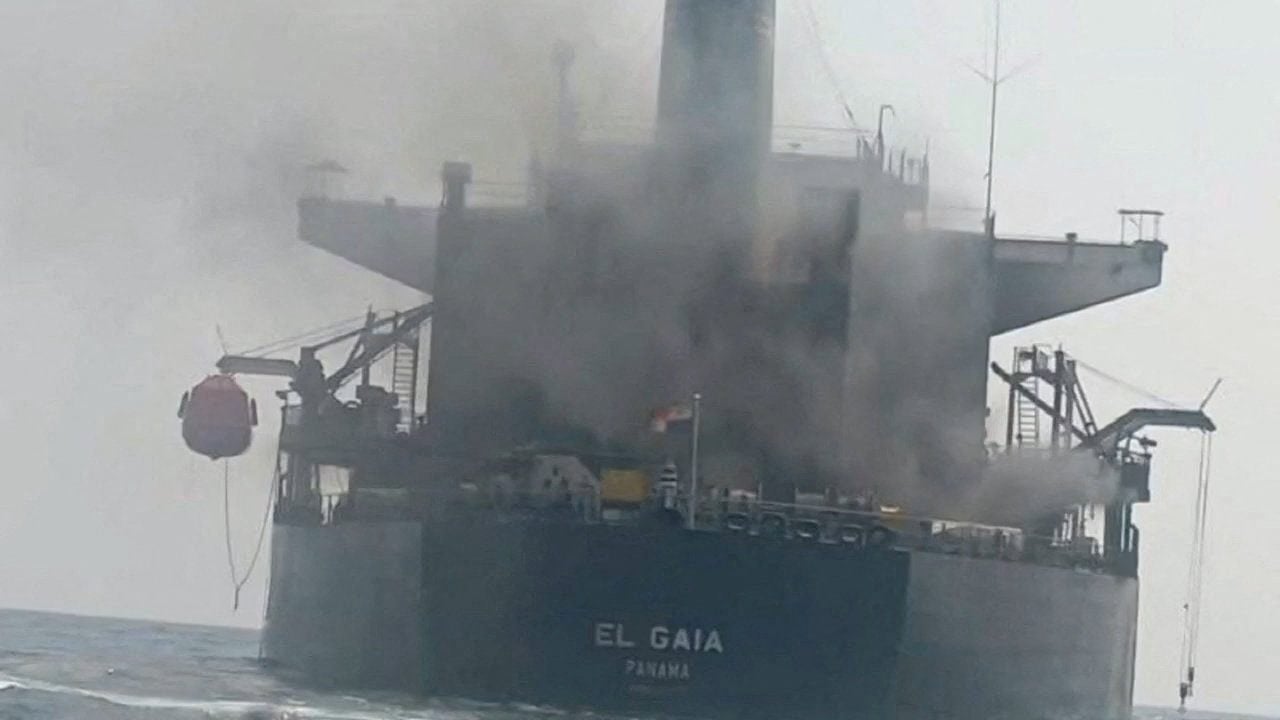
- Commercial shipping in the Strait of Hormuz is very likely to remain at elevated risk over the next 0-14 days. Maritime security sources reported at least 12 tanker attacks around the strait during the week of 28 September to 5 October, while IMO data recorded nine vessel incidents for that week. India’s foreign ministry said a projectile struck the Panama-flagged tanker On Peace on 6 October, injuring 12 crew members. The counts are not directly comparable, and the supplied reporting does not firmly establish responsibility for the attacks. Confidence is medium: the incident picture draws on a wire service, IMO data, JMIC reporting and a government statement, but the totals and attribution remain uncertain. (Confidence: medium · ASSESSED)
- I&W: UKMTO or JMIC reports another projectile strike, attempted attack or IRGC harassment incident involving a named vessel in the Strait of Hormuz. (0-14 days)
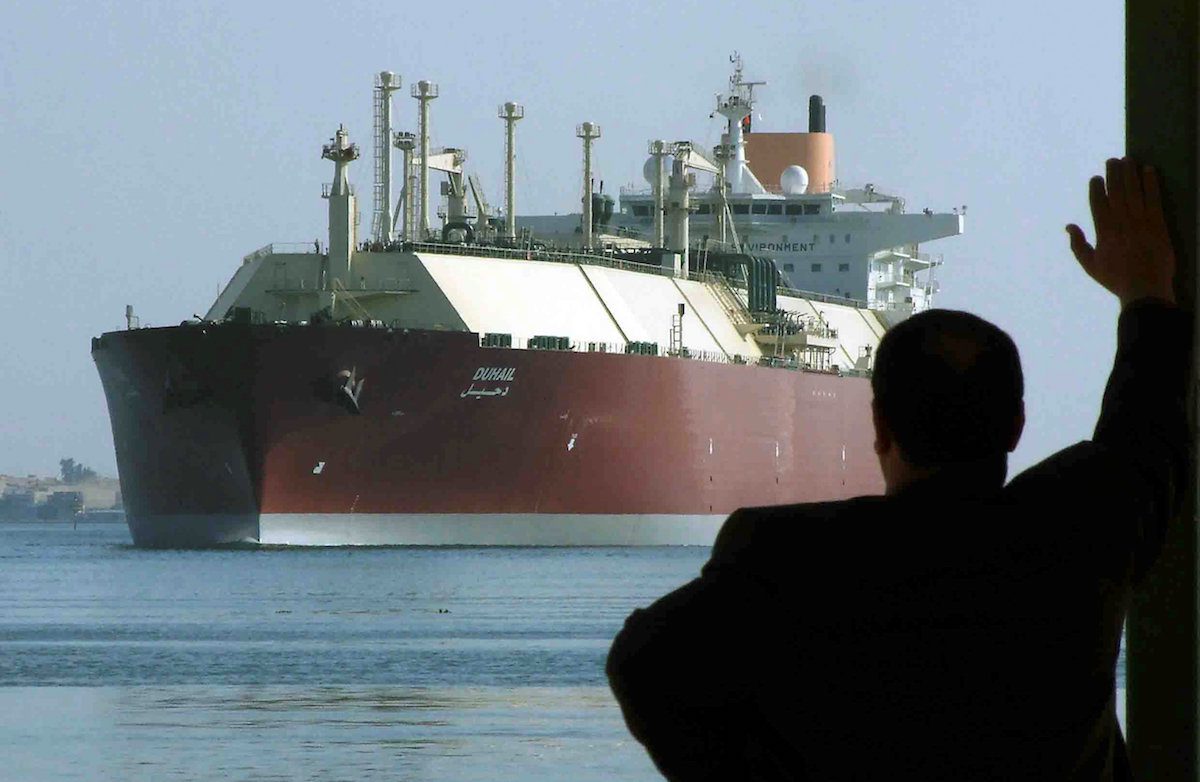
- I&W: Ship-tracking data show no laden commercial transits through the strait for 72 hours, with QatarEnergy’s waiting LNG carriers still not departing. (0-14 days)
- Houthi attacks on Saudi targets and Saudi-led coalition strikes in Yemen are likely to continue over the next 0-14 days. Saudi Arabia’s General Authority of Civil Aviation reported attacks on Abha International Airport and King Khalid International Airport in Riyadh on 6 and 7 October, with three people killed. The Houthis claimed the attacks, and the coalition said it had struck more than 80 Houthi military sites across Saada, Al Hudaydah, Al Jawf and Ma’rib. Saudi casualty reporting is corroborated by major-media coverage, but the attack and strike details rely partly on statements from parties to the conflict. Confidence is medium. (Confidence: medium · ASSESSED)
- I&W: Saudi Arabia’s General Authority of Civil Aviation reports another attack at Abha or King Khalid airport, or the Saudi-led coalition announces another strike in Saada, Al Hudaydah, Al Jawf or Ma’rib. (0-14 days)
- I&W: The General Authority of Civil Aviation reports no further attack at either airport and the coalition announces no additional strikes in Yemen. (0-14 days)
- A major-media report attributes drone and missile strikes on Qatar’s Ras Laffan gas hub, and fires near Dubai airport and Fujairah’s oil zone, to Tehran. The supplied reporting does not independently corroborate the attribution or describe the damage, so the reported incidents and responsibility remain uncertain. Confidence is low because this judgment rests on one report. (Confidence: low · REPORTED)
- I&W: Qatari or UAE authorities, or independent reporting, confirm damage at Ras Laffan, near Dubai airport or in Fujairah’s oil zone and identify the weapon or point of origin. (0-14 days)
- I&W: Qatari or UAE authorities explicitly deny damage at the named sites, and no independent reporting corroborates the reported strikes. (0-14 days)
- Commercial traffic through the Strait of Hormuz is very likely continuing at some level, but the supplied reporting does not establish normal access or who controls passage. US Secretary of State Marco Rubio said oil volumes were approaching pre-conflict levels and that Iran had lost control, while Mohammad Reza Naqdi said the strait remained closed and under Iranian control. September LNG traffic rose to its highest level since the war began, but remained about 75 per cent below February levels. These reports support continued movement alongside substantial disruption, not either official’s full account of control. Confidence is medium because shipping data and official statements provide useful but conflicting evidence. (Confidence: medium · ASSESSED)
- I&W: Ship-tracking or satellite data record laden oil and LNG carriers transiting the Strait of Hormuz. (0-14 days)
- I&W: Tracking data show no laden commercial transits for 72 hours, or Iranian forces are reported to have physically blocked or destroyed passages in the strait. (0-14 days)
Outlook & scenarios
Continued exchanges with intermittent shipping (45%)
Houthi attacks on Saudi targets and Saudi-led coalition strikes continue, while attacks and harassment around the Strait of Hormuz keep commercial shipping exposed. Some oil and LNG traffic continues, but operators face repeated interruptions and uncertainty over access.
Further expansion to Gulf energy and transport sites (30%)
The reported attacks on Ras Laffan, near Dubai airport and Fujairah’s oil zone are independently confirmed. Further attacks on Gulf energy or transport sites widen the conflict’s direct effects beyond the Iran-Israel theatre.
Acute restriction of Hormuz transit, low-probability wildcard (10%)
Iran acts on Naqdi’s statement about closing passages, or repeated attacks lead to a sharp halt in laden commercial transits. This would deepen the shipping disruption even if the parties continue to dispute who controls the strait.
Temporary pause in attacks (15%)
The parties reduce or halt attacks for a short period, allowing Saudi airport operations and commercial shipping to proceed without new reported incidents. The supplied reporting provides no evidence of an agreed pause, so this scenario depends on a change in behaviour rather than a reported diplomatic arrangement.
Recommendations
- For daily updates, separate confirmed incident reporting from claims of responsibility. Prioritise updates from UKMTO, JMIC, India’s foreign ministry and Saudi Arabia’s General Authority of Civil Aviation, and label statements from the Houthis, Iranian officials and the Saudi-led coalition as party claims.
- Track Hormuz incidents by date, vessel type, location and incident category. Keep the maritime security sources’ figure of at least 12 tanker attacks separate from the IMO figure of nine vessel incidents until their counting methods are reconciled.
- Verify the reported strikes at Ras Laffan, near Dubai airport and Fujairah’s oil zone before treating Iranian responsibility or damage as established. Record official statements and independent confirmation separately.
- Monitor departures and transits of QatarEnergy’s waiting LNG carriers alongside reported LNG traffic. Use this to test claims about whether the strait is operational, without treating traffic as proof of control.
- Keep the Yemen battlefield picture open. The claims that the Houthis captured Mocha and that Saudi forces retook it conflict; do not state current control of Mocha or Bab el-Mandeb without independent confirmation.
Confidence & uncertainty
Overall confidence is medium. Major-media and wire-service reporting, Saudi civil aviation statements, IMO figures and JMIC reporting provide corroboration for several incidents, including the Saudi airport casualties and elevated maritime activity. Confidence is lower for attribution of Hormuz attacks and the reported strikes on Qatar and the UAE, which lack independent corroboration in the supplied material. Counts of maritime incidents differ, and US and Iranian officials give opposing accounts of control of the Strait of Hormuz.
Intelligence gaps
- [EEI 1.1 · PARTIAL] Number, type, launch times, and trajectories of ballistic missiles, cruise missiles, armed UAV strikes, and combat-air sorties launched by Iranian or Israeli forces toward the other's territory or forward bases within a 72-hour window. Recommended collection: signals/intel
- [EEI 1.2 · PARTIAL] Observable changes in Israeli and Iranian force posture: mobilization or reserve call-up orders, unit road/rail movements, dispersal or sortie rates of air squadrons, redeployment of air-defense batteries, and activation of civil-defense alerts or sirens in major population centers. Recommended collection: open-source/media
- [EEI 1.3 · PARTIAL] Indications of strike authorization or targeting preparations in Iranian or Israeli command chains: authenticated public orders by senior commanders, detected increases in encrypted communications consistent with targeting, or visible movement of strike munitions to launch/storage sites. Recommended collection: signals/intel
- [EEI 2.1 · UNCOVERED] Counts, launch locations (coordinates), weapons types, and assessed damage from rocket/missile/drone strikes originating from Lebanon into northern Israel attributed to Hezbollah or allied groups. Recommended collection: open-source/media
- [EEI 2.2 · PARTIAL] Reported attacks by Iranian-backed militias in Iraq and Syria: rocket/IED strikes on bases hosting US/coalition or Israeli personnel, documented militia unit movements toward borders, and captured movement or transfer of weapons systems to forward militia positions. Recommended collection: human
- [EEI 2.3 · PARTIAL] Maritime harassment or attacks by proxies (e.g., Houthis): incidents of missile/rocket strikes against commercial vessels, small-boat swarm attacks, discovery or detonation of naval mines, and corresponding AIS anomalies in the Red Sea, Gulf of Aden, or southern Arabian Gulf. Recommended collection: maritime/AIS
- [EEI 3.1 · PARTIAL] Movements and arrival dates of foreign military assets into the region: carrier strike groups, amphibious ships, surface combatants, strategic airlift/tanker deployments, and air/sea patrol patterns by US, European, Russian, or regional militaries. Recommended collection: imagery/satellite
- [EEI 3.2 · PARTIAL] Concrete diplomatic and political actions: emergency UN/Arab League meetings called, official embassy evacuation orders, public declarations of intent to interpose or protect shipping/airspace, and newly announced sanctions or arms-transfer approvals tied to the conflict. Recommended collection: diplomatic
Cited sources
[1] Reuters (republished by gCaptain) · Attacks on Tankers in Hormuz Hit Highest of Any Week Since Start of Iran War, Sources Say (A) · 7 October 2026 · sha256:ea46bef7d328 [2] gCaptain (republishing Bloomberg News) · Qatar Brings Empty LNG Ships Into Gulf in Potential Export Boost (C) · 7 October 2026 · sha256:c2690a083a60 [3] BBC News · Three people killed in attacks on Saudi Arabia airports, officials say (A) · 8 October 2026 · sha256:140771515b91 [4] Al Jazeera · Map of Middle East redrawn after October 7 (A) · 8 October 2026 · sha256:0cb945354476 [5] Euronews (Arabic) · واشنطن وطهران تتنازعان رواية السيطرة على هرمز. وإيران تلوّح بهجوم استباقي وتعتزم إغلاق مسارات التهريب (B) · 7 October 2026 · sha256:99bbe4caf0d2
Source content hashes were computed at collection time; the cited text is preserved unmodified for the life of this product.
Red cell review: CONCUR WITH COMMENT
TLP:CLEAR