TLP:CLEAR · Disclosure is not limited.
Iran, Israel: Hormuz contestation intensifies, UAE threat elevated, Houthi front heating up
Time window: Last 1 day · Audience: General analyst · Type: Situation report · DTG: 2026-07-04 12:12Z · Overall confidence: MEDIUM
BLUF
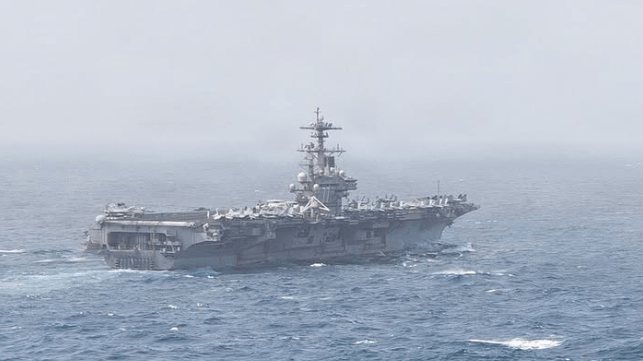
The Strait of Hormuz remains contested and unsafe as Iran and Oman signal joint management while the United States rejects any Iranian control and keeps two carrier groups and Apaches in theatre to protect shipping. Threat to U.S. personnel and facilities in the UAE is high after Tehran signalled intent to target U.S.-linked locations there, and an Israel, Houthi flare‑up is likely in the near term.
Executive summary
Competing moves over the Strait of Hormuz have hardened: Iran and Oman issued joint language on managing traffic and affirmed sovereignty, China urged unhindered transit, and European powers are reportedly accepting the prospect of fees, while Washington rejects any Iranian control and insists no charges apply. U.S. forces maintain a robust naval, air posture in theatre, even as some aircraft redeploy, with the stated aim of safeguarding commerce. The threat environment in the United Arab Emirates remains elevated given U.S. evacuation orders, FAA caution, and Tehran’s stated intent to target U.S.-associated sites. On the Yemen track, Israeli defence planning and rhetoric against the Houthi leadership, paired with assessments that Iran will not abandon the Houthis, point to likely escalation. Diplomatic arrangements around an Islamabad MoU and a 60‑day ceasefire concept remain fragile amid accusations of violations and continued strike activity. Humanitarian and economic knock‑on effects persist.
Change from previous assessment
Compared with the prior brief, assessments are updated on three fronts: Hormuz dynamics now feature explicit joint Iran, Oman management language and Chinese calls for unhindered transit, alongside reports of European acceptance of fees and firm U.S. rejection, sharpening the contestation picture. U.S. military posture is clarified with two carrier strike groups and Apaches in theatre despite some aircraft redeployments, confirming sustained readiness. The Israel, Houthi track has moved toward likely escalation given Israeli defence preparations and leadership statements, and reporting on U.S. fears of Israeli targeting of Iranian negotiators remains contested after Israeli denials. The overall confidence level remains medium.
Key judgments
- Hormuz will remain contested and unsafe for commercial transit in the near term, with Iran and Oman signalling joint management and sovereignty claims, China calling for unhindered passage, European powers reportedly accepting fees, and the United States rejecting any Iranian control while keeping carriers and Apaches in theatre to maintain the flow of commerce. (Confidence: medium · ASSESSED)
- I&W: Publication of a joint Iran, Oman transit directive requiring pre-clearance or fees for Hormuz passage by commercial shippers. (1-3 months)
- I&W: Official U.S. announcement that unescorted, routine transits have resumed with reduced war-risk ratings by major marine insurers. (1-3 months)
- Threat to U.S. personnel and facilities in the United Arab Emirates is high, given Washington’s ordered departure of non‑emergency staff, FAA caution to carriers, official warnings about armed conflict and terrorism, and Tehran’s stated intention to target U.S.-linked locations in the UAE. (Confidence: high · REPORTED)
- I&W: Additional U.S. government evacuation instructions or heightened airspace restrictions for UAE routes. (0-14 days)
- I&W: U.S. State Department lowers the UAE travel advisory and reverses ordered departure. (1-3 months)
- Despite some U.S. combat aircraft redeployments, U.S. naval, air presence in the Middle East remains robust and focused on keeping Hormuz traffic moving. (Confidence: medium · ASSESSED)
- I&W: Pentagon confirms extension of both carrier strike group deployments in theatre. (1-3 months)
- I&W: Official notice of carrier departures from the region without replacement. (0-14 days)
- An Israel, Houthi flare‑up is likely in the coming weeks, as Israeli defence planning and leadership rhetoric converge with assessments that Iran will preserve Houthi leverage and that Bab el‑Mandeb is part of Tehran’s economic coercion strategy. (Confidence: medium · ASSESSED)
- I&W: Houthi announcements or launches targeting Israeli interests or Red Sea shipping, or IDF claims of long‑range strikes in Yemen. (0-30 days)
- I&W: Public Iranian signalling of a Houthi stand‑down tied to regional arrangements. (1-3 months)
- Reports that Washington feared Israeli assassination attempts on Iranian negotiators during talks are credible but contested, with major‑media accounts citing U.S. concerns and Israeli officials issuing categorical denials. (Confidence: medium · ASSESSED)
- I&W: On‑record U.S. acknowledgement of protective measures for specific Iranian negotiators or a pause in talks citing security threats. (0-30 days)
- I&W: Joint U.S., Israeli public repudiation of the reporting with aligned talking points. (0-30 days)
- Any ceasefire architecture between Washington and Tehran is likely to remain fragile through August, with compliance disputes and strike activity persisting unless the sanctions waiver is extended and navigation arrangements are formalised. (Confidence: medium · ASSESSED)
- I&W: U.S. announcement extending the sanctions waiver beyond 21 August and a published implementation notice for navigation under the MoU. (1-3 months)
- I&W: Documented U.S. or Iranian strike claims during the nominal ceasefire period. (0-30 days)
- The conflict is likely to continue driving civilian harm and economic spillovers beyond the region, including sustained pressure on fuel prices. (Confidence: medium · ASSESSED)
- I&W: Multilateral reporting linking Middle East disruptions to increased fiscal burdens in low‑income states. (1-3 months)
- I&W: Sustained reversal in retail fuel pricing toward pre‑war levels. (1-3 months)
Outlook & scenarios
Managed contestation at Hormuz with continued U.S. escorts (50%)
Iran and Oman operationalise joint language on managing traffic while avoiding formal fee imposition, European stakeholders tacitly accommodate registration processes, and the United States sustains naval, air cover to keep commerce flowing. Passage remains risky but largely continuous as opposing positions are de facto reconciled at sea rather than on paper.
Red Sea extension: Israel, Houthi confrontation (40%)
Israeli long‑range strikes target Houthi assets or leadership after renewed threats against Red Sea shipping, prompting Houthi launches that disrupt traffic and raise insurance and naval escort demands. Iran leverages both Bab el‑Mandeb and Hormuz pressure points while avoiding direct conventional engagement.
Fragile de‑escalation under an extended waiver (30%)
Washington extends the sanctions waiver beyond August and Tehran publicises compliance with the Islamabad MoU. Japanese buyers tentatively resume engagement, and navigation arrangements reduce uncertainty without resolving sovereignty disputes. Isolated violations occur but are managed diplomatically.
Negotiator targeting shock triggers rapid regional escalation (15%)
A credible plot or attack against an Iranian negotiator surfaces, Tehran responds with rapid regional strikes and intensified pressure at Hormuz, and U.S. force protection measures surge in the UAE. Shipping disruptions spike and emergency evacuations resume.
Recommendations
- Task a daily watch on Hormuz tripwires: official maritime notices from Tehran and Muscat, insurer war‑risk adjustments, and any carrier guidance on registration or fees. Share a rolling matrix with shipping desks and energy analysts.
- Coordinate with CENTCOM and the U.S. Navy on expected carrier timelines and escort capacity, and prepare a contingency brief for clients if one carrier group departs without relief.
- Update mission protection and evacuation triggers for the UAE, aligning State Department posture, FAA notices, and any Iranian statements about targeting U.S.-linked sites.
- Develop a Red Sea escalation playbook identifying likely Houthi target sets and diversion routes, and pre‑draft advisories for maritime clients operating from the Suez approaches to Bab el‑Mandeb.
- Map the ceasefire and MoU timelines against the sanctions waiver expiry and likely extension window; prepare talking points for principals on the consequences if the waiver lapses.
- Maintain a cross‑cutting humanitarian and macroeconomic tracker that links regional disruptions to fuel price movements and low‑income country stress indicators to inform policy options.
Confidence & uncertainty
Overall confidence is medium. Several judgments rest on multiple, corroborating official and major‑media sources, including U.S. force posture in theatre, the UAE threat environment, and competing positions on Hormuz. Other areas carry contradictions or single‑source elements, notably fee acceptance versus Omani denials and contested reporting about Israeli intentions toward Iranian negotiators. Think‑tank assessments inform the Houthi outlook but are not fully cross‑validated. These gaps and competing narratives limit confidence to medium.
Alternative analysis (red cell)
The claim set shows competing statements, single-source reporting, and direct contradictions (e.g., d5537acb vs 79b2e41f; dbfe70f7 vs 5836f1fd). A defensible alternative analytic line is that the situation is characterized by contested claims, precautionary posturing, and episodic incidents rather than settled control of Hormuz, imminent targeting of U.S. personnel in the UAE, or an imminent Israel–Houthi escalation. Additional multi-source operational indicators are required to move these judgments from plausible to well‑substantiated.
Intelligence gaps
- [EEI 1.1 · UNCOVERED] Movement, dispersal, or emplacement of Iranian conventional or IRGC heavy assets (ballistic missile launchers, Khoramshahr/Toofan-class missile transporters, ground-to-ground TELs, air defense batteries, amphibious units) from garrison areas toward forward bases or coastal launch sites. Recommended collection: satellite/IMINT
- [EEI 2.1 · UNCOVERED] Observable pre-launch preparations for missile/rocket/cruise missile strikes (fueling, warhead mating, launcher orientation, support vehicle congregation) and abnormal munitions handling at known launch sites. Recommended collection: satellite/IMINT
- [EEI 2.2 · PARTIAL] Indications of proxy arms shipments and weapons transfers (truck convoys, small boat transfers, container movements from Iran to proxies, new stockpiles in Lebanon, Iraq, Yemen, Syria). Recommended collection: maritime/AIS
- [EEI 2.3 · UNCOVERED] Evidence of cyber attack planning or active exploitation campaigns targeting Israeli or U.S. military/critical infrastructure (emergence of new command-and-control servers, spear-phishing campaigns against defense personnel, successful intrusions). Recommended collection: cyber
- [EEI 3.2 · PARTIAL] Official or leaked U.S. government/diplomatic communications indicating thresholds for strikes, authorization for offensive operations, or limits on action (NSC/DoD statements, congressional notifications, diplomatic notes). Recommended collection: diplomatic/human
- [EEI 4.1 · UNCOVERED] Hezbollah-specific indicators: convoys and logistics movements toward Lebanon–Israel border, artillery/rocket emplacement in southern Lebanon, documented strikes-preparation activity, public mobilization orders or recruitment drives. Recommended collection: satellite/IMINT
- [EEI 4.2 · PARTIAL] Houthi-attributed maritime attack indicators: AIS anomalies/loss of contact for commercial vessels, reports of missile/drone strikes or near-miss incidents in Bab al-Mandeb/Red Sea, Houthi claims paired with imagery of weapons launches. Recommended collection: maritime/AIS
- [EEI 4.3 · UNCOVERED] Militia cross-border attack evidence from Iraq/Syria: recorded rocket/mortar launch events into Israel or strikes against U.S. facilities, movement of armed convoys toward border areas, and intercepted communications coordinating cross-border operations. Recommended collection: signals/ELINT
Cited sources
[1] alhurra.com · مطامع إيران في هرمز. ماذا يقول قانون البحار؟ | الحرة (B) · sha256:9d493aef8548 [2] gcaptain.com · China Urges ‘Unimpeded Passage’ of Hormuz as Fee Chatter Mounts (B) · sha256:0c6f2badd924 [3] gcaptain.com · Japan Weighs Return to Iranian Oil as Shipping Risks Cloud Sanctions Waiver (B) · sha256:422058aef7bb [4] maritime-executive.com · US Forces Still Poised in the Arabian Gulf Area (B) · sha256:bc323b87762b [5] cnn.com · US officials attempted to warn Iran of fears that Israel would assassinate mediators | CNN Politics (A) · sha256:ecc65241aec5 [6] Wikipedia · 2026 Iran war (B) · sha256:03206dc1cd98 [7] U.S. Department of State · United Arab Emirates Travel Advisory (A) · sha256:7a0c71f2991b [8] مركز صنعاء للدراسات الإستراتيجية · هل أصبح باب المندب ورقة إيران الأخطر إلى جانب هرمز؟ - مركز صنعاء للدراسات الإستراتيجية (C) · sha256:cc6b899d620b [9] ynetnews.com · Netanyahu, Trump agree to meet in US amid Iran deal tensions (B) · sha256:905bd4f9ef4a [10] nbcnews.com · U.S. was concerned Israel might try to kill Iran negotiators, sources say (A) · sha256:c469126ba3e2 [11] islamtimes.com · Iran Raps US Aggression, Defends Right to Self-Defense - Islam Times (A) · sha256:fa17432e4cf6 [12] United Nations · Middle East conflict leaves developing countries paying the price (A) · sha256:6b051a6c2c28 [13] gcaptain.com · US Oil Companies See Big Profit Jump, Gird for Clash Over Pump Prices With Trump (B) · sha256:aaea24c8af22
Source content hashes were computed at collection time; the cited text is preserved unmodified for the life of this product.
Red cell review: PARTIAL DISSENT
TLP:CLEAR