TLP:CLEAR · Disclosure is not limited.
Israel-Gaza Regional Escalation: Hebron Operation and Regional Risks
Time window: Last 7 days · Audience: General analyst · Type: Situation report · DTG: 2026-10-25 13:10Z · Overall confidence: HIGH
BLUF
Hebron is the immediate escalation centre: Israeli forces have imposed wide movement restrictions and displaced about 2,000 to 2,200 Palestinians after the 23 October checkpoint attack. Gaza’s acute food insecurity remains severe, while reports of a strike on Gaza’s Islamic University are uncorroborated. In Lebanon, the ceasefire framework remains stalled and reporting describes military preparations, but does not establish a new Israel-Hezbollah exchange.
Executive summary
Reporting describes a broad Israeli operation in Hebron following an attack that killed two Israeli soldiers. Israeli officials and local media give different displacement figures, while accounts of the attack’s wounded also conflict. Israel has announced West Bank crossing closures and restrictions on Palestinian workers for election day on 27 October, but reports differ on the restrictions’ scope. The UN World Food Programme estimates that 1.4 million people in Gaza face crisis-level food insecurity or worse. Social media reports of strikes on Gaza’s Islamic University lack independent corroboration. In southern Lebanon, a US-backed framework remains stalled, Israeli forces reportedly retain a security zone, and reports describe Hezbollah rebuilding capabilities and preparing for renewed fighting. These reports indicate heightened readiness, not a confirmed new exchange.
Change from previous assessment
Since the 24 October brief, reporting adds detail on the Hebron cordon, demolitions and displacement, including an official estimate of about 2,000 displaced and a local estimate above 2,200. It also reports raids in at least 15 northern West Bank localities, at least 70 arrests and election-day crossing and worker restrictions. The Gaza Islamic University strike reports are new but remain uncorroborated. For Lebanon, reporting now describes a stalled framework, a roughly 10-kilometre Israeli security zone and Hezbollah military preparations; it still does not establish a renewed Israel-Hezbollah exchange. The assessment that public reporting does not establish US authorisation for renewed strikes on Iran remains unchanged.
Key judgments
- Almost certainly, two Palestinian gunmen killed two Israeli soldiers at a checkpoint near Hebron on 23 October, and Israeli troops killed both attackers. Major media accounts report three Israeli soldiers wounded, while a local media account reports five people wounded, two seriously, without reporting the fatalities. The discrepancy in the wounded count remains unresolved. (Confidence: high · REPORTED)
- I&W: An Israeli military or hospital casualty update confirms two soldiers killed and gives a final count of wounded. (0-14 days)
- I&W: An official casualty correction or a separate hospital account reports a materially different fatality or wounded count. (0-14 days)
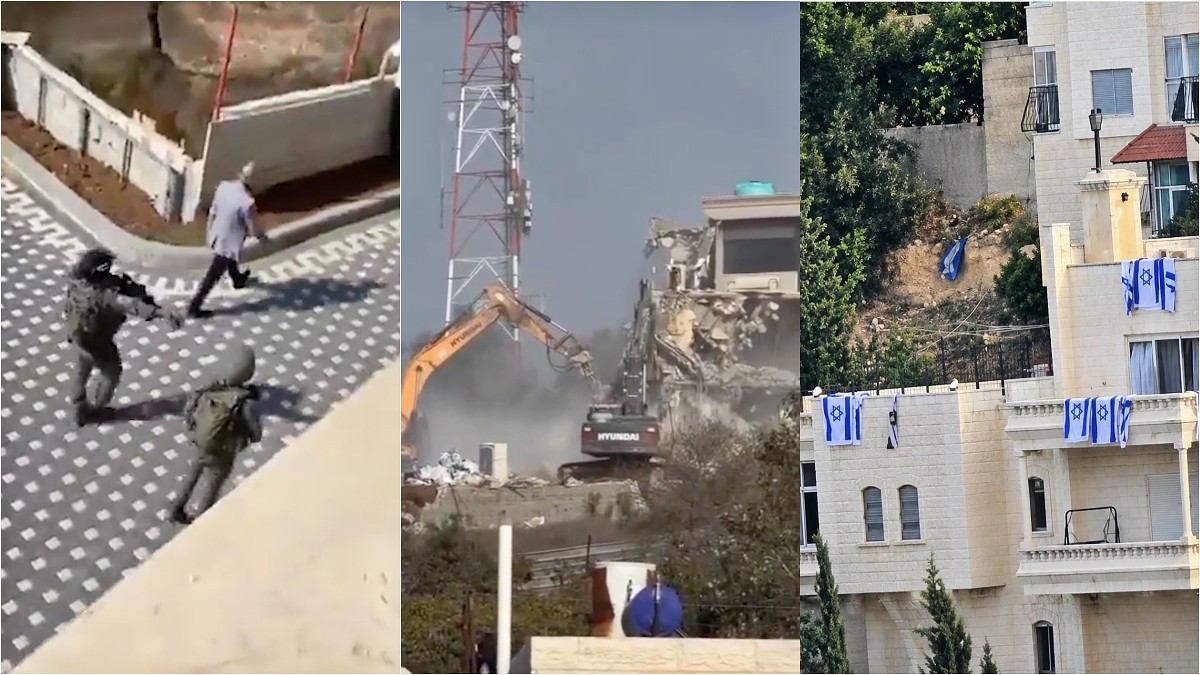
- Very likely, the Israeli operation around Hebron has expanded into broad movement restrictions, demolitions and mass displacement. The Israeli military cordoned off Hebron, a city of about 200,000 residents. Defence Minister Israel Katz cited about 2,000 people displaced, while local media reported more than 2,200; reports also describe at least 70 arrests and raids in at least 15 northern West Bank localities. The displacement totals and the extent of the evacuation order remain disputed. (Confidence: medium · REPORTED)
- I&W: Israeli forces maintain the Hebron cordon or continue demolitions and displacement after election day. (0-14 days)
- I&W: Israeli authorities reopen Hebron access routes and report the return of displaced residents. (0-14 days)
- Likely, the Israel Defense Forces will close West Bank land crossings and restrict Palestinian worker movement on 27 October, as announced. One account describes restrictions on workers entering settlements; another describes a broader ban throughout Judea and Samaria and the Jordan Valley, including industrial zones. The source claims are low confidence, so the scope of the order is uncertain. (Confidence: low · REPORTED)
- I&W: Border crossing status and access for Palestinian workers on 27 October show whether the announced closure and restrictions take effect. (0-2 days)
- I&W: The Israel Defense Forces issues a clarification specifying which workers, crossings and industrial zones are covered. (0-2 days)
- Very likely, acute food insecurity in Gaza remains severe. The UN World Food Programme estimated on 19 October that about 1.4 million people, roughly two-thirds of Gaza’s population, faced crisis-level food insecurity or worse. This is an institutional estimate reported through major media; it does not establish conditions in every locality or household. (Confidence: medium · REPORTED)
- I&W: A new UN World Food Programme assessment keeps the number facing crisis-level food insecurity or worse near 1.4 million or reports an increase. (1-3 months)
- I&W: A new UN World Food Programme assessment reports a lower crisis-level caseload and explains the change in food access or assistance. (1-3 months)
- Roughly even chance, Israeli strikes hit Gaza’s Islamic University during the reporting period. Social media accounts describe a morning drone strike that wounded students and a second strike that killed at least three people; the reports provide no event date and no independent confirmation. Attribution and casualty details are therefore unverified. (Confidence: low · REPORTED)
- I&W: Gaza’s Islamic University or health officials issue an account confirming the strikes, naming casualties and giving the incident date. (0-14 days)
- I&W: The university issues an account stating that the campus was undamaged and classes continued through the reported incident period. (0-14 days)
- Likely, the ceasefire framework in southern Lebanon will remain stalled over the next one to three months, with Israeli forces retaining a security zone and Hezbollah continuing reported military preparations. The framework calls for Hezbollah disarmament, Israeli withdrawal and Lebanese Armed Forces deployment, but reporting says implementation has largely stalled and Israeli forces remain in a zone extending roughly 10 kilometres into southern Lebanon. Claims about Hezbollah’s rebuilding and training, and the Israel Defense Forces’ preparations, rely largely on one medium-reliability report. (Confidence: low · ASSESSED)
- I&W: Independent reporting confirms Lebanese Armed Forces deployments in southern Lebanon alongside a measurable Israeli withdrawal from the reported security zone. (1-3 months)
- I&W: A verified Hezbollah attack or Israeli strike in Lebanon marks a return to direct hostilities rather than military preparation alone. (0-3 months)
- Unlikely, available public reporting establishes that the US has authorised or will launch renewed strikes on Iran within the next 14 days. Donald Trump publicly floated renewed strikes on 23 October, and reporting describes reduced US embassy staffing amid Iranian threat warnings. These reports indicate concern about threats to US personnel, not an authorisation decision. (Confidence: low · ASSESSED)
- I&W: The White House or Department of Defense publicly announces an authorised strike operation against Iran. (0-14 days)
- I&W: The US administration publicly rules out renewed strikes and confirms that embassy staffing reductions have ended. (0-14 days)
Outlook & scenarios
Hebron restrictions ease after election day (55%)
The 27 October crossing closures and worker restrictions end on schedule. Israeli forces ease the Hebron cordon, while searches and raids continue in parts of the West Bank. Gaza’s reported food insecurity remains severe, and Lebanon’s ceasefire framework remains stalled without a confirmed new Israel-Hezbollah exchange.
Hebron operation and regional pressure persist (30%)
Israeli forces maintain restrictions in Hebron after election day, with further demolitions, arrests or displacement reported. The gap between official and local displacement figures remains unresolved. In southern Lebanon, Israeli forces retain their security zone while reports of Hezbollah rebuilding and training continue, without confirmed cross-border fire.
Regional conflict widens (10%)
A renewed US or Israeli strike on Iran triggers retaliation and draws in regional actors. Ebrahim Azizi’s threats and the Islamic Resistance in Iraq’s pledge to support Iran are indicators of the high-impact risk, not evidence that such escalation has begun. A Hezbollah attack on Israel would create a separate path to renewed fighting in Lebanon.
Recommendations
- Track the 27 October crossing closures against the Israel Defense Forces’ stated order. Record which crossings close, which categories of Palestinian workers are barred, and when restrictions are lifted.
- Reconcile the Hebron casualty and displacement figures with subsequent Israeli military, hospital, municipal and humanitarian reporting. Keep the official estimate of about 2,000 displaced separate from the local report of more than 2,200.
- Seek independent confirmation of the Gaza Islamic University reports from the university, Gaza health officials and Israeli military statements before treating the strike or casualty claims as established.
- Monitor implementation of the Lebanon framework through reporting on Lebanese Armed Forces deployments, Israeli withdrawals from the reported security zone and verified attacks by Hezbollah or Israeli forces.
- Distinguish public remarks about Iran from evidence of a US strike decision. Prioritise explicit White House or Department of Defense announcements over embassy staffing changes when assessing authorisation.
Confidence & uncertainty
Overall confidence is high in the broad situation picture because multiple major-media accounts support the core Hebron attack and operation, and the food insecurity estimate is attributed to the UN World Food Programme. Confidence is lower on the precise Hebron displacement and wounded totals, the uncorroborated Islamic University reports, and claims about military preparations in Lebanon, which rely largely on one medium-reliability report. The overall rating reflects confidence in the main developments, not in every reported detail.
Alternative analysis (red cell)
The evidence more securely establishes a set of localized restrictions, demolitions, and reported displacements than a single broad Hebron operation producing mass displacement across the city. Claims 42dee7d1-0c8d-48ea-8728-cd00221758f4 and 426ac520-9a35-4b8b-8fdd-9b4aa5b1e4a7 support movement restrictions, but claims, and a41d1ab4-2326-4eeb-915a-d4bb37bb0953 materially disagree on the scale of displacement and evacuation. The northern West Bank raids in 37f654f7-0630-4ce9-abb1-59b2ba9548b1 should not be treated as evidence of the Hebron operation’s geographic expansion without a direct link.
Intelligence gaps
- [EEI 1.1 · UNCOVERED] Number, type and geolocated coordinates of projectiles (rockets, mortars, anti-tank guided missiles) fired from Lebanon into Israel in the last 24/72 hours, including time-stamped launch and impact locations. Recommended collection: signals/intel
- [EEI 1.2 · PARTIAL] Satellite or aerial imagery showing movement, concentration, or forward displacement of Hezbollah-associated military assets (armored vehicles, artillery pieces, mobile rocket launchers, logistics convoys) to positions within 0-10 km of the Israel-Lebanon border. Recommended collection: satellite/imagery
- [EEI 1.3 · UNCOVERED] Intercepted or captured Hezbollah command-and-control communications or orders explicitly directing cross-border operations or coordinated strikes with Palestinian groups (time-stamped messages, unit identifiers, orders to fire/move). Recommended collection: signals/intel
- [EEI 1.4 · PARTIAL] Observable changes in Israeli northern-front posture within Israel (numbers and types of reinforcements deployed to northern brigades, activation of reserves, air defense redeployments, evacuation orders or shelter alerts in northern towns), including timestamps and unit IDs where available. Recommended collection: human/intel
- [EEI 2.1 · UNCOVERED] Official or corroborated reports of IDF reservist mobilization and unit-level deployment orders (number of reservists called, named brigades/units ordered to deploy, deployment timelines). Recommended collection: open-source/media
- [EEI 2.2 · UNCOVERED] Satellite or ground imagery showing concentrations of IDF heavy equipment (tanks, infantry fighting vehicles, engineering vehicles), staging areas, field hospitals or forward supply dumps within X km of the Gaza border and at known crossing points. Recommended collection: satellite/imagery
- [EEI 2.3 · PARTIAL] Change in strike patterns consistent with pre-ground-attack shaping: sustained high-frequency airstrikes on tunnel networks, command nodes, coastal launch sites, and known insurgent concentrations (strike counts, munition types, locations, times). Recommended collection: open-source/media
- [EEI 2.4 · UNCOVERED] Logistics indicators: verified convoys of fuel/ammunition entering staging areas, establishment of forward logistics or medical bases, or documented requisitioning orders for bulk combat supplies with timestamps and quantities. Recommended collection: human/intel
- [EEI 3.1 · UNCOVERED] Number, participants and content of diplomatic contacts or negotiation sessions in the last 48 hours involving mediators (Egypt, Qatar, US, UN), including any proposed ceasefire text, prisoner/exchange lists, timelines or verification mechanisms. Recommended collection: diplomatic
- [EEI 3.2 · UNCOVERED] Public statements, press releases or verified communiqués from Hamas and other Gaza armed groups specifying acceptance, rejection, or conditions for a ceasefire (explicit conditions such as prisoner release lists, withdrawal terms, lifting of blockades), with timestamps and speaker attribution. Recommended collection: open-source/media
- [EEI 3.3 · UNCOVERED] Humanitarian indicators relevant to ceasefire: establishment and operation of agreed humanitarian corridors/checkpoints, number of aid deliveries admitted, civilian evacuations completed, and NGO/hospital reports of access denials or safe-passage violations. Recommended collection: humanitarian/NGO reports
- [EEI 3.4 · PARTIAL] Operational evidence of a de facto pause: verified sustained reduction (e.g., ≥12 hours) in strikes or launches from either side in specific sectors, supported by strike/impact logs, radar tracks and incident reports. Recommended collection: open-source/media
Red cell review: PARTIAL DISSENT
TLP:CLEAR