TLP:CLEAR · Disclosure is not limited.
Jordan’s Syria strikes and domestic security incidents
Time window: Last 1 day · Audience: General analyst · Type: Situation report · DTG: 2026-11-06 09:36Z · Overall confidence: HIGH
BLUF
Reporting supports that Jordanian forces struck targets in Syria on 26 October after the 23 October church attack in Karak, but the supplied evidence does not establish the targets’ ISIS affiliation or reconcile the casualty claims. A separate stabbing in Amman killed a police corporal; the reported suspect was detained, and no link to the church attack has been established.
Executive summary
The St George Greek Orthodox Church attack in Hammud, Karak, on 23 October killed nine people. Accounts differ on the number of attackers, and one reports more than 30 wounded while another specifies 40. Jordanian forces reportedly struck ISIS camps in Syria on 26 October in retaliation. The Jordanian military claimed 20 militants were killed, while Syrian officials reported seven civilian deaths, including three children. Reporting published on 6 November says a police corporal, Jawad Ali Khalaf Al-Salayta, died after being stabbed on Medina Street in Amman; a patrol detained the assailant. Jordanian authorities are investigating, but the motive and any connection to the church attack or ISIS remain unestablished.
Change from previous assessment
Since the 5 November brief, the supplied reporting has added details on the 26 October strikes: the Jordanian military’s claim that 20 militants were killed and Syrian officials’ report of seven civilian deaths, including three children. Confidence that Jordan conducted the strikes rises from low to medium, while confidence in the target attribution and casualty account remains low. New reporting describes the death of Jordanian police corporal Jawad Ali Khalaf Al-Salayta after a stabbing in Amman and the detention of the assailant. No new evidence resolves coordination with Damascus or establishes an ISIS link to the Karak attackers.
Key judgments
- Jordanian armed forces conducted retaliatory airstrikes in Syria on 26 October, three days after the St George Greek Orthodox Church attack in Hammud, Karak. The supplied reporting describes the strikes as retaliation, but does not independently verify their locations or whether Amman coordinated with Damascus. (Confidence: medium · REPORTED)
- I&W: A Jordanian Armed Forces statement identifies the strike locations, targets and operational rationale, confirming or materially revising the reported account. (0-14 days)
- I&W: A Syrian government statement confirms or denies prior coordination with Amman over the strikes. (0-14 days)
- It is unlikely that the supplied reporting establishes that the 26 October targets were ISIS camps or that 20 ISIS fighters were killed. The Jordanian military claimed 20 militants were killed, while Syrian officials reported seven civilian deaths, including three children; those accounts leave the target identities and full casualty toll unresolved and are not necessarily mutually exclusive. (Confidence: low · ASSESSED)
- I&W: Jordanian or Syrian authorities publish named casualty lists and strike-site details that permit the reported militant and civilian deaths to be checked. (0-14 days)
- I&W: A second, independently sourced account identifies the strike locations and provides evidence for or against an ISIS presence at those sites. (1-3 months)
- The 23 October church attack killed nine people, but the supplied accounts do not settle the number or identity of the attackers. One account describes three men storming the church, while another attributes the attack to an unknown attacker; the reported wounded toll ranges from more than 30 to 40. (Confidence: medium · REPORTED)
- I&W: Jordanian charging documents or an official investigation statement identify the number and identities of the accused in the church attack. (0-30 days)
- I&W: Jordanian authorities publish a final injury count that clarifies whether 40 people were wounded. (0-30 days)
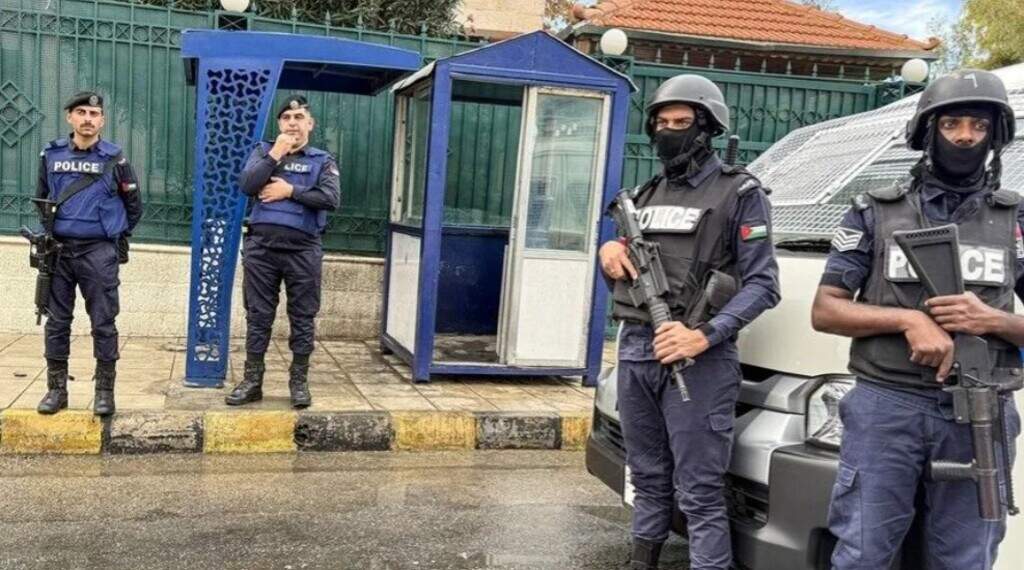
- A report published on 6 November says Jordanian police corporal Jawad Ali Khalaf Al-Salayta died after an unidentified individual stabbed him on Medina Street in Amman, and a police patrol detained the assailant. Initial indications cited by Jordanian authorities point to an intended attack on Public Security Directorate members, but the supplied reporting establishes neither the assailant’s motive nor a link to the Karak attack or ISIS. (Confidence: medium · REPORTED)
- I&W: Jordanian authorities release an investigation finding that identifies the assailant’s motive and whether the attack targeted Public Security Directorate members. (0-14 days)
- I&W: A court filing or official statement documents a connection between the Amman assailant and the Karak attackers or ISIS, or rules out such a connection. (0-30 days)
- The report of armed men attempting to enter Jordan from the Syrian border remains unverified and does not establish a connection to the 26 October airstrikes. The underlying reporting was available only as an article summary, so this judgment rests on thin, low-reliability information. (Confidence: low · ASSESSED)
- I&W: A full report or Jordanian Army statement gives a date, location and details of the reported border clash and attempted infiltration. (0-14 days)
- I&W: A second reliable report independently confirms the incident and identifies the armed men’s connection to Daraa Governorate. (0-30 days)
Outlook & scenarios
Jordan contains the security response (65%)
Jordan is likely to focus on the investigations into the Karak church attack and the Medina Street stabbing, while seeking to clarify the strikes’ targets and casualties. This is the most likely near-term course given the reported detention of the Amman assailant and the government’s stated focus on the investigation.
Renewed cross-border action (25%)
A further Jordanian strike in Syria is unlikely on the supplied evidence, but becomes more plausible if Jordanian authorities publicly link the Karak attackers to active ISIS positions or report another attempted infiltration from Syria. The disputed civilian casualty account would add pressure for clearer target and casualty information.
Further attack inside Jordan (10%)
A further deadly attack on a church or Jordanian security personnel is a low-probability, high-impact wildcard. The supplied reporting establishes neither an ISIS link to the Karak attackers nor a connection between that attack and the Amman stabbing, so it does not support treating a coordinated campaign as the expected outcome.
Recommendations
- Seek a Jordanian Armed Forces account identifying the 26 October strike locations, intended targets and evidence for the ISIS attribution; compare it with Syrian official statements and casualty reporting before treating the claim of 20 militants killed as verified.
- Track Jordanian investigation and court statements on the Karak suspects, the number of attackers, and the final injury count. Keep the church case separate from the Medina Street stabbing unless authorities provide evidence linking them.
- Obtain the full report behind the Syrian border infiltration summary and seek a dated Jordanian Army statement before using that item to assess cross-border escalation.
- Monitor Jordanian and Syrian government statements for confirmation or denial of coordination over the 26 October strikes.
Confidence & uncertainty
The high overall rating applies to the broad situation picture: two separate publications report the 23 October church attack, and a wire-service report provides a detailed account of the Amman stabbing and the Jordanian authorities’ response. It does not extend to the airstrike target identities or casualty totals, which are supported by one publication and include competing official accounts. The reported border incident is based only on a summary and remains low confidence.
Intelligence gaps
- [EEI 1.1 · PARTIAL] Jordanian Armed Forces aircraft, drones, artillery, or ground units identified operating near or across the Jordan-Syria border after the initial strikes. Recommended collection: military activity/satellite imagery
- [EEI 1.2 · UNCOVERED] Changes in Jordanian force posture, border closures, air-defense deployments, or military alert levels along the Syria border. Recommended collection: official statements/local reporting
- [EEI 1.3 · PARTIAL] Jordanian government statements defining red lines, attribution standards, or conditions for additional strikes. Recommended collection: government statements
- [EEI 1.4 · UNCOVERED] New attacks on Jordanian territory, border personnel, security forces, or religious sites attributed to ISIS or Syria-based actors. Recommended collection: incident reporting/security services
- [EEI 2.1 · PARTIAL] ISIS claims of responsibility, threats, operational instructions, or propaganda referencing the church attack, Jordan, or the retaliatory airstrikes. Recommended collection: militant communications
- [EEI 2.2 · PARTIAL] Evidence of ISIS casualty, leadership, weapons, logistics, or command-and-control losses at the reported strike locations. Recommended collection: satellite imagery/intelligence reporting
- [EEI 2.3 · PARTIAL] Arrests, weapons seizures, disrupted plots, or identified ISIS cells in Jordan following the church attack. Recommended collection: Jordanian security reporting
- [EEI 2.4 · UNCOVERED] Attempts to move ISIS personnel, weapons, or facilitators across the Jordan-Syria border after the strikes. Recommended collection: border security reporting
- [EEI 3.1 · UNCOVERED] Syrian government condemnation, military alerts, air-defense activity, or announced retaliatory measures against Jordan. Recommended collection: Syrian official statements/military reporting
- [EEI 3.2 · PARTIAL] Military movements or operational changes by Syrian forces, Iran-aligned groups, or other armed actors near southern Syria and the Jordanian border. Recommended collection: satellite imagery/local security reporting
- [EEI 3.3 · UNCOVERED] Public or private diplomatic interventions by the United States, Russia, Gulf states, Israel, or Arab League members concerning the strikes. Recommended collection: diplomatic statements
- [EEI 4.1 · UNCOVERED] Additional attacks, sectarian threats, protests, communal violence, or mobilization linked to the church attack or the airstrikes. Recommended collection: local media/social media
- [EEI 4.2 · UNCOVERED] Changes in border-crossing operations, refugee movements, commercial traffic, or humanitarian access between Jordan and Syria. Recommended collection: border authorities/humanitarian reporting
- [EEI 4.3 · UNCOVERED] Changes in travel advisories, embassy security measures, foreign force protection, or warnings concerning Jordan and southern Syria. Recommended collection: government advisories
- [EEI 4.4 · PARTIAL] Evidence of civilian casualties, displacement, infrastructure damage, or disputed target identification resulting from the Jordanian strikes. Recommended collection: local reporting/satellite imagery
Red cell review: CONCUR WITH COMMENT
TLP:CLEAR