TLP:CLEAR · Disclosure is not limited.
Mali: FLA, JNIM April Offensive Shifts Northern Fronts, Russia Deepens Role
Time window: Last 7 days · Audience: General analyst · Type: Situation report · DTG: 2026-07-13 12:14Z · Overall confidence: MEDIUM
BLUF
A coordinated FLA, JNIM offensive on 25 April 2026 forced Malian and allied Russian Africa Corps units to withdraw from Kidal, Aguelhok and Tessalit, with Kidal falling to the rebels. Bamako’s widening break with Western partners and growing dependence on Russia, coupled with Libya’s rising logistical relevance, makes further northern losses and regional spillover likely in the near term.
Executive summary
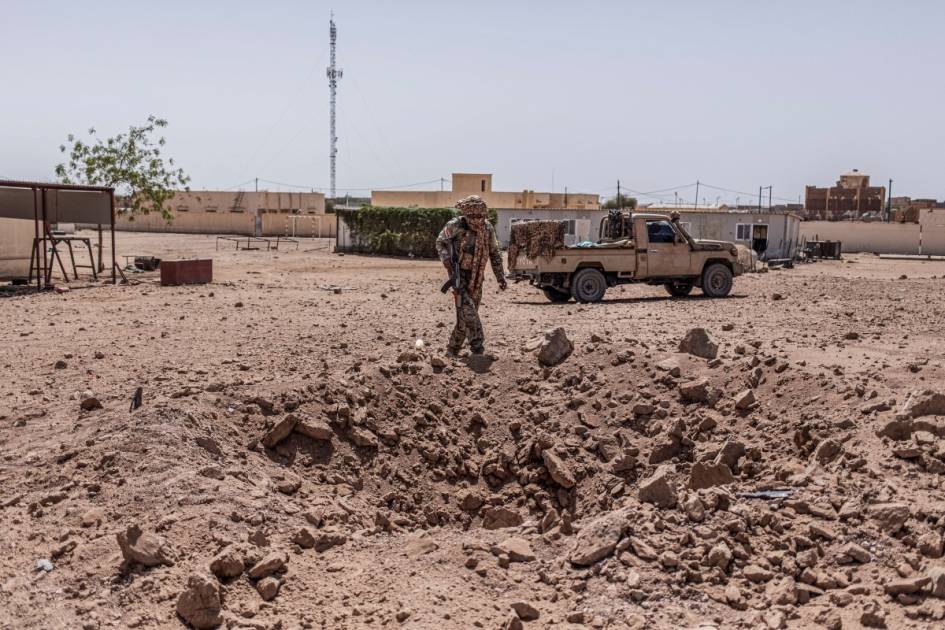
Fighting that began in 2012 has re-energised. On 25 April 2026, the Azawad Liberation Front (FLA) and Jama’at Nusrat al‑Islam wal‑Muslimin (JNIM) mounted what was described as the largest offensive since 2012, with simultaneous violence in Gao, Sévaré, Kidal and Mopti. Kidal fell to the FLA and Malian troops with Russia’s Africa Corps withdrew from Kidal, Aguelhok and Tessalit; blasts were also reported near Kati and Russian mercenary involvement was reported near Bamako. The offensive follows years of eroding state control and continued attacks in the north. Regionally, Mali’s shift away from France and ECOWAS, closer military cooperation with Russia, and Libya’s growing role as a logistical outlet tie Mali’s conflict more tightly to its neighbours. One unconfirmed report alleges JNIM killed Defence Minister Sadio Camara during the Kati attack; this single‑source claim, if validated, would indicate a step‑change in insurgent capability against regime targets.
Key judgments
- It is likely the 25 April 2026 FLA, JNIM offensive overwhelmed Malian positions across Gao, Sévaré, Kidal and Mopti, culminating in Kidal falling to the FLA and in Malian and Russia’s Africa Corps withdrawals from Kidal, Aguelhok and Tessalit; the action was described as the largest offensive since 2012, with blasts reported near Kati and reports of Russian mercenary activity near Bamako. (Confidence: medium · REPORTED)
- I&W: Independent confirmation that FLA maintains administrative or security control in Kidal, with continued Malian or allied withdrawals from Aguelhok and Tessalit (0-14 days)
- I&W: Malian or Africa Corps ground convoys re-enter and garrison Kidal, or official announcements of reoccupation (0-14 days)
- It is very likely Bamako’s security centre of gravity has shifted from France to Russia, with Russia now one of Mali’s principal security partners, ongoing training, logistics and defence ties, fresh equipment deliveries, and Russian mercenary support to Malian units in combat. (Confidence: high · REPORTED)
- I&W: Publicly documented additional Russian equipment deliveries or rotations of Africa Corps personnel into Mali (1-3 months)
- I&W: Any formal resumption of French or broader Western defence cooperation with Mali (1-6 months)
- It is likely the Malian battlefield is increasingly coupled to southern Libya, with pressure in Mali elevating Libya’s role as a logistical outlet and shaping security dynamics in Libya’s south; Tuareg elements may redeploy into the Libya, Niger, Algeria border triangle if operations intensify. (Confidence: medium · ASSESSED)
- I&W: Reporting of rebel columns or leadership relocating into the Libya, Niger, Algeria border triangle, or interdictions of arms and fuel along southern Libyan routes (1-3 months)
- I&W: Evidence of effective cross-border clampdowns that curtail movement through southern Libya (1-3 months)
- It is likely the Alliance of Sahel States’ withdrawal from ECOWAS and cutting of Western military ties narrows external stabilisation options for Mali and constrains Western-supported counterterrorism coordination. (Confidence: medium · ASSESSED)
- I&W: Announcements expelling additional Western military personnel, cancelling joint exercises or training missions across AES members (1-3 months)
- I&W: Public moves by ECOWAS or AES to re-open structured security cooperation (1-6 months)
- It is likely Malian state control remains fragile and has deteriorated over time, given estimates that by 2020 only about one third of the country was under government authority and that armed attacks continued in the north through late 2023 ahead of the 2026 losses. (Confidence: medium · ASSESSED)
- I&W: Additional confirmed town or base losses to the FLA or JNIM in northern Mali (0-30 days)
- I&W: Official restoration of control over Kidal or reliable evidence of secured main supply routes in the north (1-3 months)
- There is a roughly even chance the reported JNIM assassination of Defence Minister Sadio Camara in Kati on 25 April 2026 occurred; if confirmed, it would indicate capacity to strike high‑value regime targets in the capital’s security perimeter. (Confidence: low · ASSESSED)
- I&W: Official confirmation and public funeral proceedings for Sadio Camara, or corroborated imagery confirming his death (0-14 days)
- I&W: Credible public appearance or address by Sadio Camara contradicting the report (0-14 days)
Outlook & scenarios
Rebel, jihadist consolidation across the Kidal, Aguelhok, Tessalit corridor (60%)
The FLA, with JNIM operating alongside, entrenches control in Kidal and holds Aguelhok and Tessalit after the withdrawals, while Malian forces regroup along axes towards Gao and Sévaré. Russia’s Africa Corps presence grows to stiffen defences but struggles to reverse gains quickly. This sustains insurgent momentum and heightens the risk of further northern losses.
Russia-enabled counteroffensive retakes key nodes (30%)
Fresh Russian equipment deliveries and advisory support enable Malian units to re-enter parts of Kidal Region, re-establishing garrisons and limited state presence. Gains are tactical and require continued Russian backing, with jihadist and Tuareg elements dispersing into remote areas and across borders.
Spillover intensifies into southern Libya (50%)
Sustained pressure in northern Mali increases reliance on Libyan routes for logistics and sanctuary. Tuareg fighters and facilitators reposition in the Libya, Niger, Algeria border triangle, complicating both Libyan security dynamics and any Malian stabilisation plan.
Leadership decapitation shock in Bamako’s orbit (20%)
Confirmation of a successful strike on a top regime figure triggers security purges and short-term disarray around Kati and Bamako. Regime cohesion holds, but command disruptions slow any counteroffensive tempo and embolden insurgent targeting of senior officials.
Recommendations
- Prioritise control-line verification in Kidal Region: task commercial imagery and geolocation of open‑source footage for Kidal, Aguelhok and Tessalit over the next 14 days to confirm who holds key administrative sites and garrisons.
- Exploit insurgent communications: track and archive FLA and JNIM claims of responsibility, battlefield communiqués and imagery; geolocate and time‑stamp to map the command relationship and areas of responsibility.
- Monitor Russian support pipelines: catalogue reported equipment deliveries, advisory deployments and Africa Corps footprint changes; correlate with observed shifts in Malian operational tempo.
- Watch the Libya, Niger, Algeria border triangle: collect on movement of Tuareg fighters, fuel and arms along southern Libyan routes; integrate with interdiction and arrest reporting to assess cross‑border facilitation networks.
- Track AES policy signals: monitor official statements on ECOWAS relations and Western military engagement for any openings or further restrictions that would reshape external stabilisation options.
- Validate or refute the Kati leadership‑targeting report: establish a standing requirement for official Malian announcements, state media appearances and credible third‑party confirmations regarding Sadio Camara and other senior figures.
Confidence & uncertainty
Overall confidence is medium. The core battlefield developments in late April 2026 are supported by multiple, generally reliable reports that are consistent with each other, though many are single‑report items rated at medium confidence. Russia’s role and Mali’s break with France and ECOWAS are corroborated across several independent claims. Key uncertainties remain around single‑source or thinly corroborated elements, notably the reported killing of Defence Minister Sadio Camara, and timing nuances in the Alliance of Sahel States’ formation and expulsions, which temper confidence.
Alternative analysis (red cell)
An alternative, evidence-grounded reading is that the 25 April attacks produced notable local gains and caused tactical withdrawals by Malian and Russian-aligned forces in parts of northern Mali, but the current reporting does not uniformly support an uncontested collapse across all named towns nor definitive FLA control of Kidal. Russia has clearly deepened security ties with Bamako, yet the operational evidence for a decisive shift of Mali’s security centre of gravity to Russia is incomplete and requires corroboration of mercenary presence, equipment deliveries, and command influence. Reports of a high‑value assassination in Kati remain unconfirmed and contradicted by other accounts; independent, corroborative documentation is necessary before treating that event as established.
Cited sources
[1] Wikipedia · Mali War (B) · sha256:d05033f937e4 [2] Wikipedia · 2026 Mali offensives (B) · sha256:23eaae2b4f04 [3] Wikipedia · Alliance of Sahel States (A) · sha256:54f03dd824e0 [4] africa.businessinsider.com · Africa's 3-country UN Security Council members at the center of Russia's new security diplomacy push (B) · sha256:3d3ec15e22cf [5] independentarabia.com · التصعيد في مالي يهدد الثقل الجيوسياسي لليبيا (B) · sha256:88163914d915
Source content hashes were computed at collection time; the cited text is preserved unmodified for the life of this product.
Red cell review: PARTIAL DISSENT
TLP:CLEAR