TLP:CLEAR · Disclosure is not limited.
Maritime chokepoints: Hormuz disruption, selective Houthi controls and unverified price headline
Time window: Last 1 day · Audience: General analyst · Type: Situation report · DTG: 2026-11-08 14:50Z · Overall confidence: HIGH
BLUF
Commercial movement through the Strait of Hormuz is severely disrupted, while Houthi transit permits and restrictions at Bab-el-Mandeb do not establish a complete blockade. The supplied evidence does not substantiate disruption at four of five key straits or Brent at $108 on 8 November.
Executive summary
Hormuz remains the clearest source of maritime risk. A trade publication reports commercial transits below one-tenth of pre-crisis levels, while AIS reporting records a tanker crossing on 7 November and moving on the Persian Gulf side on 8 November. UKMTO reported 11 confirmed attacks in and around the Gulf of Oman and Hormuz across late October and early November. At Bab-el-Mandeb, reports describe Houthi transit controls and a seven-day permit for a Chinese container ship, alongside a claimed blockade directed at Saudi Arabia. These reports indicate selective restrictions, not a verified closure of all commercial traffic. Freight costs are elevated, but the latest official Brent spot figure in the supplied record is $107.03 on 3 November, not a confirmed $108 reading on 8 November.
Change from previous assessment
Since the 7 November brief, reporting adds the disabling of M/V Huda, UKMTO's tally of 11 confirmed attacks across late October and early November, and new evidence of Houthi email-based transit controls and a seven-day permit for a Chinese container ship. The assessment remains that Hormuz is severely disrupted but not proven completely closed, and that a full Bab-el-Mandeb blockade is not established. The new reporting still does not verify disruption at four of five straits or Brent at $108 on 8 November.
Key judgments
- Commercial traffic through the Strait of Hormuz is very likely to remain severely depressed over the next 14 days, but a complete cessation of passage is unlikely. A trade publication put commercial transits below one-tenth of the pre-crisis level, while AIS reporting recorded the Barbados-flagged tanker MARINE FLUX crossing on 7 November and moving at 7 knots on the Persian Gulf side on 8 November. UKMTO reported 11 confirmed attacks in the Gulf of Oman and Hormuz area across late October and early November. The low-transit estimate is not independently reconciled with those vessel observations. (Confidence: medium · ASSESSED)
- I&W: Confirms: AIS-based daily reporting continues to show fewer than 9 commercial Hormuz crossings a day, using the reported pre-crisis average of about 85 a day. (0-14 days)
- I&W: Breaks: AIS-based reporting shows more than 25 commercial crossings a day for three consecutive days. (0-14 days)
- A full Bab-el-Mandeb blockade is unlikely over the next 14 days; the reporting instead indicates selective Houthi controls over passage. A local-media report attributed to the Wall Street Journal describes an email-based transit request system, and another report says the Houthis issued a seven-day permit to a Chinese container ship. The Houthi figure of 1,083 October transits is self-reported, and control of the Yemeni coast near the strait remains contested. (Confidence: medium · ASSESSED)
- I&W: Confirms: Houthi authorities continue issuing case-specific transit permits or safe-passage decisions for named commercial vessels. (0-14 days)
- I&W: Breaks: Independent maritime reporting confirms commercial transits have stopped at Bab-el-Mandeb, including for vessels without reported Saudi links. (0-14 days)
- Elevated freight costs are likely to persist over the next month if Hormuz restrictions and route diversions continue. Valero executive Randy Hawkins reported US Gulf Coast-to-Asia crude freight at $30 to $35 a barrel, compared with about $5 a year earlier; separate reporting says eight of the nine largest container carriers suspended Hormuz transits or rerouted some Asia-to-Europe traffic around the Cape of Good Hope. The evidence supports higher transport costs, but does not quantify current war-risk premiums or establish fertilizer supply effects. (Confidence: medium · ASSESSED)
- I&W: Confirms: US Gulf Coast-to-Asia crude freight remains at or above $30 a barrel in the next reported market update. (0-14 days)
- I&W: Breaks: A market update reports freight returning towards the approximately $5-a-barrel year-earlier level and major carriers resuming Hormuz transits. (1-3 months)
- The supplied claims do not verify Brent at $108 on 8 November or disruption at four of five key maritime straits. The latest official Brent spot observation in the record is $107.03 a barrel on 3 November. The supplied transit evidence concerns Hormuz and Houthi controls at Bab-el-Mandeb; it does not provide comparable evidence for three other straits. (Confidence: medium · REPORTED)
- I&W: Confirms the price figure: an official Brent spot observation or dated market report records $108 a barrel on 8 November. (0-2 days)
- I&W: Breaks the four-strait claim: transit data for the other three named straits show no material disruption during the reporting period. (0-14 days)
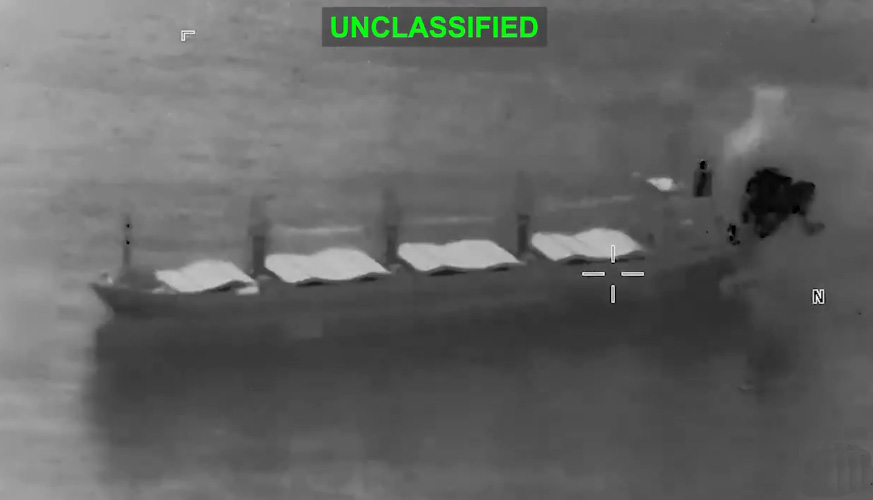
- Further interference with commercial vessels in the Gulf of Oman or Strait of Hormuz is likely over the next 14 days. CENTCOM reported disabling the St Kitts-flagged M/V Huda on 7 November during enforcement of the blockade against Iran. UKMTO reported multiple recent attacks, while the IRGC Navy has warned ships against using routes it considers unauthorised. The IRGC reports of tanker mine strikes remain unverified in the supplied record, and reports differ on whether two or three tankers were affected. (Confidence: medium · ASSESSED)
- I&W: Confirms: UKMTO reports another confirmed vessel attack, or CENTCOM reports disabling another commercial vessel in the Gulf of Oman or Hormuz area. (0-14 days)
- I&W: Breaks: No further confirmed vessel attacks or blockade-related vessel strikes are reported for 14 consecutive days, and the IRGC Navy withdraws its warning on unauthorised routes. (0-14 days)
Outlook & scenarios
Prolonged disruption with selective passage (55%)
Hormuz commercial traffic remains very low as the US blockade and Iranian restrictions continue. Houthi authorities retain selective influence over Bab-el-Mandeb passage, issuing permissions while targeting Saudi-linked interests. Elevated freight costs persist, without evidence in the supplied record of a complete Bab-el-Mandeb closure.
Managed de-escalation and partial transit recovery (25%)
Qatar-mediated US-Iran talks produce steps that reduce interference with commercial shipping. Hormuz crossings rise from current depressed levels, and Houthi permit controls remain in place without a general halt to traffic. The prior collapse of a preliminary US-Iran agreement makes a rapid return to normal passage less certain.
Escalation spreads across the shipping routes (15%)
Additional attacks, mine incidents or blockade enforcement actions prompt more operators to suspend or divert voyages. Houthi actions against Saudi-linked shipping add pressure on Red Sea routing. A wider shutdown across several named straits remains a low-probability, high-impact outcome because the supplied evidence does not establish such disruption now.
Recommendations
- Track daily AIS commercial crossing counts at Hormuz against the reported pre-crisis baseline, and distinguish verified transits from vessel counts within the wider region.
- Maintain a separate Bab-el-Mandeb watchlist for named-vessel permits, reported attacks and independently verified transit counts. Do not treat a Houthi declaration of blockade as evidence that all passage has stopped.
- Use dated official Brent spot data and dated freight reports when updating the market picture. Label the $108 figure unverified unless a same-day market observation supports it.
- Request fresh reporting from maritime security and shipping sources on tanker incidents, including vessel identities, locations and casualty counts, before attributing mine strikes or publishing a total.
- Include a contingency line for prolonged rerouting and higher freight costs in shipping-risk updates, while withholding claims of fertilizer shortages or disruption at other straits until supported by route-specific reporting.
Confidence & uncertainty
Overall confidence is high for the occurrence of the main operational developments: reporting from UKMTO, CENTCOM, major media and maritime trade sources supports recent vessel attacks, the disabling of M/V Huda and continued disruption around Hormuz. Confidence is lower in the exact number and cause of reported tanker fires, the extent of Houthi territorial control near Bab-el-Mandeb and the current Brent price. Houthi transit totals are self-reported, and the supplied record does not substantiate the claim of disruption at four of five straits.
Alternative analysis (red cell)
The evidence does not yet distinguish between a genuinely selective Houthi transit-control system and an effective blockade that permits limited exemptions. Claims c28e7e1d-89ff-45be-b5d4-b899d5af4274 and adea6403-5463-452e-adb2-b900d3f1d55b are D1 and are directly in tension with blockade reporting in claims c497ba8f-2825-45e3-9c45-89ce11d01c29 and 04cb02bd-3209-488a-8150-b1938a027321. A full blockade therefore cannot be treated as unlikely with medium confidence until independent traffic data and control-status reporting become available.
Intelligence gaps
- [EEI 1.3 · PARTIAL] Daily vessel-transit volume, AIS dark activity, anchorage buildup, and rerouting rates at Hormuz and Bab-el-Mandeb compared with pre-crisis levels. Recommended collection: maritime/AIS
- [EEI 2.1 · PARTIAL] US, coalition, Iranian, Saudi, Omani, and other naval force posture changes, including escorts, convoy schedules, mine-countermeasure deployments, air patrols, and rules-of-engagement announcements. Recommended collection: maritime/defense-reporting
- [EEI 2.2 · PARTIAL] Tanker and container-ship rerouting through the Cape of Good Hope or other alternatives, including added sailing days, fuel consumption, and available vessel capacity. Recommended collection: shipping-industry/AIS
- [EEI 2.3 · UNCOVERED] War-risk insurance premium, deductible, coverage-exclusion, and voyage-approval changes for Hormuz, Bab-el-Mandeb, Red Sea, Gulf of Aden, and adjacent waters. Recommended collection: insurance-market
- [EEI 2.4 · PARTIAL] Operational status and export-loading changes at Saudi, UAE, Omani, Iranian, Djiboutian, and Red Sea ports, terminals, pipelines, and storage facilities. Recommended collection: port-operator/energy-infrastructure
- [EEI 3.1 · PARTIAL] Brent and Dubai crude price movements, futures-curve shifts, volatility, and the spread between regional and global crude benchmarks. Recommended collection: commodity-markets
- [EEI 3.2 · PARTIAL] Changes in crude, refined-product, LNG, and LPG volumes transiting the straits and in announced production cuts, strategic-stock releases, or emergency cargo substitutions. Recommended collection: energy-trade/AIS
- [EEI 3.3 · UNCOVERED] Fertilizer shipment delays, canceled or redirected cargoes, regional price increases for urea and ammonia, and reported inventory levels in import-dependent markets. Recommended collection: commodity-trade/port-data
- [EEI 3.4 · PARTIAL] Container freight rates, vessel charter rates, bunker costs, port congestion, and manufacturing or retail supply disruptions attributable to the chokepoint crisis. Recommended collection: shipping-and-logistics-markets
- [EEI 4.3 · PARTIAL] Shipping-company decisions to resume, suspend, or expand transits and corresponding changes in insurer voyage approvals and war-risk premiums. Recommended collection: shipping-and-insurance-industry
- [EEI 4.4 · UNCOVERED] New incidents, military alerts, vessel diversions, or port restrictions at other critical chokepoints indicating geographic spread beyond Hormuz and Bab-el-Mandeb. Recommended collection: maritime/AIS-official-notices
Red cell review: PARTIAL DISSENT
TLP:CLEAR