TLP:CLEAR · Disclosure is not limited.
Middle East: Regional Escalation and Maritime Risk Persist
Time window: Last 1 day · Audience: General analyst · Type: Situation report · DTG: 2026-08-22 12:13Z · Overall confidence: LOW
BLUF
Regional escalation is likely to persist over the next 14 days. Israeli activity in southern Lebanon, Iranian readiness warnings, below-normal traffic through the Strait of Hormuz, and reported hijackings in the Gulf of Aden and off Somalia keep the immediate risk concentrated on Lebanon, shipping and regional connectivity. Overall confidence is low because the reporting combines current, undated and historical claims with unresolved attribution and chronology conflicts.
Executive summary
On 21 August, Israel carried out an airstrike against a house near Baraachit in southern Lebanon. UNIFIL reported 86 Israeli airspace violations from Monday to Wednesday, while a separate multilateral report recorded nine airstrikes and 265 projectiles in southern Lebanon. Iran called for an end to the months-long war on 21 August, but Iranian military reporting also described additional systems entering service and warned of a wider response to future attacks. NASA FIRMS recorded four Middle East thermal anomalies on 22 August, none high-confidence, and cannot establish their cause. Maritime traffic through the Strait of Hormuz remains below pre-war levels, UAE airlines reported cancellations and delays, and the Sibu 1 and Lutuf were reportedly hijacked in separate incidents in the Gulf of Aden and off Somalia. Humanitarian conditions remain severe in Gaza, where UN agencies report that 94 per cent of 2.1 million residents need shelter, while Lebanon faces renewed economic contraction and inflationary pressure.
Change from previous assessment
Since the 21 August prior brief, the assessment of persistent escalation remains unchanged and confidence remains low. New reporting adds an Israeli airstrike near Baraachit on 21 August, 86 UNIFIL-observed airspace violations, a reported Sibu 1 hijacking in the Gulf of Aden, two reported Somali pirate attacks and UAE airline cancellations and delays. The Hormuz and de-escalation judgements remain directionally unchanged, but Iran's call for an end to the war is a new counter-signal that lowers confidence in a simple escalation-only reading. The humanitarian judgement is retained with expanded Gaza and Lebanon indicators. The assessment adds a separate judgement on economic pressure on Iran and keeps the possibility of wider Israel-Türkiye-Syria spillover in the scenario set rather than as a standalone judgement.
Key judgments
- Regional escalation is likely to persist through 5 September 2026, with the immediate pressure points in southern Lebanon and the wider Gulf. Israel carried out an airstrike near Baraachit in southern Lebanon on 21 August; UNIFIL reported 86 Israeli airspace violations; and separate reporting recorded nine Israeli airstrikes and 265 projectiles in southern Lebanon. Iran has reported missile and drone strikes against Israel, US bases and Arab countries, while Iranian military officials have warned of a wider response to future attacks. The chronology and attribution remain insecure because the package combines current claims with undated and historical reporting. NASA FIRMS recorded four thermal anomalies on 22 August, but none was high-confidence and the system does not establish cause. (Confidence: low · ASSESSED)
- I&W: CONFIRM: Israeli forces conduct another strike in southern Lebanon, or Iran launches a further missile or drone strike against Israel, US bases or an Arab country. (0-14 days)
- I&W: BREAK: Iran and Israel announce and implement a cessation of attacks, while UNIFIL reports no new Israeli airspace violations. (0-14 days)
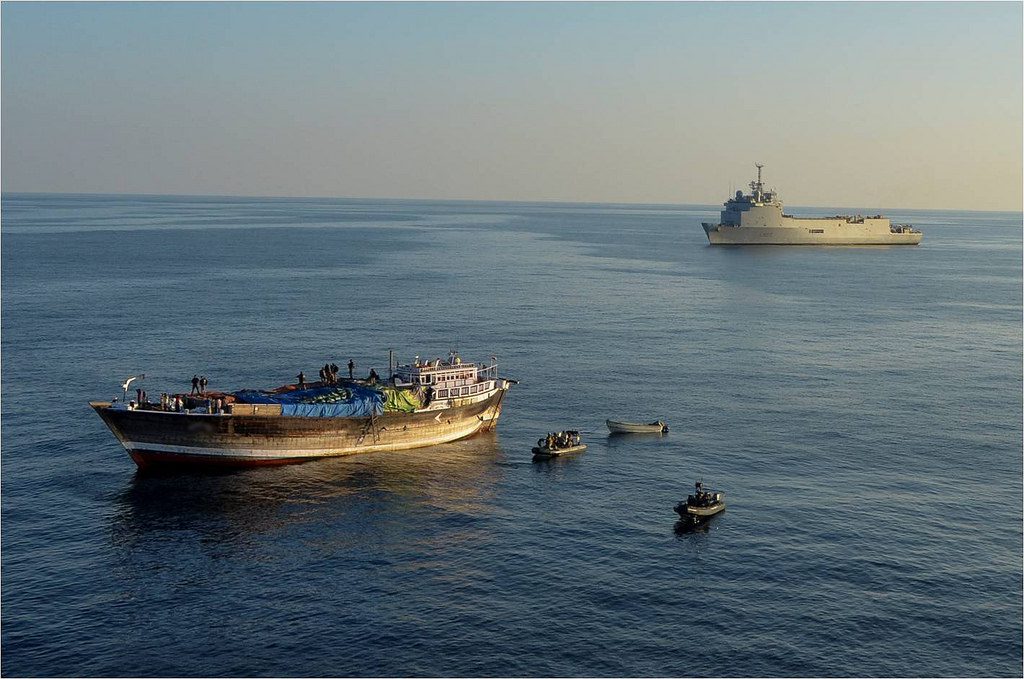
- Commercial transport disruption is likely to remain over the next 14 days. Maritime traffic through the Strait of Hormuz remains below pre-war levels, and UAE airlines reported cancellations and delays on 21 August. The package also reports the hijacking of the oil-products tanker Sibu 1 in the Gulf of Aden and the hijacking of the Cameroon-flagged cargo ship Lutuf off Somalia, alongside two attacks on ships by Somali pirates. The claims place the named hijackings in different locations and do not establish whether they are connected, keeping confidence low. (Confidence: low · ASSESSED)
- I&W: CONFIRM: UAE airlines report another day of cancellations or delays, or a new hijacking or attack is reported in the Gulf of Aden, off Somalia, or near the Strait of Hormuz. (0-14 days)
- I&W: BREAK: Traffic through the Strait of Hormuz returns to pre-war levels and UAE airlines report no cancellations or delays for 14 consecutive days. (0-14 days)
- A formal US-Iran de-escalation arrangement is unlikely over the next 14 days. Iran called for an end to the months-long war on 21 August, but reporting from 17 August placed the US and Iran further apart in negotiations. Iran has also brought additional military systems into operation, described its doctrine as more offensive, and warned that future aggression would trigger an immediate and wider response. These competing signals are largely single-source or medium-confidence, and the reporting does not establish direct talks or agreed implementation terms. (Confidence: low · ASSESSED)
- I&W: CONFIRM: Iranian military officials announce another system entering service or repeat a wider-response warning after a US or Israeli threat. (0-14 days)
- I&W: BREAK: Washington and Tehran announce direct talks that produce agreed ceasefire or deconfliction terms with an implementation mechanism. (0-14 days)
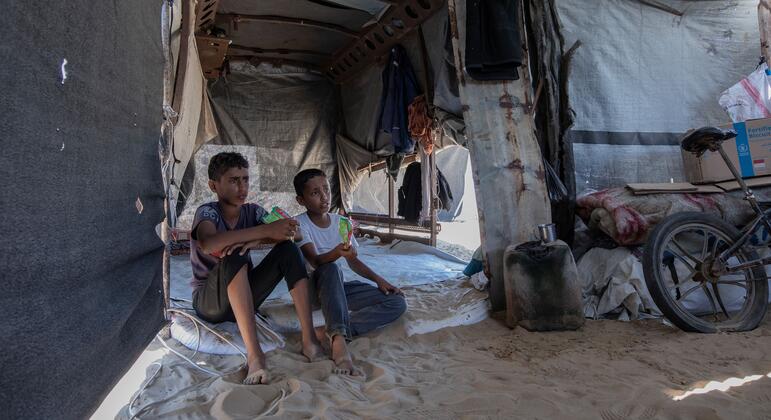
- Humanitarian pressure in Gaza and Lebanon is very likely to remain severe over the next one to three months. UN agencies and peacekeepers report that 94 per cent of Gaza's 2.1 million residents need shelter, while 50 Palestinians have been buried after their bodies were recovered from rubble. UN partners estimate that $562 million is needed to improve living conditions, and the World Food Programme reaches around 1.5 million people with food parcels. Israeli restrictions continue to impede aid deliveries and services. In Lebanon, inflation is expected to reach 17.5 per cent and the economy is projected to contract by 6.4 per cent in 2026. (Confidence: medium · REPORTED)
- I&W: CONFIRM: UN agencies continue to report that 94 per cent of Gaza's residents need shelter, while Israeli restrictions continue to impede aid deliveries. (1-3 months)
- I&W: BREAK: UN partners revise the Gaza funding requirement below $562 million and report a sustained reduction in shelter needs. (1-3 months)
- Economic pressure on Iran is likely to remain a constraint on Tehran over the next one to three months, but its effect on Iranian military policy is uncertain. Mohammad Baqer Qalibaf acknowledged strain on Iran's economy, Iran has faced near-continuous sanctions for nearly 50 years, and China was reported to buy more than 80 per cent of Iran's shipped oil. China has also rejected US sanctions against Iran. This is a low-confidence inference because the current package provides limited economic data and does not establish whether Iranian decision-makers will trade military activity for sanctions relief. (Confidence: low · ASSESSED)
- I&W: CONFIRM: Iranian officials report further economic strain, while China remains the buyer of more than 80 per cent of Iran's shipped oil. (1-3 months)
- I&W: BREAK: Iranian officials report easing economic strain and China's share of Iran's shipped oil falls below 80 per cent. (1-3 months)
Outlook & scenarios
Continued calibrated escalation (55%)
Likely baseline. Israeli strikes and airspace activity in southern Lebanon continue, Iran sustains readiness warnings and limited military pressure, and shipping and aviation disruption persists without a confirmed direct US-Iran settlement.
Limited deconfliction without settlement (30%)
Unlikely but credible. Iran's call to end the war gains diplomatic traction, while the US effort to establish a deconfliction mechanism involving Israel, Türkiye and Syria produces limited arrangements. The US-Iran negotiations remain unresolved and maritime traffic stays below pre-war levels.
Multi-front regional shock (15%)
Very unlikely, high impact. A further Iranian missile or drone strike against Israel, US bases or an Arab country coincides with expanded Israeli operations in Lebanon and additional attacks on commercial vessels in the Gulf of Aden or off Somalia. UAE air transport disruption and humanitarian pressure in Gaza intensify.
Recommendations
- Maintain a 24-hour event log for Israeli operations in southern Lebanon, UNIFIL airspace-violation reporting, Iranian missile and drone activity, and activity involving US bases and the USS George Washington. Record each event by date, location, actor and source reliability.
- Keep current reporting separate from historical material. Do not merge the 28 February 2026 US and Israeli strike claims with the 18 August 2023 Abu al-Duhur reporting or the 19 August 2023 carrier reporting unless independent evidence re-dates the events.
- Build a maritime watchlist covering the Strait of Hormuz, the Gulf of Aden and waters off Somalia. Track the Sibu 1 and Lutuf separately, verify whether either vessel is recovered, and compare daily Hormuz traffic estimates with the pre-war baseline.
- Use UN reporting as the primary humanitarian baseline for Gaza. Track the 94 per cent shelter figure, the $562 million funding requirement, WFP coverage of around 1.5 million people and any change in Israeli restrictions on aid deliveries.
- Treat the diplomatic signals as competing indicators. Track whether Iran's call for an end to the war produces direct US-Iran talks, while separately monitoring the US effort involving Israel, Türkiye and Syria and Iran's statements on Iraqi sovereignty.
- Exclude low-confidence social media claims, including the allegation that Saudi Arabia is invading Iraq, from headline assessments until corroborated by official, multilateral or independent reporting.
Confidence & uncertainty
Overall confidence is low. The package contains strong UN, NASA and official-government reporting on Gaza, Lebanon and thermal detections, but many military and maritime claims come from medium- or low-confidence major-media, trade, think-tank and social-media reporting. The principal uncertainties concern the chronology and attribution of the 28 February 2026 US-Israeli strikes, the connection between reported maritime incidents in the Gulf of Aden and off Somalia, and whether Iran's call for an end to the war represents a negotiating position or a tactical message.
Intelligence gaps
- [EEI 1.1 · PARTIAL] Number, type, launch times, and trajectories of ballistic missiles, cruise missiles, armed UAV strikes, and combat-air sorties launched by Iranian or Israeli forces toward the other's territory or forward bases within a 72-hour window. Recommended collection: signals/intel
- [EEI 1.2 · PARTIAL] Observable changes in Israeli and Iranian force posture: mobilization or reserve call-up orders, unit road/rail movements, dispersal or sortie rates of air squadrons, redeployment of air-defense batteries, and activation of civil-defense alerts or sirens in major population centers. Recommended collection: open-source/media
- [EEI 1.3 · PARTIAL] Indications of strike authorization or targeting preparations in Iranian or Israeli command chains: authenticated public orders by senior commanders, detected increases in encrypted communications consistent with targeting, or visible movement of strike munitions to launch/storage sites. Recommended collection: signals/intel
- [EEI 2.1 · PARTIAL] Counts, launch locations (coordinates), weapons types, and assessed damage from rocket/missile/drone strikes originating from Lebanon into northern Israel attributed to Hezbollah or allied groups. Recommended collection: open-source/media
- [EEI 2.2 · PARTIAL] Reported attacks by Iranian-backed militias in Iraq and Syria: rocket/IED strikes on bases hosting US/coalition or Israeli personnel, documented militia unit movements toward borders, and captured movement or transfer of weapons systems to forward militia positions. Recommended collection: human
- [EEI 2.3 · PARTIAL] Maritime harassment or attacks by proxies (e.g., Houthis): incidents of missile/rocket strikes against commercial vessels, small-boat swarm attacks, discovery or detonation of naval mines, and corresponding AIS anomalies in the Red Sea, Gulf of Aden, or southern Arabian Gulf. Recommended collection: maritime/AIS
- [EEI 3.1 · PARTIAL] Movements and arrival dates of foreign military assets into the region: carrier strike groups, amphibious ships, surface combatants, strategic airlift/tanker deployments, and air/sea patrol patterns by US, European, Russian, or regional militaries. Recommended collection: imagery/satellite
- [EEI 3.3 · PARTIAL] Immediate commercial and market indicators: rerouting of commercial tankers and container vessels (e.g., avoidance of Bab el-Mandeb or Strait of Hormuz), sudden spikes in war-risk insurance premiums for regional sea lanes, temporary port closures, and near-term price moves in regional benchmark crude tied to incidents. Recommended collection: financial/market
Cited sources
[1] gulfnews.com · Iran calls for end to war as US pressure mounts: What UAE residents need to know tonight (August 21) (B) · sha256:4531ed899e8c [2] United Nations · Middle East: 94 per cent need shelter in Gaza, Israel ramps up demolitions in Lebanon (A) · sha256:aa5d2b0f402c [3] Wikipedia · Reactions to the 2026 Iran war (B) · sha256:8ab767e21339 [4] sundayguardianlive.com · US-Israel-Iran War Latest Live News: Iran Army Warns of ‘Broader’ Response to Any Attack, Says Military Posture Has Shifted From Defensive to Offensive (B) · sha256:dda754c86b53 [5] NASA FIRMS · NASA FIRMS thermal detections — Middle East (1d) (A) · sha256:f19a8cf646d2 [6] gulfnews.com · Watch: USS George Washington ramps up night flights in Arabian Sea amid Iran tensions (B) · sha256:3b3e98ec87d8 [7] gcaptain.com · Piracy Observer Says Somali Incidents Rising as Navies Stretched (B) · sha256:8a3c3a8b2aaf [8] CityNews Halifax · Prices for gas, diesel still high amid U.S., Iran stalemate (B) · sha256:0333ff53b401 [9] gcaptain.com · Iran Vows 'Devastating' Response to US Threat to Cut Off Its Economic Lifelines (A) · sha256:ec2f20ca0068 [10] aljazeera.com · World Bank projects war-hit Lebanon’s economy to contract by 6.4 percent (A) · sha256:8de3b299d843 [11] Knewdex News · China stands against US sanctions on Iran amid escalating conflict (B) · sha256:85fea1ba84f4
Source content hashes were computed at collection time; the cited text is preserved unmodified for the life of this product.
TLP:CLEAR