TLP:CLEAR · Disclosure is not limited.
Myanmar: Civilian attacks reported as 100,000 death toll remains unsupported
Time window: Last 1 day · Audience: General analyst · Type: Situation report · DTG: 2026-10-30 08:35Z · Overall confidence: MEDIUM
BLUF
The supplied reporting does not substantiate a UN-documented death toll above 100,000 since the February 2021 coup. Local reporting describes junta air attacks on a school and market in Kyeinchaung Village on 30 October, but those incident details remain uncorroborated in the available material.
Executive summary
The latest figures in the supplied reporting are at least 8,384 civilians killed by the Myanmar military through 15 September, according to UN Special Rapporteur Kelley Anne Eckels-Currie, and 8,477 people killed by the junta through 30 September, according to the Assistance Association for Political Prisoners. These figures differ in scope and should not be combined into a single cumulative total. Local media report that junta aircraft bombed a school and nearby market in Arakan State's Kyeinchaung Village on 30 October, damaging buildings but causing no reported civilian casualties. A separate local report describes a two-drone attack in Ponnagyun Township on 29 October. The broader reporting describes sustained military pressure on civilian infrastructure, but the specific recent incidents lack independent corroboration.
Change from previous assessment
Since the 29 October brief, the assessment remains unchanged that the supplied reporting does not substantiate a death toll above 100,000. The current brief adds the UN Special Rapporteur's figure of at least 8,384 civilian deaths through 15 September and AAPP's 8,477 people killed by the junta through 30 September; the totals have different scopes and are not combined. New local reporting shifts the latest incident focus to Arakan State, with reports of a 30 October bombing in Kyeinchaung and a 29 October drone attack in Kyaukseik. Confidence in those incident details is low pending independent corroboration.
Key judgments
- The supplied evidence does not substantiate a UN-documented death toll above 100,000 since the February 2021 coup. UN Special Rapporteur Kelley Anne Eckels-Currie reported at least 8,384 civilians killed through 15 September 2026; AAPP recorded 8,477 people killed by the junta through 30 September. The figures cover different populations and periods, and neither establishes a combined national total. (Confidence: medium · REPORTED)
- I&W: A UN Human Rights Office or Special Rapporteur publication documents a cumulative civilian death count above 100,000 since the coup, with its coverage and methodology stated. This would overturn the current assessment. (1-3 months)
- I&W: The UN and AAPP publish a reconciliation of their totals by date, definition and methodology, clarifying whether either series supports a substantially higher cumulative count. (1-3 months)
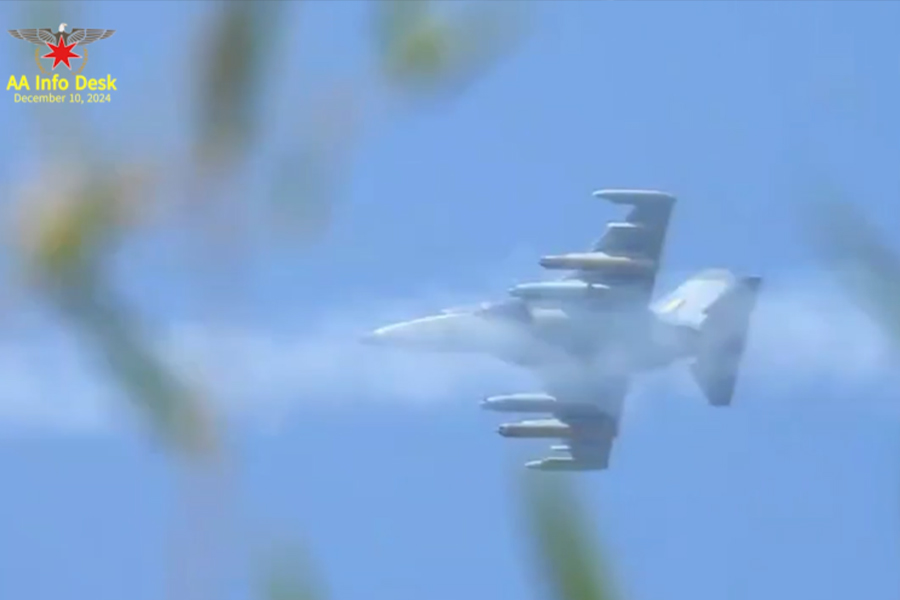
- Local reporting indicates that junta forces attacked civilian sites in Arakan State on 29 and 30 October. Residents reported that a junta jet fighter dropped two bombs on a high school in Kyeinchaung Village, Maungdaw Township, on 30 October; the attack also damaged school facilities and nearby homes, with no civilian casualties reported. A separate report says two junta suicide drones attacked Kyaukseik Village, Ponnagyun Township, on 29 October, with no injuries. These details rely on local reporting and lack independent corroboration in the supplied material. (Confidence: low · REPORTED)
- I&W: Geolocated imagery or independent reporting confirms damage to the Kyeinchaung high school or adjacent market, strengthening the account of the 30 October attack. (0-14 days)
- I&W: A corroborated incident record identifies civilian deaths or injuries from either the Kyeinchaung or Kyaukseik attack, changing the current report of no casualties. (0-14 days)
- Junta air and artillery attacks on civilian infrastructure are likely to continue over the next three months. The UN Special Rapporteur describes attacks on schools, health facilities, religious buildings, markets and displacement camps, and identifies a military strategy of cutting food, resources, humanitarian access and support networks from resisting areas. Recent local reports place attacks in Arakan Army-controlled Kyeinchaung and in Ponnagyun Township; think-tank reporting also describes junta battlefield setbacks. This is an analytic forecast, not a directly reported prediction. (Confidence: medium · ASSESSED)
- I&W: Independent incident reports document another junta air or artillery attack on a school, market, health facility or displacement site in Rathedaung, Kyauktaw, Buthidaung, Maungdaw, Ponnagyun or Sittwe Township. (0-14 days)
- I&W: The junta announces a halt to air and artillery attacks on civilian sites, followed by 30 days without a verified attack on such a site in the named Arakan State townships. (1-3 months)
Outlook & scenarios
Continued attacks alongside contested front lines (60%)
Junta air and artillery attacks continue as resistance forces retain territory and the military faces setbacks. Reports of attacks on civilian sites recur, while the national cumulative death toll remains difficult to establish from the available figures.
Diplomatic contact without a durable reduction in violence (30%)
ASEAN contact with Myanmar's authorities continues, but it does not produce a sustained reduction in attacks. The Kachin Independence Army's rejection of a junta peace-talks overture and the absence of a reported ceasefire keep this scenario focused on limited contact rather than a broad settlement.
High-impact expansion of attacks on civilian sites (10%)
Junta aircraft and drones conduct a concentrated series of attacks on civilian sites in Arakan State, causing casualties beyond those reported in the 29-30 October incidents. This is a low-probability, high-impact scenario; the supplied reporting does not establish preparations for such a campaign.
Recommendations
- Treat a death toll above 100,000 as unverified. Maintain separate UN and AAPP figures, with each series labelled by its date range, population counted and attribution method.
- Prioritise independent verification of the 29-30 October reports from Kyeinchaung and Kyaukseik. Separate confirmation of the attack, weapon type, damage and civilian casualties rather than treating them as one finding.
- Monitor incident reporting for the named Arakan State townships and record whether strikes hit schools, markets, health facilities or displacement sites. Flag reports based only on local accounts until independently corroborated.
- Do not use satellite thermal detections alone to attribute an incident to a strike or identify the responsible actor; seek corroboration from incident reporting and imagery.
Confidence & uncertainty
Overall confidence is medium because UN-linked and AAPP reporting provide identifiable but differently scoped casualty figures, while UN and think-tank reporting supports a broader pattern of military pressure. The specific 29-30 October attack details come from local reporting and lack independent corroboration in the supplied material. No supplied source establishes a cumulative death toll above 100,000.
Intelligence gaps
- [EEI 1.2 · PARTIAL] Changes in the weekly number of civilian deaths, injuries, detentions, enforced disappearances, and reported attacks compared with the preceding four weeks. Recommended collection: UN reporting and incident-monitoring databases
- [EEI 1.3 · PARTIAL] Junta force movements, aircraft sorties, artillery deployments, and preparations near densely populated areas or displacement concentrations. Recommended collection: commercial satellite imagery, local reporting, and military-source reporting
- [EEI 2.1 · PARTIAL] Newly displaced civilians by state or region, including the number of people fleeing each major attack area and the direction of movement. Recommended collection: UN OCHA, humanitarian partners, and local civil-society reporting
- [EEI 2.2 · PARTIAL] Access conditions and stock levels for food, medicine, fuel, shelter, and clean water in conflict-affected townships. Recommended collection: humanitarian field reporting and satellite imagery
- [EEI 2.4 · PARTIAL] Changes in cross-border refugee flows and requests for emergency assistance in neighboring countries. Recommended collection: border authorities, UNHCR, and humanitarian reporting
- [EEI 3.3 · UNCOVERED] Evidence of resistance forces establishing evacuation routes, civilian-protection arrangements, local administration, or restrictions on attacks affecting civilian areas. Recommended collection: local governance reporting, NGO interviews, and resistance statements
- [EEI 3.4 · UNCOVERED] Changes in resistance access to weapons, ammunition, drones, communications equipment, training, and cross-border logistical support. Recommended collection: weapons-tracking reporting, border reporting, and imagery analysis
- [EEI 4.1 · PARTIAL] New arms transfers, aviation fuel deliveries, spare-parts shipments, financial flows, or maintenance support reaching the junta. Recommended collection: customs data, sanctions investigations, shipping databases, and commercial imagery
- [EEI 4.3 · PARTIAL] Changes in neighboring states' border controls, refugee policies, cross-border aid access, and engagement with junta or resistance representatives. Recommended collection: official statements, border reporting, and diplomatic reporting
- [EEI 4.4 · UNCOVERED] Changes in commercial aviation-fuel prices, war-risk insurance, shipping access, or banking restrictions affecting junta-controlled ports and airports. Recommended collection: maritime/shipping data, financial reporting, and sanctions-monitoring sources
Red cell review: CONCUR WITH COMMENT
TLP:CLEAR