TLP:CLEAR · Disclosure is not limited.
Myanmar: civilian deaths and drone attacks, 100,000 toll unverified
Time window: Last 1 day · Audience: General analyst · Type: Situation report · DTG: 2026-10-31 08:36Z · Overall confidence: HIGH
BLUF
The supplied reporting does not substantiate a UN-documented death toll above 100,000 since the 2021 coup. AAPP reports 8,627 cumulative deaths through 30 October 2026 and 103 deaths attributed to the junta during October, including 94 from airstrikes; separate reporting indicates the junta now accounts for most recorded drone attacks.
Executive summary
New reporting adds an AAPP cumulative death figure and a detailed October breakdown, but neither establishes a UN-documented national toll above 100,000. The 100,000 figure appears in an NGO claim without a supporting methodology in the supplied material, and it is not directly comparable with AAPP's tally of identified deaths attributed to the junta and pro-military groups. AAPP also reports 90 additional October civilian deaths whose identities remain unconfirmed. Separately, EL PAÍS reports ACLED data showing a sharp rise in the junta's share of drone attacks. Document-led reporting describes aviation-fuel imports misdeclared as diesel between December 2024 and November 2025, but does not establish current import volumes.
Change from previous assessment
The assessment that the supplied evidence does not substantiate a UN-documented death toll above 100,000 is unchanged. New reporting adds AAPP's 8,627 cumulative figure and October breakdown, with 94 of 103 reported deaths attributed to airstrikes and 90 additional civilian deaths awaiting identity confirmation. The assessment of ongoing attacks is now supported by quantified reporting beyond the previously uncorroborated local Arakan reports. New judgments cover the junta's rising share of recorded drone attacks and reported aviation-fuel procurement methods; confidence in current fuel volumes remains limited.
Key judgments
- The supplied reporting does not establish a UN-documented cumulative death toll above 100,000 since the 1 February 2021 coup. AAPP reports 8,627 deaths attributed to the junta and pro-military groups through 30 October 2026; an NGO's separate 100,000 figure lacks supporting scope, methodology or UN attribution in the material provided. The figures may cover different populations and methods, so they should not be treated as directly comparable. (Confidence: medium · ASSESSED)
- I&W: The UN Human Rights Office publishes a defined, auditable cumulative death toll above 100,000 for deaths since 1 February 2021, which would break this judgment. (1-3 months)
- I&W: A UN or independent reconciliation publishes a scope-adjusted cumulative figure below 100,000 using documented case criteria, which would support this judgment. (1-3 months)
- Junta airstrikes were the leading reported cause of deaths in AAPP's October tally: 94 of 103 people reported killed from 1 to 30 October were attributed to airstrikes. AAPP separately reports 90 additional civilian deaths from junta attacks whose identities are not yet confirmed. Incident reporting also records five family members killed in an airstrike at Htan Taw Village, Kanbalu Township, on 23 October, and 12 civilian deaths in eastern Myanmar during the first three weeks of September from drone and air strikes. (Confidence: medium · REPORTED)
- I&W: AAPP's November 2026 breakdown again identifies airstrikes as the largest cause of verified deaths; another leading cause would break this judgment. (0-30 days)
- I&W: BNI reporting records civilian deaths from drone or air strikes in eastern Myanmar during November 2026, confirming continued reported civilian harm from these attack types. (0-30 days)
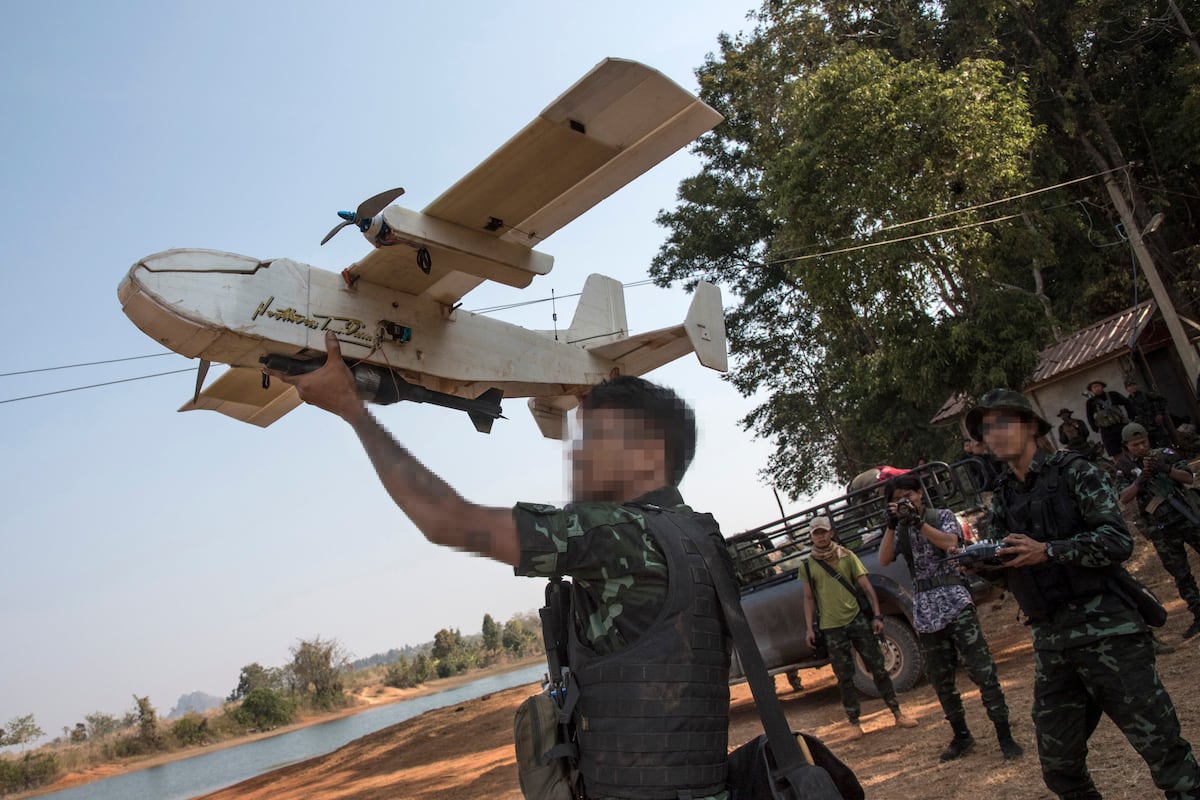
- The junta has become the majority actor in recorded drone attacks: ACLED figures reported by EL PAÍS put its share at 5% in 2023 and 71% since June 2025, within 6,215 drone incidents recorded since the coup. Resistance forces also retain drone capacity, including Kachin guerrillas' reported attack on a supply convoy on the Irrawaddy River. These figures describe recorded drone activity, not the share of civilian casualties caused by drones. (Confidence: medium · REPORTED)
- I&W: The next ACLED period-specific breakdown continues to show the junta responsible for more than half of recorded drone attacks; a share below half would break the judgment that it remains the majority actor. (1-3 months)
- The junta likely sustained aviation-fuel imports through trade misdeclaration during December 2024 to November 2025. Justice For Myanmar identified six authorised imports worth $109.5 million described as high-speed diesel, and Reuters reporting traced aviation fuel from Bandar Abbas, Iran, to Myanmar. The records support past import activity and concealment methods, but do not establish current volumes or prove that the same routes remain active in 2026. (Confidence: medium · ASSESSED)
- I&W: Follow-on customs or shipping records identify a post-November 2025 aviation-fuel cargo routed from Bandar Abbas to Myanmar or declared as diesel, confirming continued use of the reported methods. (0-3 months)
- I&W: An auditable review of 2026 trade and vessel records finds no post-November 2025 deliveries through the identified routes or intermediaries, weakening the inference that the network remains active. (0-3 months)
Outlook & scenarios
Air and drone attacks continue to drive reported deaths (65%)
Junta air and drone attacks are likely to continue over the next three months, with airstrikes remaining a leading cause in reported death tallies. AAPP's October figures provide the immediate baseline; the 90 unconfirmed deaths leave room for that month's final count to rise.
Fuel-network enforcement constrains imports (20%)
A coordinated investigation by authorities in Thailand, Singapore and the United Arab Emirates, alongside enforcement by the US and other partners, is an unlikely but plausible route to disrupting the procurement channels described in the reporting. Any effect on junta air operations would depend on whether those channels remain active and whether alternative supply routes are affected.
ICJ ruling is followed by renewed violence against the Rohingya (15%)
There is an unlikely, high-impact risk that an ICJ ruling on genocide allegations linked to the military's 2017 campaign is followed by renewed violence against the Rohingya or other minorities. Kelley Currie warned of violence after a ruling, but the supplied material does not establish that such violence is imminent.
Recommendations
- Do not describe the 100,000 figure as a UN-documented death toll. Require the underlying UN publication, case definition and period covered before using it, and keep it separate from AAPP's 8,627 identified deaths.
- Track AAPP's 103 October deaths separately from the 90 additional deaths awaiting identity confirmation. Cross-check subsequent AAPP updates against BNI incident reporting and distinguish civilian deaths, all reported deaths and airstrike-attributed deaths.
- Maintain a monthly drone-activity series using ACLED's actor attribution and reporting period. Do not infer civilian casualty shares from the overall drone-incident count.
- Refer the aviation-fuel records for validation by sanctions and financial analysts. Check the six reported imports, FESC approvals, NEPAS intermediaries and the Bandar Abbas route against follow-on trade and shipping records before assessing whether the network remains active.
Confidence & uncertainty
Overall confidence is high for the broad situation picture because AAPP's dated casualty records, EL PAÍS reporting on ACLED data, BNI incident reporting and document-led fuel reporting that includes Reuters shipping analysis provide distinct, attributable streams of evidence. These sources support separate elements of the assessment rather than a single reconciled national death total. The 100,000 figure lacks UN documentation in the supplied material; AAPP's 90 pending deaths and current aviation-fuel volumes remain unresolved.
Alternative analysis (red cell)
The evidence more securely establishes that the junta authorized and received at least some aviation-fuel shipments using misleading descriptions and intermediary companies than that it maintained a sustained import stream. Six identified transactions and one independently traced shipment demonstrate a recurring or attempted procurement mechanism, but do not establish continuity, delivered volume, or operational significance. A reasonable alternative assessment is therefore that trade misdeclaration was documented during the period, while the scale and persistence of the supply network remain unresolved.
Intelligence gaps
- [EEI 1.1 · PARTIAL] Geolocated airstrikes, artillery strikes, raids, arson attacks, and mass-casualty incidents attributed to junta forces during the reporting period. Recommended collection: OSINT/geospatial and local human-rights reporting
- [EEI 1.2 · PARTIAL] Changes in the weekly number of civilian deaths, injuries, detentions, enforced disappearances, and reported attacks compared with the preceding four weeks. Recommended collection: UN reporting and incident-monitoring databases
- [EEI 1.3 · PARTIAL] Junta force movements, aircraft sorties, artillery deployments, and preparations near densely populated areas or displacement concentrations. Recommended collection: commercial satellite imagery, local reporting, and military-source reporting
- [EEI 1.4 · PARTIAL] Evidence that attacks are targeting ethnic, religious, political, or resistance-supporting communities, including repeated attacks on the same locations. Recommended collection: witness interviews, human-rights documentation, and geospatial analysis
- [EEI 2.1 · PARTIAL] Newly displaced civilians by state or region, including the number of people fleeing each major attack area and the direction of movement. Recommended collection: UN OCHA, humanitarian partners, and local civil-society reporting
- [EEI 2.2 · UNCOVERED] Access conditions and stock levels for food, medicine, fuel, shelter, and clean water in conflict-affected townships. Recommended collection: humanitarian field reporting and satellite imagery
- [EEI 2.3 · PARTIAL] Closure or damage of hospitals, schools, markets, roads, bridges, and aid facilities in areas experiencing intensified attacks. Recommended collection: local reporting, NGO reporting, and commercial satellite imagery
- [EEI 2.4 · UNCOVERED] Changes in cross-border refugee flows and requests for emergency assistance in neighboring countries. Recommended collection: border authorities, UNHCR, and humanitarian reporting
- [EEI 3.1 · PARTIAL] Resistance attacks, territorial gains, loss of key transport routes, and changes in control of towns or administrative centers. Recommended collection: conflict-event databases, local media, and geospatial analysis
- [EEI 3.2 · UNCOVERED] Junta retaliatory operations, including collective-punishment measures, village burnings, airstrikes, artillery barrages, and arrests following resistance activity. Recommended collection: local human-rights reporting and incident databases
- [EEI 3.3 · UNCOVERED] Evidence of resistance forces establishing evacuation routes, civilian-protection arrangements, local administration, or restrictions on attacks affecting civilian areas. Recommended collection: local governance reporting, NGO interviews, and resistance statements
- [EEI 3.4 · PARTIAL] Changes in resistance access to weapons, ammunition, drones, communications equipment, training, and cross-border logistical support. Recommended collection: weapons-tracking reporting, border reporting, and imagery analysis
- [EEI 4.2 · PARTIAL] New or expanded sanctions, arms embargo measures, accountability proceedings, diplomatic initiatives, or humanitarian funding commitments. Recommended collection: government, UN, and international-organization statements
- [EEI 4.3 · PARTIAL] Changes in neighboring states' border controls, refugee policies, cross-border aid access, and engagement with junta or resistance representatives. Recommended collection: official statements, border reporting, and diplomatic reporting
- [EEI 4.4 · PARTIAL] Changes in commercial aviation-fuel prices, war-risk insurance, shipping access, or banking restrictions affecting junta-controlled ports and airports. Recommended collection: maritime/shipping data, financial reporting, and sanctions-monitoring sources
Red cell review: PARTIAL DISSENT
TLP:CLEAR