TLP:CLEAR · Disclosure is not limited.
Red Sea: Houthi enforcement risk keeps Bab el Mandeb shipping under pressure
Time window: Last 7 days · Audience: General analyst · Type: Situation report · DTG: 2026-06-17 01:11Z · Overall confidence: MEDIUM
BLUF
Yemen’s Houthi leadership has declared Israeli-linked shipping a target in the Red Sea, and the risk to transits near Bab el Mandeb remains elevated. Multiple small-boat approaches reported off Yemen and Iran-linked signalling about using the Houthis to pressure the strait mean episodic disruption is likely despite diplomatic activity elsewhere.
Executive summary
On 8 June, Yemen’s Iran-aligned Houthi movement announced a ban on Israeli maritime navigation in the Red Sea, reinforcing earlier messaging on Israel-linked traffic. Separate reporting describes small armed craft approaching and firing on merchant vessels near Balhaf and south-east of Aden, indicating a persistent skiff threat across the Gulf of Aden approaches to Bab el Mandeb. Analysts and US intelligence warn that Tehran could leverage the Houthis to escalate at Bab el Mandeb if negotiations sour, and one outlet reports prior Iranian planning to extend chokepoint pressure to this waterway with Houthi help. Red Sea-Suez impacts remain visible: the IMF reported a 50 percent year-on-year drop in Suez Canal trade in early 2024 and the Suez Canal Authority recorded sharply lower annual revenue, while commentators note higher shipping costs tied to Houthi activity. Humanitarian and governance conditions in Houthi-held areas are strained, with UN and NGO detentions and threats to aid operations, complicating de-escalation and crisis-management channels.
Change from previous assessment
Since the 15 June brief, we have incorporated additional open reporting that Iran has planned to expand chokepoint pressure to Bab el Mandeb with Houthi support and US intelligence warnings of that pathway, raising our assessed risk of attempted interdictions if negotiations falter. Our view of the small-boat threat in the Gulf of Aden approaches is unchanged, with similar modus operandi to the 10 June reporting. We added Suez trade and revenue context to refine the shipping-cost outlook. Confidence remains medium given limited direct evidence of new Houthi enforcement actions within the window.
Key judgments
- It is very likely that Yemen’s Houthi leadership intends to enforce a declared ban on Israel-linked shipping through the Red Sea and Bab el Mandeb in the near term. (Confidence: medium · ASSESSED)
- I&W: Houthi channels issue specific threats and claim interdictions against named or IMO-identified merchant vessels transiting the southern Red Sea or Bab el Mandeb. (0-14 days)
- I&W: Public rescission or clear softening of the ban by senior Houthi figures, followed by a fortnight without Houthi claims against Israel-linked shipping. (0-14 days)
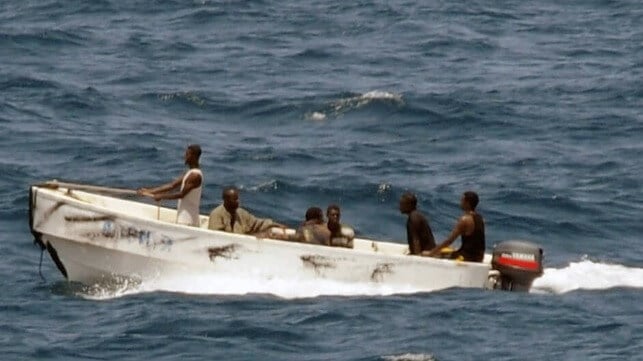
- Merchant vessels in the Gulf of Aden approaches to Bab el Mandeb likely face a persistent risk from small armed craft, evidenced by reported approaches and exchanges of fire near Balhaf and south-east of Aden. (Confidence: medium · REPORTED)
- I&W: Additional UKMTO or MSCIO advisories of skiff approaches or small-arms/RPG fire within 150 nm of Aden or Balhaf. (0-14 days)
- I&W: EUNAVFOR Atalanta bulletins note a sustained decline in skiff approaches in the Gulf of Aden corridor. (1-3 months)
- If US-Iran negotiations stall, it is likely that Iran will support Houthi efforts to expand disruption at Bab el Mandeb, creating a roughly even chance of attempted chokehold tactics, including mining or missile/drone harassment, over the next 1-3 months. (Confidence: medium · ASSESSED)
- I&W: Official or trade-press reporting of mine sightings or recovery operations in the southern Red Sea or near Yemeni ports such as Mokha or Hodeidah. (1-3 months)
- I&W: Iranian or Houthi statements explicitly linking Bab el Mandeb to broader chokepoint pressure in response to setbacks in talks. (0-14 days)
- Red Sea-Suez route economics are likely to remain strained relative to pre-crisis levels, with elevated costs and reduced transits persisting into the next quarter. (Confidence: medium · ASSESSED)
- I&W: Suez Canal Authority reporting shows monthly revenues or transits remaining well below 2023 levels. (1-3 months)
- I&W: Trade press continues to report higher freight and war-risk premiums for Red Sea voyages versus alternative routings. (1-3 months)
- Humanitarian strain and detentions in Houthi-held areas are likely to complicate maritime de-escalation channels and crisis response around Bab el Mandeb. (Confidence: medium · ASSESSED)
- I&W: Verified release of detained UN and NGO personnel and resumption of paused aid programmes in Houthi-controlled areas. (1-3 months)
- I&W: New detentions or threats against international staff reported by UN member states or agencies. (0-14 days)
Outlook & scenarios
Managed harassment campaign continues at Bab el Mandeb (60%)
The Houthis maintain a targeted harassment posture against Israel-linked ships, relying on threats, select missile or drone launches, and occasional skiff approaches. Traffic reroutes and risk premiums persist, but the waterway remains open to most non-Israel-linked commercial traffic.
Escalation to chokepoint pressure coordinated with Iran (35%)
If talks with the US falter, Iran supports a sharper Houthi campaign to stress Bab el Mandeb, including attempts at mining or more frequent stand-off strikes. Short-lived closures or convoying requirements emerge, with sharper impacts on energy and container flows.
Partial de-escalation to preserve talks with Saudi Arabia (20%)
Houthi leadership trims maritime enforcement to avoid jeopardising a favourable arrangement with Saudi Arabia, reducing strike tempo and emphasising messaging over interdictions. Operators begin gradual re-engagement with Red Sea routing while maintaining higher-than-normal precautions.
Recommendations
- Maintain a standing watch on UKMTO and MSCIO alerts for the Gulf of Aden and Bab el Mandeb corridor, with geofenced triggers keyed to areas cited in recent skiff approaches, including off Balhaf and south-east of Aden.
- Task collection to track Houthi maritime communiques for explicit vessel naming and to archive any imagery of interdiction attempts for attribution and legal use.
- Establish a liaison point with EUNAVFOR Atalanta to share and receive near-real-time pattern-of-life data on skiff activity and suspected launch areas along Yemen’s coast.
- Direct analysts to use NASA FIRMS thermal anomaly feeds as a cueing tool near Yemeni littoral areas while avoiding attribution based solely on heat signatures.
- Prioritise a vessel ownership and charter-party scrub to identify traffic perceived as Israel-linked, enabling tailored routing and timing advice for higher-risk voyages.
- Update war-risk and delay-cost assumptions for Red Sea-Suez transits using recent Suez traffic and revenue baselines and incorporate contingency routing via the Cape in operational planning.
- Develop and brief an indicators-and-warnings card for Bab el Mandeb that includes mine sighting reports, Houthi claims of strikes, and spikes in UKMTO skiff advisories.
- Coordinate with humanitarian and diplomatic channels monitoring detentions in Yemen to anticipate knock-on effects on de-escalation mechanisms and crisis response.
Confidence & uncertainty
Overall confidence is medium. The core judgments draw on multiple credible sources, including official statements and maritime reporting, regarding the Houthi ban, small-boat threats near Yemen, and Red Sea-Suez trade impacts. Assessments of Iranian intent and potential escalation rely on analytic reporting and risk assessments rather than direct evidence of new operations at Bab el Mandeb. Some inputs are dated or from commentary outlets, and attribution for skiff activity remains unclear, which constrains confidence.
Alternative analysis (red cell)
Houthi public threats and isolated harassment incidents elevate risk to ships, but available reporting is primarily declaratory or speculative and lacks clear evidence of orders, transfers, or operational preparations to enforce a comprehensive near-term ban or a coordinated Iran-enabled chokehold at Bab el Mandeb. Given the mix of analyst warning and episodic incidents, outcomes ranging from targeted harassment to calibrated restraint are more plausible than immediate, sustained enforcement or full chokehold operations; further ISR, SIGINT, and maritime traffic data are needed to distinguish these pathways.
Intelligence gaps
- [EEI 1.2 · UNCOVERED] Public Houthi claims of attacks or warnings tied to specific dates/routes, including social-media posts, official statements, and timing relative to merchant transits. Recommended collection: open-source/social_media
- [EEI 1.3 · UNCOVERED] Unusual Houthi force posture indicators along Yemen’s Red Sea coast: movement or concentration of small boats, visible coastal missile/rocket emplacements, or logistics buildup at known launch sites (locations, timestamps). Recommended collection: imagery/satellite
- [EEI 1.4 · UNCOVERED] Intercepts or communications indicating orders, targeting lists, or intent to strike merchant shipping (messages referencing specific vessel classes, companies, or chokepoints). Recommended collection: signals/communications
- [EEI 2.1 · UNCOVERED] Reports or visual confirmation of floating or moored mines and debris fields in shipping lanes or approaches to Bab-el-Mandeb, with geolocation and time. Recommended collection: imagery/satellite
- [EEI 2.2 · UNCOVERED] Detection of mine-laying activity: small vessels loitering in lane approaches, unexpected AIS track patterns consistent with mine deployment, or salvage/mining vessels operating in the area. Recommended collection: maritime/AIS
- [EEI 2.3 · PARTIAL] Hydrographic notices, naval warnings, or port authority advisories closing lanes or imposing route restrictions (text of Notice to Mariners, issuing agency, effective times/areas). Recommended collection: naval/port_authority
- [EEI 2.4 · PARTIAL] Naval or commercial reports of mine-countermeasure operations or confirmed mine removal events (location, time, platforms involved). Recommended collection: naval/intelligence
- [EEI 3.1 · PARTIAL] Movements and presence of foreign warships and support vessels: names/classes, task group compositions, patrol areas and timelines, and whether vessels are conducting escort or interdiction operations. Recommended collection: naval/intelligence
- [EEI 3.2 · PARTIAL] Official announcements or directives from states/coalitions regarding convoys, armed escorts, protected corridor establishment, or changes to rules of engagement for merchant protection. Recommended collection: diplomatic/public_affairs
- [EEI 3.3 · PARTIAL] Recorded interactions between naval forces and vessels in the corridor (hailings, boardings, warnings, defensive strikes), including timestamps and outcomes. Recommended collection: maritime/AIS
- [EEI 3.4 · PARTIAL] Planned or ongoing multinational exercises, air ISR sorties, or logistics moves that increase or decrease naval capacity in the area (exercise name, participating units, dates, locations). Recommended collection: open-source/military_reporting
- [EEI 4.1 · PARTIAL] Transit volume and pattern changes: number of commercial transits per day/week through Bab-el-Mandeb and southern Red Sea compared with baseline, and instances of rerouting around Africa (position/time data). Recommended collection: maritime/AIS
- [EEI 4.2 · UNCOVERED] War-risk and hull insurance coverage changes: issuance refusals, premium increases for Red Sea transits, or explicit route exclusions by underwriters (policy notices or market rate data with dates). Recommended collection: commercial/insurance_data
- [EEI 4.3 · PARTIAL] Freight and charter market signals tied to the corridor: spot rates for container, tanker, and dry bulk routes affected by Red Sea disruptions, and reported port congestion or turnaround-time increases at nearby hubs. Recommended collection: commercial/market_data
- [EEI 4.4 · PARTIAL] Incidents of cargo denial or diversion for critical goods (crude oil, refined products, LNG, high-value container cargo) including vessel IDs, cargo type, reroute/turnback actions, and economic impact estimates where available. Recommended collection: maritime/AIS
Cited sources
[1] The Media Line · The Houthis Weigh the Cost of Escalation at Bab el Mandeb - The Media Line (B) · sha256:b4853e2806d0 [2] AJArabic.Yemen · تتصاعد التوترات في مضيق باب المندب بعد فرض جماعة أنصار الله حظرًا على الملاحة المرتبطة بإسرائيل. فكيف ستؤثر تلك الخطوة على حركة السفن بالبحر الأحمر؟ ومن هم أكثر المتضررين؟ #الجزيرة_فيديو | الجزيرة - اليمن (E) · sha256:ea80e97045ef [3] maritime-executive.com · Ships Report Trading Shots with Pirates, Including a 30-Minute Firefight (B) · sha256:838603ca1287 [4] forbes.com · Iran Has More Control Over Strait Of Hormuz Than Before War, U.S. Intel Finds (A) · sha256:3fb33ef590c8 [5] unian.net · США подготовили наземную операцию в Иране, но Трамп все отменил, – CNN (B) · sha256:5d85547265fa [6] Oil & Gas 360 · Back to where we started? - Oil & Gas 360 (C) · sha256:eced9b937847 [7] jpost.com · Scouring Strait of Hormuz for mines could take weeks, delaying return to normal shipping (B) · sha256:0c9ee9b366cb [8] Middle Eastern Observer · How Houthis Broke Global Trade (B) · sha256:20ca70160472 [9] gov.uk · The UK provided over $190m towards the humanitarian response in Yemen, and we remain committed to working collectively with partners to reach those most in need: UK statement at the UN Security Council (A) · sha256:a81485164709
Source content hashes were computed at collection time; the cited text is preserved unmodified for the life of this product.
Red cell review: PARTIAL DISSENT
TLP:CLEAR