TLP:CLEAR · Disclosure is not limited.
Red Sea shipping disruption: limited carrier return amid continued attack risk and Hormuz drag
Time window: Last 7 days · Audience: General analyst · Type: Situation report · DTG: 2026-07-11 01:09Z · Overall confidence: MEDIUM
BLUF
Threat to merchant shipping in the southern Red Sea remains elevated after a reported attack off Al Hudaydah, even as Maersk restarts limited Suez routings. Concurrent disruption and high war‑risk pricing around the Strait of Hormuz are likely to keep most owners cautious, restraining a rapid, broad‑based return to Red Sea transits.
Executive summary
A cargo ship reported an attack 56 km off Al Hudaydah in Houthi‑controlled waters, with UKMTO noting the incident but no confirmed perpetrator. Against this backdrop, carriers are probing a narrow reopening: Maersk has resumed the AE15 service via Suez, announced a second route, moved to route MECL through Suez, and put specific sailings, including Majestic Maersk in the southern Red Sea and Maersk Denver westbound, onto the schedule. Industry posture remains cautious. Simultaneously, insecurity in and around the Strait of Hormuz has depressed traffic and pushed war‑risk cover higher, with insurers reporting fewer enquiries, steep premiums and thousands of seafarers stranded. NASA FIRMS shows minor thermal detections near Bab el‑Mandeb, but these do not validate attacks on their own.
Change from previous assessment
Initial assessment of this topic for this run, building on the prior day’s brief: new reporting highlights a cargo‑ship attack 56 km off Al Hudaydah with unconfirmed attribution, while Maersk’s incremental return via Suez is now evidenced by Majestic Maersk’s southern Red Sea transit and a scheduled Maersk Denver westbound leg. Reporting on Hormuz reinforces elevated war‑risk pricing and stranded crews, sustaining caution about a broader, rapid Suez reopening.
Key judgments
- The maritime threat to commercial shipping in the southern Red Sea and Bab el‑Mandeb is very likely to remain elevated in the near term, anchored in a newly reported attack 56 km off Al Hudaydah in Houthi‑controlled waters and a sustained Houthi campaign against merchant vessels since late 2023. This rests on multiple independent reports, though attribution for the latest incident is unconfirmed. (Confidence: high · ASSESSED)
- I&W: Additional UKMTO reports of missile, drone or small‑boat attacks against merchant shipping within 100 km of Al Hudaydah or Mocha. (0-14 days)
- I&W: A full month without UKMTO or industry reports of attacks in the southern Red Sea, alongside multiple carriers publicly expanding Suez routings. (1-3 months)
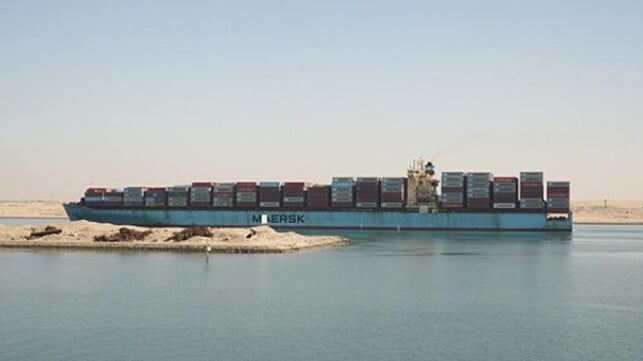
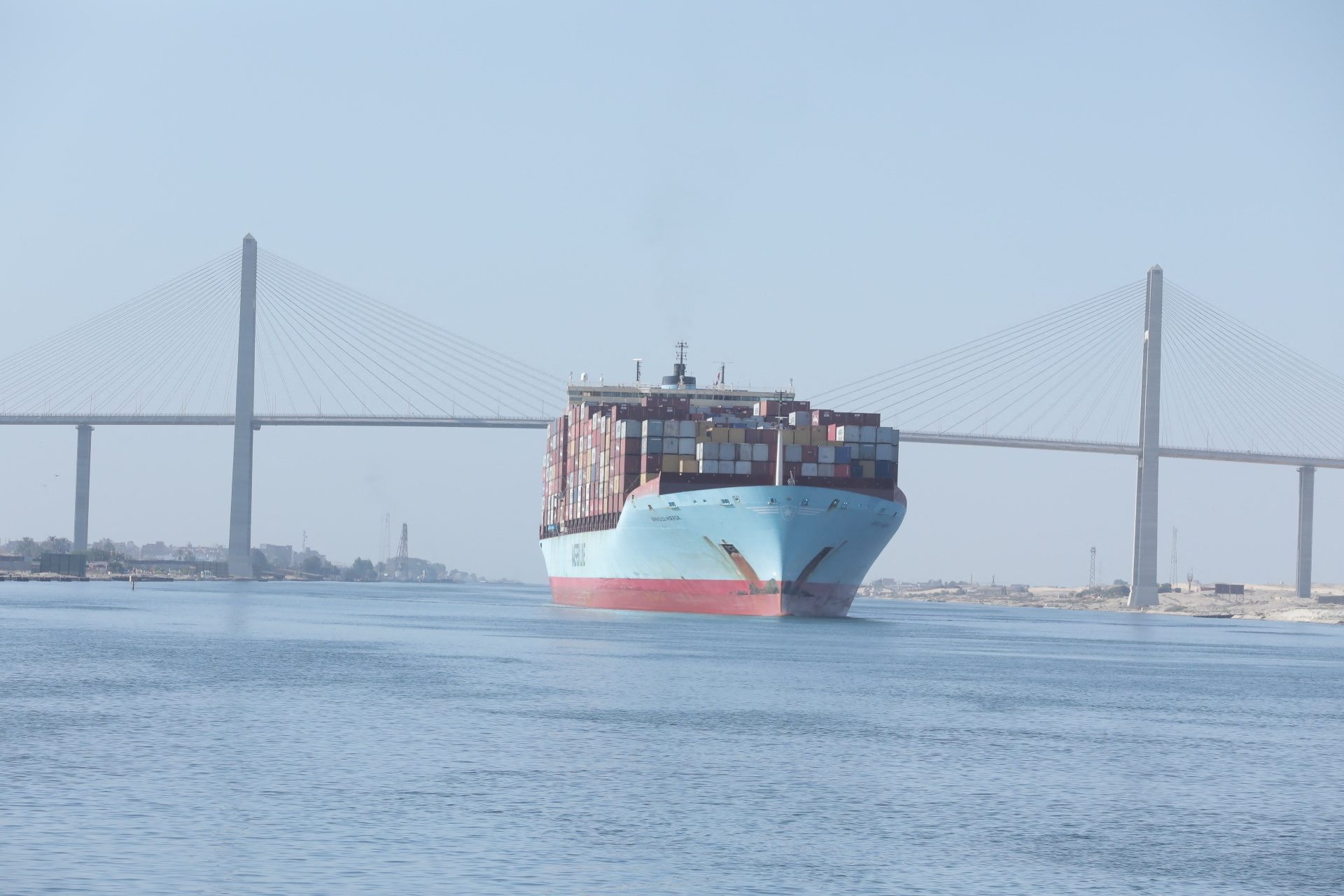
- Container lines are cautiously restarting Suez, Red Sea transits, led by Maersk, but this is likely to remain a controlled, limited reopening rather than a wholesale return. Maersk has reinstated the AE15 Asia, Europe service via Suez, announced a second route, moved its MECL service to the Red Sea, Suez corridor, and executed specific sailings including Majestic Maersk through the southern Red Sea and Maersk Denver westbound. UKMTO assesses overall industry posture as cautious. (Confidence: high · ASSESSED)
- I&W: Additional carrier network notices adding named Asia, Europe and Middle East, US East Coast loops via Suez, beyond AE15 and MECL. (1-3 months)
- I&W: Public suspension by Maersk of AE15 or MECL Red Sea legs following an at‑sea security incident. (0-14 days)
- Regional insecurity around the Strait of Hormuz is likely to depress owners’ willingness to add Red Sea exposure and to keep war‑risk pricing elevated, slowing a broad‑based Suez return. Brokers and underwriters report fewer enquiries and higher war‑risk rates, premiums for a $100 million tanker near $6 million, visible traffic sharply reduced, and thousands of seafarers stranded; however, reporting diverges on whether flows have ‘ground to a halt’ or merely fallen sharply. (Confidence: medium · ASSESSED)
- I&W: War‑risk add‑ons for Hormuz quoted at or above 2 percent of hull value and low quote volumes from London market brokers persist. (0-30 days)
- I&W: Reported Hormuz war‑risk add‑ons fall below 1 percent with a rebound in insurance quote requests and daily transits approaching pre‑escalation averages. (1-3 months)
- Attribution for the latest Red Sea attack remains unconfirmed, with only a roughly even chance Houthi units conducted it. The incident occurred in waters they control and aligns with their stated target set and prior campaign, but present reporting does not verify responsibility and should be treated with caution. (Confidence: low · ASSESSED)
- I&W: A named claim of responsibility from Houthi military media identifying the vessel and strike method. (0-14 days)
- I&W: A flag‑state or UKMTO update attributing the attack to non‑Houthi actors such as armed criminal groups. (1-3 months)
- NASA FIRMS thermal detections near Bab el‑Mandeb almost certainly cannot, by themselves, verify attacks at sea; they indicate heat, not cause, and should be used only alongside incident reporting and AIS distress data. (Confidence: medium · ASSESSED)
- I&W: Thermal hotspots appear in FIRMS with no corresponding UKMTO alerts or AIS distress messages. (0-14 days)
- I&W: Consistent one‑to‑one correlation between high‑confidence FIRMS anomalies and verified maritime attack reports. (1-3 months)
Outlook & scenarios
Managed risk, selective Suez reopening persists (60%)
Sporadic attacks continue in Houthi‑controlled waters, but carriers like Maersk and CMA CGM keep limited corridors open with carefully selected voyages and schedules. UKMTO continues to characterise posture as cautious, and insurers keep war‑risk pricing above pre‑crisis norms. The net effect is incremental increases in Suez routings but no rapid normalisation.
Escalation triggers renewed industry pullback (35%)
A successful strike damages a container ship or tanker in the southern Red Sea or near Bab el‑Mandeb, with credible attribution to Houthi forces. UKMTO raises warnings, insurers hike rates further, and major carriers suspend new Red Sea legs, reverting to Cape of Good Hope routings.
De‑escalation enables wider Suez return (25%)
Regional diplomacy reduces cross‑theatre tensions and incident rates. War‑risk premiums ease, UKMTO threat characterisations soften, and multiple carriers publish expanded Suez schedules. Red Sea transits increase materially, though some residual risk aversion remains.
Recommendations
- Track UKMTO alerts and advisories daily and maintain a log of incidents within 100 km of Al Hudaydah and Mocha to map patterns and likely operating windows.
- Monitor carrier network notices and AIS for named voyages on Maersk AE15 and MECL, including Majestic Maersk and Maersk Denver sailings, to gauge the scale and cadence of the reopening.
- Collect weekly war‑risk quoting data from London market brokers to quantify rate movements, enquiry volumes and conditions of cover that could gate a broader Suez return.
- Use FIRMS detections only as corroborative inputs, validating any thermal hotspot near Bab el‑Mandeb against UKMTO reporting and vessel distress or deviation data before treating it as an attack indicator.
- Flag higher‑risk transits for owners with Israel‑linked beneficial ownership and ships scheduled through Houthi‑controlled waters, aligning vessel risk profiles with routing choices.
- Prepare alternative routing and dwell‑time impact estimates for Cape of Good Hope diversions to brief logistics, trade and energy stakeholders if escalation forces a renewed pullback.
Confidence & uncertainty
Overall confidence is medium. Multiple independent, generally reliable reports underpin the recent attack off Al Hudaydah, the sustained Houthi threat, and the measured carrier return via Suez. Insurance market feedback on enquiries and pricing is consistent across sources. However, attribution for the latest Red Sea incident remains unconfirmed, some Hormuz traffic reporting conflicts on severity, and several carrier updates derive from trade publications without official timestamps. These gaps and contradictions limit a high‑confidence assessment.
Alternative analysis (red cell)
The ledger supports concern about maritime risk but not the higher‑confidence readings. The reported Red Sea incident is unverified and may be amplified by overlapping or not‑fully independent reports; Maersk’s announcements and isolated sailings (some from the same reporting cluster) could represent trials or symbolic transits rather than a controlled industry reopening; insurance and traffic indicators are mixed and sometimes contradictory. Absent forensic evidence, independent multi‑source confirmation, and broader carrier behavior changes, a more cautious, conditional estimate of sustained elevated threat and a limited industry return is defensible.
Intelligence gaps
- [EEI 1.2 · PARTIAL] Public Houthi claims of attacks or warnings tied to specific dates/routes, including social-media posts, official statements, and timing relative to merchant transits. Recommended collection: open-source/social_media
- [EEI 1.3 · UNCOVERED] Unusual Houthi force posture indicators along Yemen’s Red Sea coast: movement or concentration of small boats, visible coastal missile/rocket emplacements, or logistics buildup at known launch sites (locations, timestamps). Recommended collection: imagery/satellite
- [EEI 1.4 · UNCOVERED] Intercepts or communications indicating orders, targeting lists, or intent to strike merchant shipping (messages referencing specific vessel classes, companies, or chokepoints). Recommended collection: signals/communications
- [EEI 2.1 · UNCOVERED] Reports or visual confirmation of floating or moored mines and debris fields in shipping lanes or approaches to Bab-el-Mandeb, with geolocation and time. Recommended collection: imagery/satellite
- [EEI 2.2 · UNCOVERED] Detection of mine-laying activity: small vessels loitering in lane approaches, unexpected AIS track patterns consistent with mine deployment, or salvage/mining vessels operating in the area. Recommended collection: maritime/AIS
- [EEI 2.3 · PARTIAL] Hydrographic notices, naval warnings, or port authority advisories closing lanes or imposing route restrictions (text of Notice to Mariners, issuing agency, effective times/areas). Recommended collection: naval/port_authority
- [EEI 2.4 · UNCOVERED] Naval or commercial reports of mine-countermeasure operations or confirmed mine removal events (location, time, platforms involved). Recommended collection: naval/intelligence
- [EEI 3.1 · PARTIAL] Movements and presence of foreign warships and support vessels: names/classes, task group compositions, patrol areas and timelines, and whether vessels are conducting escort or interdiction operations. Recommended collection: naval/intelligence
- [EEI 3.2 · UNCOVERED] Official announcements or directives from states/coalitions regarding convoys, armed escorts, protected corridor establishment, or changes to rules of engagement for merchant protection. Recommended collection: diplomatic/public_affairs
- [EEI 3.3 · UNCOVERED] Recorded interactions between naval forces and vessels in the corridor (hailings, boardings, warnings, defensive strikes), including timestamps and outcomes. Recommended collection: maritime/AIS
- [EEI 3.4 · UNCOVERED] Planned or ongoing multinational exercises, air ISR sorties, or logistics moves that increase or decrease naval capacity in the area (exercise name, participating units, dates, locations). Recommended collection: open-source/military_reporting
- [EEI 4.2 · UNCOVERED] War-risk and hull insurance coverage changes: issuance refusals, premium increases for Red Sea transits, or explicit route exclusions by underwriters (policy notices or market rate data with dates). Recommended collection: commercial/insurance_data
- [EEI 4.3 · PARTIAL] Freight and charter market signals tied to the corridor: spot rates for container, tanker, and dry bulk routes affected by Red Sea disruptions, and reported port congestion or turnaround-time increases at nearby hubs. Recommended collection: commercial/market_data
Cited sources
[1] informat.ro · Вооруженное нападение на грузовое судно в Красном море, выпущена тревога (B) · sha256:713faac0a8e0 [2] antikor.ua · DW: У побережья Йемена в Красном море вооружённые нападавшие атаковали грузовое судно (B) · sha256:a22112a174b3 [3] gcaptain.com · Maersk Expands Red Sea Return With MECL Service Through Suez Canal (C) · sha256:f5da53a1e4ba [4] Wikipedia · Red Sea crisis (B) · sha256:a06024efa561 [5] maritime-executive.com · Maersk to Restore Second Route with US-Flagged Vessels in the Suez-Red Sea (C) · sha256:72a73af12753 [6] Al Jazeera · Strait of Hormuz traffic plunges as US, Iran resume fighting (A) · sha256:21a47b5646d7 [7] africa.businessinsider.com · World’s second-largest shipping giant resumes operations on Africa’s busiest shipping waterway as Egypt eyes revenue recovery (B) · sha256:c53f29c4f981 [8] gcaptain.com · Hormuz War-Risk Cover Climbs as Shipowners Pull Back (B) · sha256:0c13f8271499 [9] gcaptain.com · INTERTANKO: Hormuz Tanker Transits Via Southern Route Fall to Single Digits After Renewed Fighting (C) · sha256:caa60cd7dc03 [10] United Nations · US-Iran war: Renewed attacks in Strait of Hormuz prompt another global energy alert (A) · sha256:8033925ddfa0 [11] gcaptain.com · Oil Market Recovery Hinges on Hormuz Stability as IEA Warns Renewed Fighting Clouds Outlook (B) · sha256:b448c5eceb59 [12] NASA · NASA FIRMS thermal detections — Bab-el-Mandeb (2d) (A) · sha256:4902959dfc7e
Source content hashes were computed at collection time; the cited text is preserved unmodified for the life of this product.
Red cell review: PARTIAL DISSENT
TLP:CLEAR