TLP:CLEAR · Disclosure is not limited.
Red Sea shipping disruption SITREP, 28 June 2026
Time window: Last 7 days · Audience: General analyst · Type: Situation report · DTG: 2026-06-28 01:11Z · Overall confidence: MEDIUM
BLUF
Houthi intent and capability to threaten merchant traffic in the southern Red Sea and Bab el Mandeb remain active. Israel‑linked vessels are very likely at greatest risk, and while naval protection and routing enable some continued transits, exposure persists and reporting on throughput is mixed.
Executive summary
The Houthis have declared any Israel‑linked ship a target and announced a ban on Israeli maritime navigation, alongside past actions that include missile strikes on three commercial ships in the Red Sea and the seizure of a Japanese‑operated cargo ship. A US‑led maritime security effort remains in place to protect Red Sea shipping, yet attacks have still occurred. Some reporting indicates traffic through the Red Sea and Bab el Mandeb has at times continued without disruption, and recent satellite thermal detections over the Red Sea record heat but do not confirm cause. The broader Yemen littoral remains a high‑risk operating environment, reflected in ongoing FAA restrictions, landmine contamination and a US Coast Guard finding that Yemeni ports lack effective anti‑terrorism measures.
Change from previous assessment
Since the prior brief, we have incorporated reporting that traffic through the Red Sea and Bab el Mandeb was not disrupted during recent fighting, alongside fresh satellite thermal detections over the Red Sea that record heat but not cause. These add nuance to the threat‑throughput picture and modestly lower confidence on disruption assessments while leaving our core judgments on Houthi intent and elevated risk to Israel‑linked vessels unchanged.
Key judgments
- Houthi risk to merchant shipping in the southern Red Sea and Bab el Mandeb is very likely to persist over the next 1-3 months. (Confidence: medium · ASSESSED)
- I&W: Credible reports of Houthi missile or UAV launches against merchant vessels in the southern Red Sea or near Bab el Mandeb. (0-14 days)
- I&W: A verified Houthi announcement suspending maritime operations, followed by an absence of reported incidents. (1-3 months)
- Vessels with Israeli ownership, management, cargo, or destination are very likely at heightened risk while transiting the Red Sea and Bab el Mandeb. (Confidence: high · ASSESSED)
- I&W: Public Houthi claims of strikes or interdictions explicitly citing Israeli linkage of the targeted vessel. (0-14 days)
- I&W: Multiple Israel‑linked vessels complete Bab el Mandeb transits without harassment or threats in open reporting. (1-3 months)
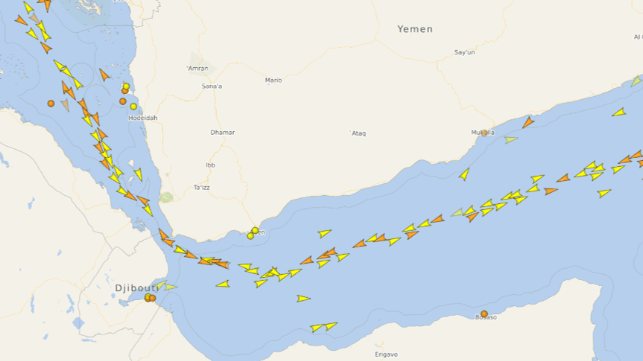
- Despite attacks, portions of commercial traffic are likely continuing to transit the Red Sea and Bab el Mandeb, producing an uneven risk picture. (Confidence: medium · ASSESSED)
- I&W: Sustained AIS‑visible merchant transits through Bab el Mandeb reported alongside limited incident reports. (0-14 days)
- I&W: Widespread carrier announcements of rerouting away from the southern Red Sea. (0-14 days)
- Coalition naval measures likely reduce, but do not eliminate, the risk to merchant shipping in the Red Sea. (Confidence: medium · ASSESSED)
- I&W: Reporting of attempted attacks disrupted or intercepted by naval assets with minimal vessel damage. (0-14 days)
- I&W: Successful multi‑vessel strikes or another ship seizure in the Red Sea despite naval presence. (0-14 days)
- The operating environment around Yemen’s littorals remains high‑risk for maritime and aviation activity, consistent with continued Red Sea maritime threat. (Confidence: high · REPORTED)
- I&W: Continuation of FAA special restrictions for operations within or near Yemen and unchanged US port‑security posture on Yemeni ports. (1-3 months)
- I&W: Official downgrading of Yemen‑related aviation and port security advisories. (1-3 months)
Outlook & scenarios
Baseline: Harassment persists, trade continues with constraints (55%)
The Houthis maintain a low‑to‑moderate tempo of harassment and occasional strikes in the southern Red Sea, prioritising Israel‑linked vessels. Naval protection and routing under the existing security effort enable continued, but uneven, transits through Bab el Mandeb.
Escalation: Higher strike rate and mine threat (30%)
Tensions in Yemen rise and the Houthis increase missile and UAV activity in the Red Sea, while the risk from naval mines becomes more salient. Shipping delays, insurance costs and selective diversions increase as operators rebalance exposure.
De‑escalation: Reduced incidents following political signalling (20%)
Houthi leadership tempers maritime activity to avoid jeopardising dialogue with Saudi Arabia. Threat rhetoric remains, but reported incidents in the Red Sea decline and more operators resume routine transits.
Recommendations
- Prioritise risk screening for vessels with Israeli ownership, management, cargo, or destination on Red Sea legs. Maintain a live exposure list and alert operators before Bab el Mandeb transits.
- Synchronise with maritime security partners on convoying and deconfliction measures associated with the ongoing protection effort. Capture lessons from any disrupted attacks to refine routing and communications.
- Treat satellite thermal detections over the Red Sea as weak signals. Require corroboration from maritime reporting before using them as evidence of attacks.
- Advise against port calls at Yemeni facilities given the determination that ports lack effective anti‑terrorism measures, and reflect this in voyage planning and insurance briefs.
- Maintain continuity with aviation and maritime risk posture around Yemen, referencing the ongoing FAA restrictions and travel advisories when briefing operators and interagency partners.
Confidence & uncertainty
Overall confidence is medium because multiple independent sources corroborate Houthi intent and capability, past attacks on merchant shipping and the heightened risk to Israel‑linked vessels. Official government advisories and determinations reinforce the hazardous operating environment around Yemen. However, reporting is not uniform on the extent of disruption to Red Sea traffic, and satellite thermal detections do not by themselves confirm maritime attacks. These inconsistencies, and reliance on some single‑source media reporting for specific episodes, constrain confidence from being high.
Alternative analysis (red cell)
Houthi declarations and discrete attacks indicate a credible threat vector, but the available reporting contains unaddressed contradictions and largely declaratory or ambiguous indicators. A defensible alternative estimate is that the threat is episodic and geographically selective — concentrated on declared Israeli‑linked targets and specific corridors — and that coalition measures and commercial behavioral changes produce substantial temporal variation in risk rather than a uniform, very‑likely persistent campaign across the entire 1–3 month window.
Intelligence gaps
- [EEI 1.1 · UNCOVERED] Incidents of hostile action against commercial vessels: vessel name/IMO, position (lat/long), time/date, observable damage or casualties, and weapon type reported (missile, drone, small-arms, explosive-laden boat). Recommended collection: maritime/AIS
- [EEI 1.2 · UNCOVERED] Public Houthi claims of attacks or warnings tied to specific dates/routes, including social-media posts, official statements, and timing relative to merchant transits. Recommended collection: open-source/social_media
- [EEI 1.3 · UNCOVERED] Unusual Houthi force posture indicators along Yemen’s Red Sea coast: movement or concentration of small boats, visible coastal missile/rocket emplacements, or logistics buildup at known launch sites (locations, timestamps). Recommended collection: imagery/satellite
- [EEI 1.4 · UNCOVERED] Intercepts or communications indicating orders, targeting lists, or intent to strike merchant shipping (messages referencing specific vessel classes, companies, or chokepoints). Recommended collection: signals/communications
- [EEI 2.1 · UNCOVERED] Reports or visual confirmation of floating or moored mines and debris fields in shipping lanes or approaches to Bab-el-Mandeb, with geolocation and time. Recommended collection: imagery/satellite
- [EEI 2.2 · UNCOVERED] Detection of mine-laying activity: small vessels loitering in lane approaches, unexpected AIS track patterns consistent with mine deployment, or salvage/mining vessels operating in the area. Recommended collection: maritime/AIS
- [EEI 2.3 · UNCOVERED] Hydrographic notices, naval warnings, or port authority advisories closing lanes or imposing route restrictions (text of Notice to Mariners, issuing agency, effective times/areas). Recommended collection: naval/port_authority
- [EEI 2.4 · UNCOVERED] Naval or commercial reports of mine-countermeasure operations or confirmed mine removal events (location, time, platforms involved). Recommended collection: naval/intelligence
- [EEI 3.1 · UNCOVERED] Movements and presence of foreign warships and support vessels: names/classes, task group compositions, patrol areas and timelines, and whether vessels are conducting escort or interdiction operations. Recommended collection: naval/intelligence
- [EEI 3.2 · UNCOVERED] Official announcements or directives from states/coalitions regarding convoys, armed escorts, protected corridor establishment, or changes to rules of engagement for merchant protection. Recommended collection: diplomatic/public_affairs
- [EEI 3.3 · UNCOVERED] Recorded interactions between naval forces and vessels in the corridor (hailings, boardings, warnings, defensive strikes), including timestamps and outcomes. Recommended collection: maritime/AIS
- [EEI 3.4 · UNCOVERED] Planned or ongoing multinational exercises, air ISR sorties, or logistics moves that increase or decrease naval capacity in the area (exercise name, participating units, dates, locations). Recommended collection: open-source/military_reporting
- [EEI 4.1 · UNCOVERED] Transit volume and pattern changes: number of commercial transits per day/week through Bab-el-Mandeb and southern Red Sea compared with baseline, and instances of rerouting around Africa (position/time data). Recommended collection: maritime/AIS
- [EEI 4.2 · UNCOVERED] War-risk and hull insurance coverage changes: issuance refusals, premium increases for Red Sea transits, or explicit route exclusions by underwriters (policy notices or market rate data with dates). Recommended collection: commercial/insurance_data
- [EEI 4.3 · UNCOVERED] Freight and charter market signals tied to the corridor: spot rates for container, tanker, and dry bulk routes affected by Red Sea disruptions, and reported port congestion or turnaround-time increases at nearby hubs. Recommended collection: commercial/market_data
- [EEI 4.4 · UNCOVERED] Incidents of cargo denial or diversion for critical goods (crude oil, refined products, LNG, high-value container cargo) including vessel IDs, cargo type, reroute/turnback actions, and economic impact estimates where available. Recommended collection: maritime/AIS
Cited sources
[1] Wikipedia · Red Sea crisis (B) · sha256:0bb3071324f3 [2] dw.com · Global shipping on alert after Houthis attack vessels (A) · sha256:a153089cb891 [3] Wikipedia · 2026 Houthi strikes on Israel (B) · sha256:54e4427f70e0 [4] maritime-executive.com · Rising Tensions in Yemen Threaten Red Sea Transits (B) · sha256:6b0a65e2653c [5] NASA · NASA FIRMS thermal detections — Red Sea (2d) (A) · sha256:32aad9bf8ac4 [6] Middle Eastern Observer · Red Sea: The World's Cheapest Naval War (B) · sha256:77fff833115b [7] U.S. Department of State · Oman Travel Advisory | Travel.State.gov (A) · sha256:dfdad5d52acc [8] U.S. Department of State · Yemen Travel Advisory | Travel.State.gov (A) · sha256:d87365caec69
Source content hashes were computed at collection time; the cited text is preserved unmodified for the life of this product.
Red cell review: PARTIAL DISSENT
TLP:CLEAR