TLP:CLEAR · Disclosure is not limited.
Russia Intensifies Strikes on Ukraine
Time window: Last 7 days · Audience: General analyst · Type: Situation report · DTG: 2026-08-27 12:08Z · Overall confidence: MEDIUM
BLUF
Russia is very likely intensifying its conventional strike campaign against Ukraine, with recent attacks reaching Kyiv, Odesa, Poltava and other Ukrainian cities. Further strikes on urban, industrial and energy targets are likely in the next 0-14 days, while the available reporting does not indicate imminent tactical nuclear use.
Executive summary
On 27 August, Russia reportedly launched a massive overnight strike on nine Ukrainian cities, including attacks that damaged residential areas in four Kyiv districts, struck industrial and energy infrastructure in Poltava, and lasted more than seven hours in southern Odesa. Russian forces also launched 127 drones, while the Ukrainian air force reported shooting down or suppressing seven ballistic missiles. Bloomberg reporting based on sources close to the Kremlin indicates that Moscow is preparing more strikes after judging peace talks to have stalled. Ukraine continues to strike Russian military, logistics, fuel and industrial sites, raising pressure for further conventional retaliation. Reporting on mobilisation and casualty totals remains less certain.
Key judgments
- Russia is very likely intensifying its conventional strike campaign against Ukraine after the Kremlin concluded that peace talks had reached a dead end. The 27 August multi-city attack, the reported use of 127 drones, the increase in Russian missile attacks on urban centres, and reported planning for stepped-up ballistic missile strikes on Kyiv and other Ukrainian infrastructure support this assessment. The planning element rests on a single report citing sources close to the Kremlin, so intent is less firmly established than the increase in strike activity. (Confidence: medium · ASSESSED)
- I&W: CONFIRM: Within 0-14 days, Russian forces conduct another overnight strike involving Kyiv and at least two other named Ukrainian cities, with more than 100 drones or ballistic missiles reported. (0-14 days)
- I&W: BREAK: Through the next 14 days, reporting records no further multi-city Russian strike and shows Russian operations confined to isolated front-line military targets. (0-14 days)
- Russian strikes are likely to continue hitting civilian, urban, industrial and energy targets rather than remaining confined to front-line positions. Reports identify damage to residential blocks, homes, a school and a children's hospital in Kyiv, industrial and energy facilities in Poltava, and civilian casualties in southern Zaporizhzhia. The Kyiv fatality count remains contested, with reports of 15 and at least 16 deaths, while a separate report records at least 10 deaths in Pechenihy on 20 August. The casualty disagreement lowers confidence in the human impact figures but does not materially change the target-pattern assessment. (Confidence: medium · ASSESSED)
- I&W: CONFIRM: Ukrainian authorities report another Russian strike damaging an energy or industrial facility in Poltava or residential buildings in Kyiv. (0-14 days)
- I&W: BREAK: During the next 14 days, independently corroborated reporting records no Russian strikes on urban, civilian, industrial or energy sites and identifies only military targets. (0-14 days)
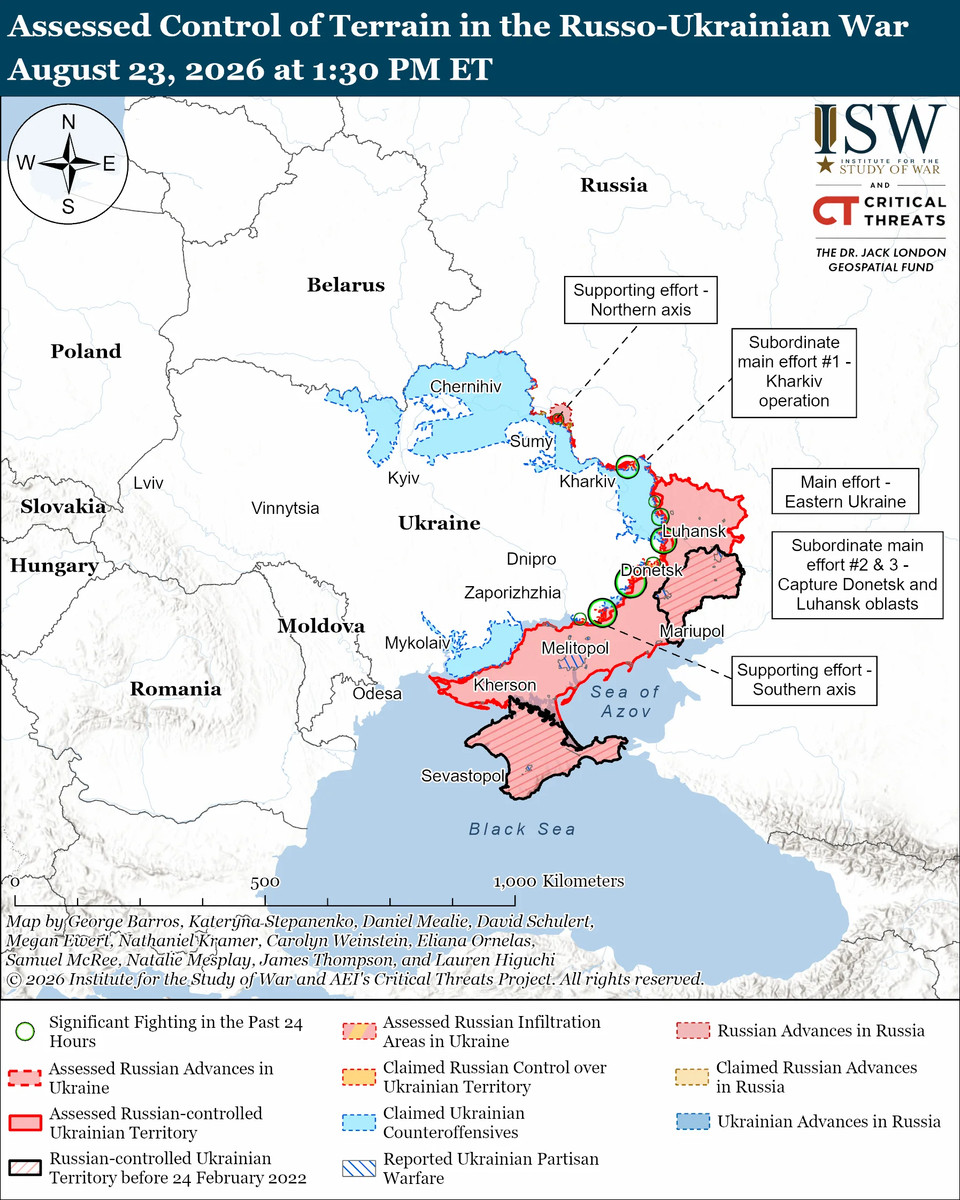
- Ukraine's long-range strikes on Russian military, logistics, fuel and industrial infrastructure are likely to sustain Kremlin pressure for conventional retaliation, but a rapid Russian territorial gain is unlikely. Ukraine has reported strikes on drone launch sites at Donetsk City and Primorsko-Akhtarsk, a refining unit at Ufa, the Progress Rocket and Space Centre, and logistics centres at Makhachkala, Nevinnomyssk and Enem. Russian forces have recently advanced east of Slovyansk, but Ukrainian units reportedly still defend about 20% of Donetsk and market pricing indicates a decreased likelihood of Russian forces entering Sloviansk by the end of 2026. Some of the rear-area strike reporting is medium or low confidence, limiting confidence in the scale of the campaign. (Confidence: medium · ASSESSED)
- I&W: CONFIRM: Within 0-14 days, Ukraine reports or geolocated imagery shows another strike on a Russian fuel, logistics, electrical or drone-launch facility, followed by another Russian multi-city strike. (0-14 days)
- I&W: BREAK: Within 1-3 months, Russian forces enter Sloviansk or advance beyond the currently reported Ukrainian defensive position in Donetsk without a corresponding fall in Ukrainian long-range strike activity. (1-3 months)
- Russia is very unlikely to use tactical nuclear weapons in Ukraine in the next 1-3 months. Reporting states that there are no signs Moscow is preparing for such use, and an external expert assesses the risk as extremely low. Reports that a growing number of Russian officials believe President Vladimir Putin could eventually consider tactical nuclear use show concern within Russia, but they do not establish an operational decision or preparation. The assessment therefore rests on indirect reporting about intent and carries medium confidence. (Confidence: medium · ASSESSED)
- I&W: CONFIRM: Russian authorities publicly announce preparations for tactical nuclear use in Ukraine or issue an operational order that moves beyond existing discussion of nuclear options. (1-3 months)
- I&W: BREAK: Russian statements continue to provide no indication of preparation and all reported Russian attacks remain conventional through the next three months. (1-3 months)
- Russia is likely to mobilise another 300,000 troops later in 2026, but this remains a low-confidence forecast rather than a confirmed decision. The estimate comes from Ukrainian President Volodymyr Zelensky, who also assessed that Vladimir Putin would deploy newly mobilised troops according to conditions in eastern Ukraine. The reported Russian loss of 267,000 personnel since the start of the year and Moscow's continuing objective of capturing Donetsk provide context, but the casualty figure and mobilisation forecast are not independently corroborated in the available reporting. (Confidence: low · REPORTED)
- I&W: CONFIRM: The Russian government or Russian Ministry of Defence announces a further mobilisation authorising a call-up of approximately 300,000 personnel. (1-3 months)
- I&W: BREAK: No such announcement appears within three months and market pricing continues to show a decreased likelihood of Russian forces entering Sloviansk by the end of 2026. (1-3 months)
Outlook & scenarios
Conventional strike intensification without a decisive territorial shift (62%)
Russia continues multi-city missile and drone strikes against Kyiv, Odesa, Poltava and other Ukrainian cities over the next several weeks. Ukraine maintains long-range attacks on Russian military and economic infrastructure. Russian forces increase pressure in Donetsk but do not rapidly enter Sloviansk.
Mobilisation increases pressure in eastern Ukraine (25%)
Russia announces a further mobilisation of approximately 300,000 troops and uses the additional manpower to increase pressure on Ukrainian positions in Donetsk and east of Sloviansk. Ukrainian units continue defending part of Donetsk while Russian strikes against Ukrainian cities persist.
Limited diplomatic pause (10%)
The Ukraine-US-Europe proposal gains enough traction to produce renewed talks and a temporary reduction in Russian strikes. The pause remains fragile because the Kremlin continues to view earlier concessions as weakening Russia's position.
Nuclear escalation wildcard (3%)
Russian officials move from discussing possible tactical nuclear use to publicly announcing preparations or an operational decision in Ukraine. This is a low-probability, high-impact pathway and conflicts with current reporting that identifies no signs of preparation and assesses the risk as extremely low.
Recommendations
- For the next 14 days, maintain a twice-daily strike dashboard covering Kyiv's four affected districts, southern Odesa, Poltava energy and industrial facilities, southern Zaporizhzhia, the total number of targeted Ukrainian cities, drone launches and ballistic missile interceptions.
- Separate strike confirmation from cause attribution. Treat NASA thermal anomalies as corroborating evidence only when matched with local reporting, because the detections record heat and do not establish whether a fire resulted from a strike, shelling, an industrial accident or a wildfire.
- Prioritise independent confirmation of Russian planning for stepped-up ballistic missile strikes on Kyiv and other cities. Compare Kremlin-source reporting with subsequent force activity, target selection and strike volume before raising confidence in a deliberate escalation decision.
- Track Ukrainian attacks on Russian rear-area assets at Ufa, Donetsk City, Primorsko-Akhtarsk, the Progress Rocket and Space Centre, Makhachkala, Nevinnomyssk and Enem, then assess whether each is followed by a measurable change in Russian strike tempo or target selection.
- Monitor Russian mobilisation announcements, personnel-generation measures and force movements linked to eastern Ukraine. Keep the 300,000-person forecast separate from confirmed military activity until Russian authorities issue corroborating evidence.
- Maintain a dedicated nuclear-warning watch that distinguishes official Russian preparation or orders from commentary by Russian officials and outside experts. Do not treat conventional missile and drone escalation alone as evidence of imminent tactical nuclear use.
Confidence & uncertainty
Overall confidence is medium. Multiple high-confidence major-media reports, official statements and think-tank assessments corroborate the 27 August strike activity and the broader pattern of Russian attacks on urban, industrial and energy targets. Confidence is lower on Kremlin intent, a further 300,000-person mobilisation and the scale of Ukrainian rear-area strikes because those points rely on indirect, single-source or medium-confidence reporting. Exact casualty totals in Kyiv are also disputed, while nuclear-risk reporting distinguishes between officials' concern and the absence of observable preparation.
Cited sources
[1] meduza.io · Kremlin sources tell Bloomberg that Putin is preparing to escalate the war in Ukraine. A growing number of Russian officials believe that could eventually mean a tactical nuclear weapon. (B) · sha256:009d70846c33 [2] nypost.com · Russia says it launched ‘massive’ overnight strike on 9 Ukrainian cities (B) · sha256:51cc914d94ab [3] Kyiv Post · ISW Russian Offensive Campaign Assessment, August 23, 2026 (C) · sha256:acdba802fae8 [4] cryptobriefing.com · Russian strikes hit Kyiv homes, school, children's hospital: Zelenskyy (B) · sha256:389e64d83f04 [5] Los Angeles Times · A Russian missile and drone barrage kills at least 16 in Ukraine's Kyiv region - Los Angeles Times (A) · sha256:1b9fb455f948 [6] Al Jazeera · Russian expert warns of impending social crisis as Ukraine death toll rises (A) · sha256:8e857ab2d143 [7] cnn.com · Russia likely to mobilize at least 300,000 more troops to Ukraine war, Zelensky warns | CNN (A) · sha256:71ec81a347b5
Source content hashes were computed at collection time; the cited text is preserved unmodified for the life of this product.
TLP:CLEAR