TLP:CLEAR · Disclosure is not limited.
Russia Signals Wider Strikes as Ukraine War Diplomacy Stalls
Time window: Last 7 days · Audience: General analyst · Type: Situation report · DTG: 2026-08-27 00:09Z · Overall confidence: LOW
BLUF
Russia is very likely preparing to intensify conventional strikes against Ukraine after diplomatic efforts stalled. The immediate risk is a reciprocal strike cycle involving Kyiv, Ukrainian economic infrastructure, and Russian military, fuel, port and logistics targets. Tactical nuclear use remains very unlikely in the near term, although related Russian concern warrants monitoring.
Executive summary
Reporting from 20 to 27 August 2026 indicates that Russia is preparing wider strikes after concluding that peace talks have reached a dead end. Vladimir Putin said on 23 August that Russia would respond to Ukrainian attacks with strikes on sensitive economic sectors, while Russian forces reportedly launched large drone and missile salvos against Ukraine. Ukrainian forces have continued strikes against Russian air-defence, aviation, fuel and logistics assets in Rostov Oblast, Krasnodar Krai, occupied Crimea and elsewhere. Putin's 22 August United Russia speech framed victory in Ukraine as a party duty, while a reported Ukraine-US-Europe peace proposal has not produced evidence of meaningful Russian compromise. Reporting on a possible Russian mobilisation after the September elections is single-source and internally inconsistent. Overall confidence remains low because several core claims rely on medium or low-confidence reporting, and the dataset contains unresolved disputes over dates, locations, casualty figures and attribution.
Key judgments
- Russia is very likely preparing to intensify conventional strikes against Ukraine, with Kyiv, other urban centres and sensitive economic infrastructure among the stated targets. The assessment rests on a report attributed to sources close to the Kremlin and is supported by Vladimir Putin's 23 August response statement and reported Russian launches of 127 drones and of ballistic and cruise missiles with 271 drones. Confidence is reduced because the planning report is not independently corroborated. (Confidence: medium · REPORTED)
- I&W: Confirmation: Russian forces launch another strike against Kyiv or another Ukrainian urban centre involving ballistic or cruise missiles and a drone total comparable to or exceeding 127, or strike Ukrainian economic infrastructure. (0-14 days)
- I&W: Break: The Kremlin announces meaningful peace negotiations and no comparable missile or drone surge follows. (0-14 days)
- The Russia-Ukraine exchange of long-range strikes is likely to intensify over the next two weeks. Ukrainian forces are targeting Russian military and air-defence assets in Rostov Oblast, Krasnodar Krai and occupied Crimea, as well as fuel, port and dual-use logistics infrastructure including the refining unit at Ufa, the Progress Rocket and Space Centre 800 kilometres east of Moscow, and Ozon logistics centres. Russia has publicly framed such attacks as grounds for retaliation. Confidence is medium because several specific Ukrainian strike claims come from think-tank reporting or Ukrainian official statements without independent confirmation. (Confidence: medium · ASSESSED)
- I&W: Confirmation: Ukrainian forces report or independently document new strikes on Russian military or air-defence assets in Rostov Oblast, Krasnodar Krai or occupied Crimea, or on Russian oil, port or logistics sites, followed by Russian strikes on Kyiv or sensitive economic sectors. (0-14 days)
- I&W: Break: No further long-range strikes against the named target sets are reported for one month and both sides publicly suspend such operations. (1-3 months)
- Meaningful Russia-Ukraine peace negotiations are very unlikely in the next one to three months. Putin has reiterated unwillingness to engage in meaningful negotiations, described United Russia's duty as achieving victory, and the Kremlin reportedly believes previous concessions weakened Russia's position. A Ukraine-US-Europe proposal presented on 23 August has not produced evidence of Russian compromise. Confidence is medium because the proposal and Kremlin-position reporting come from limited sources, although the reported statements point in the same direction. (Confidence: medium · ASSESSED)
- I&W: Confirmation: Russian officials publicly reject the 23 August Ukraine-US-Europe proposal or repeat that Russia will not compromise on its core demands. (0-14 days)
- I&W: Break: Russia accepts a formal negotiating agenda with Ukraine, US and European representatives and suspends planned strikes during the talks. (0-14 days)
- Russia is likely to prepare an additional mobilisation of roughly 300,000 personnel after the 18-20 September 2026 parliamentary elections, but confidence is low. The claim comes principally from Volodymyr Zelensky, and the reporting is internally inconsistent about whether the 300,000 personnel represent a post-election draft or part of a broader 500,000-person goal extending into 2027. (Confidence: low · ASSESSED)
- I&W: Confirmation: After the 18-20 September elections, Russia issues a mobilisation or draft decree covering approximately 300,000 additional personnel. (14-60 days)
- I&W: Break: The elections pass without such a decree and Russian officials publicly reject the reported 300,000-person figure. (14-60 days)
- Russia is very unlikely to use tactical nuclear weapons in Ukraine during the next one to three months. Reporting that a growing number of Russian officials view such use as an eventual extreme option conflicts with separate reporting that there are no signs of preparations and with an expert assessment that the risk remains extremely low. The judgement therefore rests on competing single-source and expert reporting rather than on direct evidence of Russian nuclear preparations. (Confidence: medium · ASSESSED)
- I&W: Confirmation: Russian strikes remain conventional and reporting continues to identify no preparations for tactical nuclear use. (0-14 days)
- I&W: Break: Russian officials announce preparations for tactical nuclear use in Ukraine or state that such use has become active policy. (0-14 days)
Outlook & scenarios
Conventional strike surge (55%)
Russia expands missile and drone attacks against Kyiv, other Ukrainian urban centres and economic infrastructure. Ukrainian forces continue strikes on Russian military, air-defence, fuel and logistics targets. Diplomatic contacts remain stalled.
Sustained attritional stalemate (35%)
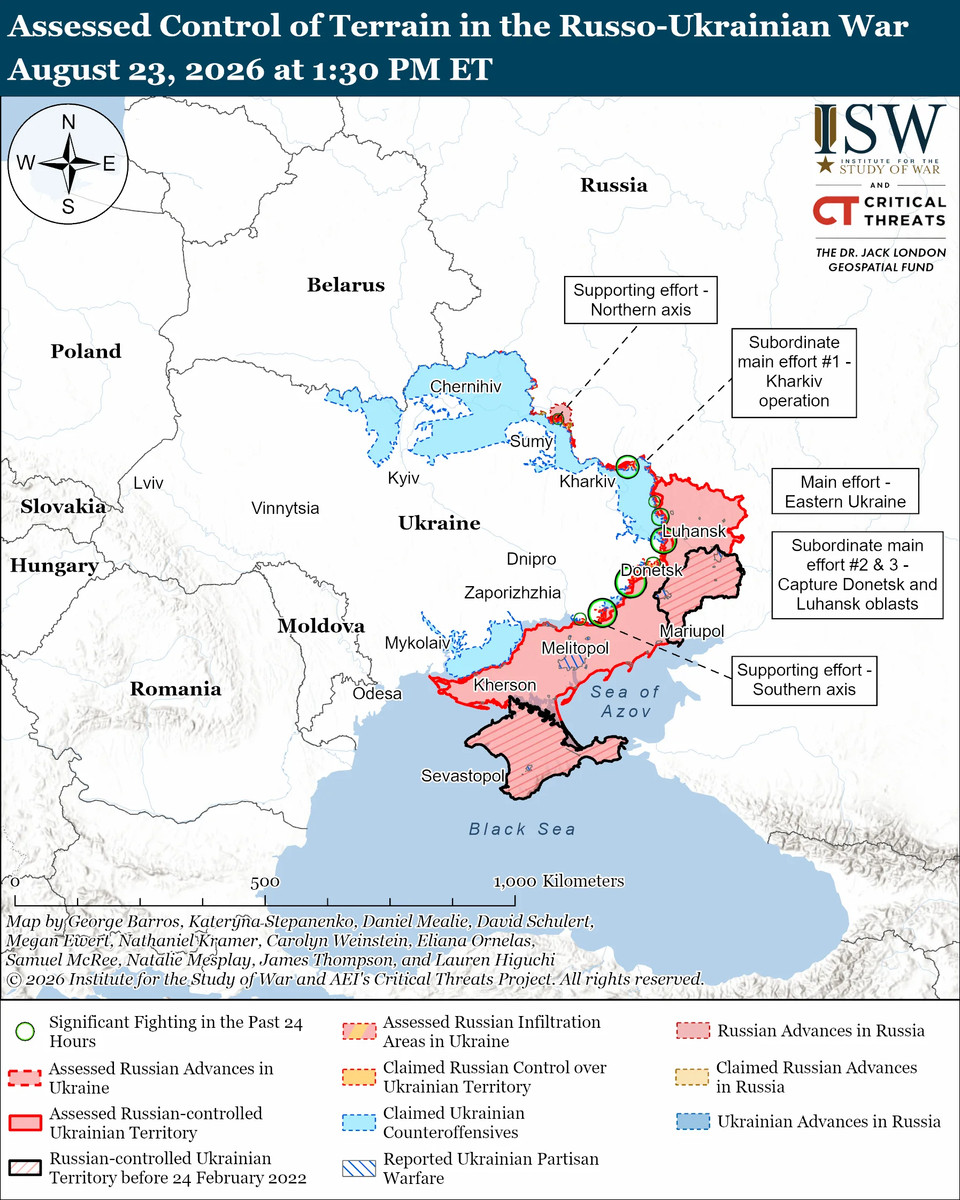
Russia maintains ground pressure east of Slovyansk and across Donetsk while Ukraine holds key positions and continues local advances. Long-range strikes continue, but neither side achieves a decisive territorial breakthrough before the end of 2026.
Limited diplomatic pause (18%)
The Ukraine-US-Europe proposal produces renewed contacts or a temporary reduction in strikes. The Kremlin retains its core demands, so the pause does not develop into a durable settlement.
Nuclear escalation wildcard (3%)
Russian officials move from discussing tactical nuclear use as an eventual option to announcing preparations or use in Ukraine. This would sharply widen the conflict and overturn the current assessment that nuclear use is very unlikely.
Recommendations
- Maintain a daily 0-14 day watchlist for Russian missile and drone activity against Kyiv, other Ukrainian urban centres and sensitive economic infrastructure. Record weapon types, launch volumes, target locations and civilian impact separately from attribution.
- Prioritise corroboration of Ukrainian strike claims in Rostov Oblast, Krasnodar Krai, occupied Crimea, Ufa and the named Ozon logistics centres before treating reported damage to aircraft, radars, fuel facilities or warehouses as confirmed.
- Track Russian official statements after the 23 August response and the United Russia Congress speech. Treat acceptance of a formal negotiating agenda as a break indicator for the near-term no-talks assessment.
- Prepare a mobilisation tracker for the 18-20 September Russian parliamentary elections and the following 60 days. Look for a formal decree, regional recruitment quotas or other official measures before upgrading the 300,000-person mobilisation claim.
- Keep tactical nuclear use as a low-probability, high-impact watch item. Do not upgrade the assessment without corroborated reporting of Russian preparations or an explicit policy change by Russian officials.
- Quarantine claims dated after 27 August 2026 from the current situation picture until the reporting window advances. This will prevent future-dated material from influencing the present assessment.
Confidence & uncertainty
Overall confidence is low because the central escalation assessment relies partly on reporting attributed to sources close to the Kremlin, while supporting military reporting comes mainly from think tanks, major media and Ukrainian statements. Several specific strike, casualty and attribution claims are medium or low confidence. The dataset also contains unresolved disputes over casualty figures, strike dates, locations and the timing of a possible mobilisation. Reports that Russian officials view tactical nuclear use as an eventual option conflict with reporting that there are no signs of preparations, leaving a material uncertainty around escalation limits.
Cited sources
[1] meduza.io · Kremlin sources tell Bloomberg that Putin is preparing to escalate the war in Ukraine. A growing number of Russian officials believe that could eventually mean a tactical nuclear weapon. (B) · sha256:009d70846c33 [2] NBC News · Ukraine drone strikes target second Russian retail giant, seeking to deepen economic chaos (A) · sha256:5d47837e3185 [3] Institute for the Study of War · ISW Russian Offensive Campaign Assessment, August 23, 2026 (B) · sha256:acdba802fae8 [4] understandingwar.org · Russian Offensive Campaign Assessment, August 22, 2026 (B) · sha256:4589d200783a [5] cryptobriefing.com · Russian strikes hit Kyiv homes, school, children's hospital: Zelenskyy (B) · sha256:389e64d83f04 [6] understandingwar.org · Russian Offensive Campaign Assessment, August 24, 2026 (B) · sha256:650e0e0897c1 [7] Al Jazeera · Russian expert warns of impending social crisis as Ukraine death toll rises (A) · sha256:8e857ab2d143 [8] understandingwar.org · Russian Offensive Campaign Assessment, August 23, 2026 (B) · sha256:6b844413e14b [9] The Moscow Times · Putin Wants to Draft 300K New Troops, Zelensky Says - The Moscow Times (B) · sha256:0c0cfc420c6b [10] CNN · Russia likely to mobilize at least 300,000 more troops to Ukraine war, Zelensky warns | CNN (A) · sha256:71ec81a347b5
Source content hashes were computed at collection time; the cited text is preserved unmodified for the life of this product.
TLP:CLEAR