TLP:CLEAR · Disclosure is not limited.
Russia-Ukraine Front Line: Local Fighting and Strike Risks
Time window: Last 7 days · Audience: General analyst · Type: Situation report · DTG: 2026-11-04 07:15Z · Overall confidence: MEDIUM
BLUF
Current reporting does not establish a broad change in front-line control, and claims of major gains by either side remain unverified. The clearest near-term concerns are Russia's reported barrage against Ukrainian energy infrastructure, the reported high casualty toll at Komyshuvakha, and continued attacks on Black Sea shipping.
Executive summary
The front-line picture remains uncertain. A report of Russian advances in Donetsk conflicts with social-media claims of Ukrainian gains and other claims of Russian momentum near Zaporizhzhia. Reporting published on 4 November describes a large Russian strike package against Ukrainian energy infrastructure, including three drones directed at a substation crucial to the Khmelnytskyi Nuclear Power Plant. New reporting also puts the Komyshuvakha toll at at least 33 dead and 50 unaccounted for. Separate reports describe Russian anti-Starlink jammers along the front and repeated vessel strikes in the Black Sea, but their operational effects and some incident counts remain unresolved.
Change from previous assessment
Since the 3 November brief, the assessment that no broad front-line shift is verified remains, and confidence in that assessment remains low. New battlefield claims do not resolve the direction of change. The Komyshuvakha casualty reporting has risen from the prior brief's figures of 26 and at least 29 dead to a report of at least 33 dead and 50 unaccounted for. New reporting adds a Russian barrage against energy infrastructure, drone targeting of a substation crucial to the Khmelnytskyi Nuclear Power Plant, and claims about Volna Kupol Garant deployment. This brief adds a separate judgement on Black Sea vessel-strike risk.
Key judgments
- The front line is likely to remain locally contested over the next 14 days, but the supplied reporting does not establish a front-wide change in control. A local-media snippet reports Russian advances in Donetsk Oblast, while social-media claims range from Russian forces being 5 km from Zaporizhzhia to Ukrainian forces having retaken 16 towns; other commentary describes pressure around Dobropillya. Confidence is low because the directional claims conflict, the Donetsk and DeepState map items were available only as ledes, and the other battlefield claims are social-media commentary rather than corroborated control data. (Confidence: low · ASSESSED)
- I&W: Confirm: DeepState's next dated Donetsk Oblast map and a second map-based report show the same named settlement changing control in the same direction. (0-14 days)
- I&W: Break: The next two dated map updates show no net change in Donetsk Oblast and no independently corroborated change around Zaporizhzhia or Dobropillya. (0-14 days)
- Russian forces likely launched a large barrage against Ukraine's energy infrastructure, but the supplied reporting does not establish damage or service interruption. Reporting published on 4 November described hundreds of drones and dozens of cruise and ballistic missiles; Ukraine's Energy Minister Denys Shmyhal said three drones were directed at a substation crucial to the Khmelnytskyi Nuclear Power Plant. The account comes from one major-media report quoting Ukrainian officials, so confidence is medium rather than high. (Confidence: medium · REPORTED)
- I&W: Confirm: Ukraine's Energy Ministry or the IAEA reports damage at the substation or confirms that drones reached it. (0-14 days)
- I&W: Break: A technical update from Ukraine's Energy Ministry identifies no strike on the substation and reports no damage or interruption there. (0-14 days)
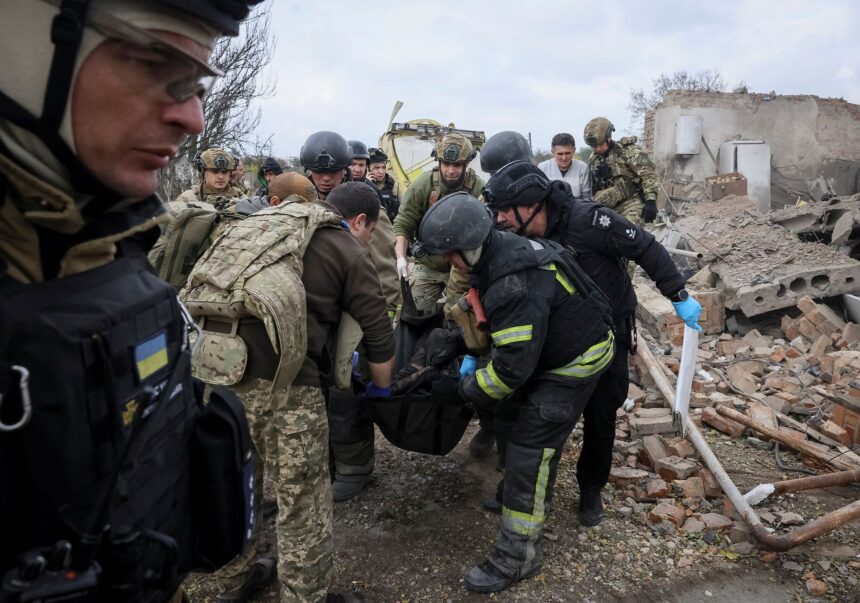
- At least 33 people were reported dead and 50 unaccounted for after Russian forces dropped at least nine bombs on a school building in Komyshuvakha, Zaporizhzhia region, used as a civilian shelter and aid distribution centre. Reporting published on 4 November attributes the casualty figures to local authorities; Governor Mykhailo Semikin identified KAB-500 and FAB-3000 bombs, and the account describes a second strike after emergency responders arrived. Confidence is medium because these details come from one major-media account relaying Ukrainian officials, with no independent casualty tally or confirmation of the reported strike sequence in the supplied material. (Confidence: medium · REPORTED)
- I&W: Confirm: Local authorities publish a revised casualty list that maintains at least 33 deaths or accounts for people previously reported missing. (0-14 days)
- I&W: Break: Local authorities revise the death toll downward or account for the people reported unaccounted for without confirming the reported strike sequence. (0-14 days)
- Russia is likely expanding deployment of Volna Kupol Garant trailer-mounted jammers along the front line, adding a reported threat to Ukrainian strike and deep-recon missions that rely on Starshield. Ukrainian drone adviser Serhii Beskrestnov says each system covers about 25 square kilometres and that Russia is spreading out and concealing newer variants; TASS reported serial production in August. Confidence is medium because deployment and coverage claims rest mainly on Beskrestnov's account, while the production report does not independently verify field numbers or operational effects. (Confidence: medium · ASSESSED)
- I&W: Confirm: Separate reporting or imagery identifies Volna Kupol Garant trailers at more than one additional front-line site, including the newer single-antenna variants. (1-3 months)
- I&W: Break: Ukrainian military reporting says Starshield-enabled strike and deep-recon links remain unaffected, while independent imagery provides no confirmation of additional front-line deployments. (1-3 months)
- Commercial shipping in the Black Sea and Sea of Azov is likely to remain exposed to strike risk over the next 30 days. Ambrey analyst Tomas Alexa counted 317 merchant and other vessels hit between May and October, more than four times the 74 reported in the previous half-year. Another report says nine ships were hit in October near Romania and Bulgaria, while a NATO account cites seven strikes on cargo ships in the preceding month and says the alliance will deploy maritime patrol aircraft, radars and drones. Confidence is medium because the reported counts use periods that are not reconciled, and the available claims do not attribute every strike. (Confidence: medium · ASSESSED)
- I&W: Confirm: A coastal authority or vessel operator reports another merchant-vessel strike in the Black Sea or Sea of Azov. (0-30 days)
- I&W: Break: Coastal authorities report no new vessel strikes in the named waters during the period, and the only documented change is NATO's planned patrol deployment. (0-30 days)
Outlook & scenarios
Continued local fighting and strike pressure (60%)
The front remains locally contested without a verified front-wide shift. Russian strikes on Ukrainian energy infrastructure recur, while the operational effects of the reported Khmelnytskyi substation targeting and Volna Kupol Garant deployments remain unclear.
A verified local shift in control (30%)
Dated map updates establish a local gain by one side in Donetsk Oblast or southern Ukraine. This would resolve part of the conflicting battlefield reporting, but would not by itself establish a front-wide collapse or reversal.
Energy infrastructure shock (10%)
Low-probability, high-impact wildcard: a subsequent strike disables the substation crucial to the Khmelnytskyi Nuclear Power Plant. The current reporting says three drones were directed at the substation but does not report damage; confirmed disruption would sharply raise the immediate energy and operational risk assessment, even if front-line control remained unchanged.
Recommendations
- Keep the front-line assessment at low confidence until dated map updates and a second map-based report corroborate the same settlement-level changes in Donetsk Oblast or southern Ukraine.
- Seek confirmation from Ukraine's Energy Ministry and the IAEA on whether the substation crucial to the Khmelnytskyi Nuclear Power Plant was damaged or disrupted. Do not infer an outage from the report that drones were directed at it.
- Track revisions to the Komyshuvakha casualty count and seek separate confirmation of the reported second strike before treating the sequence as established.
- Assess Volna Kupol Garant deployment separately from its claimed operational effect. Record confirmed trailer locations and distinguish Ukrainian adviser reporting from independently corroborated evidence of interference with Starshield missions.
- Reconcile the October Black Sea vessel count against the separate seven-strike report by date and location, and track whether NATO's announced maritime patrol aircraft, radars and drones are deployed.
Confidence & uncertainty
Overall confidence is medium because several current event claims appear in major-media reporting that quotes named Ukrainian officials, but the supplied material does not independently confirm key effects or casualty details. Front-line direction is especially uncertain: claims conflict, and some map reporting was available only as a lede or social-media summary. The Black Sea vessel counts are also not fully reconciled.
Intelligence gaps
- [EEI 1.1 · PARTIAL] Geotagged UAV/satellite imagery showing abandoned defensive positions or newly occupied settlements. Recommended collection: overhead imagery
- [EEI 1.2 · UNCOVERED] Confirmed movement of frontline ambulance evacuation routes beyond previous coordinates. Recommended collection: SIGINT/medical logistics
- [EEI 2.1 · PARTIAL] Concentration of assault battalions (≥3 mechanized companies) within 15km of contact line. Recommended collection: SIGINT/UAV
- [EEI 2.2 · UNCOVERED] Unusual artillery stockpile buildup at forward depots exceeding 30-day consumption rates. Recommended collection: overhead imagery/logistics
- [EEI 3.1 · UNCOVERED] Bridge structural damage assessments at 5 key Dnieper River crossings via multispectral imaging. Recommended collection: overhead imagery
- [EEI 3.2 · UNCOVERED] Rail traffic volume changes at Kryvyi Rih and Pokrovsk rail hubs compared to 7-day baseline. Recommended collection: commercial freight data
Red cell review: CONCUR WITH COMMENT
TLP:CLEAR