TLP:CLEAR · Disclosure is not limited.
Russia-Ukraine Front Line: Local Ukrainian Gains, Sustained Russian Strikes
Time window: Last 7 days · Audience: General analyst · Type: Situation report · DTG: 2026-09-16 07:09Z · Overall confidence: HIGH
BLUF
Ukrainian forces are likely to retain local initiative around Lyman and Kupiansk, but Russian forces are likely to continue pressure towards the Sloviansk-Kramatorsk agglomeration without a decisive breakthrough. Russia is very likely to sustain high-volume strikes across Ukraine, while Ukraine is likely to continue deep strikes inside Russia. A substantive ceasefire remains unlikely despite renewed US-Russia-Ukraine contacts.
Executive summary
Between 9 and 16 September 2026, reporting strengthened the assessment that Ukrainian forces had eliminated or reduced the Russian salient north of Lyman and restored limited ground near Kupiansk. Russian forces nevertheless retained pressure around Mykolaivka, Kostiantynivka and the eastern approaches to Sloviansk and Kramatorsk. Russia continued near-nightly drone and missile attacks, including strikes affecting Kyiv, Odesa, energy infrastructure and rail links near the Polish border. Ukraine intensified long-range attacks on Russian radar, drone, refinery and military facilities. Claims of an aerial or energy-strike halt remain unverified because Donald Trump's announcement conflicts with Volodymyr Zelenskyy's conditional position and subsequent reporting of continued attacks.
Change from previous assessment
Since the 15 September brief, the assessment has shifted from a predominantly positional front to a contested local initiative. New reporting strengthens the judgement that Ukrainian forces eliminated or reduced the Russian salient north of Lyman and restored ground near Kupiansk, while also showing continued Russian pressure at Mykolaivka, Kostiantynivka and east of Sloviansk and Kramatorsk. Confidence in the local battlefield picture remains medium because territorial claims conflict. Confidence in continued Russian strikes remains high. The ceasefire assessment remains low confidence after the conflicting Trump and Zelenskyy accounts.
Key judgments
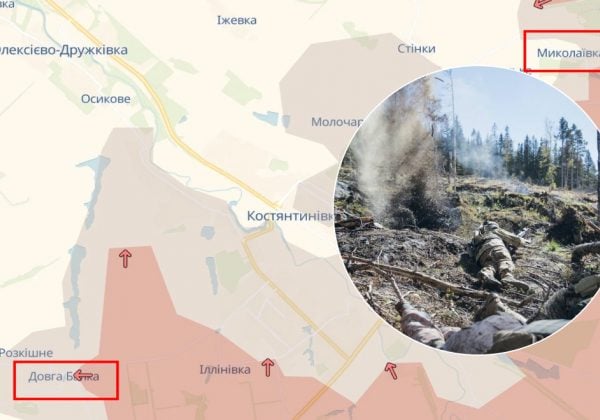
- Ukrainian forces are likely to retain local initiative around Lyman and Kupiansk over the next 0-14 days, while Russian forces are likely to continue attacks towards the Sloviansk-Kramatorsk agglomeration at a reduced tempo. ISW assessed near-zero Russian net gains since March and successful Ukrainian counterattacks in the Kupiansk, Oleksandrivka and Lyman sectors. Reporting on 16 September placed fighting at Mykolaivka, less than 10 km from Sloviansk, while other reporting recorded Russian gains near Mykolaivka and Dovha Balka. The Russian claim that Vladimir Putin's forces captured Sviatohirsk on 1 September was contradicted by Andriy Biletskyi's video from the city centre and reporting that Ukrainian forces retained control. This is an assessed battlefield picture, not a settled territorial account. Confidence is medium because ISW, major-media, local-media and official claims corroborate the broad pattern, but local control and the scale of Ukrainian gains remain contested. (Confidence: medium · ASSESSED)
- I&W: Confirm: Geolocated imagery and Ukrainian or Russian military reporting show Ukrainian control extending east of the Zherebets River or Russian withdrawals from positions north of Lyman. (0-14 days)
- I&W: Break: Russian forces are independently confirmed in Sviatohirsk or make verified advances through Mykolaivka towards Sloviansk. (0-14 days)
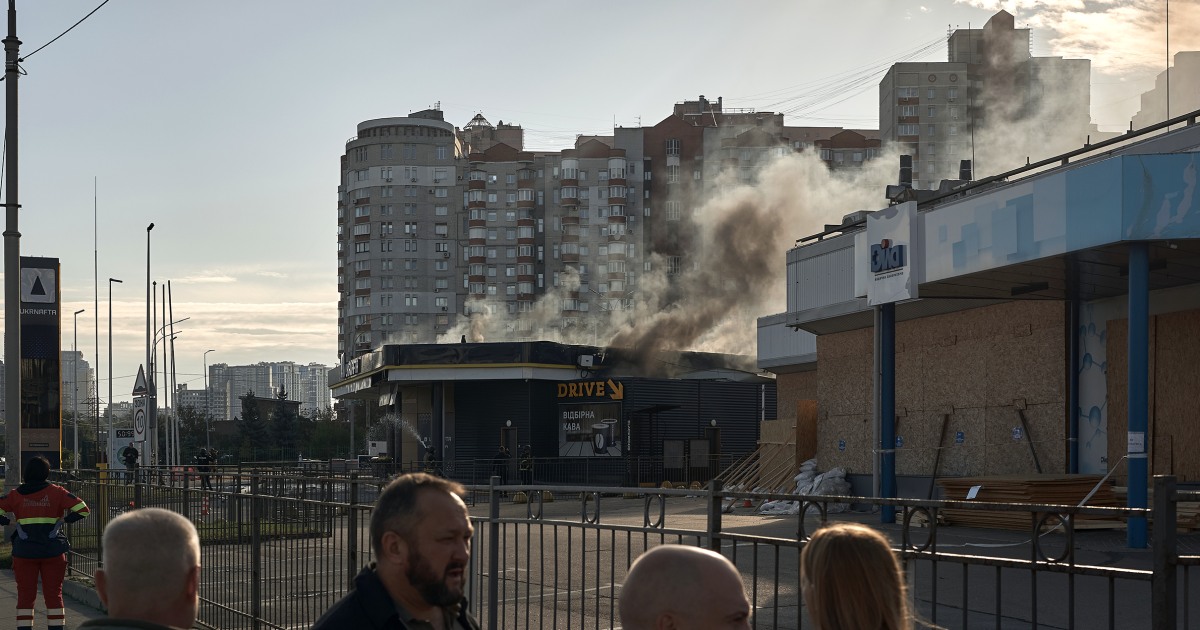
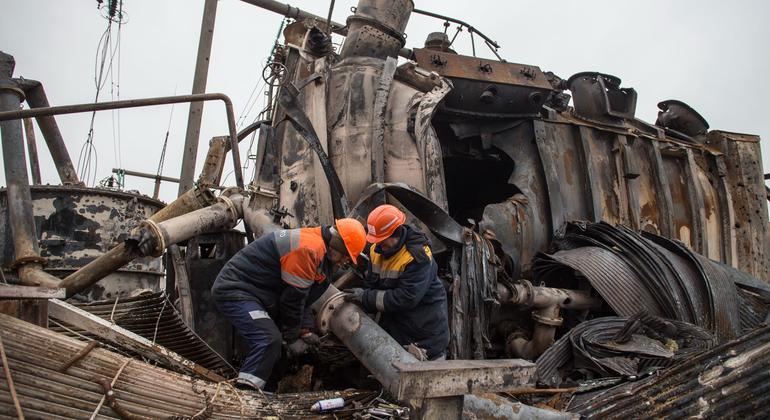
- Russia is very likely to sustain high-volume drone and missile strikes against Ukrainian cities and critical infrastructure over the next 0-14 days. The Kremlin has conducted near-nightly attacks, including a 10-day air campaign against Kyiv that killed at least 53 people, while Ukrainian reporting recorded 863 Russian drones over one 24-hour period and 102 drones overnight on 13-14 September. Russian attacks have affected approximately half of Ukraine's energy infrastructure, and reporting records strikes on Odesa, Volyn rail infrastructure and the Yahodyn-Dorohusk border area. The exact drone volume remains unresolved because the reported counting windows and totals differ. Confidence is high because major-media, Ukrainian official, ACLED, CSIS and think-tank reporting corroborate the sustained strike pattern, although the exact daily totals are less certain. (Confidence: high · ASSESSED)
- I&W: Confirm: Ukrainian authorities report another 24-hour Russian drone total above 500, or Russian strikes again hit Kyiv, Odesa, energy infrastructure or western rail links. (0-14 days)
- I&W: Break: Ukraine records seven consecutive days without reported Russian drone or missile strikes against major cities or critical infrastructure. (0-14 days)
- Ukraine is likely to continue long-range strikes against Russian military, energy and logistics infrastructure over the next 0-30 days. Volodymyr Zelenskyy announced a target of at least 1,000 drones per day against Russia, compared with an earlier average of about 300. Ukrainian forces struck the 92N6 radar for an S-400 system in Sochi on the night of 13-14 September, a drone launch site near Kursk, radar sites in Bryansk, the Slavyansk Oil Refinery and a field artillery ammunition depot near occupied Teple. The reported destruction of two refinery oil tanks has satellite support, while several other damage assessments rely on Ukrainian official or think-tank reporting. Confidence is medium because the strike pattern is corroborated, but intent, damage and casualty details are not independently established in every case. (Confidence: medium · ASSESSED)
- I&W: Confirm: Another Ukrainian strike is geolocated against a Russian refinery, air-defence radar, drone launch facility or ammunition depot more than 100 km from the front. (0-30 days)
- I&W: Break: No further Ukrainian long-range strike is credibly reported against Russian military, energy or port infrastructure for 14 consecutive days. (0-30 days)
- A substantive ceasefire is unlikely over the next 0-30 days, while diplomatic contacts are likely to continue. Donald Trump announced on 14 September that Russia and Ukraine had agreed to halt their aerial exchange and separately stated that both sides had agreed not to strike energy infrastructure. Volodymyr Zelenskyy instead described a conditional proposal requiring Russian reciprocity and said he did not trust the Kremlin to comply. Dmitry Peskov welcomed Trump's proposal and said Russia remained in contact with the US, while also indicating that three-way negotiations could take place in October. Both sides have already agreed to temporary pauses that produced no demonstrable results. Confidence is low because the evidence consists largely of politically interested statements and contains a direct dispute over whether any mutual halt exists. (Confidence: low · ASSESSED)
- I&W: Confirm: Russian and Ukrainian forces report fresh strikes after any announced pause, or either government publicly rejects the other's account of the pause. (0-14 days)
- I&W: Break: Moscow and Kyiv issue matching written terms for a monitored halt and sustain at least 72 hours without confirmed aerial or energy strikes. (0-30 days)
- Zaporizhzhia Nuclear Power Plant safety margins are likely to remain degraded over the next 0-30 days despite the recent restoration of off-site power. ZNPP experienced ten off-site power losses during the latest reporting period, bringing the conflict total to 26, and more than one-third of all such losses occurred in the preceding three months. Fewer than one-third of off-site radiation monitoring stations remained operational by mid-July, and the IAEA had warned that the plant faced a station blackout without restored power. The reported 13 September drone strikes on fuel trucks near ZNPP, which Rosatom head Alexey Likhachev linked to two deaths, are single-source Russian reporting and remain less corroborated. Confidence is high for the underlying power and monitoring assessment because IAEA-related, UK government and plant-specific reporting corroborate the core indicators. (Confidence: high · ASSESSED)
- I&W: Confirm: ZNPP records another off-site power loss, relies on emergency diesel generation, or reports further damage to radiation monitoring equipment. (0-14 days)
- I&W: Break: Off-site power remains uninterrupted for 30 days and more than two-thirds of radiation monitoring stations return to operational status. (1-3 months)
- Russia is likely to pursue an additional force-generation measure within the next 1-3 months, but an immediate mobilisation of 800,000 personnel is very unlikely. Ukraine's GUR head Lieutenant General Oleh Ivashchenko reported that Russian generals had requested 800,000 additional troops after the September State Duma elections. ISW assessed that Russia cannot integrate and train 800,000 recruits at one time and that a gradual, covert mobilisation is more likely. Ivashchenko also stated that the Russian military can absorb 300,000 to 500,000 recruits at once and that elements of the 25th Combined Arms Army and 20th Combined Arms Army were engaged near Lyman. Confidence is medium because the mobilisation request is primarily Ukrainian intelligence reporting, while the feasibility assessment comes from ISW and Russian capacity figures remain unverified. (Confidence: medium · ASSESSED)
- I&W: Confirm: After the 18-20 September State Duma elections, Russia issues a mobilisation decree, expands recruitment targets or visibly increases the formation and training of new units. (1-3 months)
- I&W: Break: No mobilisation measure, recruitment expansion or new force-generation activity is reported during the three months after the elections. (1-3 months)
- Further cross-border airspace and border-infrastructure incidents are likely over the next 0-30 days. On 13 September, a Russian drone struck a Kyiv-Warsaw train locomotive about 2 km from the Polish border, while Russian forces also struck infrastructure near the Yahodyn-Dorohusk crossing and have struck four Ukrainian-Moldovan border crossings since August. NATO fighter jets shot down an uncrewed aircraft in Lithuanian airspace overnight into 15 September, and Denmark summoned Russia's ambassador after a Russian warship fired flares towards a Danish military helicopter on 14 September. The train incident remains partly contested because other reporting described damage to a truck about 0.8 km from Poland. Confidence is medium because the incident pattern is multiply reported, but the precise target and attribution of some events remain unresolved. (Confidence: medium · ASSESSED)
- I&W: Confirm: Another strike occurs within 5 km of the Polish or Moldovan border, or NATO aircraft intercept or destroy an uncrewed aircraft in allied airspace. (0-30 days)
- I&W: Break: No further incident affects a border crossing, civilian rail link or NATO airspace for 30 consecutive days. (0-30 days)
Outlook & scenarios
Most likely: Positional attrition with reciprocal strike campaigns (55%)
The front remains locally contested. Ukrainian forces hold or consolidate positions around Lyman and Kupiansk, while Russian forces continue reduced-tempo attacks around Mykolaivka, Kostiantynivka and the eastern approaches to Sloviansk and Kramatorsk. Russia sustains near-nightly strikes on Ukrainian cities and infrastructure, and Ukraine maintains deep attacks on Russian military and energy targets.
Russian pressure towards the Sloviansk-Kramatorsk agglomeration (25%)
Russian forces exploit pressure around Mykolaivka, Kostiantynivka and the eastern approaches to Sloviansk and Kramatorsk to regain operational momentum before winter conditions reduce drone effectiveness. Ukrainian forces retain the Lyman area but face intensified attacks against the Fortress Belt.
Ukrainian local counteroffensive expands (15%)
Ukrainian forces consolidate the Lyman salient operation, expand gains near Kupiansk or Sloviansk, and sustain strikes against Russian radar, drone-launch and refinery facilities. Russian forces respond with additional recruitment and localised attacks rather than a decisive breakthrough.
Unlikely but high-impact: Cross-border or nuclear safety incident (5%)
A further strike damages infrastructure at ZNPP or Chornobyl, or an uncrewed aircraft enters allied airspace after another attack near Poland or Moldova. The incident produces a sustained cross-border security crisis while complicating already disputed ceasefire contacts.
Recommendations
- Maintain a daily geolocated control matrix for Lyman, the Zherebets River, Sviatohirsk, Kupiansk, Mykolaivka, Kostiantynivka, Sloviansk and Kramatorsk. Separate confirmed control, claimed control and contested terrain.
- Do not aggregate the reported Ukrainian gains of roughly 29 square miles cleared, 4 square miles recaptured, more than 77 square miles, nearly 200 square kilometres and 290 square miles in southern Ukraine until their locations and operational phases are reconciled.
- Track Russian strike volume by reporting window and methodology. Separate the 102-drone overnight count from the 863-drone 24-hour count, then record impacts on Kyiv, Odesa, energy infrastructure, western rail links and border crossings.
- Monitor the sequence of Ukrainian deep strikes against the Sochi S-400 radar, Kursk and Bryansk sites, the Slavyansk Oil Refinery, the Teple ammunition depot and facilities in Tatarstan. Prioritise satellite or geolocated confirmation of damage.
- Treat the announced aerial and energy-strike pauses as unverified until Moscow and Kyiv issue matching terms and a monitored halt produces at least 72 hours without confirmed violations. Track the proposed October three-way talks separately from battlefield compliance.
- Maintain a nuclear safety warning matrix for ZNPP and Chornobyl. Track off-site power losses, emergency generator use, radiation monitoring station availability, fuel-truck incidents, damage to the Chornobyl protective structure and reported daily drone overflights.
- Review Russian force-generation indicators after the 18-20 September State Duma elections, including mobilisation decrees, recruitment targets, training capacity and the formation or deployment of new units near Lyman and the Sloviansk-Kramatorsk axis.
- Keep a cross-border escalation watch covering the Polish and Moldovan border crossings, the Kyiv-Warsaw rail link, Lithuanian airspace and Russian military activity near Danish aircraft. Record the exact target, distance from the border and attribution for each incident.
Confidence & uncertainty
Overall confidence is high because the central developments are supported by high-reliability ISW, UN and IAEA-related reporting, official Ukrainian and Russian statements, major-media coverage and satellite imagery for selected strikes and territorial changes. The main uncertainties concern exact front-line boundaries, the scale and location of Ukrainian territorial gains, the reported Russian mobilisation request, differing Russian drone counts and the status of the announced aerial or energy-strike pause.
Intelligence gaps
- [EEI 1.1 · UNCOVERED] Geotagged UAV/satellite imagery showing abandoned defensive positions or newly occupied settlements. Recommended collection: overhead imagery
- [EEI 1.2 · UNCOVERED] Confirmed movement of frontline ambulance evacuation routes beyond previous coordinates. Recommended collection: SIGINT/medical logistics
- [EEI 2.1 · PARTIAL] Concentration of assault battalions (≥3 mechanized companies) within 15km of contact line. Recommended collection: SIGINT/UAV
- [EEI 2.2 · UNCOVERED] Unusual artillery stockpile buildup at forward depots exceeding 30-day consumption rates. Recommended collection: overhead imagery/logistics
- [EEI 3.1 · UNCOVERED] Bridge structural damage assessments at 5 key Dnieper River crossings via multispectral imaging. Recommended collection: overhead imagery
- [EEI 3.2 · PARTIAL] Rail traffic volume changes at Kryvyi Rih and Pokrovsk rail hubs compared to 7-day baseline. Recommended collection: commercial freight data
Cited sources
[1] Institute for the Study of War (ISW) · Russian Offensive Campaign Assessment, September 13, 2026 (B) · Mon Sep 14 2026 01:52:08 GMT+0000 (Coordinated Universal Time) · sha256:f1e1caa75ead [2] Institute for the Study of War (ISW) · Russian Offensive Campaign Assessment, September 12, 2026 (B) · Sun Sep 13 2026 01:38:00 GMT+0000 (Coordinated Universal Time) · sha256:2099c5246f5c [3] Newsweek · Map shows major Ukrainian frontline breakthrough after months of clashes (B) · Mon Sep 14 2026 17:02:14 GMT+0000 (Coordinated Universal Time) · sha256:948247d90595 [4] Radio Svoboda (RFE/RL) · Битва за Донбасс: главное 15 сентября (обновляется) (A) · Tue Sep 15 2026 10:50:00 GMT+0000 (Coordinated Universal Time) · sha256:a0f976f81b7d [5] BBC News Russian Service · Россия приближается к «поясу крепостей», несмотря на поражение под Лиманом. Что происходит на Славянско-Краматорском направлении - BBC News Русская служба (A) · Wed Sep 16 2026 03:57:56 GMT+0000 (Coordinated Universal Time) · sha256:68850f415069 [6] Главред (Glavred) · Войска РФ продвинулись на важном участке фронта: где ситуация обостряется (D) · Sun Sep 13 2026 11:52:00 GMT+0000 (Coordinated Universal Time) · sha256:46c1e1901920 [7] Atlantic Council · As Russia’s invasion falters, Putin boasts of imaginary victories (C) · Thu Sep 10 2026 13:59:01 GMT+0000 (Coordinated Universal Time) · sha256:b1512686a5c0 [8] Institute for the Study of War (ISW) · Russian Offensive Campaign Assessment, September 9, 2026 (B) · Wed Sep 09 2026 23:56:15 GMT+0000 (Coordinated Universal Time) · sha256:eb215b8a06c4 [9] Institute for the Study of War (ISW) · Russian Offensive Campaign Assessment, September 14, 2026 (B) · Mon Sep 14 2026 22:56:27 GMT+0000 (Coordinated Universal Time) · sha256:da7c0ea8321a [10] NBC News · Russia and Ukraine launch new attacks on energy despite Trump’s ceasefire claim (A) · Tue Sep 15 2026 14:48:41 GMT+0000 (Coordinated Universal Time) · sha256:0a5bfedeeaad [11] Al Jazeera · In maps and charts: Russian and Ukrainian attacks on civilian targets (A) · Wed Sep 09 2026 08:42:33 GMT+0000 (Coordinated Universal Time) · sha256:1a604ecb921f [12] Al Jazeera · Ukraine drone strikes kill four as Russia attacks close to Poland border (A) · Sun Sep 13 2026 13:05:40 GMT+0000 (Coordinated Universal Time) · sha256:ce4cab9d62c3 [13] Atlantic Council · Russia’s escalating bombing campaign is terrorizing Ukrainian schoolchildren (C) · Thu Sep 10 2026 14:40:02 GMT+0000 (Coordinated Universal Time) · sha256:9989bb8c4cb0 [14] United Nations (UN News) · Ukraine: Drone attacks on Chornobyl are ‘gambling with the safety of millions of people’ (A) · Thu Sep 10 2026 20:29:23 GMT+0000 (Coordinated Universal Time) · sha256:bef20539447b [15] UK Government (GOV.UK) · UK statement on Ukraine - IAEA Board of Governors September 2026 (A) · Fri Sep 11 2026 09:44:02 GMT+0000 (Coordinated Universal Time) · sha256:a6a2e20d6d16
Source content hashes were computed at collection time; the cited text is preserved unmodified for the life of this product.
Red cell review: CONCUR WITH COMMENT
TLP:CLEAR