TLP:CLEAR · Disclosure is not limited.
Russia-Ukraine Front Line: Sustained Pressure and Expanding Strike Activity
Time window: Last 7 days · Audience: General analyst · Type: Situation report · DTG: 2026-08-23 07:07Z · Overall confidence: HIGH
BLUF
Russian forces are likely to sustain pressure along the Kostiantynivka-Druzhkivka-Kramatorsk axis, but current reporting does not establish an operational breakthrough. Russian long-range strikes on Ukrainian cities and Ukrainian deep strikes against Russian territory are very likely to continue, while a deliberate Russian attack on NATO territory remains unlikely but low-confidence.
Executive summary
Between 16 and 23 August 2026, reporting indicated continued Russian pressure towards Kramatorsk, Sloviansk and Druzhkivka, including reported advances near Vasyutynske and Raiske and movement along the Kazenyi Torets River. Ukrainian forces reportedly cleared Russian infiltrators from western Kostyantynivka, leaving the extent of Russian control contested. Russian ballistic missile strikes hit Kyiv on 19 to 20 August, with conflicting casualty figures, while Ukrainian forces conducted large drone attacks inside Russia and reportedly struck an oil refinery in Samara. The reporting supports continued reciprocal long-range strikes, but it does not establish their immediate effect on battlefield operations. Claims of Russian pressure on NATO territory remain less well corroborated.
Change from previous assessment
Since the 22 August 2026 brief, the assessment retains the judgment that Russian forces are applying pressure without a confirmed operational breakthrough, but confidence rises from low to medium because the current reporting adds specific positions near Kramatorsk and Druzhkivka, continued movement along the Kazenyi Torets River and reporting on Russian small-group infiltration. The strike assessment now incorporates the 19 to 20 August Kyiv attack, the conflicting casualty totals and the reported Ukrainian strike on the Samara refinery. A separate judgment on Ukrainian mobilisation strain is added. The prior Romania and Moldova spillover judgment is not carried forward as a standalone assessment because this run provides no new corroborated incident there; the broader NATO spillover judgment remains low-confidence.
Key judgments
- Russian forces are likely to sustain offensive pressure along the Kostiantynivka-Druzhkivka-Kramatorsk axis over the next 1 to 3 months, but an operational breakthrough is not established. Reporting states that Russian forces captured Vasyutynske, 5 to 7 kilometres from Kramatorsk, reached Raiske, 3 to 5 kilometres from Druzhkivka, continued advancing along the Kazenyi Torets River and attempted an assault on Oleksiievo-Druzhkivka. Russian forces are also pressing Kramatorsk and Sloviansk from several directions. Ukrainian forces reportedly cleared Russian infiltrators from western Kostyantynivka, and Russian troops are using one to three-person groups in the Sumy sector. The assessment is therefore sustained pressure rather than confirmed breakthrough. Confidence is medium because several territorial claims rely on major-media reporting or battlefield accounts and conflict with reporting on Ukrainian clearance operations. (Confidence: medium · ASSESSED)
- I&W: Confirm: geolocated imagery and separate Ukrainian and Russian reporting show sustained Russian control of Vasyutynske and Raiske, with a new Russian assault on Oleksiievo-Druzhkivka. (0 to 14 days)
- I&W: Break: Ukrainian forces reclear Vasyutynske or Raiske, halt Russian movement along the Kazenyi Torets River, or establish durable control of western Kostyantynivka. (0 to 14 days)
- Russian long-range strikes against Kyiv and other Ukrainian locations are very likely to continue over the next 1 to 3 months, although the scale and effectiveness of individual attacks will remain uncertain. Reporting states that the 19 to 20 August attack on Kyiv involved ballistic missiles and that Russian Tu-95 bombers were preparing for another strike within hours. The reported casualty figures conflict, ranging from 12 killed and 30 injured to 17 killed and more than 40 injured, with seven people killed in a nine-storey apartment building in the Solomianskyi district. Russian forces have also intensified the use of glide bombs and drones and have repeatedly targeted Ukrainian civilian infrastructure since October 2022. Confidence is medium because the attack itself is corroborated by multilateral and major-media reporting, but the casualty totals, missile composition and defensive effectiveness are contested. (Confidence: medium · ASSESSED)
- I&W: Confirm: Ukrainian or UN reporting records another Russian ballistic missile attack on Kyiv or another Ukrainian urban location, accompanied by bomber activity or renewed use of glide bombs and drones. (0 to 14 days)
- I&W: Break: no additional Russian ballistic or long-range strike is reported by Ukrainian authorities or UN monitors during the next 1 to 3 months. (1 to 3 months)
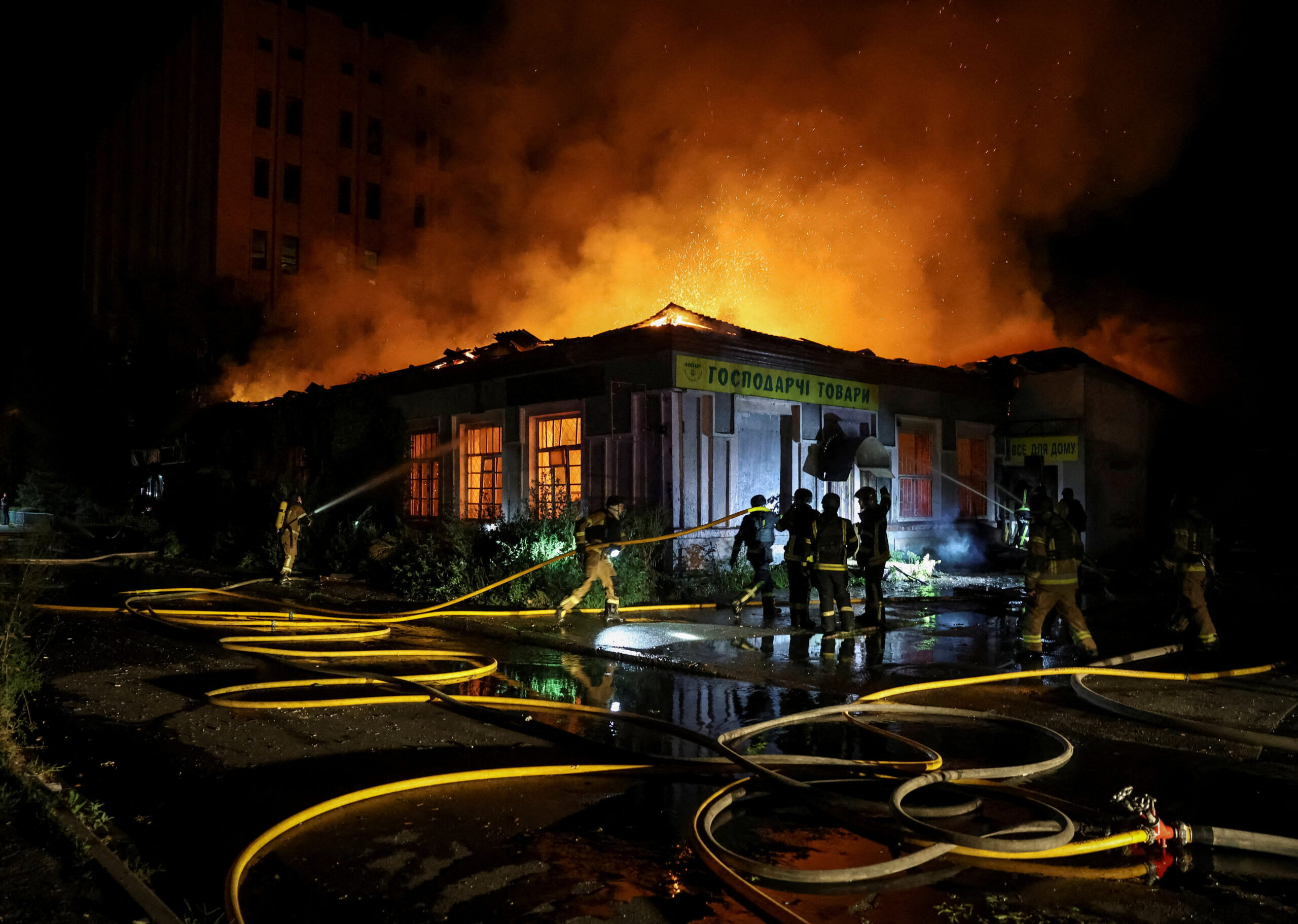
- Ukrainian forces are likely to continue deep strikes against Russian military and industrial targets, but their immediate effect on Russian battlefield operations is unlikely to be established within the next 1 to 3 months. Ukrainian forces launched several drone attacks inside Russia in August, while Russian air defences claimed to have intercepted and destroyed 726 Ukrainian drones between 17 and 18 August. Reporting also describes a Ukrainian strike on an oil refinery in Samara, civilian casualties from drone strikes in Ulyanovsk and Belgorod, and Ukrainian attacks on Russian refineries, export terminals and logistics hubs since the start of 2026. Vladimir Putin acknowledged economic harm from the bombing campaign. Confidence is medium because the pattern of attacks is supported by multiple reports, while the extent of damage and its effect on Russian operations rely partly on Ukrainian claims and a single think-tank assessment. (Confidence: medium · ASSESSED)
- I&W: Confirm: independent imagery and facility reporting verify new fires or production disruption at Russian refineries, export terminals or logistics hubs after Ukrainian strikes. (0 to 14 days)
- I&W: Break: imagery and operator reporting show no strike damage at named facilities, while no further Ukrainian deep strike inside Russia is corroborated over the next 1 to 3 months. (1 to 3 months)
- Russian coercive pressure on Ukraine's external supporters is likely to include threats and ambiguous incidents, but a deliberate Russian attack on NATO territory is unlikely in the next 1 to 3 months. The Kremlin warned Britain of unspecified consequences after reports that Ukraine was using British-made drones, and investigators linked an armed drone found at Leipzig Airport to Russia. Separate reporting states that Russian drones and cruise missiles have repeatedly violated NATO airspace since the start of 2026, while a US intelligence assessment said the Kremlin might be preparing a limited attack on a NATO member within months. Confidence is low because the warning and Leipzig incident are reported by non-government sources, the airspace claim is not independently corroborated in the supplied material, and the attack forecast is a single-source assessment. (Confidence: low · ASSESSED)
- I&W: Confirm: NATO authorities attribute another armed drone incident or airspace violation to Russia, or Russian officials announce retaliatory action against Britain or another NATO member. (0 to 14 days)
- I&W: Break: an official investigation disassociates the Leipzig drone from Russia and no further NATO airspace violation or direct threat is reported during the next 1 to 3 months. (1 to 3 months)
Outlook & scenarios
Sustained Russian pressure without a confirmed breakthrough (55%)
Most likely, Russian forces continue small-group infiltration, glide-bomb and drone attacks along the Kostiantynivka-Druzhkivka-Kramatorsk axis. Russian forces retain pressure near Vasyutynske, Raiske and Oleksiievo-Druzhkivka, while Ukrainian forces prevent a confirmed operational breakthrough.
Local Russian breach towards Kramatorsk or Druzhkivka (20%)
A less likely scenario is a local Russian breach if movement along the Kazenyi Torets River combines with successful assaults on Oleksiievo-Druzhkivka and further consolidation near Vasyutynske or Raiske. This outcome would require corroborated territorial control rather than isolated claims of advance.
Reciprocal deep-strike escalation (20%)
A less likely scenario is a further expansion of Russian ballistic and drone strikes against Ukrainian cities alongside Ukrainian attacks on Russian refineries, logistics hubs and other military-industrial sites. Civilian casualties increase in Ukraine, while Russian authorities report further disruption to facilities and transport.
Deliberate Russian attack on NATO territory (5%)
A very unlikely but high-impact wildcard is a deliberate Russian attack on a NATO member following further airspace incidents, an armed drone event or coercive action against Britain. The supplied reporting does not establish that this scenario is underway.
Recommendations
- Prioritise collection and cross-checking on the Kostiantynivka-Druzhkivka-Kramatorsk axis. Track Vasyutynske, Raiske, Oleksiievo-Druzhkivka, the Kazenyi Torets River and western Kostyantynivka separately rather than treating the axis as a single battlefield.
- Maintain a 14-day alert cycle for Russian ballistic missile and Tu-95 activity. Reconcile casualty totals for the 19 to 20 August Kyiv attack before using them in trend assessments.
- Separate confirmed Ukrainian strike damage from Ukrainian or Russian claims. Give priority to imagery and facility-level reporting for Samara and any additional Russian refinery, export-terminal or logistics-hub incidents.
- Track NATO airspace and external-supporter incidents against a higher evidentiary threshold. Require an official attribution, geolocated evidence or independent corroboration before assessing a deliberate Russian attack on NATO territory.
- Monitor mobilisation friction inside Ukraine as a front-line enabler. Report new attacks on enlistment officers, changes to mobilisation methods and evidence of effects on force generation separately, because the supplied reporting establishes domestic strain but not a quantified reduction in recruitment.
- Exclude the supplied 2023-dated clash and attack figures from the current 2026 operational baseline unless their dates and relevance are independently resolved.
Confidence & uncertainty
Overall confidence is high because the core developments are supported by corroborating reporting from the UN, BBC, Ukrinform, NASA and other major-media sources. The continued Russian pressure, the Kyiv strike and the existence of reciprocal deep-strike activity are better supported than claims about exact territorial control, casualty totals, missile composition, economic damage or NATO spillover. Those uncertainties lower confidence in the individual assessments without overturning the broader situation picture.
Intelligence gaps
- [EEI 1.1 · PARTIAL] Geotagged UAV/satellite imagery showing abandoned defensive positions or newly occupied settlements. Recommended collection: overhead imagery
- [EEI 1.2 · UNCOVERED] Confirmed movement of frontline ambulance evacuation routes beyond previous coordinates. Recommended collection: SIGINT/medical logistics
- [EEI 2.1 · UNCOVERED] Concentration of assault battalions (≥3 mechanized companies) within 15km of contact line. Recommended collection: SIGINT/UAV
- [EEI 2.2 · UNCOVERED] Unusual artillery stockpile buildup at forward depots exceeding 30-day consumption rates. Recommended collection: overhead imagery/logistics
- [EEI 3.1 · UNCOVERED] Bridge structural damage assessments at 5 key Dnieper River crossings via multispectral imaging. Recommended collection: overhead imagery
- [EEI 3.2 · UNCOVERED] Rail traffic volume changes at Kryvyi Rih and Pokrovsk rail hubs compared to 7-day baseline. Recommended collection: commercial freight data
Cited sources
[1] meduza.io · Russia and Ukraine are sending assault groups deep behind enemy lines, blurring the front line (B) · sha256:cdf0338c3fec [2] Kyiv Post · Russia Turns to 1-3-Man Infiltration Groups as Offensive Stalls Across Multiple Fronts (B) · sha256:88f6d34a3a91 [3] Atlantic Council · What it feels like under a Russian missile attack, and what the US can do about it (B) · sha256:c85fa613adec [4] United Nations · Russian missiles kill 17 more in Ukraine as Guterres calls for ceasefire (A) · sha256:7b0d1cd4e4b2 [5] world-nuclear.org · Ukraine: Russia-Ukraine War and Nuclear Energy (B) · sha256:e22d46ecd730 [6] bbc.co.uk · Rescuers dig through Ukraine mall wreckage as Zelensky condemns 'despicable' Russian strike (A) · sha256:c9edd6c0aff1 [7] Atlantic Council · As pressure mounts on Putin, Russia is escalating against Ukraine’s allies (C) · sha256:5813f6f4dc20 [8] zn.ua · Программа правительства на 2026–2027 годы (A) · sha256:f3b00743dd53
Source content hashes were computed at collection time; the cited text is preserved unmodified for the life of this product.
Red cell review: CONCUR WITH COMMENT
TLP:CLEAR