TLP:CLEAR · Disclosure is not limited.
Sahel Jihadist Pressure Tests Mali's Stability
Time window: Last 7 days · Audience: General analyst · Type: Situation report · DTG: 2026-08-21 00:09Z · Overall confidence: MEDIUM
BLUF
JNIM's economic blockade and coordinated operations are placing sustained pressure on Mali, while FLA territorial gains and Russian Africa Corps defeats limit the junta's ability to restore control in the north. Humanitarian needs and access constraints are likely to remain severe, but responsibility for some attacks and the sequence of recent operations remain contested.
Executive summary
Mali is the main pressure point in the current Sahel security picture. JNIM has imposed fuel and economic blockades, regained control of Intahaka, and operated alongside the FLA in attacks on Malian and Russian positions. The FLA has taken Kidal and Tessalit, while reporting describes increasing Africa Corps defeats and limited regional military support for Mali. The threat extends towards Benin and northwestern Nigeria. Nearly 33 million people in the Sahel need life-saving assistance, and humanitarian access remains severely constrained.
Key judgments
- JNIM is very likely to sustain economic and military pressure on Mali over the next 1-3 months. Reporting attributes to JNIM a fuel blockade affecting major Malian cities, a wider economic blockade, renewed control of Intahaka, and coordinated operations with the FLA on 25 April 2026. Confidence is medium because responsibility for some April attacks is described differently across sources, and the duration of the fuel blockade rests partly on low-confidence think-tank reporting. (Confidence: medium · ASSESSED)
- I&W: Confirm: verified reporting shows continued JNIM-linked restrictions on fuel deliveries to Bamako or other major Malian cities, alongside attacks on Malian or Africa Corps positions. Break: sustained restoration of fuel flows and no further JNIM-linked attacks on key military or economic sites. (0-14 days)
- I&W: Confirm: JNIM retains access to Intahaka or other northern Malian economic assets. Break: Malian Armed Forces or Africa Corps re-establish and hold control of Intahaka. (1-3 months)
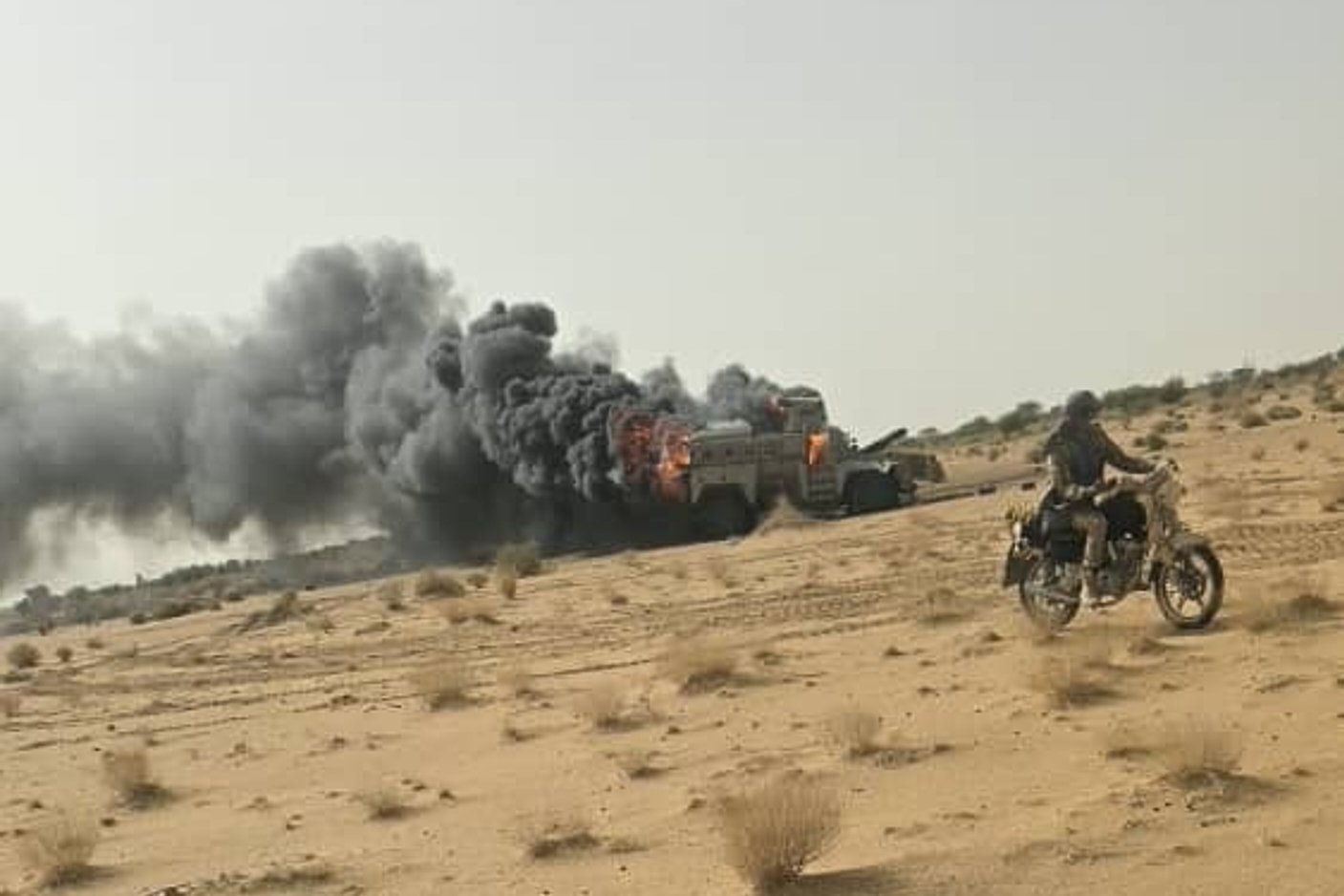
- The Malian Armed Forces and Russia's Africa Corps are unlikely to restore uncontested government control across northern Mali within the next 1-3 months. The FLA is reported to control Kidal and to have taken the Tessalit base, while JNIM has driven Malian and Russian forces from northern areas and the Africa Corps has suffered increasing defeats. Confidence is medium because the territorial claims come mainly from major-media and think-tank reporting, with limited direct confirmation of current force dispositions. (Confidence: medium · ASSESSED)
- I&W: Confirm: the FLA continues to hold Kidal and Tessalit, or releases further Malian soldiers captured in northern Mali. Break: Malian Armed Forces and Africa Corps units reoccupy and hold either location. (1-3 months)
- I&W: Confirm: the Alliance of Sahelian States does not deploy forces under its regional defence agreement. Break: named member states deploy forces to support Malian positions in the north. (1-3 months)
- Humanitarian strain in the Sahel and Mali is very likely to remain severe over the next 1-3 months. Multilateral reporting places nearly 33 million people in need of life-saving assistance and describes humanitarian access as severely constrained, while women, children and young people continue to experience displacement, insecurity and limited essential services. A separate assessment places internal displacement in Mali at almost half a million people. Confidence is medium because the regional needs and access reporting is strong, but the Mali displacement estimate comes from a single think-tank source. (Confidence: medium · ASSESSED)
- I&W: Confirm: OCHA or other UN agencies continue to report severely constrained humanitarian access in Mali or the wider Sahel, with internal displacement in Mali remaining near or above half a million. (0-3 months)
- I&W: Break: UN reporting records sustained restoration of humanitarian access in affected Malian areas and a clear reduction in displacement. (1-3 months)
- JNIM is very unlikely to take control of Mali within the next 1-3 months, but it is likely to maintain pressure beyond Mali's borders, particularly in Benin and northwestern Nigeria. JNIM is assessed to have around 6,000 active fighters and has begun spreading into those areas, while one analyst describes a takeover of Mali as distant without support from competing terrorist groups. Confidence is low because the takeover assessment rests chiefly on a single analyst's judgement and the cross-border expansion claim has no independent corroboration in the provided reporting. (Confidence: low · ASSESSED)
- I&W: Confirm: JNIM or an allied force captures and holds a major government or military site in Bamako or Kati, or announces an administration backed by control of access routes. (1-3 months)
- I&W: Break: Malian Armed Forces and Africa Corps reoccupy Kidal and Tessalit while JNIM loses its fuel blockade and cross-border activity declines. (1-3 months)
Outlook & scenarios
Protracted JNIM coercion (55%)
JNIM sustains fuel and economic pressure on Bamako while the FLA retains positions in northern Mali. Malian Armed Forces and Africa Corps units defend the junta's core areas but do not reverse the northern losses. Humanitarian access remains constrained and displacement remains high.
Limited Malian and Russian counter-operations (35%)
The Malian Armed Forces and Africa Corps conduct local counter-operations around key military and economic sites. They recover some routes or positions, but fragmented control persists and JNIM retains the capacity to disrupt fuel supplies and attack vulnerable locations.
Regional containment (25%)
Nigeria, the US and neighbouring states improve intelligence-sharing and border security cooperation. The African Union sustains dialogue and international support. These measures contain JNIM pressure in Benin and northwestern Nigeria without resolving the conflict in Mali.
JNIM strategic breakthrough (10%)
Low-probability, high-impact wildcard: JNIM obtains the manpower, money and weapons of a national military, or receives support from competing terrorist groups. It then converts its territorial and economic gains into a sustained drive against Bamako, sharply altering the security balance across the Sahel.
Recommendations
- Prioritise 0-14 day collection on JNIM's fuel blockade. Track deliveries into Bamako, fuel availability at major depots, road access and any official or independent reporting of blockade enforcement.
- Separate the 25 April and 4 July 2026 attacks in all databases and assessments. Reconcile the differing attributions involving JNIM, the FLA and unnamed rebels before drawing conclusions about command relationships or operational reach.
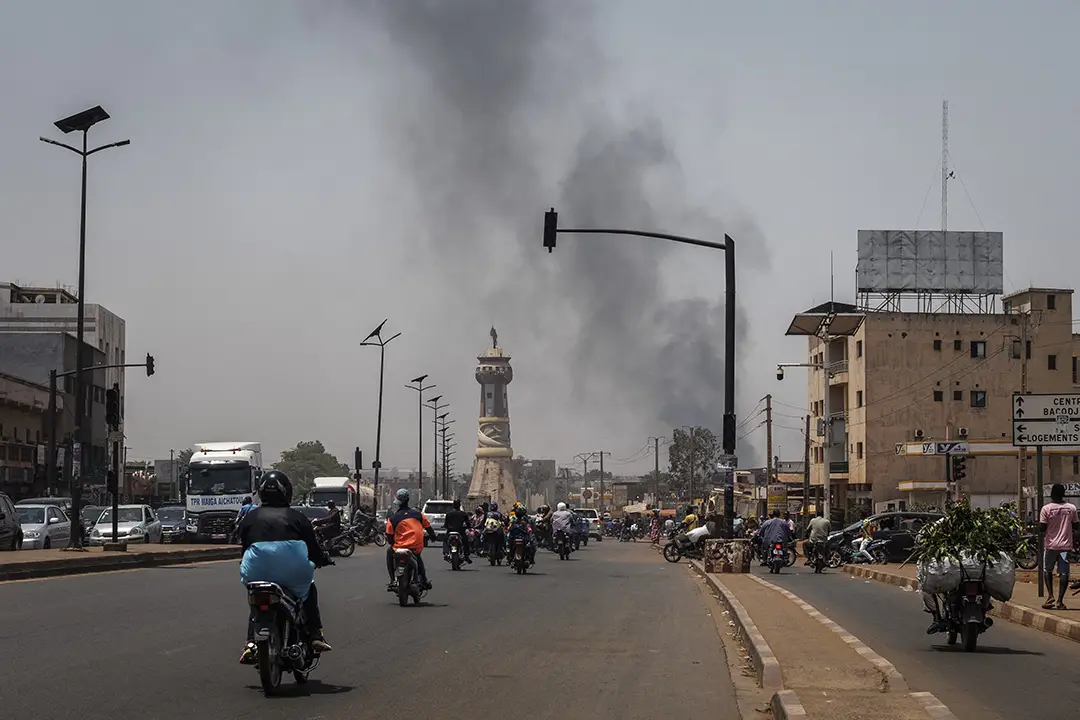
- Task imagery and open-source analysts to monitor Kidal, Tessalit, Intahaka and military positions around Bamako and Kati. Use NASA thermal detections to identify possible fires or strikes, but do not treat them as proof of cause.
- Monitor Benin and northwestern Nigeria for incidents attributed to JNIM, recruitment or movement indicators, and concrete outcomes from the US-Nigeria working group meeting held on 14 August 2026.
- Maintain humanitarian planning assumptions for nearly 33 million people across the Sahel. Track access restrictions, displacement in Mali and the effects of fuel disruption on essential services.
- Treat Sergey Lavrov's allegations about Ukrainian military personnel and French support for armed groups as reported assertions, not established facts. Track whether Malian or Russian authorities use those allegations to justify new security measures or diplomatic action.
Confidence & uncertainty
Overall confidence is medium. Multilateral reporting provides strong support for the scale of humanitarian needs, constrained access and the acute threat in the central Sahel and northern Nigeria. Major-media reporting corroborates key accounts of JNIM and FLA operations in Mali, but responsibility for Sadio Camara's death, the distinction between some FLA and Azawad Liberation Front references, and the sequence of April and July attacks remain unresolved. Several judgements also rely on single-source think-tank assessments or contested force estimates.
Cited sources
[1] Wikipedia · Mali (B) · sha256:7c753beb8878 [2] adf-magazine.com · Terrorist Rule in Mali Would Upend Region (B) · sha256:f14da53baf47 [3] The Soufan Center · How Stable is Mali’s Junta? (C) · sha256:bf7127a8c112 [4] Wikipedia · 2026 Mali offensives (B) · sha256:6dcaf0b6ff15 [5] Harvard Political Review · The Malian Rebel Spring Offensive and the New Order in the Sahel - Harvard Political Review (B) · sha256:14d9dcf71863 [6] United Nations · UN Meetings Coverage and Press Releases (A) · sha256:5fb0dbe344f9 [7] United Nations Office for West Africa and the Sahel (UNOWAS) · UN / WEST AFRICA THE SAHEL (A) · sha256:5b32bc02133e
Source content hashes were computed at collection time; the cited text is preserved unmodified for the life of this product.
TLP:CLEAR