TLP:CLEAR · Disclosure is not limited.
Sahel security brief: Menaka killings, disputed Kidal control and ECOWAS-AES talks
Time window: Last 7 days · Audience: General analyst · Type: Situation report · DTG: 2026-10-20 15:23Z · Overall confidence: HIGH
BLUF
Reporting indicates that at least 48 civilians were killed in attacks on Daoussahak settlements in Mali’s Menaka region on 18-19 October; later accounts put the toll at 50 or more, while responsibility remains unconfirmed. Conflicting accounts leave control of Kidal unresolved, and the ECOWAS-AES opening in Dakar remains a technical process rather than a cooperation deal.
Executive summary
Armed attackers struck settlements in Tinabou and the Tagadayat area, about 50 km from Menaka city. Reports put the death toll at 48, then 50 or more, and say families fled to Menaka; an Islamic State attribution appears in reporting but is not independently established. Accounts also conflict over whether Malian and Russian forces or JNIM and the Front for the Liberation of Azawad held Kidal after recent fighting. JNIM’s ability to disrupt Bamako’s fuel access remains a concern, but the reporting does not establish a continuous blockade. At the 17 October Dakar meeting, ECOWAS and the Confederation of Sahel States agreed to technical working groups, not new trade terms or changes to cross-border arrangements. Separately, Médecins sans frontières reported thousands of displaced people in Macina after September violence and high demand for medical care.
Change from previous assessment
Since the prior brief, reporting adds the 18-19 October killings in the Menaka region and new accounts that leave Kidal’s current control unresolved. Confidence in the Kidal assessment is lower because the accounts attribute the retaking of the city to opposing forces. The new fuel-blockade reporting reinforces JNIM’s reported ability to exert economic pressure, but does not establish a continuous blockade and does not overturn the prior assessment. The Dakar meeting confirms a technical dialogue process, not a cooperation deal. Initial casualty and attribution reporting for Menaka remains unsettled.
Key judgments
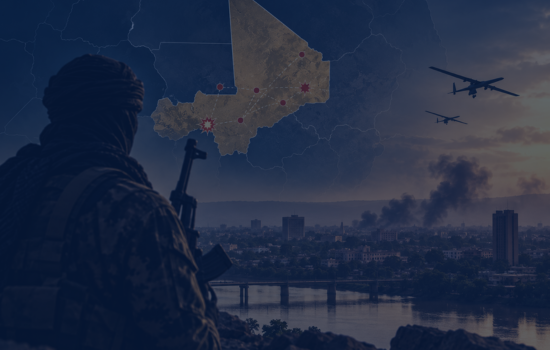
- At least 48 civilians were killed in attacks on Daoussahak settlements in Tinabou and the Tagadayat area of Mali’s Menaka region on 18-19 October. A security official later reported 50 deaths, and an elected local official said he saw more than 50 bodies. The one-day difference in reported timing and the changing toll leave the exact date and final count unsettled. (Confidence: medium · REPORTED)
- I&W: Confirm the reported scale if a named local authority, health facility or independent reporting outlet publishes an updated count of at least 48 deaths specifically from Tinabou and Tagadayat. (0-14 days)
- I&W: Revise the assessment if a credible investigation establishes that the reported deaths were from separate incidents or that fewer than 40 people were killed in these attacks. (0-30 days)
- Islamic State group fighters likely carried out the Menaka-area attack, but responsibility remains unconfirmed. A wire-service account attributes the attack to Islamic State members, while the Daoussahak community’s executive bureau suspected Islamic State involvement; other reporting describes the attackers as unidentified. (Confidence: medium · REPORTED)
- I&W: Confirm the attribution if Islamic State claims the attack and provides details independently verified against the sites or victims. (0-14 days)
- I&W: Break the attribution if credible local or investigative reporting identifies a different armed group as responsible. (0-30 days)
- The available reporting does not establish who controlled Kidal as of 20 October. One account says the Malian military and its Russian allies retook the city after a Tuareg withdrawal; other reporting attributes a Kidal recapture to JNIM and the Front for the Liberation of Azawad, and says Africa Corps withdrew from the city. These accounts may describe different phases, but the sequence and current control remain unresolved. (Confidence: low · ASSESSED)
- I&W: Confirm that control remains unresolved if new, dated accounts continue to give opposing control claims without independently verified evidence from Kidal. (0-14 days)
- I&W: Break the assessment if independently verified, dated imagery or reporting establishes which force controls Kidal’s main administrative centre and military positions. (0-30 days)
- JNIM likely retains the ability to disrupt fuel and cargo access to Bamako, but the supplied reporting does not establish a continuous blockade. A think-tank account links an earlier blockade to fuel shortages, power outages and flight disruptions; a social-media post says a fuel blockade is continuing. A separate low-confidence account describes suspected JNIM attempts to obstruct cargo convoys on the Bamako-Kourémalé route. (Confidence: low · ASSESSED)
- I&W: Confirm continuing disruption if independently reported attacks or closures repeatedly stop cargo on the Bamako-Kourémalé route, alongside documented fuel shortages or power outages in Bamako. (0-14 days)
- I&W: Weaken the assessment if dated reporting documents regular cargo movement on the Bamako-Kourémalé route and sustained fuel availability in Bamako. (0-30 days)
- ECOWAS and the Confederation of Sahel States are likely to sustain technical contact over the next 1-3 months, but a substantive trade or cross-border agreement is unlikely on the evidence from Dakar. The 17 October meeting established joint working groups whose findings are to go to ministers; the communiqué announced no new trade agreement or changes to existing cross-border arrangements. The three states announced withdrawal from ECOWAS in January 2024, and their departure formally took effect on 29 January 2025. (Confidence: medium · ASSESSED)
- I&W: Confirm continuing contact if ECOWAS and AES publish working-group terms of reference, hold a technical session or announce the next ministerial session. (1-3 months)
- I&W: Break the assessment that no substantive arrangement is near if the parties sign an agreement that changes trade terms or cross-border procedures. (1-3 months)
- Médecins sans frontières reporting indicates that Macina’s humanitarian caseload was already high after September violence in the Ségou region. More than 3,400 displaced people reportedly arrived, on top of more than 5,000 already hosted in Macina; an MSF mobile clinic treated 2,131 patients in 15 days, and MSF reported that several humanitarian organisations had left the area because of funding difficulties. (Confidence: medium · REPORTED)
- I&W: Confirm continuing pressure if MSF or local health facilities report further arrivals in Macina or continued treatment volumes near the reported 2,131 patients per 15 days. (1-3 months)
- I&W: Revise the assessment if MSF reports that displaced families have returned and its mobile clinic or other humanitarian services have scaled down because demand has fallen. (1-3 months)
Outlook & scenarios
Fragmented violence and limited regional dialogue (55%)
The most likely course is continued localised attacks and displacement in northern and central Mali, with competing claims over Kidal and intermittent pressure on Bamako’s supply routes. ECOWAS-AES contact remains focused on technical working groups, without a new cross-border agreement.
Worsening pressure on Malian state positions and civilians (25%)
Further JNIM and FLA operations compound uncertainty over Kidal and increase pressure on Malian military positions or civilian settlements. Additional disruption on routes serving Bamako deepens fuel and service shortages. The October attacks in Menaka and earlier reports of an economic siege provide warning context, but do not establish that this course is already under way.
Technical dialogue produces practical steps (15%)
ECOWAS and AES working groups submit proposals to ministers and agree on limited practical measures, such as a defined process for managing trade or cross-border arrangements. This would represent progress beyond the Dakar communiqué, which did not itself change those arrangements.
Wildcard: coordinated offensive and severe supply disruption (5%)
A very unlikely, high-impact outcome is a renewed coordinated JNIM-FLA offensive that changes control around Kidal while JNIM disrupts routes supplying Bamako. Such a combination would sharpen military and economic pressure on the Malian government. Existing claims establish reported coordination and past economic pressure, not an imminent operation.
Recommendations
- Separate confirmation of the Menaka killings from attribution. Seek updated casualty figures and incident timing from local authorities, health facilities, community representatives and independent reporting before stating a final toll or naming the perpetrators.
- Prioritise verification of Kidal control. Build a dated sequence from Malian military, Africa Corps, JNIM and FLA claims, and seek independently verified reporting on control of the city’s administrative and military positions.
- Track specific indicators of pressure on Bamako: cargo movement on the Bamako-Kourémalé route, fuel availability, reported power outages and flight disruptions. Do not describe the city as continuously blockaded without evidence of sustained access denial.
- Follow the ECOWAS-AES working groups for terms of reference, meeting dates and ministerial decisions. Distinguish technical contact from any signed change to trade or cross-border arrangements.
- Request updated MSF and local reporting on displacement and health-service capacity in Macina, including new arrivals, clinic caseloads and humanitarian organisations operating in the area.
Confidence & uncertainty
Overall confidence is high in the broad situation picture because reporting from a wire service, local media, community representatives and a security official corroborates the Menaka attack, while the Dakar account specifies the working groups’ mandate and limits. Confidence is lower on the exact Menaka toll and timing, responsibility for the attack, current control of Kidal and the extent of fuel disruption around Bamako. Those details rest on evolving, conflicting or single-source reporting.
Intelligence gaps
- [EEI 1.2 · UNCOVERED] Observed movement and size of armed columns (vehicle counts, heavy weapons present) along approach routes to population centers or borders documented by imagery, local reporting, or border guards. Recommended collection: imagery/SATCOM
- [EEI 1.3 · PARTIAL] Reports of occupation, administration, or imposition of checkpoints/taxes by armed groups in named towns, villages, markets, or on specified road segments. Recommended collection: OSINT (local media/social)
- [EEI 1.4 · PARTIAL] Seizure or acquisition of heavy weapons or air-defense systems (mortars >81mm, artillery, armored vehicles, MANPADS) attributed to specific groups as evidenced by photos, captured weapons inventories, or weapons interdictions. Recommended collection: forensics/field reporting
- [EEI 2.1 · PARTIAL] Internal security force movements: redeployment of army units, garrison withdrawals, or mass troop movements toward/away from capitals and regional command posts. Recommended collection: imagery/SATCOM
- [EEI 2.2 · UNCOVERED] Detentions, public dismissals, resignations, or public statements by senior military, police, or government officials indicating factional splits (named individuals, ranks, units). Recommended collection: diplomatic/OSINT
- [EEI 3.1 · UNCOVERED] Interdictions or seizures at borders/markets of weapons, ammunition, fuel, or contraband (type/quantity, seizure location, alleged origin/destination). Recommended collection: border/customs
- [EEI 3.2 · PARTIAL] Recorded movements of known smuggling routes and convoy volumes: counts of commercial/privately registered vehicles and informal river crossings on specific cross-border corridors. Recommended collection: ground/HUMINT
- [EEI 3.3 · UNCOVERED] Monitored financial flows linked to illicit trade: large cash movements, changes in declared gold exports at named mines/ports, or arrests of money couriers with amounts and origins. Recommended collection: financial/forensics
- [EEI 3.4 · PARTIAL] Observed changes at border security posts: closures, reductions in personnel, destroyed checkpoints, or documented agreements allowing free movement at named crossings. Recommended collection: imagery/OSINT
Red cell review: CONCUR WITH COMMENT
TLP:CLEAR