TLP:CLEAR · Disclosure is not limited.
Sahel Security Crisis: JNIM Pressure Persists as Mali’s Fuel Corridor Holds
Time window: Last 7 days · Audience: General analyst · Type: Situation report · DTG: 2026-09-22 04:09Z · Overall confidence: MEDIUM
BLUF
JNIM and the Azawad Liberation Front are likely to sustain coordinated pressure on FAMa and Russia’s Africa Corps in northern and central Mali over the next 1-3 months. Army-escorted fuel deliveries are likely to keep Bamako supplied in the near term, but Niger’s August mutiny and Burkina Faso’s limited territorial control continue to expose wider state-cohesion risks.
Executive summary
The security situation remains most acute in Mali, where JNIM and the FLA have conducted coordinated attacks and JNIM attacked an army camp in Dioura on 10 September. JNIM’s pressure on fuel routes from Senegal and Côte d’Ivoire continues, although the Malian government reported that more than 900 tankers entered Bamako under military escort on 14 September. Burkina Faso’s government reportedly controls around 40% of national territory. Nigerien authorities retained control after the 28-29 August mutiny in Niamey, but the incident, the killing of around 18 soldiers near Dosso and Algeria’s deployment of four Su-30 aircraft indicate continuing cohesion concerns. Mali’s counter-insurgency remains linked to Russia’s Africa Corps, while allegations of civilian harm from Malian military drone strikes remain contested. UNHCR estimated that more than 400,000 people were internally displaced in Mali as of June.
Change from previous assessment
Since 21 September, the assessment has added reporting on JNIM’s 10 September attack on the Dioura army camp, the reported death of Defence Minister Sadio Camara in the April attacks, and the Malian government’s report that more than 900 fuel tankers entered Bamako under escort on 14 September. These developments reinforce the judgement that Mali’s insurgent pressure remains high and raise the fuel-access assessment from low to medium confidence. The assessment of Burkina Faso and AES institutionalisation is broadly unchanged. The Niger mutiny and drone-attribution judgements remain constrained by incomplete or conflicting reporting.
Key judgments
- JNIM and the Azawad Liberation Front are likely to sustain coordinated pressure on FAMa and Russia’s Africa Corps in northern and central Mali over the next 1-3 months. A wider campaign reaching sites south of Bamako has a roughly even chance. The assessment draws on reporting of coordinated attacks in northern Mali, the April offensive across Bamako, Kati, Mopti, Gao and Kidal, the 10 September attack on the Dioura army camp and the 4 July attack on Kéniéroba prison. Confidence is medium because the geographic link between the northern offensives and the Kéniéroba attack remains disputed. (Confidence: medium · ASSESSED)
- I&W: Confirm: JNIM or FLA attacks target military sites in Dioura, Bamako, Kati, Mopti, Gao or Kidal, or FAMa and Africa Corps lose another military base. (0-14 days)
- I&W: Break: No further attacks are reported at the named locations and FAMa and Africa Corps retain all recently held bases for 1-3 months. (1-3 months)
- JNIM is likely to continue targeting Mali’s fuel tankers and highways from Senegal and Côte d’Ivoire, while military-escorted deliveries are likely to keep Bamako supplied in the near term. The Malian government’s report that more than 900 tankers entered Bamako on 14 September improves confidence in near-term supply access, but the tanker count is not independently corroborated. Confidence is medium. (Confidence: medium · ASSESSED)
- I&W: Confirm: JNIM attacks another tanker or fuel highway, followed by renewed shortages in Bamako or reported disruption to electricity and schooling. (0-30 days)
- I&W: Break: Fuel remains available in Bamako while repeated escorted deliveries arrive without reported disruption to electricity or schooling. (0-30 days)
- The Burkina Faso government is unlikely to establish uncontested control over Burkina Faso within the next 1-3 months. A major-media estimate places state control at around 40% of national territory, but the claim is a single current territorial estimate and does not establish exact front lines. Confidence is medium. (Confidence: medium · ASSESSED)
- I&W: Confirm: New reporting places non-state armed groups in control of additional Burkina Faso communes or keeps estimated state control at or below 40%. (0-3 months)
- I&W: Break: Independent mapping places state control above 60% and records sustained government access across previously contested areas. (1-3 months)
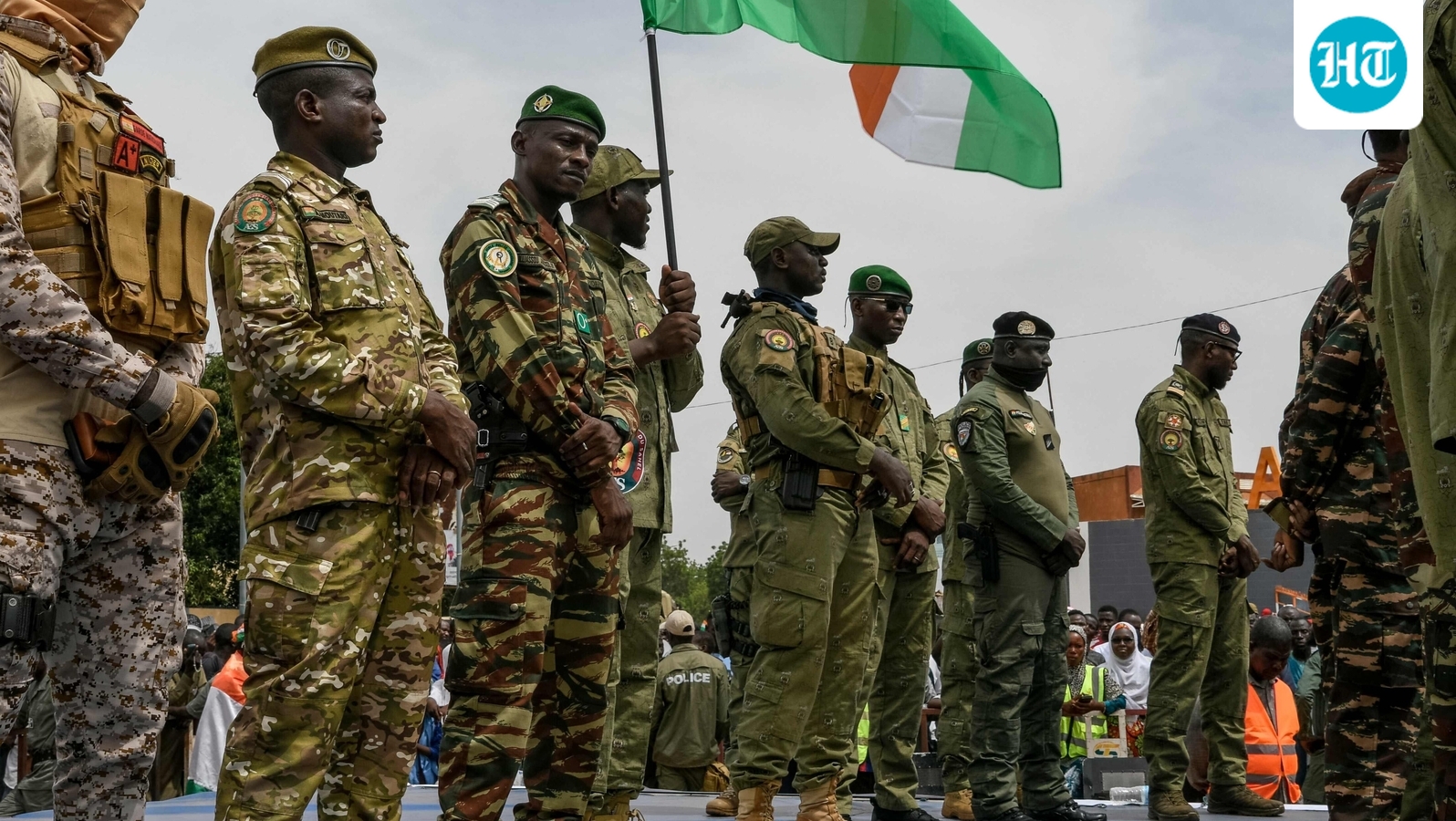
- Nigerien authorities are likely to retain control of Niamey over the next 1-3 months, but Nigerien military cohesion is likely to remain vulnerable. The 28-29 August mutiny targeted the presidential palace, Diori-Hamani International Airport and Military Base 101, while around 18 soldiers were killed near Dosso the previous week. Russia’s Africa Corps reportedly helped foil the mutiny, and Algeria deployed four Su-30 fighters and support aircraft at Nigerien request. Confidence is medium because the reporting establishes the incidents but does not establish the depth of internal military support for the mutiny. (Confidence: medium · ASSESSED)
- I&W: Confirm: A renewed mutiny, senior-officer dismissals or arrests, or attacks again target the presidency, Diori-Hamani International Airport or Military Base 101. (0-30 days)
- I&W: Break: Nigerien authorities complete 1-3 months without another reported internal armed challenge and retain uninterrupted control of the three named strategic sites. (1-3 months)
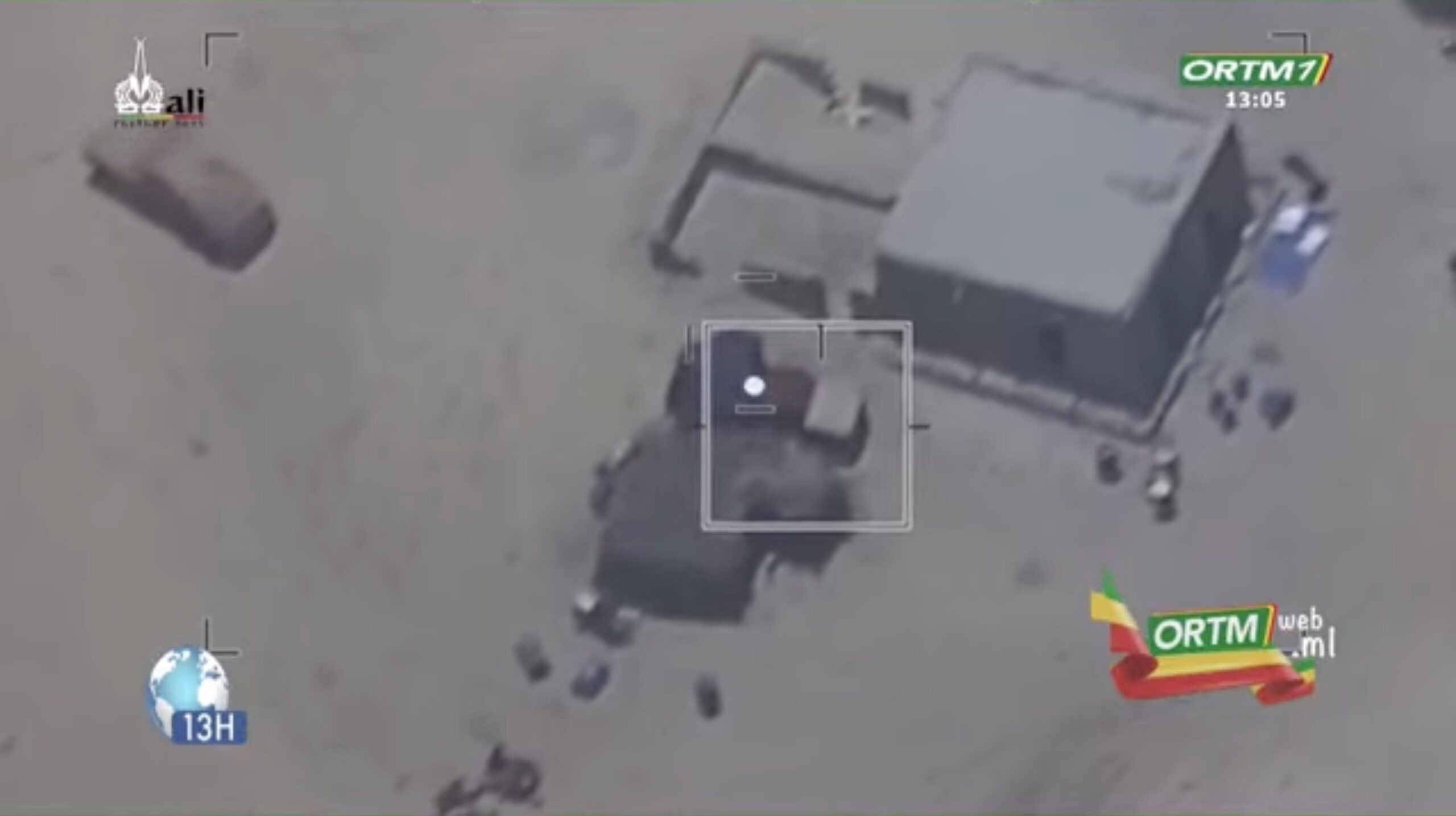
- Malian military drone operations are likely to continue over the next 1-3 months, and allegations of civilian harm are likely to persist. Attribution of individual strikes and drone platforms remains contested: Bellingcat geolocated Shahed-136 type drones and strike damage, while Mali acquired Turkish-made Bayraktar TB2 systems and FAMa described the Zouera strike as an attack on a terrorist supply vehicle; MSF reported four civilian deaths and five injuries at Zouera. Confidence is medium because geolocation, satellite imagery and casualty reporting provide corroboration, but individual-strike attribution remains disputed and some reporting is low confidence. (Confidence: medium · ASSESSED)
- I&W: Confirm: New geolocated footage, identifiable drone debris or satellite imagery shows further strikes and civilian damage in Mali. (0-30 days)
- I&W: Break: No new geolocated strike footage, identifiable debris or satellite-confirmed damage is recorded in Mali for 90 days. (1-3 months)
- The AES states are likely to continue institutionalising their bloc and relying on Russian security support over the next 3 months. The US relationship is likely to remain contested: Washington’s 2026 strategy emphasises intelligence-sharing and capacity-building with AES states, while separate reporting says Mali, Burkina Faso and Niger restricted US operations and turned to Russia. Confidence is medium because the claims may reflect different timeframes and do not establish the current level of US operational access. (Confidence: medium · ASSESSED)
- I&W: Confirm: The AES announces a new joint security organ, operation or formal coordination mechanism, or Russia’s Africa Corps expands its documented role in Mali or Niger. (0-3 months)
- I&W: Break: The US secures publicly acknowledged operational access in an AES state that exceeds intelligence-sharing and capacity-building, or an AES government formally curtails Russia’s security role. (1-3 months)
- Humanitarian pressure in Mali is likely to persist over the next 1-3 months. UNHCR estimated more than 400,000 internally displaced people in Mali as of June, while human rights groups and humanitarian reporting allege civilian deaths linked to Russian-backed operations and Malian military drone strikes. Confidence is medium because the displacement estimate is from a reliable multilateral source, but casualty figures and responsibility for individual strikes remain contested. (Confidence: medium · ASSESSED)
- I&W: Confirm: UNHCR or another multilateral source reports a further increase in Mali’s internally displaced population, or health organisations document new civilian casualties from air operations. (1-3 months)
- I&W: Break: A multilateral update records a sustained fall in displacement and no newly documented civilian casualties from Malian military operations. (1-3 months)
Outlook & scenarios
Sustained insurgent pressure without state collapse (55%)
The most likely path is continued JNIM and FLA attacks against FAMa and Africa Corps positions in Mali, alongside persistent insecurity in Burkina Faso and Tillaberi. Bamako remains supplied by escorted convoys, but rural access and civilian security deteriorate.
Managed containment around Bamako and Niamey (25%)
Army-escorted fuel movements continue, Mali avoids a major attack on Bamako, and Nigerien authorities prevent a second mutiny. This outcome limits immediate disruption without reversing insurgent territorial pressure or Burkina Faso’s control deficit.
Nigerien cohesion crisis (15%)
A renewed internal challenge in Niger targets the presidency, Diori-Hamani International Airport or Military Base 101. External support from Russia and Algeria helps the government retain Niamey, but arrests, dismissals or command disputes weaken military cohesion.
Multi-front deterioration (5%)
A very unlikely, high-impact outcome combines renewed JNIM and FLA attacks in Mali, disruption of fuel routes into Bamako and a fresh Nigerien mutiny. The result is simultaneous pressure on Mali’s logistics and Niger’s political centre, with wider displacement and civilian-harm allegations.
Recommendations
- Prioritise collection on JNIM and FLA activity around Dioura, Bamako, Kati, Mopti, Gao, Kidal and Kéniéroba. Cross-check official communiqués with geolocated imagery and independent reporting within 0-14 days.
- Track Mali’s fuel corridor from Senegal and Côte d’Ivoire separately from government claims. Record tanker movements, escort frequency, fuel availability in Bamako, and reported effects on electricity and schooling on a daily basis.
- Maintain a dedicated Niger watch covering the presidential palace, Diori-Hamani International Airport and Military Base 101. Monitor senior-officer removals, arrests, troop movements and the continued presence of Russian and Algerian support assets.
- Treat claims about Malian drone platforms, strike responsibility and civilian casualties as separate analytic questions. Require geolocation, satellite imagery, debris analysis and humanitarian reporting before assigning a platform or actor to an individual strike.
- Incorporate Mali’s more than 400,000 internally displaced people into humanitarian and political risk tracking. Flag new displacement and civilian casualty reporting as indicators of further loss of state legitimacy.
- For US policy analysis, separate the reported restriction of US operations in the AES states from the 2026 strategy of intelligence-sharing and capacity-building. Track concrete access, liaison arrangements and partner activity rather than treating the two claims as fully reconciled.
Confidence & uncertainty
Overall confidence is medium. The core assessment is supported by multiple major-media reports, Bellingcat geolocation and satellite analysis, UNHCR reporting, and corroborating local or specialist sources. Confidence is lower on the scale of Nigerien military dissent, Burkina Faso’s precise territorial control, Mali’s fuel throughput and the attribution of individual drone strikes. The reported US relationship with the AES also reflects an unresolved difference between restricted operations and a later policy emphasis on intelligence-sharing and capacity-building.
Intelligence gaps
- [EEI 1.1 · PARTIAL] Number, location, and scale of attacks (IEDs, ambushes, complex attacks) per week against towns, military bases, police posts, or convoys, with casualty and equipment-loss counts. Recommended collection: ground/HUMINT
- [EEI 1.2 · UNCOVERED] Observed movement and size of armed columns (vehicle counts, heavy weapons present) along approach routes to population centers or borders documented by imagery, local reporting, or border guards. Recommended collection: imagery/SATCOM
- [EEI 1.3 · PARTIAL] Reports of occupation, administration, or imposition of checkpoints/taxes by armed groups in named towns, villages, markets, or on specified road segments. Recommended collection: OSINT (local media/social)
- [EEI 1.4 · UNCOVERED] Seizure or acquisition of heavy weapons or air-defense systems (mortars >81mm, artillery, armored vehicles, MANPADS) attributed to specific groups as evidenced by photos, captured weapons inventories, or weapons interdictions. Recommended collection: forensics/field reporting
- [EEI 2.1 · PARTIAL] Internal security force movements: redeployment of army units, garrison withdrawals, or mass troop movements toward/away from capitals and regional command posts. Recommended collection: imagery/SATCOM
- [EEI 2.2 · PARTIAL] Detentions, public dismissals, resignations, or public statements by senior military, police, or government officials indicating factional splits (named individuals, ranks, units). Recommended collection: diplomatic/OSINT
- [EEI 3.1 · UNCOVERED] Interdictions or seizures at borders/markets of weapons, ammunition, fuel, or contraband (type/quantity, seizure location, alleged origin/destination). Recommended collection: border/customs
- [EEI 3.2 · PARTIAL] Recorded movements of known smuggling routes and convoy volumes: counts of commercial/privately registered vehicles and informal river crossings on specific cross-border corridors. Recommended collection: ground/HUMINT
- [EEI 3.3 · UNCOVERED] Monitored financial flows linked to illicit trade: large cash movements, changes in declared gold exports at named mines/ports, or arrests of money couriers with amounts and origins. Recommended collection: financial/forensics
- [EEI 3.4 · UNCOVERED] Observed changes at border security posts: closures, reductions in personnel, destroyed checkpoints, or documented agreements allowing free movement at named crossings. Recommended collection: imagery/OSINT
Cited sources
[1] Bellingcat · “A Recurring Pattern”: Civilians Paying the Price in Mali’s Drone Campaign - bellingcat (A) · Wed Sep 16 2026 16:04:19 GMT+0000 (Coordinated Universal Time) · sha256:240eaaf5fb84 [2] Al Jazeera · Mali marks independence amid a worsening security crisis (A) · Tue Sep 22 2026 00:02:53 GMT+0000 (Coordinated Universal Time) · sha256:d530ad4ab78a [3] journaldumali.com · Koulikoro: le couvre-feu s’installe dans la durée (F) · Mon Aug 24 2026 13:56:17 GMT+0000 (Coordinated Universal Time) · sha256:86c153519621 [4] Bellingcat · Shahed-Type Drones Filmed During Mali Village Attacks - bellingcat (B) · Fri Jul 24 2026 15:39:05 GMT+0000 (Coordinated Universal Time) · sha256:83cab117dd5c [5] Hindustan Times · Where is India in West Africa’s security bet? | Hindustan Times (B) · Sat Sep 19 2026 01:02:33 GMT+0000 (Coordinated Universal Time) · sha256:8f2fc4c2f018 [6] Middle East Eye · Sahel instability pushes Algeria to rethink its long-standing non‑intervention doctrine (B) · Fri Sep 18 2026 13:21:48 GMT+0000 (Coordinated Universal Time) · sha256:37fe246d6a48 [7] Mmegi (mmegi.bw) · Security-for-resources model as a counter- terrorism strategy in the Sahel (D) · Mon Sep 21 2026 06:00:00 GMT+0000 (Coordinated Universal Time) · sha256:dac8df5e7da3 [8] World Journal of Advanced Research and Reviews · [PDF] examining the immediate and structural drivers of coups in the africa.. (C) · sha256:155063daa176
Source content hashes were computed at collection time; the cited text is preserved unmodified for the life of this product.
TLP:CLEAR