TLP:CLEAR · Disclosure is not limited.
Sahel security crisis: Mali corridor pressure and Guinea-Mali displacement
Time window: Last 7 days · Audience: General analyst · Type: Situation report · DTG: 2026-11-18 04:07Z · Overall confidence: LOW
BLUF
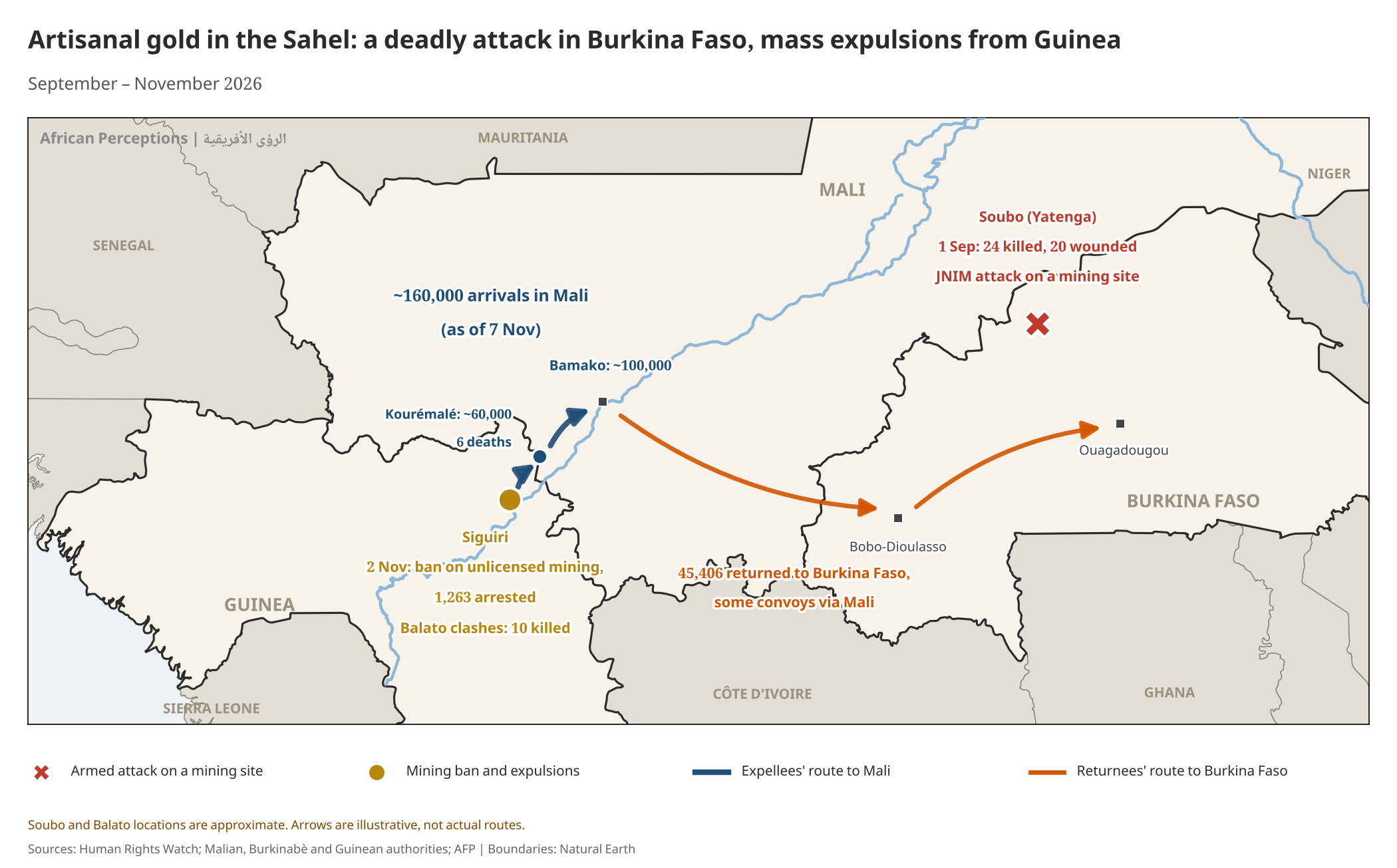
JNIM is likely to continue disrupting Mali’s supply routes, but reported convoy movements indicate a porous interruption rather than a complete cutoff. The immediate new concern is cross-border movement following Guinea’s Siguiri mining ban: Malian authorities reported 160,000 arrivals, while Burkina Faso reported repatriating 45,406 citizens from Guinea; the figures are not independently reconciled. Reporting on the Soubo attack records 24 deaths as civilian, a classification JNIM disputes.
Executive summary
Guinea’s ban on unlicensed artisanal mining in Siguiri took effect on 2 November, followed by reported arrests and expulsions, mainly of workers from Mali and Burkina Faso. Malian authorities said on 7 November that about 160,000 people had arrived from Guinea, while Burkina Faso reported repatriating 45,406 citizens from Guinea, some in convoys through Mali. Reports also cite deaths in Kourémalé, Mali, and Balato, Guinea, during enforcement activity. In Burkina Faso, a Human Rights Watch account of the 1 September attack on the Soubo mining site reports 24 civilian deaths and at least 20 wounded; JNIM acknowledged the attack but disputed that the victims were civilians. Separate reporting describes sustained pressure on Mali’s trade routes since September 2025, alongside escorted convoys and fuel deliveries that show the routes were not fully sealed. The available claims do not establish whether Russian security involvement has improved outcomes in Mali or Niger.
Change from previous assessment
Since the 17 November brief, this assessment adds reporting on Guinea’s mining-ban enforcement and arrivals in Mali, the Soubo attack and additional figures on Mali’s trade-route disruption. The assessment that the fuel blockade is porous rather than complete is unchanged, though the new convoy and container figures add detail. No new claims resolve the prior brief’s Kidal report or its assessment of US and Turkish defence contacts.
Key judgments
- Cross-border movement into Mali is likely to remain elevated over the next month as Guinea’s mining-enforcement campaign continues. Malian authorities reported about 160,000 arrivals from Guinea, including roughly 100,000 in Bamako and nearly 60,000 in Kourémalé; Burkina Faso separately reported repatriating 45,406 citizens from Guinea. These totals are not directly comparable or independently reconciled. Reports of six deaths in Kourémalé and 10 deaths and 13 wounded in Balato during enforcement activity add to the risk of further localised displacement. The figures and casualty reports rely on a single publication’s account of official statements, so confidence is low. (Confidence: low · ASSESSED)
- I&W: A dated update from Malian authorities or an aid organisation reporting additional arrivals in Bamako or Kourémalé would confirm continued movement; a corrected tally showing that the 160,000 figure includes people already resident in Mali would weaken the scale assessment. (0-30 days)
- I&W: New Guinean announcements of arrests or expulsions linked to the Siguiri ban would confirm continued enforcement pressure; an official suspension of the ban or expulsions would weaken the forecast. (0-30 days)
- JNIM is likely to continue disrupting Mali’s supply corridors, but the available evidence indicates a porous interruption rather than a complete cutoff. Reporting places about 120 Mali-bound containers per day blocked at the Port of Dakar between September and November 2025, and describes stranded containers and lower Senegalese exports to Mali. Against that, Mali’s military reportedly escorted 940 supply trucks on the Kayes-Bamako corridor in late June 2026, and about 1,000 fuel trucks had reached Bamako by July. The reports differ on the blockade’s extent and on which forces escorted convoys, limiting confidence in the current scale and attribution. (Confidence: medium · ASSESSED)
- I&W: Fresh Port of Dakar records showing Mali-bound blockages near the reported level of 120 containers per day, alongside dated reports of escorted convoys, would confirm continued but porous disruption; sustained low blockage counts and regular corridor deliveries would weaken it. (1-3 months)
- I&W: A new, dated count of trucks escorted between Kayes and Bamako that identifies the escorting force would clarify whether Mali’s military, Africa Corps or Turkish drones are protecting the convoys. (0-3 months)
- JNIM fighters likely attacked the artisanal gold mining site near Soubo in Yatenga Province on 1 September 2026, but the reported death toll and the victims’ status remain disputed. Human Rights Watch reporting cited in the available account says 24 civilians were killed and at least 20 wounded; JNIM acknowledged the attack but claimed the victims were members of the army-allied Volunteers for the Defence of the Homeland. Witnesses told Human Rights Watch that no soldiers or volunteers were at the site. The incident is reported through one publication, so confidence remains low despite the reported acknowledgement by JNIM. (Confidence: low · REPORTED)
- I&W: A published Human Rights Watch follow-up or independent medical and local records confirming 24 civilian deaths would strengthen the reported casualty assessment; evidence placing Volunteers for the Defence of the Homeland at the site would weaken the civilian classification. (0-3 months)
- It is unlikely that current reporting demonstrates that Russian involvement has improved security outcomes in Mali or Niger. A trade-publication account attributes some escorts of fuel trucks reaching Bamako to Russia’s Africa Corps and Turkish drones, while Russia claims it helped end the late-August coup uprising in Niger. A separate assessment argues that Russia cannot deliver security and stability for Sahelian military governments. These accounts report activity and competing evaluations, not verified security effects; confidence is low because the Niger claim is uncorroborated and the broader assessments do not provide outcome measures. (Confidence: low · ASSESSED)
- I&W: An independently corroborated Malian convoy record naming Africa Corps and documenting deliveries, alongside lower reported corridor disruption, would provide evidence of an operational effect and weaken the judgment that results are unestablished. (1-3 months)
- I&W: An independent account identifying Russian personnel’s role in ending Niger’s late-August uprising and documenting subsequent security outcomes would weaken the assessment that the claim is unverified. (1-3 months)
Outlook & scenarios
Persistent, porous pressure on Mali’s supply routes (65%)
Over the next 1-3 months, JNIM is likely to continue imposing intermittent pressure on routes linking Dakar, Abidjan and Conakry to Bamako. The reported truck escorts and fuel deliveries show that traffic has continued, but the container backlog and lower Senegalese exports indicate that access has carried costs. Guinean enforcement and cross-border movement into Mali are also likely to remain active.
Improved corridor access and managed returns (30%)
An easing of pressure is unlikely, but it remains plausible if Mali sustains escorted deliveries and Guinea reduces expulsions or organises returns. Regular truck movements and lower blocked-container counts would indicate improving access. Published arrival figures that clarify the overlap between the reported 160,000 arrivals and Burkina Faso’s 45,406 repatriations would reduce uncertainty about the humanitarian caseload.
High-impact escalation around mining enforcement (5%)
A further lethal confrontation linked to enforcement of Guinea’s Siguiri mining ban is very unlikely, but would have high impact if it produced new deaths or a larger flow of people into Kourémalé and Bamako. The reported deaths in Kourémalé and Balato during enforcement activity provide a basis for monitoring this risk, but do not establish that escalation is under way.
Recommendations
- Keep the reported 160,000 arrivals in Mali and Burkina Faso’s 45,406 repatriations as separate figures until their populations, dates and possible overlap are verified. Seek dated counts from Malian and Guinean authorities and aid organisations.
- Track Mali-bound container backlogs at Dakar alongside dated truck-escort counts on the Kayes-Bamako route. Record whether each reported escort involved Mali’s military, Russia’s Africa Corps or Turkish drones rather than treating them as a single force.
- Describe the Soubo attack and casualty figures with attribution. Keep JNIM’s claim about Volunteers for the Defence of the Homeland separate from the Human Rights Watch account and witness reporting until additional evidence resolves the victim status.
- Assess Russian security involvement separately from its claimed effects. Seek independently corroborated reporting on named units, convoy deliveries and Niger’s late-August uprising before drawing conclusions about improved security outcomes.
Confidence & uncertainty
Overall confidence is low because key figures and incidents rely on a small set of sources, several claims are relayed through secondary reporting, and independent corroboration is limited. The available accounts conflict over whether Mali’s supply routes remain under blockade, who escorted fuel convoys and whether the Soubo victims were civilians. The reported Guinea-to-Mali movement totals are not reconciled, and the claimed Russian role in ending Niger’s coup uprising is uncorroborated.
Alternative analysis (red cell)
The reported arrivals and repatriations may represent a short-lived surge immediately after Guinea's mining ban rather than a sustained elevation in movement. Claims 0d422be4-42de-42eb-8504-03e7839accea and f0970d38-de75-4d9b-9d8a-bd393eefa1bf establish enforcement activity, but claims 0ee34120-8569-40c4-99f8-a8753a7f59a3 and 22fb07e5-f1cc-4e8b-b75e-7a9ba8858c5f do not provide a time series or show that the campaign will persist. On the available evidence, continued elevated movement is possible, but a decline after the initial displacement cannot be excluded.
Intelligence gaps
- [EEI 1.1 · PARTIAL] Number, location, and scale of attacks (IEDs, ambushes, complex attacks) per week against towns, military bases, police posts, or convoys, with casualty and equipment-loss counts. Recommended collection: ground/HUMINT
- [EEI 1.2 · PARTIAL] Observed movement and size of armed columns (vehicle counts, heavy weapons present) along approach routes to population centers or borders documented by imagery, local reporting, or border guards. Recommended collection: imagery/SATCOM
- [EEI 1.3 · PARTIAL] Reports of occupation, administration, or imposition of checkpoints/taxes by armed groups in named towns, villages, markets, or on specified road segments. Recommended collection: OSINT (local media/social)
- [EEI 1.4 · UNCOVERED] Seizure or acquisition of heavy weapons or air-defense systems (mortars >81mm, artillery, armored vehicles, MANPADS) attributed to specific groups as evidenced by photos, captured weapons inventories, or weapons interdictions. Recommended collection: forensics/field reporting
- [EEI 2.1 · UNCOVERED] Internal security force movements: redeployment of army units, garrison withdrawals, or mass troop movements toward/away from capitals and regional command posts. Recommended collection: imagery/SATCOM
- [EEI 2.2 · PARTIAL] Detentions, public dismissals, resignations, or public statements by senior military, police, or government officials indicating factional splits (named individuals, ranks, units). Recommended collection: diplomatic/OSINT
- [EEI 2.4 · PARTIAL] Targeted external support actions: sanctions, suspension of aid, delivery of weapons or logistics from foreign state or non-state actors (documented shipments, bank transfers, public announcements). Recommended collection: financial/diplomatic
- [EEI 3.1 · UNCOVERED] Interdictions or seizures at borders/markets of weapons, ammunition, fuel, or contraband (type/quantity, seizure location, alleged origin/destination). Recommended collection: border/customs
- [EEI 3.3 · PARTIAL] Monitored financial flows linked to illicit trade: large cash movements, changes in declared gold exports at named mines/ports, or arrests of money couriers with amounts and origins. Recommended collection: financial/forensics
- [EEI 3.4 · PARTIAL] Observed changes at border security posts: closures, reductions in personnel, destroyed checkpoints, or documented agreements allowing free movement at named crossings. Recommended collection: imagery/OSINT
Red cell review: PARTIAL DISSENT
TLP:CLEAR