TLP:CLEAR · Disclosure is not limited.
Sahel Security Crisis: Mali Risk and Regional Pressures
Time window: Last 7 days · Audience: General analyst · Type: Situation report · DTG: 2026-11-09 04:05Z · Overall confidence: LOW
BLUF
Mali’s security picture includes a reported coordinated attack on major cities in April 2026 and reports of civilian casualties from Malian military drone strikes. The evidence does not establish current operational tempo or a wider regional shift, so treat the attack, troop and refugee figures as provisional pending independent corroboration.
Executive summary
The reporting available for 2-9 November 2026 is chiefly contextual, not evidence of a new incident during the week. A single think-tank account describes an April 2026 attack by Islamist and Tuareg-separatist militias on all major Malian cities, including Bamako. Separate reporting on FAMa drone strikes in Amasrakad and Zouera supports reports of civilian deaths, but leaves disputes over casualty scope and target characterisation unresolved. The material also reports Africa Corps deployments in Mali, Burkina Faso and Niger, more than 300,000 Malian refugees in south-eastern Mauritania, and a frozen EU aid envelope for Mali, Burkina Faso and Niger. Corroboration is limited, and most events predate this reporting window.
Change from previous assessment
Since the prior brief on 8 November, this assessment adds reporting on the April 2026 attack account, Malian drone-strike civilian casualties, Africa Corps deployments, refugee conditions in Mauritania and the frozen EU aid envelope. It does not resolve the prior brief’s uncertainties on Guinea, Nigeria or northern Mali, and it does not confirm a new regional deterioration. Confidence remains low.
Key judgments
- Mali is likely to remain exposed to coordinated attacks by Islamist and Tuareg-separatist militias over the next 1-3 months, but this is a low-confidence assessment. The only direct evidence here is a think-tank account that the groups attacked all major Malian cities, including Bamako, in April 2026; the material does not independently verify the attack’s scale, outcomes or recurrence. (Confidence: low · ASSESSED)
- I&W: Independent reporting or a public Malian government account corroborates coordinated attacks in Bamako and other major cities in April 2026; evidence that the account was erroneous or materially narrower would weaken this judgment. (0-14 days)
- I&W: Verified reporting identifies coordinated action by Islamist and Tuareg-separatist militias in at least two Malian cities; no corroborated recurrence would weaken the near-term risk assessment. (1-3 months)
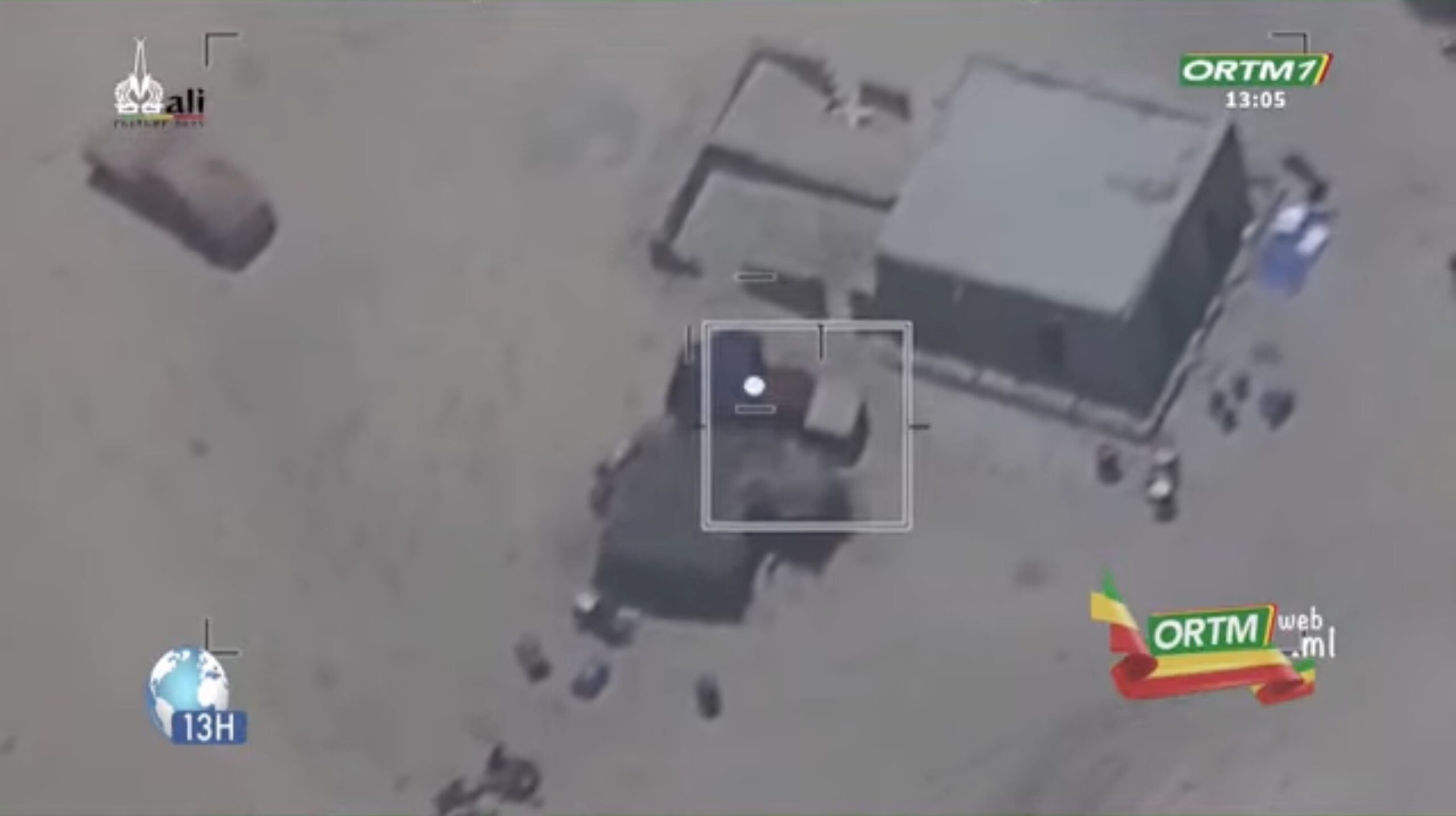
- Reporting supports civilian deaths in the Malian military’s drone strikes at Amasrakad in March 2024 and Zouera in July 2025. The evidence does not resolve whether Amasrakad casualty figures refer to the second strike or both strikes, or whether the Zouera strike hit a terrorist supply vehicle or the market where Médecins Sans Frontières reported casualties. (Confidence: medium · REPORTED)
- I&W: New independent medical or geolocated evidence specifies the casualty count and target location for either strike; evidence that materially revises the reported civilian deaths would weaken this judgment. (0-14 days)
- I&W: Malian authorities release strike records for Amasrakad or Zouera that can be compared with the existing witness, medical and geolocation reporting. (1-3 months)
- Russia’s Ministry of Defence is reported to have up to 2,000 Africa Corps troops training and fighting alongside the Malian military since late 2021, with hundreds stationed in Burkina Faso and Niger since 2024. These figures rest on think-tank reporting and are not independently corroborated in the available material. (Confidence: low · REPORTED)
- I&W: New official or independent reporting confirms or materially revises the reported Africa Corps presence in Mali, Burkina Faso or Niger, including the stated troop figures. (0-3 months)
- More than 300,000 Malian refugees are reported to be in south-eastern Mauritania without adequate access to healthcare, nutrition and education. This is a substantial reported humanitarian need, but the available material provides no independent confirmation of the count or current service gaps. (Confidence: low · REPORTED)
- I&W: An updated refugee registration or needs assessment confirms the reported population and continuing access gaps; a materially lower count or evidence of improved access would weaken this judgment. (0-3 months)
- The EU’s €195 million development aid envelope for Mali, Burkina Faso and Niger is reported to remain frozen over disputes between member states and DG INTPA. The report does not establish whether the funding status has changed since publication. (Confidence: low · REPORTED)
- I&W: An EU or DG INTPA status update confirms the envelope remains frozen or announces its release or reallocation. (0-3 months)
Outlook & scenarios
Continued security pressure in Mali (55%)
Likely over the next 1-3 months. Islamist and Tuareg-separatist militias continue to pose a threat, while FAMa drone operations remain a source of civilian-harm allegations. This is the leading scenario, but it rests on sparse and partly historical reporting.
Operational lull and unresolved reporting (30%)
Unlikely over the next 1-3 months. No corroborated repeat of the reported April 2026 multi-city attack appears, and the available evidence remains insufficient to show a sustained change in the security situation. Disputes over past strike casualties and targets remain unresolved.
Renewed coordinated attacks on multiple cities (15%)
Unlikely but high impact over the next 1-3 months. If the reported April 2026 account is accurate, renewed coordinated attacks by Islamist and Tuareg-separatist militias across multiple Malian cities, including Bamako, would mark a sharp deterioration.
Recommendations
- Prioritise independent verification of the reported April 2026 attacks, including the cities affected, the groups involved and the reported outcomes. Keep the incident provisional until corroborated.
- Compare FAMa’s descriptions of the Amasrakad and Zouera strikes with the available witness, medical and geolocation reporting. Keep the Amasrakad casualty scopes separate and do not treat the Zouera target characterisation as settled.
- Seek updated, independently sourced Africa Corps deployment figures for Mali, Burkina Faso and Niger before using the reported numbers in regional assessments.
- Request current registration and needs data for Malian refugees in south-eastern Mauritania, and check the status of healthcare, nutrition and education access.
- Verify the current status of the €195 million EU aid envelope with a dated EU or DG INTPA update before describing it as still frozen.
Confidence & uncertainty
Overall confidence is low because the central April 2026 attack account and the Africa Corps, refugee and EU funding figures rely on limited think-tank reporting without independent corroboration in the available material. The drone-strike reporting draws on several sources, including medical, investigative and witness accounts, but disputes remain over casualty scope and target characterisation. Most evidence concerns events before the current reporting window, so it does not establish the present operational tempo.
Alternative analysis (red cell)
The evidence establishes only that claim 4d1a2daa-5458-4c0f-94bb-557d1b65a139 reported a major attack in April 2026; it does not demonstrate continuing Islamist, Tuareg coordination or a sustained ability to attack major cities. A more defensible reading is that Mali experienced a reported episode of coordinated violence, while the likelihood of recurrence over the next 1-3 months remains indeterminate.
Intelligence gaps
- [EEI 1.1 · PARTIAL] Number, location, and scale of attacks (IEDs, ambushes, complex attacks) per week against towns, military bases, police posts, or convoys, with casualty and equipment-loss counts. Recommended collection: ground/HUMINT
- [EEI 1.2 · UNCOVERED] Observed movement and size of armed columns (vehicle counts, heavy weapons present) along approach routes to population centers or borders documented by imagery, local reporting, or border guards. Recommended collection: imagery/SATCOM
- [EEI 1.3 · UNCOVERED] Reports of occupation, administration, or imposition of checkpoints/taxes by armed groups in named towns, villages, markets, or on specified road segments. Recommended collection: OSINT (local media/social)
- [EEI 1.4 · UNCOVERED] Seizure or acquisition of heavy weapons or air-defense systems (mortars >81mm, artillery, armored vehicles, MANPADS) attributed to specific groups as evidenced by photos, captured weapons inventories, or weapons interdictions. Recommended collection: forensics/field reporting
- [EEI 2.1 · UNCOVERED] Internal security force movements: redeployment of army units, garrison withdrawals, or mass troop movements toward/away from capitals and regional command posts. Recommended collection: imagery/SATCOM
- [EEI 2.2 · UNCOVERED] Detentions, public dismissals, resignations, or public statements by senior military, police, or government officials indicating factional splits (named individuals, ranks, units). Recommended collection: diplomatic/OSINT
- [EEI 3.1 · UNCOVERED] Interdictions or seizures at borders/markets of weapons, ammunition, fuel, or contraband (type/quantity, seizure location, alleged origin/destination). Recommended collection: border/customs
- [EEI 3.2 · UNCOVERED] Recorded movements of known smuggling routes and convoy volumes: counts of commercial/privately registered vehicles and informal river crossings on specific cross-border corridors. Recommended collection: ground/HUMINT
- [EEI 3.3 · UNCOVERED] Monitored financial flows linked to illicit trade: large cash movements, changes in declared gold exports at named mines/ports, or arrests of money couriers with amounts and origins. Recommended collection: financial/forensics
- [EEI 3.4 · UNCOVERED] Observed changes at border security posts: closures, reductions in personnel, destroyed checkpoints, or documented agreements allowing free movement at named crossings. Recommended collection: imagery/OSINT
Red cell review: PARTIAL DISSENT
TLP:CLEAR