TLP:CLEAR · Disclosure is not limited.
Sahel Security Crisis: Mali Signals Remain Unclear
Time window: Last 7 days · Audience: General analyst · Type: Situation report · DTG: 2026-10-10 04:06Z · Overall confidence: LOW
BLUF
This reporting window adds no corroborated evidence of a change in territorial control in northern Mali. NASA FIRMS recorded 24 thermal detections in Mali over two days, but those detections show heat, not its cause; the prior assessment of durable state control around Kidal therefore remains unresolved.
Executive summary
The only timely Mali-specific operational signal in the current reporting is NASA FIRMS data showing 24 active fire or thermal detections, including five high-confidence detections, over the two days ending 9 October. The detections cover a broad area and do not identify whether the heat came from strikes, shelling, industrial fires or wildfires. Background reporting says the Azawad Liberation Front and JNIM seized parts of northern Mali in coordinated attacks during 2026, but this reporting window provides no new claim establishing current control or a fresh offensive. Earlier reports linked Malian military drone strikes at Zouera and Amasrakad to civilian deaths, though the Amasrakad toll is disputed and current strike activity is unconfirmed.
Change from previous assessment
This brief adds NASA FIRMS reporting of 24 thermal detections in Mali over the two days ending 9 October, including five high-confidence detections. Because the data do not establish cause, they do not change the prior assessment of Kidal: Malian forces' reported return remains distinct from verified durable state control. No new claim in this reporting window confirms or overturns the prior judgements on Kidal control, Burkina Faso or Niger.
Key judgments
- The 24 NASA FIRMS detections are evidence of recent heat anomalies in Mali, not evidence of a specific military action or its cause. NASA reported five high-confidence detections within the stated Mali detection area over the two days ending 9 October; the data limitation is explicit. (Confidence: medium · REPORTED)
- I&W: The next NASA FIRMS two-day product records further detections in the same Mali area, confirming that the thermal signal persisted. (0 to 14 days)
- I&W: NASA FIRMS revises or removes the reported 24 detections or their high-confidence classification. (0 to 14 days)
- The Azawad Liberation Front and JNIM are likely to retain the capacity to contest Malian state authority in parts of northern Mali, but current territorial control is not established by this reporting. The supporting account of their coordinated attacks and seizure of territory dates to 2026 and comes from a single NGO source, with no new location-specific reporting in this window. (Confidence: low · ASSESSED)
- I&W: Independent, dated reporting identifies the Azawad Liberation Front or JNIM holding or contesting named settlements in northern Mali. (0 to 14 days)
- I&W: Independent reporting verifies sustained Malian government-force presence in named northern settlements, with no reported loss of those positions. (1 to 3 months)
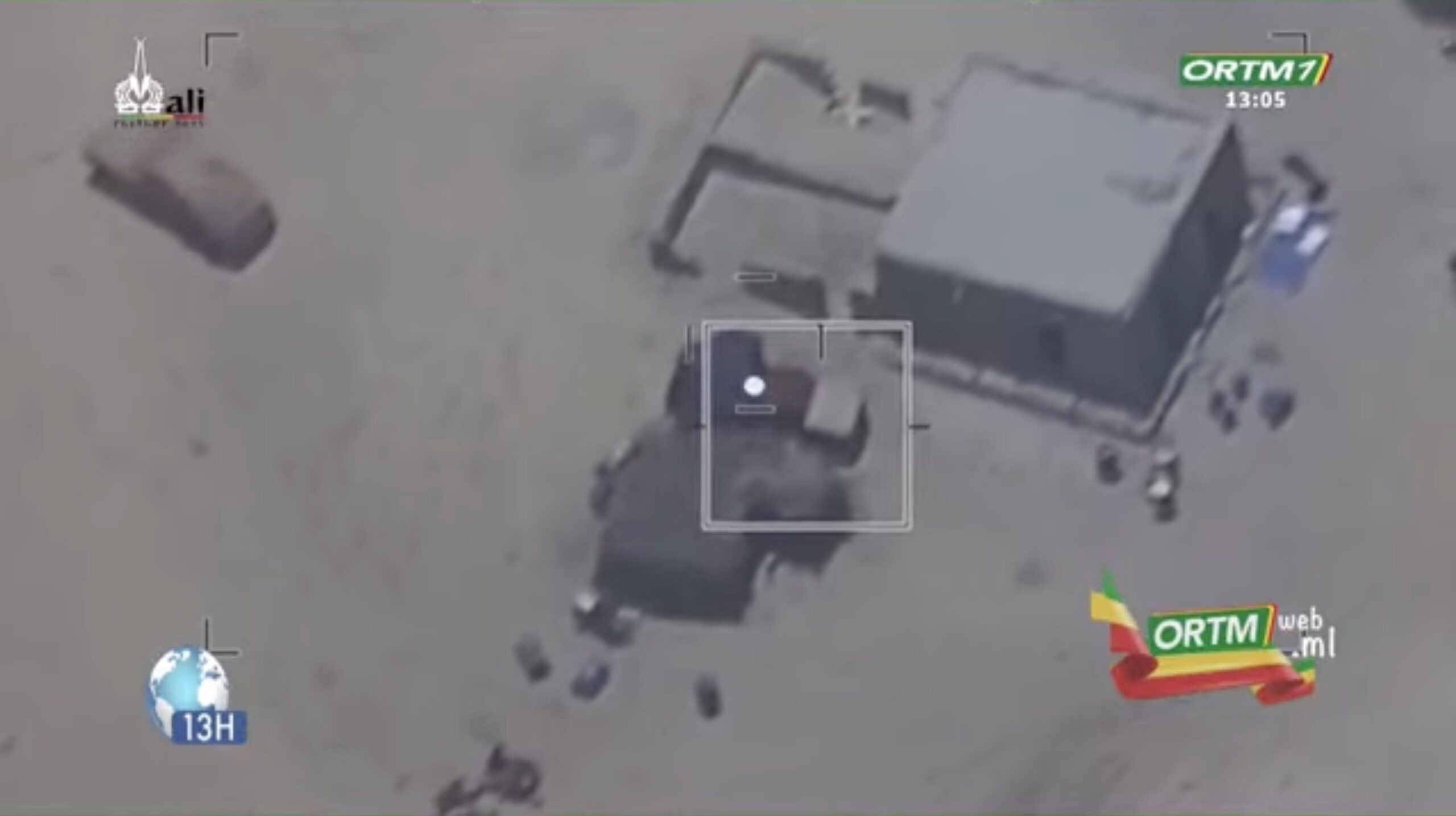
- Malian military drone strikes have been linked to civilian deaths in reporting on Zouera in July 2025 and Amasrakad in March 2024, but the Amasrakad casualty account is unresolved and current strike tempo is not established. The supporting reports include NGO and witness reporting; the Amasrakad accounts differ on whether 13 deaths occurred across two strikes or in the second strike alone. (Confidence: low · REPORTED)
- I&W: Independent reporting documents a new Malian military drone strike in Mali with civilian deaths. (1 to 3 months)
- I&W: An independent review of the Zouera and Amasrakad accounts revises the reported civilian casualty attribution or totals. (1 to 3 months)
Outlook & scenarios
Northern Mali remains contested (55%)
Over the next one to three months, the Azawad Liberation Front and JNIM retain the ability to contest Malian government authority in parts of northern Mali, without the available reporting establishing a decisive change in control. Thermal detections remain an ambiguous signal unless tied to specific events by independent reporting.
Malian forces consolidate control (25%)
Malian forces maintain or extend their presence in northern settlements, and subsequent reporting verifies sustained government control. This scenario would be supported by location-specific reporting over time, rather than thermal detections alone.
Low-probability, high-impact wildcard: renewed coordinated offensive (10%)
The Azawad Liberation Front and JNIM launch another coordinated offensive and seize additional territory in northern Mali. Earlier reporting describes coordinated attacks and territorial seizures, but this reporting window provides no evidence that a renewed offensive is under way.
Recommendations
- Treat NASA FIRMS detections as an alerting signal only. Require geolocated, independent reporting before attributing a detection to a strike, shelling or another conflict event.
- Track the Azawad Liberation Front, JNIM and Malian forces separately. Record the reported location, date and source for each control or presence claim before revising the Kidal assessment.
- Keep the Amasrakad casualty accounts distinct in reporting. Do not present a single death toll until the disagreement over the two strikes is resolved.
- Prioritise collection on current territorial control in northern Mali, since the supplied reporting does not verify durable control or a new offensive in this window.
Confidence & uncertainty
Overall confidence is low because the sole timely Mali-specific operational signal is a NASA FIRMS thermal record from a reliable official source that cannot identify the cause of the heat. The reporting on northern Mali control is a single NGO account without current location-specific corroboration. The civilian-harm reporting concerns earlier strikes and includes unresolved casualty reporting at Amasrakad. The current material does not update the Kidal control picture.
Alternative analysis (red cell)
The available evidence establishes reported past incidents, not a reliable current picture of militant capacity or military activity. In particular, the sole B3 account in claim 452174fb-a569-4b08-85e6-a04ea81391ea supports only that seizures were reported in 2026; it does not show that FLA or JNIM can still contest state authority now. A more conservative reading would treat present capacity as indeterminate pending current, independent reporting.
Intelligence gaps
- [EEI 1.1 · PARTIAL] Number, location, and scale of attacks (IEDs, ambushes, complex attacks) per week against towns, military bases, police posts, or convoys, with casualty and equipment-loss counts. Recommended collection: ground/HUMINT
- [EEI 1.2 · UNCOVERED] Observed movement and size of armed columns (vehicle counts, heavy weapons present) along approach routes to population centers or borders documented by imagery, local reporting, or border guards. Recommended collection: imagery/SATCOM
- [EEI 1.3 · PARTIAL] Reports of occupation, administration, or imposition of checkpoints/taxes by armed groups in named towns, villages, markets, or on specified road segments. Recommended collection: OSINT (local media/social)
- [EEI 1.4 · UNCOVERED] Seizure or acquisition of heavy weapons or air-defense systems (mortars >81mm, artillery, armored vehicles, MANPADS) attributed to specific groups as evidenced by photos, captured weapons inventories, or weapons interdictions. Recommended collection: forensics/field reporting
- [EEI 2.1 · PARTIAL] Internal security force movements: redeployment of army units, garrison withdrawals, or mass troop movements toward/away from capitals and regional command posts. Recommended collection: imagery/SATCOM
- [EEI 2.2 · UNCOVERED] Detentions, public dismissals, resignations, or public statements by senior military, police, or government officials indicating factional splits (named individuals, ranks, units). Recommended collection: diplomatic/OSINT
- [EEI 2.3 · UNCOVERED] Changes in foreign military footprints or security agreements: arrival/departure of foreign troops, opening/closure of foreign bases, visible presence of private military contractors (identified personnel/vehicles). Recommended collection: OSINT/imagery
- [EEI 2.4 · UNCOVERED] Targeted external support actions: sanctions, suspension of aid, delivery of weapons or logistics from foreign state or non-state actors (documented shipments, bank transfers, public announcements). Recommended collection: financial/diplomatic
- [EEI 3.1 · UNCOVERED] Interdictions or seizures at borders/markets of weapons, ammunition, fuel, or contraband (type/quantity, seizure location, alleged origin/destination). Recommended collection: border/customs
- [EEI 3.2 · UNCOVERED] Recorded movements of known smuggling routes and convoy volumes: counts of commercial/privately registered vehicles and informal river crossings on specific cross-border corridors. Recommended collection: ground/HUMINT
- [EEI 3.3 · UNCOVERED] Monitored financial flows linked to illicit trade: large cash movements, changes in declared gold exports at named mines/ports, or arrests of money couriers with amounts and origins. Recommended collection: financial/forensics
- [EEI 3.4 · UNCOVERED] Observed changes at border security posts: closures, reductions in personnel, destroyed checkpoints, or documented agreements allowing free movement at named crossings. Recommended collection: imagery/OSINT
Cited sources
[1] NASA FIRMS · NASA FIRMS thermal detections — Mali (2d) (A) · sha256:74792c079402 [2] Bellingcat · “A Recurring Pattern”: Civilians Paying the Price in Mali’s Drone Campaign - bellingcat (B) · 16 September 2026 · sha256:240eaaf5fb84
Source content hashes were computed at collection time; the cited text is preserved unmodified for the life of this product.
Red cell review: PARTIAL DISSENT
TLP:CLEAR