TLP:CLEAR · Disclosure is not limited.
Sahel Security Crisis: Niger Junta Holds as Military Fractures Persist
Time window: Last 7 days · Audience: General analyst · Type: Situation report · DTG: 2026-09-07 04:09Z · Overall confidence: HIGH
BLUF
General Abdourahamane Tchiani's junta very likely retains control of Niamey after the 29 August 2026 mutiny, with Russia's Africa Corps very likely providing direct assistance during the recapture of Air Base 101. The episode exposed unresolved grievances among Nigerien frontline units, while JNIM and ISSP-linked pressure across Niger, Mali and Burkina Faso is likely to persist over the next one to three months.
Executive summary
The Nigerien government and loyalist forces appear to have contained the 29 August mutiny that began at Air Base 101 in Niamey and reached areas near the Presidential Palace and state broadcaster. Russia's Africa Corps is reported to have supported the loyalist response, including through kamikaze drone use, although the division of responsibility between Russian personnel and Nigerien forces remains disputed. New reporting identifies frontline anti-terrorism units and soldiers from south-west Niger among the mutineers, reinforcing concerns about military cohesion. Across the wider Sahel, AES governments are deepening security ties with Russia while JNIM and ISSP-linked violence continues to pressure Niger, Mali and Burkina Faso.
Change from previous assessment
Since the 6 September 2026 brief, the core assessment that Tchiani retains control of Niamey is unchanged. New reporting more clearly identifies frontline anti-terrorism units and soldiers from south-west Niger among the mutineers, and adds reported salary levels below €150 per month for most Nigerien soldiers. The assessment of Russian assistance remains very likely, but confidence remains medium because the attribution conflict persists. The brief adds a judgment that AES collective-defence arrangements have not yet produced direct military assistance to Niger, despite deeper Russian security ties. No prior judgment has been retired.
Key judgments
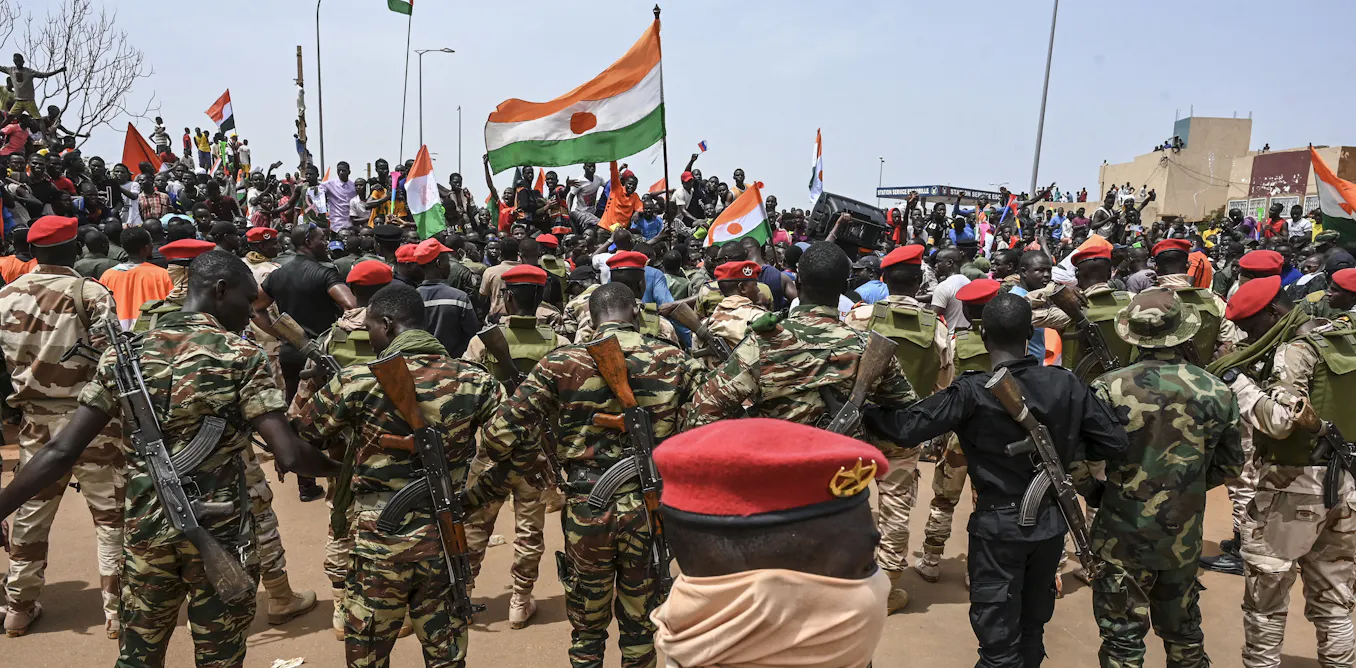
- General Abdourahamane Tchiani's junta very likely retains control of Niamey after the 29 August 2026 mutiny. Mutineers temporarily controlled Air Base 101 at Diori Hamani International Airport, and fighting reached areas near the Presidential Palace and state broadcaster, but Nigerien defence officials and other reporting state that loyalist forces regained control. The number of military facilities held by the mutineers remains disputed, with one account alleging control of three sites rather than Air Base 101 alone. (Confidence: high · ASSESSED)
- I&W: Continued operation of Niger's state broadcaster and repeated Nigerien defence ministry statements that loyalist forces control Air Base 101 within 0-14 days would confirm the assessment. (0-14 days)
- I&W: Renewed fighting or a verified mutineer presence at Air Base 101, the Presidential Palace or the state broadcaster within 0-14 days would break the assessment. (0-14 days)
- Russia's Africa Corps very likely provided direct assistance to Nigerien loyalist forces during the recapture of Air Base 101. Russia's ambassador reportedly acknowledged Russian help, while separate reporting attributes the use of kamikaze drones to Russian elements. The precise Russian role remains unresolved because another account credits Tchiani's loyalist forces alone with suppressing the mutiny. Confidence is medium because the Russian role is corroborated by several reports but the operational division of responsibility is contested. (Confidence: medium · ASSESSED)
- I&W: Independent imagery or reporting identifying Russian personnel or Russian-operated kamikaze drones at Air Base 101 during the 29 August operation within 0-14 days would confirm the assessment. (0-14 days)
- I&W: A credible, independently corroborated account stating that no Russian personnel or equipment took part in the recapture would break the assessment. (0-30 days)
- Nigerien armed forces likely remain vulnerable to renewed internal unrest over the next one to three months. The mutiny was reportedly led by frontline anti-terrorism units, included soldiers from insurgency-affected south-west Niger, and followed the 2025 Termit mutiny over poor conditions and inadequate supplies. Reported monthly pay below €150 for most Nigerien soldiers adds a persistent grievance. The evidence indicates institutional vulnerability, not a coordinated new coup plan. (Confidence: medium · ASSESSED)
- I&W: A new mutiny, refusal of orders by frontline anti-terrorism units, or detention of senior officers at Termit or another Nigerien garrison within 0-90 days would confirm the assessment. (0-90 days)
- I&W: A 1-3 month period without further military unrest, accompanied by independently documented resolution of the reported pay, supply and support grievances, would weaken the assessment. (1-3 months)
- Jihadist pressure is likely to persist across Niger, Mali and Burkina Faso over the next one to three months. In Niger, JNIM and ISSP-linked attacks have reached Niamey, including the airport, while violence has produced nearly 2,000 civilian and military casualties in 2025 and left communities in Tillabéri and Diffa exposed. In Mali, JNIM launched a major offensive on 25 April 2026 and is assessed to be preparing a broader attempt to take control of the country. Burkina Faso continues to experience frequent attacks against security forces and civilians. Confidence is medium because reporting on the number and geography of attacks on Niamey is inconsistent. (Confidence: medium · ASSESSED)
- I&W: A new attack attributed to JNIM or ISSP at Niamey airport, elsewhere in Niamey, or in Tillabéri or Diffa within 0-90 days would confirm the assessment. (0-90 days)
- I&W: No independently verified JNIM or ISSP attack in Niger, no new JNIM offensive activity in Mali, and a sustained decline in attacks against civilians and security forces in Burkina Faso over 1-3 months would weaken the assessment. (1-3 months)
- Africa Corps is unlikely to reverse JNIM's momentum in northern Mali over the next one to three months. Reporting describes setbacks in the campaign to roll back the jihadist advance, almost 80 Africa Corps or Russian fighters killed at Tinzaouaten, and continuing concern that JNIM is expanding its ambitions. The Malian army and Russian auxiliary forces have taken control of the artisanal gold mine at Intahaka, but this does not establish a wider reversal. This forward-looking assessment rests on thin, partly single-source reporting and remains low confidence. (Confidence: low · ASSESSED)
- I&W: A further JNIM seizure of a Malian military position or an attack that forces FAMa and Africa Corps units to withdraw from a northern position within 1-3 months would confirm the assessment. (1-3 months)
- I&W: Sustained FAMa and Africa Corps recapture of contested northern positions beyond Intahaka, with independently verified evidence of reduced JNIM control, within 1-3 months would break the assessment. (1-3 months)
- The Alliance of Sahel States is likely to deepen its political and military reliance on Russia while its collective-defence arrangements remain limited in practice. Burkina Faso, Mali and Niger have withdrawn from ECOWAS and turned increasingly to Russia and Africa Corps. The AES charter defines an attack on one member as an attack on all, yet Burkina Faso and Mali provided no direct ground assistance during the Niamey mutiny. Recent ECOWAS calls for renewed engagement create a competing diplomatic track. (Confidence: medium · ASSESSED)
- I&W: A new formal Russian security commitment to Niger, Mali or Burkina Faso, or another reported deployment of Russian personnel to support an AES government, within 0-90 days would confirm the assessment. (0-90 days)
- I&W: Burkina Faso or Mali sending direct ground forces to support Niger, or ECOWAS and AES governments opening a formal security dialogue with agreed measures, within 1-3 months would weaken the assessment that Russian reliance is deepening while collective defence remains limited. (1-3 months)
Outlook & scenarios
Contained junta and Russian-backed consolidation (50%)
Over the next one to three months, General Abdourahamane Tchiani retains control of Niamey, Africa Corps remains an important security partner, and the Nigerien government contains the immediate military fracture. JNIM and ISSP-linked attacks continue in peripheral areas, particularly Tillabéri and Diffa, while AES coordination remains primarily political rather than a direct military response.
Renewed military unrest in Niger (28%)
Pay, supply and support grievances among frontline anti-terrorism units generate another mutiny or detention of senior officers at Termit or another garrison. Tchiani retains the capital, but a second episode forces greater reliance on Africa Corps and further exposes the gap between Niger's internal security demands and its military capacity.
Insurgent expansion in Mali increases pressure on the AES (18%)
JNIM sustains its advance in Mali and Africa Corps and FAMa fail to reverse the setbacks reported at Tinzaouaten and elsewhere in the north. Attacks in Burkina Faso continue, forcing the three AES governments to divert resources from regime security and increasing pressure for additional Russian support.
High-impact compound crisis (4%)
A new JNIM or ISSP attack reaches Niamey while another Nigerien military faction challenges Tchiani. The combination of an urban jihadist attack and internal military fracture overwhelms the junta's existing security arrangements and prompts an emergency response involving Africa Corps and neighbouring AES governments.
Recommendations
- For the next 14 days, prioritise independent reporting on Air Base 101, the Presidential Palace and Niger's state broadcaster. Separate the Nigerien government's mutiny description from external accounts describing an attempted coup.
- Track Russian assistance through three distinct indicators: identified Africa Corps personnel in Niamey, evidence of Russian-operated drones, and public statements by Russia's ambassador or Nigerien authorities. Do not treat loyalist success as proof that Russian forces acted alone.
- Maintain a military-cohesion watchlist covering frontline anti-terrorism units, soldiers from south-west Niger, the Termit garrison and reported pay or supply grievances. Flag any detention of senior officers or refusal of orders as an early warning.
- Prioritise collection on JNIM and ISSP-linked activity around Niamey airport, Tillabéri and Diffa, and on JNIM operations in northern Mali. Track attacks against civilians and security forces in Burkina Faso separately because the available reporting does not consistently identify the responsible group.
- Assess whether ECOWAS engagement proposals led by General Birame Diop, Omar Touray and Ambassador Sola Enikanolaiye produce formal contact with Burkina Faso, Mali and Niger. Compare any diplomatic opening with evidence of new Russian security commitments.
- Keep the northern Mali assessment at low confidence until reporting independently confirms whether the Malian army and Africa Corps are holding or expanding beyond Intahaka and whether JNIM is gaining or losing territory.
Confidence & uncertainty
Overall confidence is high for the core account that the 29 August mutiny disrupted Air Base 101 and sensitive sites in Niamey, but that Tchiani's loyalist authorities regained control. Major-media, academic, local-media and think-tank reporting broadly corroborates the event sequence, and several reports support Russian involvement. The main uncertainties concern the number of military facilities held by mutineers, the precise division of responsibility between Nigerien loyalists and Africa Corps, the inconsistent count of attacks on Niamey, and the limited evidence for the forward-looking assessment on Africa Corps performance in northern Mali.
Intelligence gaps
- [EEI 1.1 · PARTIAL] Number, location, and scale of attacks (IEDs, ambushes, complex attacks) per week against towns, military bases, police posts, or convoys, with casualty and equipment-loss counts. Recommended collection: ground/HUMINT
- [EEI 1.2 · UNCOVERED] Observed movement and size of armed columns (vehicle counts, heavy weapons present) along approach routes to population centers or borders documented by imagery, local reporting, or border guards. Recommended collection: imagery/SATCOM
- [EEI 1.3 · UNCOVERED] Reports of occupation, administration, or imposition of checkpoints/taxes by armed groups in named towns, villages, markets, or on specified road segments. Recommended collection: OSINT (local media/social)
- [EEI 1.4 · UNCOVERED] Seizure or acquisition of heavy weapons or air-defense systems (mortars >81mm, artillery, armored vehicles, MANPADS) attributed to specific groups as evidenced by photos, captured weapons inventories, or weapons interdictions. Recommended collection: forensics/field reporting
- [EEI 2.1 · PARTIAL] Internal security force movements: redeployment of army units, garrison withdrawals, or mass troop movements toward/away from capitals and regional command posts. Recommended collection: imagery/SATCOM
- [EEI 2.4 · PARTIAL] Targeted external support actions: sanctions, suspension of aid, delivery of weapons or logistics from foreign state or non-state actors (documented shipments, bank transfers, public announcements). Recommended collection: financial/diplomatic
- [EEI 3.1 · UNCOVERED] Interdictions or seizures at borders/markets of weapons, ammunition, fuel, or contraband (type/quantity, seizure location, alleged origin/destination). Recommended collection: border/customs
- [EEI 3.2 · UNCOVERED] Recorded movements of known smuggling routes and convoy volumes: counts of commercial/privately registered vehicles and informal river crossings on specific cross-border corridors. Recommended collection: ground/HUMINT
- [EEI 3.3 · PARTIAL] Monitored financial flows linked to illicit trade: large cash movements, changes in declared gold exports at named mines/ports, or arrests of money couriers with amounts and origins. Recommended collection: financial/forensics
- [EEI 3.4 · UNCOVERED] Observed changes at border security posts: closures, reductions in personnel, destroyed checkpoints, or documented agreements allowing free movement at named crossings. Recommended collection: imagery/OSINT
TLP:CLEAR