TLP:CLEAR · Disclosure is not limited.
Sahel Security Crisis: Persistent Insurgent Pressure and Unresolved Malian Control
Time window: Last 7 days · Audience: General analyst · Type: Situation report · DTG: 2026-08-22 04:05Z · Overall confidence: HIGH
BLUF
Very likely JNIM will continue to pressure Malian security forces, while Islamic groups will retain substantial control in Burkina Faso and sustain severe humanitarian stress. Likely Burkina Faso, Mali and Niger will preserve their Alliance of Sahel States alignment and Russia-oriented defence ties. The latest Mali-specific signal, four NASA thermal anomalies recorded over two days ending 21 August, does not identify a strike or actor.
Executive summary
The supplied reporting indicates persistent insurgent pressure across Mali and Burkina Faso, with JNIM assessed to command 7,000 to 8,000 fighters, about half operating in Mali, and Islamic groups continuing to control large areas of Burkina Faso. The Burkina Faso insurgency has displaced more than 2 million people, caused at least 20,000 civilian and combatant deaths, and contributed to severe food insecurity and intercommunal violence. Bellingcat and Jeune Afrique verified two Shahed-136 type drone strikes at Inafarak and Talahandak in Mali, but Russian manufacture and the chain of command remain unconfirmed. Burkina Faso, Mali and Niger are likely to maintain their AES alignment and preference for non-Western security cooperation. Reported releases by the FLA, ISSP and the Malian junta have reduced the immediate number of known captives, but the supplied reporting does not establish the wider captivity picture.
Change from previous assessment
Since 21 August, the core assessment is unchanged: JNIM remains a direct threat to Malian security positions, Islamic groups retain broad control in Burkina Faso, and AES alignment with Russia remains likely. This brief refines the captivity assessment with reporting that the FLA released 82 FAMa soldiers, the Malian junta released a French intelligence agent and ISSP released Kevin Rideout. The current reporting also adds four NASA thermal anomalies recorded in Mali on 21 August, but does not resolve whether they reflect combat activity. The San battlefield outcome, the wider status of Malian captives, and Russian manufacture and command of the Shahed-136 type drones remain unresolved.
Key judgments
- Very likely JNIM will continue pressuring Malian security forces over the next 1 to 3 months. JNIM is considered the most dangerous jihadist organisation in West Africa, is assessed to command between 7,000 and 8,000 fighters with about half operating in Mali, and has been linked to major offensives with Tuareg separatists. Reporting also identifies JNIM as exploiting areas where the Malian state has inadequate presence. Confidence is medium because the fighter estimate and the account of the April 2026 offensive rely on limited-source reporting, although separate reporting supports JNIM's regional threat and operational presence. (Confidence: medium · ASSESSED)
- I&W: JNIM claims, or independent reporting attributes to JNIM, a new attack on a named FAMa position, convoy or fuel route in Mali, with the location and date corroborated by imagery or multiple outlets. (0-14 days)
- I&W: Malian authorities and independent reporting document uninterrupted resupply and government access to named positions in central or northern Mali, with no JNIM attack claim in those areas. (1-3 months)
- Very likely Islamic groups will continue holding large areas of Burkina Faso and driving humanitarian pressure over the next 1 to 3 months. Reporting states that Islamic groups retain control of large areas, while the insurgency has displaced more than 2 million people, caused at least 20,000 civilian and combatant deaths, and contributed to severe food insecurity and intercommunal violence. Confidence is medium because the territorial-control and humanitarian figures use broad or unspecified timeframes and do not establish the current operational tempo. (Confidence: medium · ASSESSED)
- I&W: New reporting identifies Islamic groups retaining control of named areas in northern Burkina Faso and records further displacement or closure of public services. (0-30 days)
- I&W: Burkinabè authorities or independent monitors document sustained state access across previously contested northern areas alongside a measurable fall in displacement or food insecurity. (1-3 months)
- Likely Burkina Faso, Mali and Niger will maintain their AES alignment and Russia-oriented defence ties through the next 3 months. The three states form the AES, have left ECOWAS, and have reduced or ended military relations with Western powers. Burkina Faso has strengthened security cooperation with Mali, Niger and Russia, while Russian forces and Africa Corps have supported FAMa operations in Mali. Confidence is medium because the evidence is well established historically but does not demonstrate a new deployment or agreement during the reporting period. (Confidence: medium · ASSESSED)
- I&W: The AES governments issue a joint security statement or conclude new military cooperation with Russia or Africa Corps, while none restores a military agreement with France or the US. (1-3 months)
- I&W: Burkina Faso, Mali or Niger publicly restores a Western military agreement, or the AES formally reopens military relations with ECOWAS. (0-3 months)
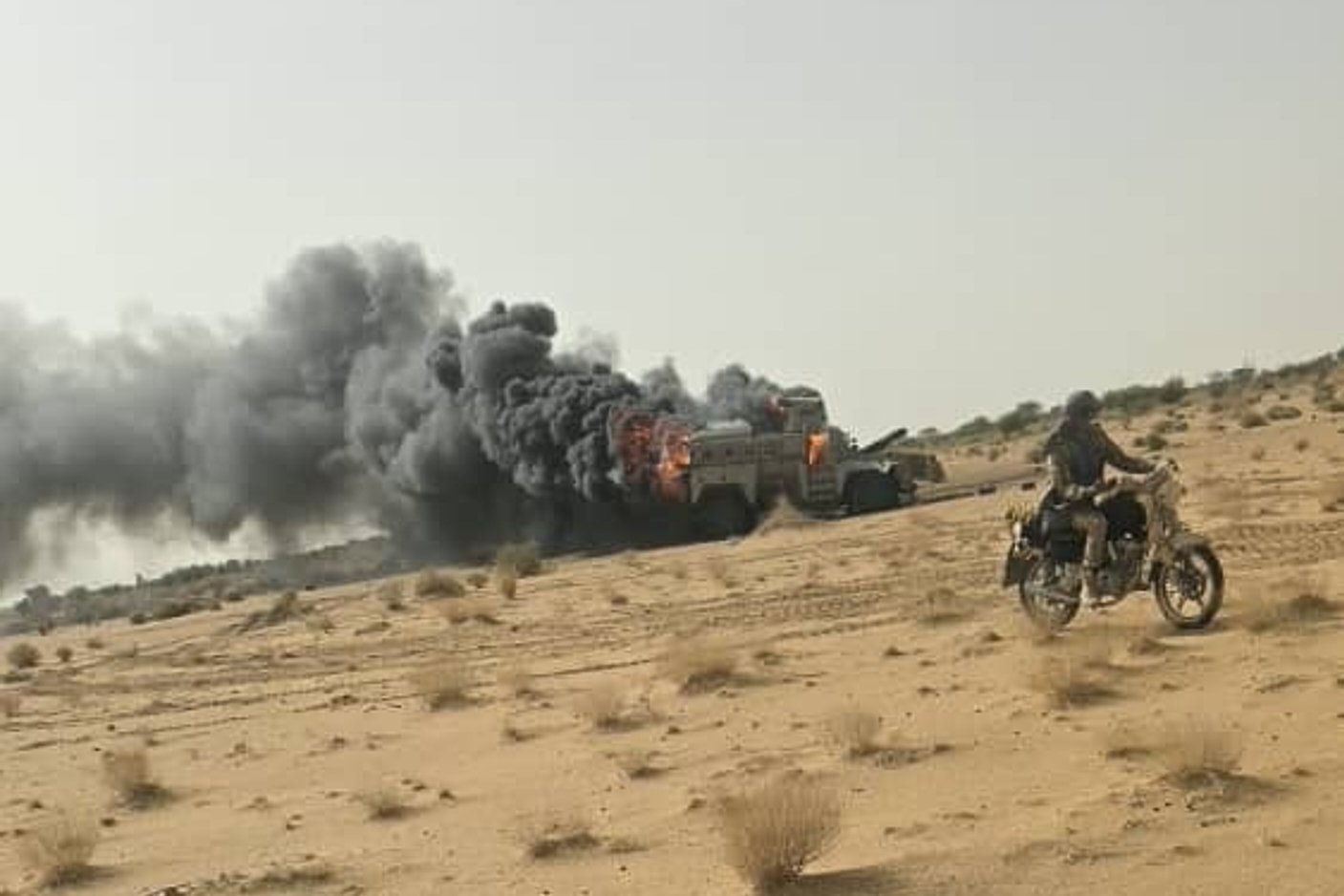
- Likely Africa Corps and FAMa have access to and have employed Shahed-136 type drones in Mali. Bellingcat geolocated operational footage and verified strikes at Inafarak and Talahandak, while a drone expert assessed that the platform provides a long-range strike capability for Africa Corps and FAMa. Russian manufacture is likely, but remains unconfirmed, as does the precise chain of command. Confidence is medium for drone use and low for manufacture and operational control because the evidence is concentrated in a limited OSINT reporting stream and includes expert inference. (Confidence: medium · ASSESSED)
- I&W: Independent OSINT geolocates another Shahed-136 type strike in Mali and links the launch, recovery or support site to Africa Corps or FAMa. (0-3 months)
- I&W: A technical review identifies the Inafarak and Talahandak platforms as another drone type, or Bellingcat withdraws the geolocation of either strike. (0-3 months)
- Likely the reported releases on 11 August reduced the immediate number of known captives held by armed groups in Mali, but very unlikely they signal a broad reduction in hostage-taking. The FLA released 82 FAMa soldiers, the Malian junta released a French intelligence agent, and ISSP released US citizen Kevin Rideout. Confidence is low because the releases rely on medium-confidence reporting from a limited source stream, and no supplied claim establishes the total number of remaining captives or a trend in captures. (Confidence: low · ASSESSED)
- I&W: The FLA, ISSP or Malian authorities confirm additional named captive releases without a new ransom or exchange announcement. (0-30 days)
- I&W: The FLA, ISSP, JNIM or Malian authorities report a new capture, ransom demand or detention of a named military or foreign national. (0-30 days)
- Very likely the four NASA VIIRS thermal anomalies recorded in Mali over the two days ending 21 August do not, by themselves, establish a new combat event or identify an actor. Two detections were assessed as high confidence, but NASA states that thermal signatures record heat and do not establish whether the cause was a strike, shelling, an industrial fire or a wildfire. Confidence is high because the observation and the methodological limitation come from an official source. (Confidence: high · REPORTED)
- I&W: Follow-on NASA or independent imagery continues to record heat detections without identifying a cause or actor. (0-14 days)
- I&W: Geolocated imagery and named local reporting identify one of the detections as a strike by JNIM, FAMa or Africa Corps. (0-14 days)
Outlook & scenarios
Persistent insurgent pressure and humanitarian deterioration (60%)
Over the next 1 to 3 months, JNIM sustains attacks and coercive pressure in Mali while Islamic groups retain large areas of Burkina Faso. The AES governments preserve their Russia-oriented security alignment. Displacement, food insecurity and service disruption in Burkina Faso remain severe.
Tactical Malian security adaptation (30%)
The Malian junta centralises defence responsibilities under General Assimi Goita and uses FAMa and Africa Corps access to long-range drone capability to contest JNIM and Tuareg groups. The adaptation produces local tactical gains without resolving the wider gaps in state presence or the territorial challenge.
Institutional and security fragmentation in Mali (20%)
Renewed JNIM and Tuareg pressure combines with internal strain, including periodic purges and contested state presence, pushing Mali towards deeper institutional and security fragmentation. The AES alignment remains politically intact while security control becomes less coherent.
Low-probability, high-impact captivity crisis (8%)
A new capture of a foreign national or senior Malian soldier by JNIM, ISSP or the FLA follows the reported releases and creates a wider political crisis for the Malian junta. The episode would raise pressure on Mali's external relationships and complicate the status of existing captives.
Recommendations
- Treat Inafarak and Talahandak as priority OSINT targets. Seek independent imagery, debris analysis, launch or recovery-site evidence and unit-level attribution before assigning the Shahed-136 type platform to Russia, Africa Corps or FAMa.
- Maintain separate activity tracks for JNIM, the FLA, ISSP, other Tuareg separatists, FAMa and Africa Corps. Do not infer coordination from simultaneous activity, shared opposition to the Malian junta or separate captive releases.
- Build a 90-day AES alignment tracker covering joint statements by Burkina Faso, Mali and Niger, Russian or Africa Corps deployments, and any restoration of military relations with France, the US or ECOWAS.
- Use Burkina Faso's displacement, food insecurity and public-service access as operational indicators alongside battlefield reporting. Request updates by named northern area rather than relying on national-level totals.
- Keep the San battlefield outcome and the wider number of Malian captives as unresolved collection gaps. Separate official Malian claims, armed-group claims and independently corroborated reporting in future updates.
- Do not treat NASA thermal detections as evidence of a JNIM, FAMa or Africa Corps strike without corroborating imagery or local reporting. Record the four detections and the two high-confidence detections as activity cues only.
Confidence & uncertainty
Overall confidence is high for the broad assessment that armed-group activity, humanitarian stress and non-Western security alignment remain central features of the Sahel crisis. The assessment draws on multiple official, multilateral, major-media and OSINT sources, including NASA thermal data, Bellingcat geolocation, reporting on JNIM and Burkina Faso, and established accounts of AES security ties. Confidence is lower for battlefield outcomes, the total number of captives, Russian manufacture of the Shahed-136 type drones and the chain of command for their use.
Intelligence gaps
- [EEI 1.1 · PARTIAL] Number, location, and scale of attacks (IEDs, ambushes, complex attacks) per week against towns, military bases, police posts, or convoys, with casualty and equipment-loss counts. Recommended collection: ground/HUMINT
- [EEI 1.2 · UNCOVERED] Observed movement and size of armed columns (vehicle counts, heavy weapons present) along approach routes to population centers or borders documented by imagery, local reporting, or border guards. Recommended collection: imagery/SATCOM
- [EEI 1.3 · UNCOVERED] Reports of occupation, administration, or imposition of checkpoints/taxes by armed groups in named towns, villages, markets, or on specified road segments. Recommended collection: OSINT (local media/social)
- [EEI 1.4 · UNCOVERED] Seizure or acquisition of heavy weapons or air-defense systems (mortars >81mm, artillery, armored vehicles, MANPADS) attributed to specific groups as evidenced by photos, captured weapons inventories, or weapons interdictions. Recommended collection: forensics/field reporting
- [EEI 2.1 · UNCOVERED] Internal security force movements: redeployment of army units, garrison withdrawals, or mass troop movements toward/away from capitals and regional command posts. Recommended collection: imagery/SATCOM
- [EEI 2.2 · PARTIAL] Detentions, public dismissals, resignations, or public statements by senior military, police, or government officials indicating factional splits (named individuals, ranks, units). Recommended collection: diplomatic/OSINT
- [EEI 3.1 · UNCOVERED] Interdictions or seizures at borders/markets of weapons, ammunition, fuel, or contraband (type/quantity, seizure location, alleged origin/destination). Recommended collection: border/customs
- [EEI 3.2 · UNCOVERED] Recorded movements of known smuggling routes and convoy volumes: counts of commercial/privately registered vehicles and informal river crossings on specific cross-border corridors. Recommended collection: ground/HUMINT
- [EEI 3.3 · PARTIAL] Monitored financial flows linked to illicit trade: large cash movements, changes in declared gold exports at named mines/ports, or arrests of money couriers with amounts and origins. Recommended collection: financial/forensics
- [EEI 3.4 · UNCOVERED] Observed changes at border security posts: closures, reductions in personnel, destroyed checkpoints, or documented agreements allowing free movement at named crossings. Recommended collection: imagery/OSINT
Cited sources
[1] Al-Estiklal Newspaper · Al-Estiklal Newspaper (B) · sha256:f72703407b23 [2] alamanahdaily.wordpress.com · Inside The AES: REPRESSION, PROPAGANDA, AND THE RISE OF MILITANCY (D) · sha256:8bed8f69074c [3] cescube.com · Between the Desert and the Savannah: Conflict and the Political Economy of Instability in the Sahel (C) · sha256:a7cb52da6e74 [4] Atlantic Council · How to push back against Mali's propagandists? Help factual creators go viral. (D) · sha256:fc915ab7ca87 [5] Wikipedia · Islamist insurgency in Burkina Faso (B) · sha256:f41ca0e4d597 [6] Wikipedia · Alliance of Sahel States (A) · sha256:c4c15ca3bf5c [7] bellingcat.com · Shahed-Type Drones Filmed During Mali Village Attacks - bellingcat (A) · sha256:83cab117dd5c [8] thesoufancenter.org · How Stable is Mali’s Junta? (C) · sha256:bf7127a8c112 [9] NASA · NASA FIRMS thermal detections — Mali (2d) (A) · sha256:c61e32e1c8e6
Source content hashes were computed at collection time; the cited text is preserved unmodified for the life of this product.
Red cell review: CONCUR WITH COMMENT
TLP:CLEAR