TLP:CLEAR · Disclosure is not limited.
Sahel security: external engagement and unverified force claims
Time window: Last 7 days · Audience: General analyst · Type: Situation report · DTG: 2026-11-24 04:05Z · Overall confidence: HIGH
BLUF
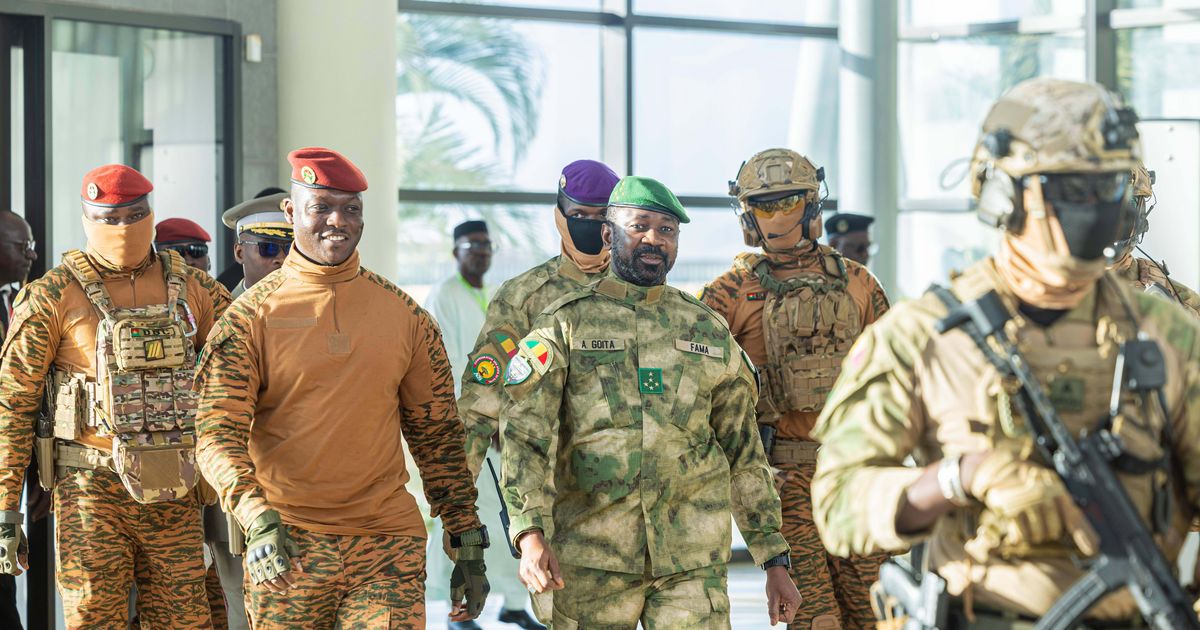
The reporting points to continued security engagement around Mali and Niger, but does not establish a new regional operation. AFRICOM commander Gen. Dagvin Anderson discussed JNIM and Islamic State in the Sahel with Mali's Transition President Assimi Goïta on 10 November; separate, single-source reporting says Algeria authorised army units to enter Niger, without confirming that they crossed the border.
Executive summary
The supplied reporting records Anderson's 10 November meeting with Goïta and their discussion of JNIM and Islamic State in the Sahel. It also includes a report that Algerian President Abdelmadjid Tebboune authorised army units to enter Niger in late October, but does not establish that units crossed or specify their mission. A separate report says Ibrahim Traoré controls less than half of Burkina Faso, without a geographical breakdown. The AES's political value to the juntas and its regional security output remain assessments by one analyst, not independently demonstrated operational findings. The UK FCDO appointed Catherine Mary Inglehearn ambassador to Mali, with her appointment due to begin in February 2027.
Change from previous assessment
The prior brief focused on the reported effects of the 21 November clashes in Niono and the attack in Arabebe. The present source set adds reporting on Anderson's 10 November meeting with Goïta, the reported Algerian authorisation concerning Niger, and the claim about Traoré's territorial control in Burkina Faso. These are newly included reports, not necessarily events that occurred after the prior brief; the Algeria claim is dated to late October and Anderson's meeting to 10 November. The AES question is retained, with political value to the juntas separated from regional security output. No settled prior forecast outcomes were provided for recalibration.
Key judgments
- US-Mali security contact at senior level is likely to continue, but the available reporting does not establish a new operational commitment. AFRICOM commander Gen. Dagvin Anderson met Transition President Assimi Goïta in Bamako on 10 November and discussed confronting JNIM and Islamic State in the Sahel; the account does not report an agreement, force deployment or joint operation. (Confidence: medium · ASSESSED)
- I&W: A further meeting involving named US and Malian officials is announced, confirming continued senior-level contact. (0-3 months)
- I&W: AFRICOM or Mali announces a signed security arrangement, joint exercise or operation with named participating units, breaking the assessment that no new operational commitment is established. (0-3 months)
- Algeria is likely seeking a more active security role in Niger, but the available reporting does not confirm that Algerian army units crossed the border. A report says Abdelmadjid Tebboune authorised their entry at the end of October; related reporting says Algeria restored diplomatic representation with Niamey and had sent military aircraft to Niamey, but provides no unit, route, force size or mission. The reporting is single-source and its chronology and purpose are not independently verified. (Confidence: low · ASSESSED)
- I&W: An Algerian or Nigerien official statement identifies an Algerian unit, its entry point and its mission in Niger, confirming an actual deployment. (0-30 days)
- I&W: An official statement says the authorisation was not implemented or that no Algerian units entered Niger, breaking the deployment inference. (0-30 days)
- A report published on 24 November says Ibrahim Traoré controls less than half of Burkina Faso, but the supplied material does not independently establish the estimate or map which areas it covers. This is single-source reporting and should not be treated as a verified measure of territorial control. (Confidence: low · REPORTED)
- I&W: A second dated territorial assessment maps named provinces or communes and also places government control below half of Burkina Faso, confirming the estimate. (1-3 months)
- I&W: A comparable assessment maps government administration across more than half of Burkina Faso, breaking the estimate. (1-3 months)
- The AES is likely to retain political value for the juntas in Burkina Faso, Mali and Niger while producing little reported regional security output in the near term. Denis Tull describes the alliance as a pillar of junta power but also says it has little to show as a regional organisation; both assessments come from the same analyst, and the supplied claims document no joint security operation. (Confidence: low · ASSESSED)
- I&W: An AES communiqué from Burkina Faso, Mali and Niger sets out a common political position, confirming continued political coordination. (1-3 months)
- I&W: The AES announces a dated joint operation with named participating forces and locations, breaking the assessment of little reported regional security output. (1-3 months)
Outlook & scenarios
Security engagement remains mainly diplomatic (60%)
This is the most likely near-term course. US-Mali senior-level contact continues, but no new operational commitment is announced. The reported Algerian authorisation remains unverified, with no public confirmation of an army entry into Niger.
Algeria confirms a limited security deployment in Niger (30%)
Algeria or Niger publicly confirms that Algerian army units entered Niger under the reported authorisation. A named mission or location would clarify whether this represents a limited security role or a broader change in regional military involvement.
Contested Algerian deployment creates a regional diplomatic dispute (10%)
This is a low-probability, high-impact wildcard. Algerian units enter Niger without a clearly stated or accepted mandate, prompting a public dispute involving Algeria and one or more Sahel governments. The supplied reporting does not establish that this is occurring.
Recommendations
- Treat the report of Algerian army entry into Niger as unverified. Seek statements from Algiers and Niamey that distinguish authorisation from actual entry, and identify any units, locations and stated mission.
- Track follow-on US-Mali engagement. Record any announced agreement, exercise or operation separately from meetings and statements, and require named participants or units before assessing an operational change.
- Do not use the under-half estimate for Burkina Faso as a settled territorial-control figure. Seek a dated map or assessment that identifies the areas included and the method used.
- Assess the AES on two separate tracks: evidence of political coordination among Burkina Faso, Mali and Niger, and evidence of joint security activity with named forces, dates and locations.
Confidence & uncertainty
Overall confidence is high for the core reported diplomatic events: the UK FCDO directly announced the ambassadorial appointment, and AFRICOM provided an account of Anderson's meetings. That headline confidence does not apply equally to every judgment. The Algerian entry authorisation and Burkina Faso territorial estimate lack independent corroboration in the supplied material, while the AES assessment rests on one analyst. These are the principal uncertainties.
Alternative analysis (red cell)
The supplied material does not establish a durable US-Mali security channel or an Algerian policy shift toward a more active security role in Niger. It shows one US-Mali meeting and several low-reliability, chronologically unresolved indications of Algerian engagement, which may reflect diplomatic activity or logistical support rather than sustained security commitments. The AES assessment is more defensible because political utility and limited regional output are not mutually exclusive, although both rest on the same low-confidence source.
Intelligence gaps
- [EEI 1.1 · PARTIAL] Number, location, and scale of attacks (IEDs, ambushes, complex attacks) per week against towns, military bases, police posts, or convoys, with casualty and equipment-loss counts. Recommended collection: ground/HUMINT
- [EEI 1.2 · UNCOVERED] Observed movement and size of armed columns (vehicle counts, heavy weapons present) along approach routes to population centers or borders documented by imagery, local reporting, or border guards. Recommended collection: imagery/SATCOM
- [EEI 1.3 · UNCOVERED] Reports of occupation, administration, or imposition of checkpoints/taxes by armed groups in named towns, villages, markets, or on specified road segments. Recommended collection: OSINT (local media/social)
- [EEI 1.4 · UNCOVERED] Seizure or acquisition of heavy weapons or air-defense systems (mortars >81mm, artillery, armored vehicles, MANPADS) attributed to specific groups as evidenced by photos, captured weapons inventories, or weapons interdictions. Recommended collection: forensics/field reporting
- [EEI 2.1 · PARTIAL] Internal security force movements: redeployment of army units, garrison withdrawals, or mass troop movements toward/away from capitals and regional command posts. Recommended collection: imagery/SATCOM
- [EEI 2.2 · UNCOVERED] Detentions, public dismissals, resignations, or public statements by senior military, police, or government officials indicating factional splits (named individuals, ranks, units). Recommended collection: diplomatic/OSINT
- [EEI 2.3 · PARTIAL] Changes in foreign military footprints or security agreements: arrival/departure of foreign troops, opening/closure of foreign bases, visible presence of private military contractors (identified personnel/vehicles). Recommended collection: OSINT/imagery
- [EEI 2.4 · UNCOVERED] Targeted external support actions: sanctions, suspension of aid, delivery of weapons or logistics from foreign state or non-state actors (documented shipments, bank transfers, public announcements). Recommended collection: financial/diplomatic
- [EEI 3.1 · UNCOVERED] Interdictions or seizures at borders/markets of weapons, ammunition, fuel, or contraband (type/quantity, seizure location, alleged origin/destination). Recommended collection: border/customs
- [EEI 3.2 · UNCOVERED] Recorded movements of known smuggling routes and convoy volumes: counts of commercial/privately registered vehicles and informal river crossings on specific cross-border corridors. Recommended collection: ground/HUMINT
- [EEI 3.3 · UNCOVERED] Monitored financial flows linked to illicit trade: large cash movements, changes in declared gold exports at named mines/ports, or arrests of money couriers with amounts and origins. Recommended collection: financial/forensics
- [EEI 3.4 · UNCOVERED] Observed changes at border security posts: closures, reductions in personnel, destroyed checkpoints, or documented agreements allowing free movement at named crossings. Recommended collection: imagery/OSINT
Red cell review: PARTIAL DISSENT
TLP:CLEAR