TLP:CLEAR · Disclosure is not limited.
Sahel SITREP: Intensified Jihadist Operations in Mali and Burkina Faso, July 2026
Time window: Last 7 days · Audience: General analyst · Type: Situation report · DTG: 2026-07-17 12:14Z · Overall confidence: MEDIUM
BLUF
Jihadist groups are expanding their operational reach and tempo across Mali and Burkina Faso, with coordinated strikes in Mali on 4 July and continued attacks in Burkina Faso’s north and east. The fight in Mali is shifting to attrition against roads and power, and control in the north remains fluid despite the reported recapture of Anfis.
Executive summary
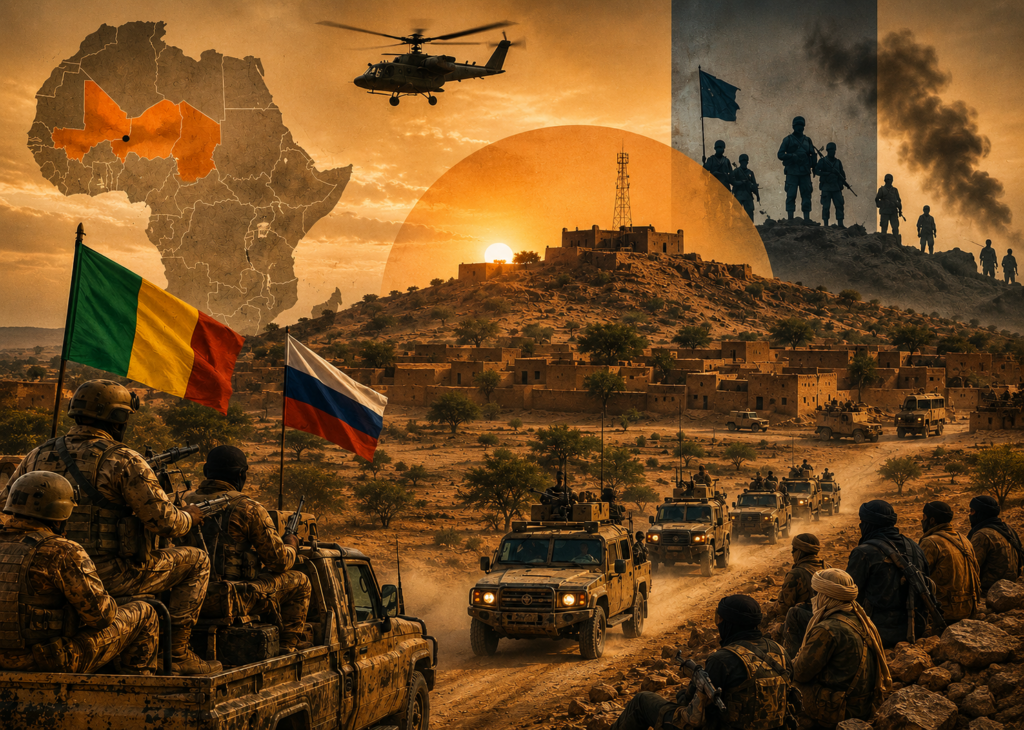
Open reporting points to a worsening security picture across the central Sahel in 2026. Burkina Faso’s northern and eastern regions continue to absorb attacks, at times involving drones. In Mali, coordinated strikes on 4 July hit multiple locations including Anfis and Kenioroba, and subsequent fighting around Anfis ran for days. The conflict is moving toward interdiction of movement and logistics, with partial road blockades restricting supplies to Bamako alongside attacks on power lines. Control in northern Mali remains contested: Kidal was reported under Azawad Liberation Front control by 25 April, while the Malian army later announced the full recapture of Anfis by 10 July, after a convoy from Gao arrived and with claims of roughly 100 militants neutralised and reporting of Russian ‘African Legion’ support. Regional trends show jihadists have doubled attack range since 2020, mounted major attacks in Sahel capitals in 2026, and conducted operations in Niger against Niamey airport and a base in Tahoua. Displacement pressures are rising, with Burkinabe movements straining neighbours such as Liberia against an already high regional baseline of internally displaced persons.
Key judgments
- Jihadist operational tempo and reach in the central Sahel are very likely rising in 2026, evidenced by sustained attacks in northern and eastern Burkina Faso, coordinated multi‑site strikes in Mali on 4 July around Anfis and Kenioroba, and Islamic State operations hitting Niamey airport and a base in Tahoua. (Confidence: medium · ASSESSED)
- I&W: Another coordinated, multi‑location attack in Mali or Burkina Faso documented by reliable outlets and geolocated within days. (0-14 days)
- I&W: Fresh attacks on Niamey airport or Tahoua base claimed by Islamic State affiliates and corroborated by imagery. (1-3 months)
- The conflict in Mali is likely shifting toward attrition and interdiction of supply lines, with partial road blockades restricting access to Bamako and attacks on power lines, and the 4-10 July Anfis battle featuring repeated attack waves, car bombs and drones. (Confidence: medium · ASSESSED)
- I&W: Verified convoy ambushes or IED incidents along the Gao, Anfis axis or on approaches to Bamako. (0-14 days)
- I&W: Corroborated reports of deliberate power‑line sabotage causing area outages. (1-3 months)
- Control in northern Mali is contested and volatile: Kidal was reported under Azawad Liberation Front control by 25 April 2026, while the Malian army announced full recapture of Anfis by 10 July after a convoy from Gao arrived and with claims of roughly 100 militants neutralised, alongside reporting of Russian ‘African Legion’ support. Earlier 2023 fighting around Anfis showed similarly rapid reversals, reinforcing the instability of gains. (Confidence: medium · ASSESSED)
- I&W: Documented Malian Armed Forces and Russia‑linked African Legion patrols or logistics movements holding terrain in and around Anfis. (0-14 days)
- I&W: Renewed FLA or allied checkpoints or governance activity reported inside Anfis or on the Anfis, Aguelhok line. (1-3 months)
- Reduced military coordination with Western states has likely degraded state counterterrorism capacity in the Sahel, enabling jihadists to expand their range and mount bolder operations in 2026. (Confidence: low · ASSESSED)
- I&W: Official announcements further curtailing Western training, advisory or intelligence‑sharing programmes in Mali or Burkina Faso. (1-3 months)
- I&W: Conversely, new joint training cycles or combined operations publicly announced and executed. (1-3 months)
- JNIM has likely established at least coercive control in and around Nioro, reflected in reporting of a blockade and of local agreements that extend its influence, consistent with jihadist practices of taxing local economies. (Confidence: medium · ASSESSED)
- I&W: Open reporting of JNIM tax collection or dispute‑resolution in Nioro markets or acknowledgement by local leaders. (1-3 months)
- I&W: Re‑entry of Malian state security and administration into Nioro with checkpoints removed. (0-14 days)
- Violence in Burkina Faso will likely continue to drive cross‑border displacement that strains neighbours, including Liberia, which has already seen Burkinabe arrivals more than triple since 2025 amid a high regional displaced population. (Confidence: medium · ASSESSED)
- I&W: Liberian or multilateral reporting of further monthly increases in Burkinabe arrivals and associated service strain. (1-3 months)
- I&W: Sustained reduction in reported attacks in Burkina Faso’s north and east coupled with stabilised cross‑border movement. (1-3 months)
Outlook & scenarios
Baseline: Protracted supply‑line war and contested control in northern Mali; persistent violence in Burkina Faso’s north and east (60%)
Malian forces hold Anfis with intermittent support from Russia‑linked elements, while FLA retains areas such as Kidal. JNIM and allied groups continue ambushes, IEDs and infrastructure sabotage along key roads and power lines. Burkina Faso’s north and east see recurring attacks, at times with drones, driving additional displacement.
Escalation: Coordinated raids into capitals and transport hubs (35%)
Building on 2026 patterns of capital‑area operations, jihadists mount another round of high‑impact attacks aimed at Bamako’s environs and at aviation and military facilities in Niger. The attacks seek to erode public confidence and stretch already thin security forces.
State consolidation: Bamako stabilises the Gao, Kidal corridor (25%)
Follow‑on operations from Anfis push north and east, reopening sections of road and re‑establishing escorted convoy movement. JNIM and FLA revert to hit‑and‑run tactics, reducing their hold of fixed positions but maintaining an insurgent presence.
Recommendations
- Build a time‑sequenced dataset of the 4-10 July Mali operations, including Anfis, Aguelhok, Gao and Kenioroba, cross‑referencing Malian army communiqués with JNIM and FLA claims and geolocated imagery to validate attack methods and timelines.
- Establish a control‑status tracker for Kidal, Anfis and Nioro. Require two‑source corroboration for any claimed changes and log duration of effective control versus temporary presence.
- Prioritise OSINT collection on Burkina Faso’s north and east for indications of drone‑enabled attacks. Task social media and local outlets for imagery of debris, munition remnants and strike patterns to confirm platform use.
- Monitor indicators of supply‑line warfare in Mali: reports of road closures to Bamako, convoy interdictions on the Gao, Anfis axis, and power‑line sabotage. Maintain a dashboard capturing incident frequency and location.
- Task monitoring for renewed attacks on Niamey airport and Tahoua base to gauge cross‑border operational reach and potential spillover effects.
- Coordinate with humanitarian reporting streams to obtain monthly data on Burkinabe arrivals in Liberia and associated service strain. Flag spikes as potential early warning of further deterioration in Burkina Faso.
- Track official statements and policy moves that further reduce or restore military coordination with Western partners in Mali and Burkina Faso, as leading indicators of state counterterrorism capacity.
Confidence & uncertainty
Overall confidence is medium. Core elements rest on multiple high‑confidence multilateral and major‑media reports, including continued attacks in Burkina Faso, ongoing fighting in northern Mali, and the 4 July coordinated strikes. Several trend and characterisations of the conflict are supported by think‑tank analyses and corroborative reporting, but there are unresolved inconsistencies, notably conflicting dates and attributions around the April 25 attacks and leadership casualties, and differing accounts of control and blockade versus control status at Nioro. These contradictions and reliance on some medium‑confidence sources constrain confidence below high.
Alternative analysis (red cell)
Available reporting documents episodic increases and specific high‑profile engagements, but the corpus does not yet substantiate sustained, theater‑wide trends or the causal links asserted. Much of the inference rests on medium‑admiralty reports and actor self‑claims (including Islamic State assertions) and on single‑theater battle narratives; alternative readings — localized surges, propaganda amplification, or temporary tactical adaptations — are equally defensible given current evidence. Additional systematic event data, IMINT/SIGINT, and independent local verification are required to confirm or refute the brief’s broader inferences.
Cited sources
[1] United Nations · West Africa and the Sahel: Terrorism is changing its face (A) · sha256:b2ef6c13ee57 [2] Wikipedia · 2026 Mali offensives (B) · sha256:23eaae2b4f04 [3] nabd.com · غرب أفريقيا يتحول إلى مركز ثقل التنظيمات الجهادية. دول غرب أفريقيا تعاني من صعوبة في كبح.. (B) · sha256:586d0efa6ec0 [4] eurasiaar.org · استعادة أنفيس. ماذا تكشف المعركة عن مستقبل الصراع في مالي والدور الروسي في الساحل؟ (C) · sha256:dfb5ad75a71e [5] svpressa.ru · Reuters: «Африканский корпус» России противостоит хаосу, угрожающему Европе и Китаю (B) · sha256:9da99003268b
Source content hashes were computed at collection time; the cited text is preserved unmodified for the life of this product.
Red cell review: PARTIAL DISSENT
TLP:CLEAR