TLP:CLEAR · Disclosure is not limited.
Sahel situation report: Niamey airport attack, Mali cluster‑munition evidence, AES border politics
Time window: Last 7 days · Audience: General analyst · Type: Situation report · DTG: 2026-06-22 04:10Z · Overall confidence: MEDIUM
BLUF
The armed attack at Niamey’s Diori Hamani International Airport and JNIM’s claim of responsibility make it very likely the urban terrorism and kidnapping risk in Niger’s capital will remain elevated over the next month. Concurrently, geolocated evidence of unexploded Russian‑made submunitions in northern Mali after 17 May airstrikes almost certainly deepens Bamako’s exposure under the cluster‑munitions regime, while Burkina Faso remains highly insecure.
Executive summary
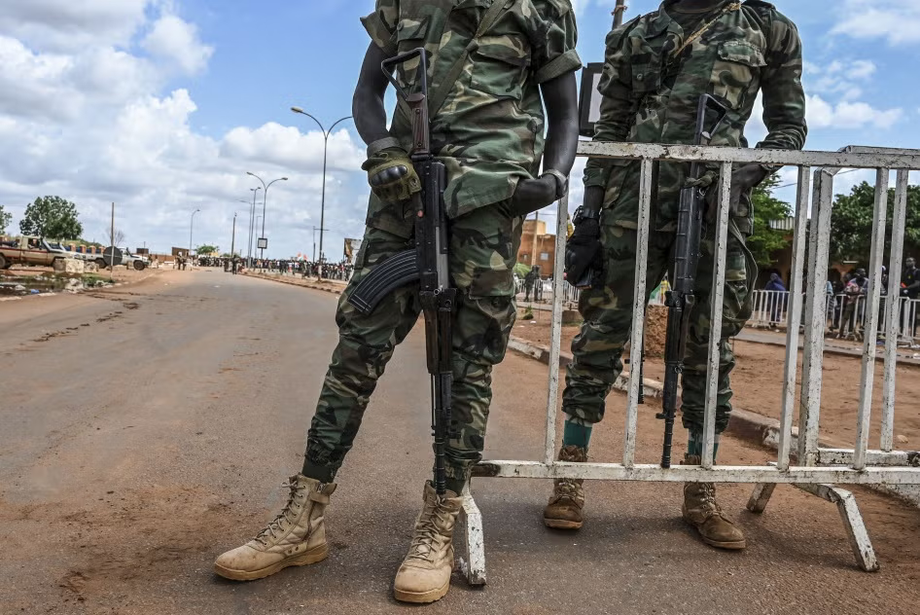
Attack reporting from Niamey points to gunmen arriving by taxi at a checkpoint near Diori Hamani International Airport, a JNIM claim of responsibility, roughly 20 arrests, and conflicting casualty figures. Official advisories already warn of persistent attack and kidnapping risk in Niger, including in the capital. In Mali, Bellingcat‑geolocated imagery of unexploded ShOAB‑0.5 bomblets at Tadjmart after 17 May airstrikes, and Mali’s status as a Convention on Cluster Munitions state party, indicate almost certain legal exposure, amid Russian Africa Corps support to Malian operations. Burkina Faso continues to face widespread insurgent activity, a state of emergency in the Sahel and East regions, and high kidnapping risk to Westerners. Regionally, Niger has set strict defence and intelligence preconditions for reopening its long‑closed border with Benin, suggesting talks may stall without binding security guarantees. Late‑June feeds on military activity in Mali are thin and at times contradictory.
Change from previous assessment
New reporting adds specifics on the Niamey airport attack, including a JNIM claim, a taxi‑based approach at a checkpoint, and roughly 20 arrests, reinforcing last brief’s warning on elevated urban risk in the capital. Open reporting also details Niger’s firm defence and intelligence preconditions for any border reopening with Benin, adding a political‑security friction point not previously covered. Satellite thermal detections in Mali and fragmentary late‑June incident signals introduce uncertainty on recent operations. Our judgments on Mali’s cluster‑munition exposure and Burkina Faso’s high insecurity are unchanged in direction and confidence. Initial assessment of AES, ECOWAS dynamics is incorporated.
Key judgments
- Niamey faces a very likely sustained high risk of further terrorist attacks and kidnap attempts over the next 30 days, including around Diori Hamani International Airport, given the armed assault in the capital, JNIM’s claim of responsibility, the taxi‑borne infiltration tactic at a checkpoint, roughly 20 arrests after the attack, and concurrent US and UK warnings of nationwide kidnapping and attack risk. (Confidence: high · ASSESSED)
- I&W: Further Embassy or FCDO alerts for Niamey citing specific plots or targeting of airport approaches. (0-14 days)
- I&W: A full month without attacks or attempted kidnappings in the capital and a public lowering of alert levels. (1-3 months)
- Unexploded Russian‑made ShOAB‑0.5 cluster bomblets almost certainly remain at Tadjmart in northern Mali following Malian Armed Forces airstrikes announced on 17 May, materially increasing Bamako’s legal exposure as a Convention on Cluster Munitions state party and tying operations more closely to Russia’s Africa Corps support footprint. (Confidence: medium · ASSESSED)
- I&W: Additional geolocated imagery of identical bomblets from Tadjmart or adjacent villages. (0-14 days)
- I&W: Formal CCM compliance actions or statements naming Mali in response to evidence from Tadjmart. (1-3 months)
- Mali almost certainly remains a high‑threat operating environment this quarter, characterised by pervasive violent crime, a high kidnapping and terrorism risk, periodic demonstrations that can turn violent, restrictions confining US government travel to Bamako, and flight safety notices to civil aviation. (Confidence: high · ASSESSED)
- I&W: Renewal or tightening of US government movement restrictions for Mali. (1-3 months)
- I&W: Withdrawal of FAA notices affecting Mali’s airspace and easing of official travel advisories. (1-3 months)
- Burkina Faso will very likely remain highly insecure over the next quarter, with at least 20,000 killed to date and more than 2 million displaced, persistent terrorist activity and a high kidnapping threat to Westerners, a standing state of emergency across the Sahel and East regions, and a record of high‑profile urban attacks. (Confidence: high · ASSESSED)
- I&W: Extension or expansion of the state of emergency or new nationwide emergency measures. (1-3 months)
- I&W: Sustained reduction in reported attacks and easing of US mission movement restrictions. (1-3 months)
- Niger’s insistence that any reopening of the Benin border be anchored in a binding defence and security agreement and a permanent bilateral intelligence‑sharing mechanism makes it likely that over the next 1 to 3 months the border will reopen only if security guarantees are formalised, otherwise talks will stall and cross‑border flows remain constrained. (Confidence: medium · ASSESSED)
- I&W: Public signing or publication of a Niger, Benin defence and security agreement and standing intelligence mechanism. (1-3 months)
- I&W: Official border reopening announced without any accompanying defence or intelligence instruments. (0-14 days)
- Late‑June reporting on military activity in Mali is fragmentary and contradictory, yielding a low‑confidence picture: a noted data gap for 17-19 June and only signals of a conventional‑force action on 20 June, an at‑odds attribution of an 19 June ‘Occupy Territory’ event near Bamako to French forces despite Mali’s 2022 termination of French defence accords, and four NASA thermal anomalies that record heat rather than cause. (Confidence: low · ASSESSED)
- I&W: Corroborated incident logs from Malian authorities and independent monitors for 19-21 June. (0-14 days)
- I&W: Formal denials by Paris and Bamako, supported by independent feeds, disproving any French presence. (0-14 days)
- Allegations of grave abuses by Nigerien security forces, including a January 2026 drone strike that killed 17 civilians, likely increase reputational and legal risk for Niamey and will complicate the optics of external security cooperation. (Confidence: medium · ASSESSED)
- I&W: Public human rights investigations or sanctions targeting named Nigerien units. (1-3 months)
- I&W: Credible official accountability measures and a quarter without new abuse allegations. (1-3 months)
Outlook & scenarios
Repeat or attempted urban attack in Niamey (60%)
JNIM or aligned cells exploit security seams to mount another attack or kidnap attempt in Niamey, potentially probing airport access routes or soft targets. Official alerts remain at heightened levels and arrests continue at pace.
Border reopening stalls without binding security guarantees (50%)
Talks with Benin falter as Niger holds to defence and intelligence preconditions. The border stays closed, prolonging disruption to trade and security coordination along the corridor.
Cluster‑munitions evidence drives diplomatic cost for Bamako (40%)
Additional geolocated evidence from Tadjmart prompts treaty‑community scrutiny and public censure, elevating legal and reputational risk for Mali’s authorities.
Wildcard: Verified French operational footprint returns to Mali (10%)
Contrary to current policy baselines, authoritative evidence confirms a renewed French military presence near Bamako, complicating Mali’s external alignments and narrative control.
Recommendations
- Maintain heightened collection on Niamey threat networks: task OSINT to track JNIM communiqués and taxi‑based ingress tactics, and coordinate with liaison for checkpoint CCTV where available.
- Update post‑specific security posture in Niamey: tighten movement approvals around airport approaches, rehearse shelter‑in‑place and medevac plans, and refresh warden messaging to US and allied communities.
- Direct GEOINT to validate NASA FIRMS thermal detections in Mali against other sensors and reporting, prioritising areas around Tadjmart and recent FAMa strike zones.
- Commission a legal assessment on Mali’s exposure under the Convention on Cluster Munitions and prepare a watch item for additional open‑source identification of ShOAB‑0.5 or similar bomblets.
- Track Niger, Benin talks for concrete texts of a defence and security agreement and the intelligence‑sharing mechanism; pre‑brief logistics and commercial stakeholders on likely timelines.
- Refresh Burkina Faso threat products for field teams, emphasising kidnapping mitigations outside Ouagadougou and contingency routing under the state of emergency.
- Map medical evacuation constraints for Mali and Burkina Faso, given limited clinical capacity, and pre‑position contractual options for stabilisation and lift.
- Flag allegations against Nigerien security forces for partner‑vetting and programme risk reviews; monitor for unit‑specific findings that could affect assistance.
Confidence & uncertainty
Official advisories and alerts from the United States and the United Kingdom, Bellingcat’s geolocation work, major‑media reporting, and NASA’s thermal detections provide multiple independent, generally reliable streams for the core threat environment in Niger, Mali and Burkina Faso. Confidence is reduced by contested casualty figures in Niamey, thin and partly contradictory late‑June Mali incident feeds, and the reliance on think‑tank signalling for some military‑activity claims. On balance this supports a medium headline confidence.
Alternative analysis (red cell)
For KJ‑0 and KJ‑4: the evidence supports elevated short‑term caution after the airport attack and Niger’s firm negotiating position, but absent intercepts/forensic linkage or draft agreement text, alternative outcomes (episodic attacks without a sustained campaign; provisional/phased border reopenings) remain plausible and should be treated as competing hypotheses.
Intelligence gaps
- [EEI 1.1 · UNCOVERED] Number, location, and scale of attacks (IEDs, ambushes, complex attacks) per week against towns, military bases, police posts, or convoys, with casualty and equipment-loss counts. Recommended collection: ground/HUMINT
- [EEI 1.2 · UNCOVERED] Observed movement and size of armed columns (vehicle counts, heavy weapons present) along approach routes to population centers or borders documented by imagery, local reporting, or border guards. Recommended collection: imagery/SATCOM
- [EEI 1.3 · UNCOVERED] Reports of occupation, administration, or imposition of checkpoints/taxes by armed groups in named towns, villages, markets, or on specified road segments. Recommended collection: OSINT (local media/social)
- [EEI 1.4 · UNCOVERED] Seizure or acquisition of heavy weapons or air-defense systems (mortars >81mm, artillery, armored vehicles, MANPADS) attributed to specific groups as evidenced by photos, captured weapons inventories, or weapons interdictions. Recommended collection: forensics/field reporting
- [EEI 2.1 · UNCOVERED] Internal security force movements: redeployment of army units, garrison withdrawals, or mass troop movements toward/away from capitals and regional command posts. Recommended collection: imagery/SATCOM
- [EEI 2.2 · UNCOVERED] Detentions, public dismissals, resignations, or public statements by senior military, police, or government officials indicating factional splits (named individuals, ranks, units). Recommended collection: diplomatic/OSINT
- [EEI 2.3 · UNCOVERED] Changes in foreign military footprints or security agreements: arrival/departure of foreign troops, opening/closure of foreign bases, visible presence of private military contractors (identified personnel/vehicles). Recommended collection: OSINT/imagery
- [EEI 2.4 · UNCOVERED] Targeted external support actions: sanctions, suspension of aid, delivery of weapons or logistics from foreign state or non-state actors (documented shipments, bank transfers, public announcements). Recommended collection: financial/diplomatic
- [EEI 3.1 · UNCOVERED] Interdictions or seizures at borders/markets of weapons, ammunition, fuel, or contraband (type/quantity, seizure location, alleged origin/destination). Recommended collection: border/customs
- [EEI 3.2 · UNCOVERED] Recorded movements of known smuggling routes and convoy volumes: counts of commercial/privately registered vehicles and informal river crossings on specific cross-border corridors. Recommended collection: ground/HUMINT
- [EEI 3.3 · UNCOVERED] Monitored financial flows linked to illicit trade: large cash movements, changes in declared gold exports at named mines/ports, or arrests of money couriers with amounts and origins. Recommended collection: financial/forensics
- [EEI 3.4 · UNCOVERED] Observed changes at border security posts: closures, reductions in personnel, destroyed checkpoints, or documented agreements allowing free movement at named crossings. Recommended collection: imagery/OSINT
Cited sources
[1] Al Jazeera · Armed attack on airport in Niger’s capital kills 11 soldiers, 2 civilians (A) · sha256:941dab8bea78 [2] Foreign, Commonwealth & Development Office (FCDO) · Niger travel advice (A) · sha256:4a2d4ee54cdc [3] bellingcat.com · Banned Russian Submunitions Found After Mali's Military Announces Airstrikes - bellingcat (A) · sha256:6788d3465fd7 [4] U.S. Department of State · Mali Travel Advisory (A) · sha256:0bd28ce550a9 [5] Wikipedia · Islamist insurgency in Burkina Faso (B) · sha256:35c16e56b6bc [6] U.S. Department of State · Burkina Faso Travel Advisory | Travel.State.gov (A) · sha256:6dbd8e921100 [7] africa.businessinsider.com · Sahel bloc politics deepen as Niger sets tough conditions for Benin border reopening (B) · sha256:6c6c5290135c [8] geobit.ai · Mali Security Brief — June 21, 2026 (C) · sha256:43a15d09a856 [9] Wikipedia · Alliance of Sahel States (F) · sha256:c0c4e5ff6b17 [10] NASA · NASA FIRMS thermal detections — Mali (2d) (A) · sha256:89d28c1624bf [11] Africa.com · Security Cooperation with Niger Overlooks.. - Africa.com (B) · sha256:10917349ed52
Source content hashes were computed at collection time; the cited text is preserved unmodified for the life of this product.
Red cell review: PARTIAL DISSENT — KJ-2 downgraded HIGH→MEDIUM (estimative_mismatch)
TLP:CLEAR