TLP:CLEAR · Disclosure is not limited.
South China Sea: arbitral ruling reaffirmed, Beijing rejects; friction around Thitu Island likely to persist
Time window: Last 7 days · Audience: General analyst · Type: Situation report · DTG: 2026-07-14 03:28Z · Overall confidence: MEDIUM
BLUF
A US‑led group and the European Union reaffirmed the 2016 arbitral award invalidating China’s expansive South China Sea claims, while Beijing again rejected it. Manila is very likely to keep asserting its maritime zones and leaning on US defence assurances, making Philippine‑administered Thitu Island a likely flashpoint this quarter.
Executive summary
Statements led by the United States and joined by partners reaffirmed that the 12 July 2016 arbitral award leaves no legal basis for China’s expansive maritime claims, and the European Union called the ruling a landmark. Beijing reiterated that the award is null and void and condemned it as infringing its rights. The Philippines has codified maritime‑zone positions in law and continues to frame the area as the West Philippine Sea, while Washington has restated that the US‑Philippines Mutual Defence Treaty applies to armed attacks on Philippine forces, vessels or aircraft in the South China Sea. Thitu Island, administered by the Philippines and also claimed by China, Taiwan and Vietnam, has seen Philippine infrastructure additions in recent years and remains a likely locus of friction.
Change from previous assessment
Since the 13 July brief, we retain the judgment that partners reaffirmed the 2016 ruling and that Beijing rejects it. We add a focused assessment on Thitu Island as a likely flashpoint, reflecting available reporting on its administration, rival claims and prior infrastructure works. We keep the outlook that Manila will lean on US defence assurances, adding citation to 2024 maritime‑zone legislation. Given no new at‑sea incidents provided in this run, we narrow the escalation assessment to remain cautious and retire the earlier judgment about likely spillover east of Taiwan for lack of corroborating claims in this window.
Key judgments
- A US‑led set of governments and the European Union almost certainly reaffirmed that the 12 July 2016 arbitral award is final and that China’s expansive maritime claims in the South China Sea have no legal basis. (Confidence: high · REPORTED)
- I&W: Additional G7 or EU member state communiqués in the next fortnight explicitly cite the 2016 award and reject expansive claims. (0-14 days)
- I&W: A participating government publicly retracts or dilutes its endorsement of the 2016 ruling. (1-3 months)
- Beijing will very likely continue to reject the 2016 award and press its claims, sustaining friction with Manila at Philippine‑administered features such as Thitu Island. (Confidence: medium · ASSESSED)
- I&W: Chinese statements or patrol notices assert jurisdiction or challenge activities within 12 nautical miles of Thitu Island. (0-14 days)
- I&W: A PRC‑Philippines joint statement references steps to operationalise deconfliction or acknowledges the award’s conclusions. (1-3 months)
- Manila is very likely to keep asserting its maritime zones and lean on United States defence guarantees, given President Ferdinand Marcos Jr.’s 2024 maritime‑zone legislation and repeated US statements that the Mutual Defence Treaty applies in the South China Sea. (Confidence: medium · ASSESSED)
- I&W: Philippine authorities issue new Notices to Mariners or exploration tenders for blocks in the West Philippine Sea. (1-3 months)
- I&W: A US‑Philippines joint communiqué explicitly reaffirms MDT coverage of attacks on Philippine vessels in the South China Sea. (0-14 days)
- It is unlikely that either Beijing or Manila will materially de‑escalate resource‑linked disputes this quarter, given estimated hydrocarbons in the South China Sea and the Philippines’ move to resume exploration in disputed waters. (Confidence: medium · ASSESSED)
- I&W: Announcement of new seismic surveys or drilling preparations by Philippine entities in contested areas of the West Philippine Sea. (1-3 months)
- I&W: A publicly announced moratorium or resource‑sharing arrangement jointly endorsed by China and the Philippines. (1-3 months)
- Thitu Island remains a likely flashpoint because the Philippines administers it, rival claimants include China, Taiwan and Vietnam, and Manila has added infrastructure there in recent years. (Confidence: low · ASSESSED)
- I&W: New Philippine public works notices, construction imagery or lighthouse maintenance activity on Thitu. (1-3 months)
- I&W: Absence of Chinese diplomatic protests or patrol activity referencing Thitu for a sustained period. (1-3 months)
Outlook & scenarios
Baseline: continued diplomatic sparring and tactical friction without major incident (60%)
US‑led and EU statements continue to cite the 2016 award; Beijing rejects them and maintains pressure in disputed waters. Manila sustains public assertions and routine activity at Philippine‑administered features such as Thitu Island. Encounters remain tense but controlled, with no lethal incident.
Escalation: run‑in around a Philippine‑administered feature triggers injuries and sharper warnings (25%)
A confrontation near Thitu Island or another Philippine‑held feature results in a collision or personnel injuries. Washington reiterates that the Mutual Defence Treaty applies to armed attacks on Philippine forces, and partners issue condemnatory statements. Beijing blames Manila and resists outside pressure.
Limited de‑escalation: quieter quarter focused on legal and narrative positioning (15%)
Both sides avoid at‑sea flashpoints while intensifying diplomatic messaging and legal positioning. Manila pauses new exploration moves pending consultations, and Beijing reduces high‑visibility patrols near Philippine‑administered features, though it does not alter its rejection of the 2016 ruling.
Recommendations
- Maintain a live tracker of official statements that reference the 2016 arbitral award from Washington, Brussels, Manila and Beijing, coding language strength and legal references for trend analysis.
- Task weekly commercial satellite reviews of Thitu Island, including change detection on airstrip, jetty and lighthouse sites, and compile a time‑series of visible works to flag new construction.
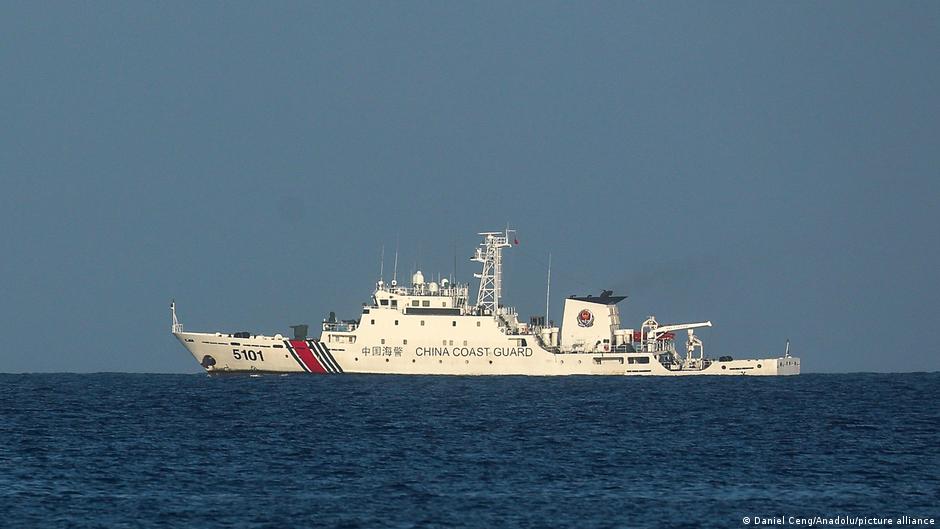
- Fuse AIS histories with visual confirmation to watch for patterns of Chinese law‑enforcement or maritime militia presence within 12 nautical miles of Thitu Island and other Philippine‑administered features.
- Monitor Philippine government portals for Notices to Mariners and energy licensing actions in the West Philippine Sea; flag any new survey or drilling tenders as potential triggers for Chinese responses.
- Prepare a rapid‑response brief template on Article IV‑V triggers under the US‑Philippines Mutual Defence Treaty, including pre‑cleared language and maps of Philippine‑administered features for senior readers.
Confidence & uncertainty
Confidence is medium overall. The reaffirmation of the 2016 arbitral award and its legal content are supported by multiple independent, reliable sources, including wire services and an EU statement, with no material contradictions. Beijing’s rejection of the ruling is also directly sourced. Forward‑looking assessments on friction around Thitu Island and the trajectory of Manila’s behaviour rest on a mix of background reporting and inference, and some supporting details draw on medium‑reliability or unknown‑source items. The absence of fresh, event‑level at‑sea reporting in this window introduces uncertainty about near‑term escalation dynamics.
Alternative analysis (red cell)
While the evidence shows many governments restated support for the 2016 tribunal and China continues to repudiate that ruling, the claim set does not explicitly show EU participation in the reaffirmation and lacks current incident-level reporting to justify near-term predictions of friction at specific features. A more cautious analytic posture would separate documented legal-political reaffirmations from projections of imminent coercive maritime actions and treat forecasts about Thitu and treaty reliance as contingent on contemporaneous operational indicators.
Intelligence gaps
- [EEI 1.1 · UNCOVERED] Number, class, and position (time-stamped) of Chinese Coast Guard (CCG), People’s Armed Forces Maritime Militia (PAFMM), and other PRC paramilitary/auxiliary vessels inside Philippine-claimed EEZ or within 12 nautical miles of Philippine-occupied features (e.g., Scarborough Shoal, Second Thomas/Ayungin Shoal, and other named features). Recommended collection: maritime/AIS
- [EEI 1.2 · UNCOVERED] Observed maneuvers or posture indicating hostile action: vessel-to-vessel blocking/contact, use of water cannons, boarding attempts, formation maneuvers to interdict Philippine vessels, or sustained stationing near Philippine resupply/relief routes. Recommended collection: imagery/satellite
- [EEI 1.3 · UNCOVERED] Incidents of Philippine vessels (coast guard, navy, supply boats, civilian fishing vessels) being ordered to alter course, detained, chased, or physically impeded — with time, location, involved units, and damage/injuries if any. Recommended collection: open-source/official statements
- [EEI 1.4 · UNCOVERED] Abrupt changes to vessel identification behavior: AIS transponder deactivations, spoofing, or mismatches between flagged identity and observed equipment/markings among PRC maritime law-enforcement or militia vessels operating near Philippine claims. Recommended collection: maritime/AIS
- [EEI 2.1 · UNCOVERED] Issued directives, patrol orders, or internal guidance from PRC Central Military Commission, PLAN, CCG, or provincial maritime authorities that specify objectives, geographic limits, patrol tempos, or escalation thresholds for operations near Philippine-claimed features. Recommended collection: signals/communications
- [EEI 2.3 · UNCOVERED] Evidence of mobilization orders, tasking lists, or logistics planning for Maritime Militia units (vessel requisitions, local fisheries bureau instructions, fuel/resupply manifests) indicating intent to employ militia alongside CCG/PLAN assets. Recommended collection: HUMINT/defense
- [EEI 3.1 · UNCOVERED] Deployment and movement of Philippine Coast Guard and Navy vessels (class, location, on-station times) and scheduled or unscheduled escort/resupply missions to occupied features. Recommended collection: military/AIS
- [EEI 3.2 · UNCOVERED] Air component activity: number and frequency of Philippine air patrol sorties, maritime domain awareness flights, and air-to-surface or maritime strike assets placed on alert or redeployed toward contested areas. Recommended collection: imagery/satellite
- [EEI 3.3 · PARTIAL] Requests for diplomatic, intelligence, or military assistance from allies (e.g., U.S., Australia, Japan) including notifications of planned joint patrols, port calls, or freedom of navigation operations with dates and participating units. Recommended collection: open-source/official statements
- [EEI 3.4 · PARTIAL] Changes to Philippine rules of engagement, emergency law measures, mobilization orders, or civil advisories (evacuations, fishing bans) that alter civilian or military behavior in contested maritime zones. Recommended collection: open-source/official statements
Cited sources
[1] Associated Press · 14 nations and the EU reaffirm 2016 ruling invalidating China's claims in South China Sea (A) · sha256:12e7c645fb78 [2] dw.com · 南海仲裁十周年 14国联合发声 (B) · sha256:22c7529c66e7 [3] Wikipedia · Territorial disputes in the South China Sea (F) · sha256:2b1001cc8220 [4] Wikipedia · Thitu Island (F) · sha256:f24105c33501 [5] Wikipedia · 南海爭端 (B) · sha256:5bf0f06dcf6c
Source content hashes were computed at collection time; the cited text is preserved unmodified for the life of this product.
Red cell review: PARTIAL DISSENT
TLP:CLEAR