TLP:CLEAR · Disclosure is not limited.
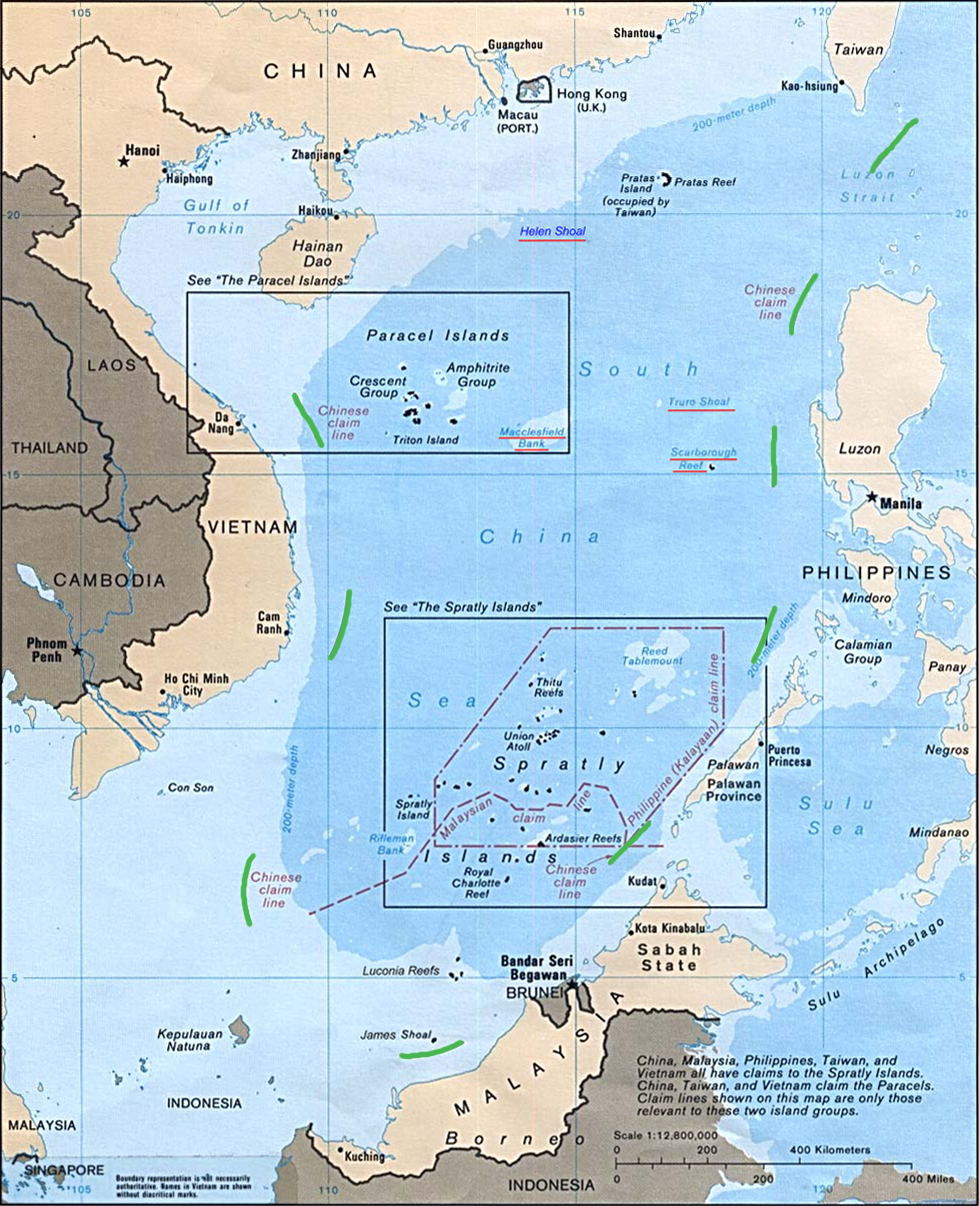
South China Sea: Beijing’s nine-dash posture endures as Coast Guard tests jurisdiction near Taiwan-held features
Time window: Last 7 days · Audience: General analyst · Type: Situation report · DTG: 2026-06-20 10:13Z · Overall confidence: MEDIUM
BLUF
Maritime friction in the South China Sea is likely to persist, with China maintaining expansive nine-dash claims and a built-out presence while testing jurisdiction around Taiwan-administered Dongsha and Taiping. The legal-diplomatic dispute will continue without resolution, and any escalation would likely carry outsized economic risk given the sea lane’s role in China’s energy flows.
Executive summary
China continues to assert expansive maritime rights in the South China Sea under the nine-dash line despite the 2016 ruling, while sustaining an on-water footprint through outposts and past land reclamation. Chinese Coast Guard activity challenging jurisdiction has included entries into restricted or prohibited waters around Taiwan-administered Dongsha and Taiping in June 2023, and coordinated ‘law enforcement’ operations in adjacent waters. Beijing rejects the 2016 award and has advanced cartographic claims in official documents, prompting protests from Manila and Hanoi. With the South China Sea carrying most of China’s energy imports, the stakes of tactical incidents remain high and are likely to drive continued US and allied presence operations.
Change from previous assessment
This update retires prior judgments on electronic warfare around Second Thomas Shoal and on tightened access control at Scarborough Shoal for this run due to the absence of directly sourced reporting in the current claim set. The assessment shifts emphasis to documented Chinese Coast Guard entries around Dongsha and Taiping and to enduring legal-diplomatic postures. Confidence remains medium given corroboration on core legal positions and historical on-water activity but limited new, time-current South China Sea incident reporting.
Key judgments
- Maritime friction in the South China Sea is likely to persist over the next quarter because Beijing still asserts the nine-dash line despite the 2016 arbitration ruling and has entrenched an on-water presence through outposts and land reclamation, amid overlapping claims by regional states. (Confidence: medium · ASSESSED)
- I&W: China Coast Guard or other Chinese maritime authorities issue new ‘law enforcement’ or navigation restriction notices for waters around Spratly features or Scarborough Shoal. (1-3 months)
- I&W: A public Chinese government statement aligns maritime claims with the 2016 award. (1-3 months)
- China is very likely to keep testing jurisdiction around Taiwan-administered features in the South China Sea, given Chinese Coast Guard entries into the restricted waters around Dongsha on 5 June 2023 and the prohibited waters around Taiping Island on 11 June 2023, alongside declared ‘law enforcement’ operations in Taiwan’s eastern approaches in early June 2023. (Confidence: medium · ASSESSED)
- I&W: Reappearance of China Coast Guard hulls such as 3501 within 12 nautical miles of Dongsha or Taiping Island. (0-14 days)
- I&W: No Chinese Coast Guard entries into these restricted zones for at least 30 days, reflected in Taiwan Coast Guard reporting. (1-3 months)
- Legal and diplomatic contention over the nine-dash line is likely to intensify rather than resolve, with Beijing publicly rejecting the 2016 ruling as Manila and Hanoi continue to protest cartographic assertions such as the 2012 Chinese passport. (Confidence: medium · ASSESSED)
- I&W: New public protest or note verbale by the Philippines or Vietnam contesting Chinese cartography or official documents. (1-3 months)
- I&W: Chinese MFA readout signalling acceptance of any element of the 2016 award. (1-3 months)
- Any escalation at sea would likely carry outsized economic risk because roughly four-fifths of China’s energy imports transit the South China Sea, a factor that will also sustain US and allied presence operations. (Confidence: low · ASSESSED)
- I&W: Public advisories from shipowners or insurers raising risk ratings or premiums for South China Sea routes. (1-3 months)
- I&W: A discernible reduction in US or allied freedom of navigation operations across a monthly cycle. (1-3 months)
- Beijing’s calibrated messaging that it does not treat all waters within the nine-dash line as internal waters is unlikely to translate into restraint in on-water enforcement. (Confidence: low · ASSESSED)
- I&W: Chinese Coast Guard patrols refrain from asserting jurisdiction beyond 12 nautical miles of disputed features for a continuous quarter. (1-3 months)
- I&W: Continuation of Chinese Coast Guard entries into restricted waters or interference with commercial shipping near Taiwan’s coast or South China Sea features. (0-14 days)
Outlook & scenarios
Steady-state friction with localised incidents (60%)
Chinese Coast Guard maintains routine patrols and occasional entries into restricted waters near Taiwan-administered Dongsha and Taiping while Beijing’s nine-dash stance and allied freedom of navigation operations continue. Incidents remain localised and short of sustained shipping disruption.
Administrative tightening by Beijing (40%)
China issues new public documents or notices that harden access control around contested features under a ‘law enforcement’ rubric, reinforcing jurisdictional claims despite the 2016 ruling and prompting fresh diplomatic protests by Southeast Asian claimants.
Legal-diplomatic pushback gathers pace (30%)
Manila and Hanoi mount new public protests and legal steps that reference the 2016 award and oppose cartographic assertions, energising diplomatic pressure but not altering on-water behaviour.
Low-probability thaw (10%)
China issues a clarifying statement that narrows aspects of the nine-dash claim consistent with prior rhetoric, paired with a reduction in Chinese Coast Guard entries around Dongsha and Taiping.
Recommendations
- Maintain a daily watch on China Coast Guard hulls 3501, 2502 and 2304 using AIS and official notices, and log any entries within 12 nautical miles of Dongsha or Taiping to update the incident baseline.
- Monitor Chinese maritime authority portals and MFA readouts for new enforcement or navigation notices and statements that reference the nine-dash line or ‘law enforcement’ actions, archiving documents for legal trend analysis.
- Track and catalogue public protests or notes verbales from the Philippines and Vietnam that contest Chinese cartography or claims, linking each to any on-water incident to map action-reaction cycles.
- Refresh the outpost and reclamation baseline by consolidating open reporting on the eight PRC outposts and the extent of reclaimed land, and flag any new construction or equipment indicators for tasking.
- Maintain an indicators-and-warnings log for South China Sea shipping risk that captures advisories from shipowners, insurers and navies alongside observed patrol patterns to enable early escalation alerts.
Confidence & uncertainty
Overall confidence is medium. Multiple claims from academic, think tank and major media sources corroborate China’s enduring nine-dash legal posture, the 2016 ruling and rejection, and a pattern of Chinese Coast Guard ‘law enforcement’ activity near Taiwan-administered features. However, much of the reporting is historical or from 2023, and several items come from sources with varying reliability or unspecified provenance. The current set contains no fresh, time-bound incidents in the reporting window for Scarborough or Second Thomas Shoal, leaving temporal gaps and limiting confidence in near-term specificity.
Alternative analysis (red cell)
The claim set documents PRC legal claims to the nine-dash line, the 2016 PCA ruling, and episodic PRC maritime operations in early June, but much of the evidence is time-limited, concentrated in a narrow window, or sourced to single origins (kj_single_origin). A reasonable alternative estimate is that Beijing’s posture could produce episodic, geographically selective enforcement rather than broad-based, sustained escalation over the next quarter; diplomatic nuance and selective operational choice (including PRC clarifications about internal waters) could moderate outcomes unless corroborating operational directives or a clear uptick in incidents appears.
Intelligence gaps
- [EEI 1.1 · UNCOVERED] Number, class, and position (time-stamped) of Chinese Coast Guard (CCG), People’s Armed Forces Maritime Militia (PAFMM), and other PRC paramilitary/auxiliary vessels inside Philippine-claimed EEZ or within 12 nautical miles of Philippine-occupied features (e.g., Scarborough Shoal, Second Thomas/Ayungin Shoal, and other named features). Recommended collection: maritime/AIS
- [EEI 1.2 · PARTIAL] Observed maneuvers or posture indicating hostile action: vessel-to-vessel blocking/contact, use of water cannons, boarding attempts, formation maneuvers to interdict Philippine vessels, or sustained stationing near Philippine resupply/relief routes. Recommended collection: imagery/satellite
- [EEI 1.3 · UNCOVERED] Incidents of Philippine vessels (coast guard, navy, supply boats, civilian fishing vessels) being ordered to alter course, detained, chased, or physically impeded — with time, location, involved units, and damage/injuries if any. Recommended collection: open-source/official statements
- [EEI 1.4 · UNCOVERED] Abrupt changes to vessel identification behavior: AIS transponder deactivations, spoofing, or mismatches between flagged identity and observed equipment/markings among PRC maritime law-enforcement or militia vessels operating near Philippine claims. Recommended collection: maritime/AIS
- [EEI 2.1 · UNCOVERED] Issued directives, patrol orders, or internal guidance from PRC Central Military Commission, PLAN, CCG, or provincial maritime authorities that specify objectives, geographic limits, patrol tempos, or escalation thresholds for operations near Philippine-claimed features. Recommended collection: signals/communications
- [EEI 2.2 · UNCOVERED] Public declarations, maritime notices, or newly published 'maritime safety' or exclusion zones, with effective dates and coordinates, issued by Chinese authorities that could be used to justify interdiction or exclusion of Philippine activity. Recommended collection: open-source/official statements
- [EEI 2.3 · UNCOVERED] Evidence of mobilization orders, tasking lists, or logistics planning for Maritime Militia units (vessel requisitions, local fisheries bureau instructions, fuel/resupply manifests) indicating intent to employ militia alongside CCG/PLAN assets. Recommended collection: HUMINT/defense
- [EEI 3.1 · UNCOVERED] Deployment and movement of Philippine Coast Guard and Navy vessels (class, location, on-station times) and scheduled or unscheduled escort/resupply missions to occupied features. Recommended collection: military/AIS
- [EEI 3.2 · UNCOVERED] Air component activity: number and frequency of Philippine air patrol sorties, maritime domain awareness flights, and air-to-surface or maritime strike assets placed on alert or redeployed toward contested areas. Recommended collection: imagery/satellite
- [EEI 3.3 · UNCOVERED] Requests for diplomatic, intelligence, or military assistance from allies (e.g., U.S., Australia, Japan) including notifications of planned joint patrols, port calls, or freedom of navigation operations with dates and participating units. Recommended collection: open-source/official statements
- [EEI 3.4 · UNCOVERED] Changes to Philippine rules of engagement, emergency law measures, mobilization orders, or civil advisories (evacuations, fishing bans) that alter civilian or military behavior in contested maritime zones. Recommended collection: open-source/official statements
Cited sources
[1] zh.wikipedia.org · 九段线 (C) · sha256:bc597490bbc5 [2] Wikipedia · Territorial disputes in the South China Sea (F) · sha256:1d5bd5a3150d [3] 經濟日報 · 葛來儀:中國海警干擾台灣海域商船 升級危險趨勢 | 國際焦點 | 國際 | 經濟日報 (A) · sha256:22e920d59534 [4] 163.com · 与日本划线失败后,菲律宾发现:辽宁舰已堵在家门口一个月了! (B) · sha256:0509873bb62d [5] 風傳媒 · 中國海警船東部巡航常態化?郭正亮示警日菲劃界後遺症:台灣海域管轄權恐被奪 | 風傳媒 | LINE TODAY (B) · sha256:a314db2ff5e0
Source content hashes were computed at collection time; the cited text is preserved unmodified for the life of this product.
Red cell review: PARTIAL DISSENT — KJ-4 downgraded MEDIUM→LOW (kj_single_origin)
TLP:CLEAR