TLP:CLEAR · Disclosure is not limited.
South China Sea: China brings Antelope Reef online as a law enforcement outpost
Time window: Last 7 days · Audience: General analyst · Type: Situation report · DTG: 2026-07-15 10:16Z · Overall confidence: MEDIUM
BLUF
China has very likely shifted its newly built Antelope Reef facility in the Paracels into operational status, with a large law enforcement vessel berthed at a new 680 m pier. This will likely tighten Chinese patrol coverage in the northern South China Sea and raise friction with Vietnam and with future freedom of navigation operations in the coming months.
Executive summary
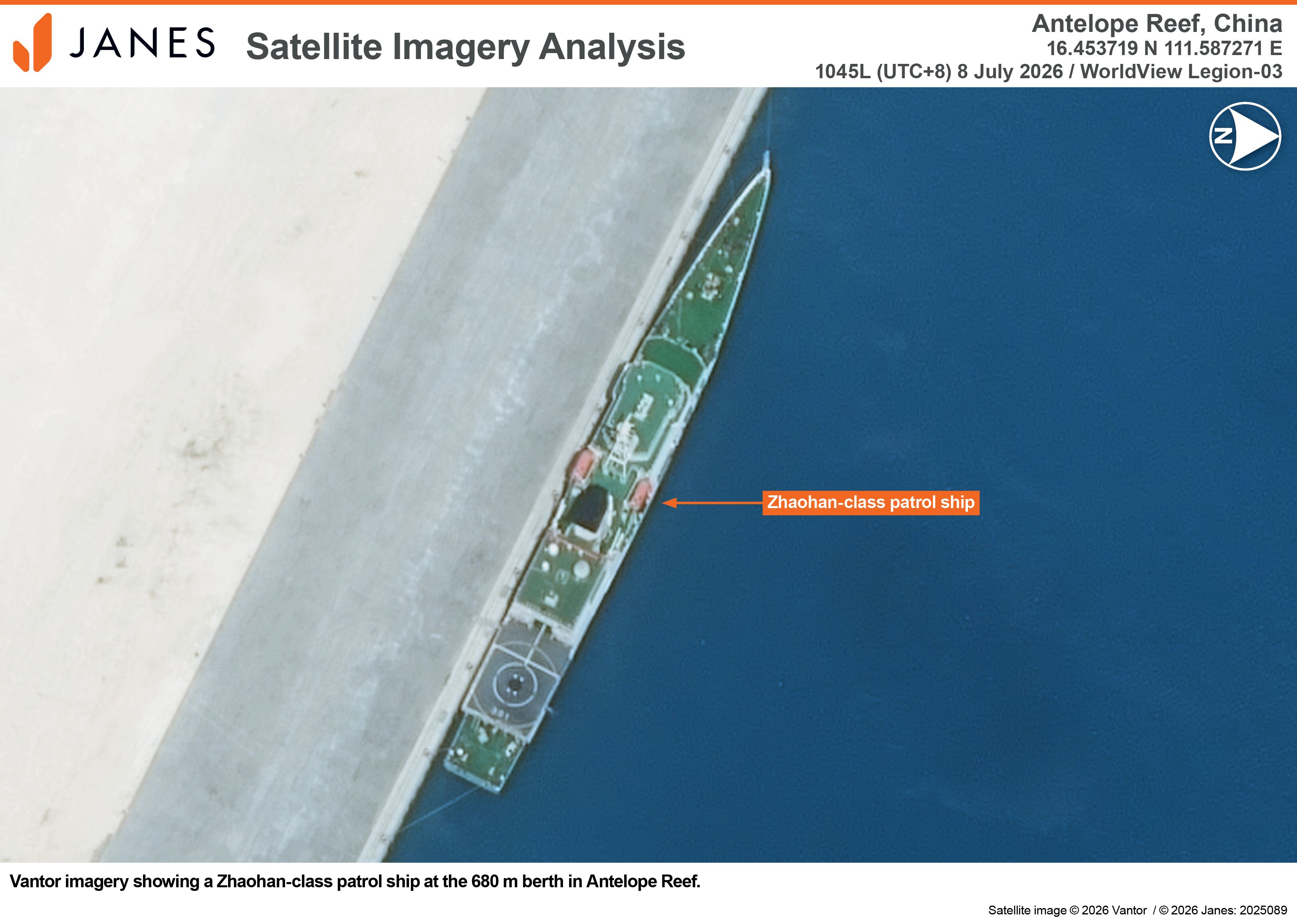
Commercial imagery from 8 July shows a large patrol vessel alongside a newly completed 680 m berth at Antelope Reef in the Paracel Islands. Reporting identifies this as the first known deployment of a government-operated law enforcement vessel to the feature since reclamation began, and analysis assesses the ship to be a 3,000-tonne Sansha City unit consistent with the Zhaohan class, which can embark a helicopter. Recent imagery shows no dredgers or pipelines, indicating the land-creation phase has concluded and the feature is transitioning to an operational outpost. These moves occur against a backdrop of long-standing, competing South China Sea claims, continued freedom of navigation operations since 2015, and the 2016 arbitral finding that China lacks historical titles within the nine-dash line. China’s energy-security stake in these sea-lanes is high. Separately, while piracy incidents across Asia have fallen, the Philippine Coast Guard reported a rise in port and anchorage incidents this year, adding pressure to domestic maritime policing.
Change from previous assessment
New imagery-led reporting of a Chinese government law enforcement vessel berthed at Antelope Reef and assessments that reclamation has concluded shift this brief’s focus toward the Paracels and the transition to operations. Judgments on likely friction with Vietnam and on the outpost’s operational profile have been added. Items on Second Thomas Shoal and Thitu Island from the prior brief are de-emphasised due to lack of fresh reporting in this run. Initial assessment of potential Philippine Coast Guard resource strain has been introduced with low confidence.
Key judgments
- China is very likely transitioning Antelope Reef in the Paracel Islands from a construction site to an operational law enforcement outpost, indicated by a large patrol vessel berthed at a newly completed 680 m pier on 8 July and reporting that this is the first known government law enforcement deployment to the feature since reclamation began, alongside imagery showing no dredgers or pipelines. (Confidence: medium · ASSESSED)
- I&W: Repeat appearances of the same Chinese government law enforcement hull alongside the Antelope Reef pier in new commercial satellite imagery. (0-14 days)
- I&W: Visible helicopter operations or support activity at the feature. (1-3 months)
- The vessel at Antelope Reef is likely a 3,000-tonne Sansha City law enforcement ship consistent with the Zhaohan class, enabling embarked helicopter operations and extended patrol endurance. (Confidence: medium · REPORTED)
- I&W: High-resolution imagery or video revealing Sansha City markings such as Sansha Zhifa 301 and a helicopter-capable flight deck at the pier. (0-14 days)
- I&W: Open-source visuals confirming the Zhaohan-class profile moored at Antelope Reef. (0-14 days)
- Chinese law enforcement basing at Antelope Reef is likely to increase friction with Vietnam and complicate future U.S. and allied freedom of navigation operations around the Paracels this quarter. (Confidence: medium · ASSESSED)
- I&W: A public protest by Vietnam’s Ministry of Foreign Affairs specifically naming Antelope Reef or new patrol activity in the Paracels. (0-14 days)
- I&W: Chinese shadowing or warnings during a U.S. or allied freedom of navigation operation near the Paracels reported in open sources. (1-3 months)
- Large-scale reclamation at Antelope Reef has very likely concluded and will give way to routine patrol basing and facility build-out. (Confidence: medium · ASSESSED)
- I&W: New fixed installations such as radar arrays, hardened shelters or expanded support buildings visible in subsequent imagery. (1-3 months)
- I&W: Absence of dredgers or floating pipelines in all imagery cycles. (0-14 days)
- Despite an overall decline in piracy across Asia, the rise to 10 reported port and anchorage incidents in the Philippines this year after none in 2025 likely diverts some Philippine Coast Guard attention from South China Sea patrol tasks. (Confidence: low · ASSESSED)
- I&W: Philippine Coast Guard statements reprioritising assets toward port security or delaying planned patrols in the West Philippine Sea. (1-3 months)
- I&W: Sustained absence of reported South China Sea patrols by Philippine cutters that previously operated on regular cycles. (1-3 months)
Outlook & scenarios
Consolidated Chinese patrol hub at Antelope Reef raises near-term stand-offs (60%)
China maintains a continuous Sansha City law enforcement presence at Antelope Reef, begins helicopter evolutions from the outpost, and expands routine patrols across the Paracels. Hanoi issues formal protests and increases Vietnam Coast Guard presence nearby. A U.S. or allied freedom of navigation transit prompts close shadowing by Chinese units, heightening risk of navigational incidents.
Quiet consolidation with limited public signalling (40%)
After the initial deployment, Beijing keeps a low media profile while finishing support infrastructure at Antelope Reef and rotating one large hull at the pier. Vietnam calibrates its response to diplomatic channels without visibly increasing at-sea presence, and external operations through the Paracels continue without unusual manoeuvring.
Short-lived deployment followed by pause (25%)
The government-operated law enforcement vessel departs and is not replaced for several weeks as construction and fit-out tasks resume ashore. The outpost remains usable but under-manned, and immediate frictions with other claimants ease temporarily.
Recommendations
- Task GEOINT for frequent revisit over Antelope Reef to track pier utilisation, hull rotations, and any helicopter operations. Prioritise change detection on radar, communications and aviation support infrastructure.
- Build and maintain a watchlist of Sansha City law enforcement vessels, including identifiers associated with the Zhaohan class, and cross-cue space-based AIS with SAR and optical imagery for positive identification.
- Set an indications-and-warnings trigger for Vietnamese diplomatic protests naming Antelope Reef and for Vietnam Coast Guard or Fisheries Surveillance activity in the Paracels to assess escalation risk.
- Compile an order-of-battle brief on Chinese law enforcement presence across the Paracels to map likely patrol radii from Antelope Reef and potential coverage overlaps with other outposts.
- Track open-source notices of freedom of navigation operations near the Paracels and document any Chinese challenges or shadowing behaviour to inform risk to navigation.
- Engage maritime security reporting from the Philippines to assess whether the rise in port and anchorage incidents is altering Philippine Coast Guard patrol tempos relevant to the West Philippine Sea.
Confidence & uncertainty
Overall confidence is medium. The core Antelope Reef developments rest on detailed commercial-imagery reporting and multiple corroborating elements within the same analytic stream, including the 8 July berth observation, first government law enforcement deployment, and assessments of vessel type and feature status. These are credible but largely single-source in origin. Context on regional claimants, legal baselines, and historical reclamation is supported but not time-sensitive. Forward-looking judgments about Vietnamese reactions, operational use of the outpost, and Philippine resource implications extend beyond direct reporting and are therefore assessed with medium to low confidence.
Alternative analysis (red cell)
The available reporting supports that a government law-enforcement vessel was observed at Antelope Reef on 8 July, but the evidence is limited (single imagery date, A6 analytic inferences for identity and construction status) and allows multiple interpretations. It is equally plausible the vessel was on a temporary visit or rotational patrol rather than establishing permanent basing, and that reclamation activity is paused rather than definitively concluded. Absent time-series imagery, shiptracking/AIS confirmation, official announcements, or corroborating SIGINT/HUMINT of sustained operations, stronger operational and diplomatic conclusions are not warranted.
Intelligence gaps
- [EEI 1.2 · UNCOVERED] Observed maneuvers or posture indicating hostile action: vessel-to-vessel blocking/contact, use of water cannons, boarding attempts, formation maneuvers to interdict Philippine vessels, or sustained stationing near Philippine resupply/relief routes. Recommended collection: imagery/satellite
- [EEI 1.3 · UNCOVERED] Incidents of Philippine vessels (coast guard, navy, supply boats, civilian fishing vessels) being ordered to alter course, detained, chased, or physically impeded — with time, location, involved units, and damage/injuries if any. Recommended collection: open-source/official statements
- [EEI 1.4 · UNCOVERED] Abrupt changes to vessel identification behavior: AIS transponder deactivations, spoofing, or mismatches between flagged identity and observed equipment/markings among PRC maritime law-enforcement or militia vessels operating near Philippine claims. Recommended collection: maritime/AIS
- [EEI 2.1 · UNCOVERED] Issued directives, patrol orders, or internal guidance from PRC Central Military Commission, PLAN, CCG, or provincial maritime authorities that specify objectives, geographic limits, patrol tempos, or escalation thresholds for operations near Philippine-claimed features. Recommended collection: signals/communications
- [EEI 2.2 · UNCOVERED] Public declarations, maritime notices, or newly published 'maritime safety' or exclusion zones, with effective dates and coordinates, issued by Chinese authorities that could be used to justify interdiction or exclusion of Philippine activity. Recommended collection: open-source/official statements
- [EEI 2.3 · UNCOVERED] Evidence of mobilization orders, tasking lists, or logistics planning for Maritime Militia units (vessel requisitions, local fisheries bureau instructions, fuel/resupply manifests) indicating intent to employ militia alongside CCG/PLAN assets. Recommended collection: HUMINT/defense
- [EEI 3.1 · UNCOVERED] Deployment and movement of Philippine Coast Guard and Navy vessels (class, location, on-station times) and scheduled or unscheduled escort/resupply missions to occupied features. Recommended collection: military/AIS
- [EEI 3.2 · UNCOVERED] Air component activity: number and frequency of Philippine air patrol sorties, maritime domain awareness flights, and air-to-surface or maritime strike assets placed on alert or redeployed toward contested areas. Recommended collection: imagery/satellite
- [EEI 3.3 · UNCOVERED] Requests for diplomatic, intelligence, or military assistance from allies (e.g., U.S., Australia, Japan) including notifications of planned joint patrols, port calls, or freedom of navigation operations with dates and participating units. Recommended collection: open-source/official statements
- [EEI 3.4 · UNCOVERED] Changes to Philippine rules of engagement, emergency law measures, mobilization orders, or civil advisories (evacuations, fishing bans) that alter civilian or military behavior in contested maritime zones. Recommended collection: open-source/official statements
Cited sources
[1] janes.com · China deploys law-enforcement vessel to newly built island in South China Sea (A) · sha256:b82062b50ef0 [2] Wikipedia · Territorial disputes in the South China Sea (F) · sha256:2b1001cc8220 [3] maritime-executive.com · Strong Decrease in Incidents of Piracy and Armed Robbery of Ships in Asia (B) · sha256:5bbe5979477b
Source content hashes were computed at collection time; the cited text is preserved unmodified for the life of this product.
Red cell review: PARTIAL DISSENT
TLP:CLEAR